OTA payout reconciliation for a car rental company means proving, booking by booking, that every reservation sold through an online travel agency or rental marketplace turned into the right amount of cash in your bank account. You compare three things: what the guest booked and you delivered, what the channel says it owes you after commission, taxes and adjustments, and what actually landed in the bank. Where those three disagree, you have a discrepancy to explain, chase or write off. This guide shows how to do it, how often, and how to record the result in your books.
TL;DR
- Reconcile on three levels: completed rentals in your system, the channel's payout statement, and the bank deposit. A match on two of three is not a reconciliation.
- Record gross revenue, channel commission, refunds and adjustments as separate lines. Never book only the net deposit as revenue.
- Use a clearing account for each channel so unmatched money stays visible until someone resolves it.
- Reconcile weekly at a minimum, and chase every short, missing or duplicate payment while the dispute window is still open.
- Software that holds reservations, payments and contracts in one place removes most of the manual matching.
Table of Contents
What OTA payout reconciliation means for a rental business
A hotel sells a room night. A rental company sells a multi-day vehicle rental with extras, insurance products, deposits, fuel or mileage charges, and sometimes one-way fees. That makes marketplace payouts harder to match than a simple one-line sale.
The channel usually pays you a net figure. Somewhere between the guest's card and your bank, the marketplace has taken a commission, possibly held back money for cancellations or disputes, and possibly paid several bookings in a single deposit. The deposit in your bank therefore rarely equals any single reservation. That is the core reason spreadsheets break down once volume grows.
Good reconciliation answers five questions for every booking:
- Did the rental actually happen, and for how long?
- What gross amount did the guest pay, and what did the channel charge you?
- Which payout statement included this booking?
- Which bank deposit contained that payout?
- If any answer is "unknown", who owns the follow-up and by when?
The records you need before you start
You cannot reconcile from the bank statement alone. Collect these for each period:
- Reservation export from your own system. Booking ID, channel reference, pickup and return timestamps, status (completed, cancelled, no-show), rate, extras and taxes.
- The channel's payout statement or transaction report. Per-booking gross, commission, adjustments, and the payout batch reference.
- Bank statements or processor reports. Deposit date, amount and the reference text the channel sends.
- Refund, damage and cancellation records. Anything that changed the amount after the booking was made.
- Your deposit and extras ledger. Security deposits are held, not earned, so keep them apart from rental revenue. Our guide to deposit automation for rental fleets covers how.
The single most useful habit is to store the channel's booking reference on your own reservation record at the moment of booking. It is the key that joins all three data sets. If you rely on guest names and dates, you will spend hours on false matches.
How to match bookings, payouts and deposits
The method is the same whether you use a spreadsheet or software. Work from the rental outward to the cash.
Step 1: Lock the list of completed rentals
Export every reservation from the channel for the period, filtered by return date, not booking date. A booking made in March for an August rental belongs to August operations, though the channel might pay you on a different schedule. Mark each as completed, cancelled or no-show based on your own records, not the channel's.
Step 2: Match rentals to the payout statement
Join your list to the channel's statement on the booking reference. You will land in one of four buckets:
- Matched and equal. Gross, commission and net all agree with what you expected.
- Matched but different. The booking is on the statement with an amount that does not agree with your records.
- On your list, not on the statement. You delivered the rental and have not been paid for it yet, or at all.
- On the statement, not on your list. Often a cancellation fee, a duplicate or a booking someone entered under another reference.
A structured walk-through of this match-then-explain approach is laid out in this step-by-step payment reconciliation process, which works for any business that receives batched settlements.
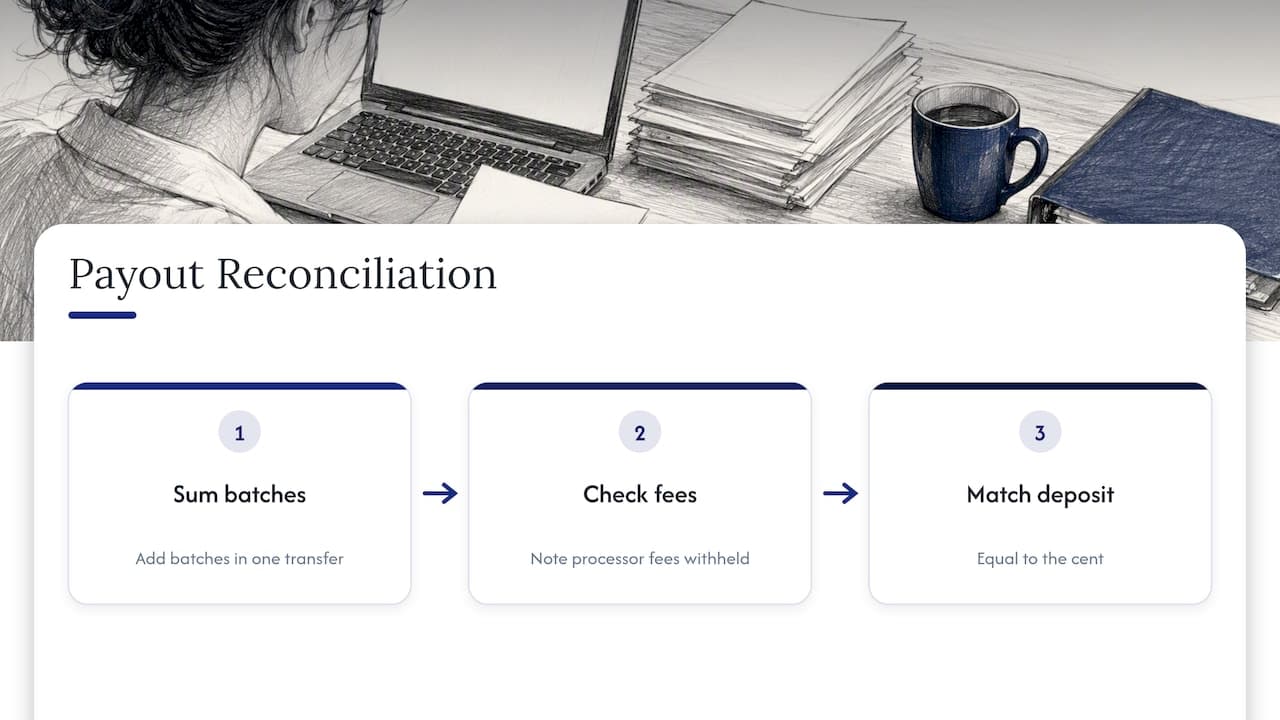
Step 3: Match the statement to the bank deposit
Sum the payout batch on the statement and look for a deposit of exactly that amount. If the channel pays several batches in one transfer, add them. If a processor sits between the channel and your bank, check whether fees were taken before the deposit. The batch total should equal the deposit to the cent. A difference of even a few dollars means something was withheld, converted or misapplied.
Step 4: Record the result and the exceptions
Every batch ends in one of two states: fully reconciled, or reconciled with named exceptions. An exception log with columns for booking, amount, suspected cause, owner and date opened is the working tool of the whole process.
Worked example
Say you rent a compact car for four days through a marketplace at $60 per day. The guest pays $240 gross. The marketplace keeps a commission of 15%, which is $36, and the statement shows a net of $204. The guest also adds a $20 child seat that you collect at pickup, and the channel never sees it.
In your books this should look like:
| Line | Amount |
|---|
| Gross rental revenue | $240.00 |
| Channel commission (expense) | $36.00 |
| Net expected from channel | $204.00 |
| Child seat revenue (collected directly) | $20.00 |
If the deposit arrives as $204 inside a batch of ten bookings, the batch reconciles. If it arrives as $168 because the channel also deducted a $36 adjustment for a different cancelled trip, you now have a $36 exception to trace. The figures here are illustrative; your commission rate and adjustment rules come from your agreement with each channel.
Missing, short, duplicate and delayed payouts
Most of the money lost in marketplace payouts is not stolen. It is misplaced in ordinary exceptions, and each type has a different fix.
Missing payouts
The rental is completed, the booking is not on any statement. Check first whether the channel treats the booking as cancelled or disputed on its side. Then check the payout schedule: some bookings pay only after the return date or after a holding period, so "missing" often means "not due yet". Keep an aging list so that anything past the expected date gets a ticket with the channel.
Short payments
The booking is paid but for less than you expected. Common causes are a commission rate different from the agreed one, a refund or goodwill credit the channel issued to the guest, a currency conversion difference, or an adjustment for an earlier booking netted against this batch. Ask the channel for the line-level breakdown, not just the total.
Duplicate payments and reversals
The same booking appears twice, or a payment is later clawed back. Do not spend the money. Record it in the clearing account as a liability until the channel confirms which entry stands.
Delayed payouts
If deposits arrive later than the schedule you recorded, note the delay pattern. Repeated delays show up as a cash flow problem long before they show up as lost revenue, so they matter for a small fleet that pays leases and insurance on fixed dates.
Chargebacks and disputes
When a guest disputes a charge, the channel may withhold or reverse the payout. Keep the signed rental contract, check-out and check-in photos, fuel and mileage readings and any damage report for every rental. Contracts and inspection records generated automatically at pickup are far easier to produce under a deadline than ones reconstructed later.
How to book OTA payouts correctly
The accounting principle is simple: show what happened, not just what arrived in the bank.
Keep gross and net separate
Under the FASB revenue standard, revenue is recognized to depict the transfer of promised services for the consideration the entity expects to receive, and consideration can be variable, with estimates included only to the extent a significant reversal is probable not to occur. For a rental company that means refunds, cancellations and discounts need a deliberate treatment, not a quiet subtraction from a deposit. Our companion article on car rental journal entries under ASC 842 and 606 walks through the entries in detail.
If payments pass through a payment processor or marketplace, you may receive a Form 1099-K. The IRS explains that it reports gross transaction amounts without reductions for fees, chargebacks, discounts or refunds. The Taxpayer Advocate Service adds that records are needed to determine the appropriate offsets. The IRS practitioner material goes further and says that books should explain fees, refunds, chargebacks, sales tax and other non-income components.
The practical consequence: your reconciliation file is the evidence that bridges the gap between the gross figure on a tax form and the net cash in your account. Without it, you risk reporting more income than you earned. Ask your CPA how your own filings should treat it.
Use a clearing account per channel
A clearing account is a holding account in your ledger. The method works like this:
- When a rental completes, post the booking to the channel clearing account at the expected net amount, with gross revenue and commission recorded on their own lines.
- When the bank deposit arrives, apply it against the clearing account for the matched bookings.
- Whatever remains in the clearing account is, by definition, unexplained. That balance is your exception list in accounting form.
A healthy clearing account trends toward zero at each close. A growing one means leakage. If you want a place for these accounts in a clean structure, see our chart of accounts for small and midsize car rentals, and for syncing the entries to your ledger, the QuickBooks integration guide for car rental.
How often to reconcile, and the controls that prevent leakage
Monthly reconciliation finds problems after the channel's dispute window may have shut. For most rental companies we would suggest this rhythm:
| Cadence | What you do |
|---|
| Daily | Confirm that completed returns are marked correctly and that each has its channel reference. |
| Weekly | Match the latest payout statements to bookings and deposits; update the exception log. |
| Monthly | Close the clearing accounts, review aged exceptions, compare commission paid with the rate in your agreement. |
| Quarterly | Review each channel's net profitability after commission, adjustments and disputes. |
The controls that matter most are low-tech:
- Separate duties. The person who handles bookings should not be the only one who reconciles payouts.
- Mandatory channel reference on every booking record, with no way to complete a rental without it.
- An aging rule. Any exception older than a set number of days goes to a manager.
- A commission check. Recalculate commission from gross for a sample of bookings each month.
- A documented dispute pack for every rental, produced at the time of return.
Our payment reconciliation close process goes deeper on the month-end side, and the real-time reporting guide shows which dashboards help you notice a growing exception balance early.
Our perspective
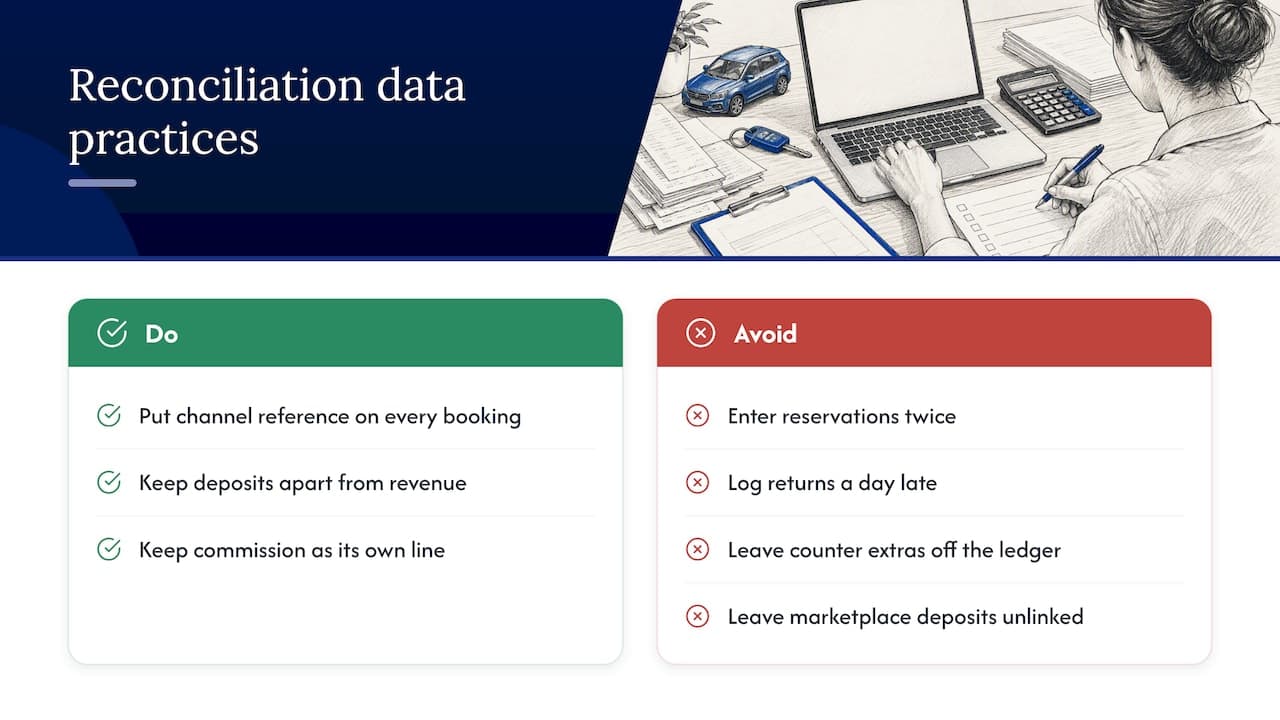
We think of rental software as the central nervous system of the operation. Reservations, vehicle status, contracts and payments all send signals through it, and reconciliation is what happens when those signals disagree. The painful cases we see are not exotic fraud. They are a reservation entered twice, a return logged a day late, an extra charged at the counter that never reached the ledger, and a marketplace deposit that nobody could tie to a booking.
That is why we built Nomora around a single record per rental. When the reservation, the contract, the payment and the vehicle's movements live in one system, matching a payout to a booking stops being a detective job and becomes a lookup. Spreadsheets can handle ten cars and one channel. They rarely survive thirty cars, three channels and a bookkeeper who is out sick.
Our advice is to fix the data first and automate second. Put the channel reference on every booking, keep deposits apart from revenue, and keep commission as its own line. Then software has clean material to work with.
— Dizzy
Where software helps
If your reconciliation currently means exporting three spreadsheets every Friday, that is the work a rental platform is built to remove. Nomora keeps reservations, contracts, automated car rental payments and fleet data together, with GPS tracking and payment gateway integrations, so completed rentals and collected money sit in the same place. Every plan includes all features, and onboarding is designed to get you operating within 24 to 48 hours.
Published plans are Starter at €45 per month, Business at €2.80 per vehicle per month and Fleet at €2.20 per vehicle per month. Enterprise and payment processing fees are quoted individually. See the details on the pricing page, or look at how the platform handles integrations before you decide.
A first-month action plan
- Week 1: Add a channel reference field to every reservation and backfill the last 90 days from channel exports.
- Week 2: Create a clearing account per channel and post the open bookings to it.
- Week 3: Reconcile the latest three payout statements to the bank and open an exception log.
- Week 4: Chase every exception older than your aging threshold, document the outcomes, and set the weekly cadence.
Also tidy up the downstream pieces: invoicing and expense tracking benefit directly from clean channel data, because commission is both a cost and a number your clients and accountants will ask about.
FAQ
How is OTA reconciliation different from normal payment reconciliation?
With direct bookings you usually match one card payment to one reservation. With a marketplace, you match many bookings to one net deposit after commission and adjustments, and the channel's statement sits between your records and the bank. That extra layer is why you need the channel's booking reference on your own records.
How long should I keep reconciliation records?
Keep them as long as your accountant advises for tax and audit purposes. Ask your CPA for the retention period that applies to your business and state, since requirements vary. Store the statements, the exception log and the dispute packs together by period.
Should the commission be deducted from revenue?
We recommend recording gross rental revenue and the commission as separate lines, rather than booking only the net deposit. This keeps your books aligned with gross-reported tax forms and lets you see what each channel really costs. Confirm the exact treatment for your entity with your CPA.
What should I do with a payout I cannot explain?
Do not count it as revenue. Hold it in the channel clearing account, ask the channel for a line-level breakdown, and record the outcome once the channel confirms. If it is a duplicate or reversal, expect it to be taken back.
Sources
Recommended