Rental payment reconciliation means proving that every rental agreement, card authorization, capture, refund and fee ties to a processor settlement and then to a bank deposit. Do it in two steps: reconcile gross activity to the processor statement first, then reconcile the net settlement to the bank. A "successful" payment in your booking system and a different number in your bank account are usually both correct, because they describe different stages of the same money.
This guide is for owners and managers of small and mid-sized rental companies, luxury and specialty fleets, and corporate fleet teams. You will leave with a close routine, an exception list, and a way to keep the evidence you need when a renter disputes a charge.
TL;DR
- Reconcile in two layers: bookings to processor transactions, then processor settlements to bank deposits. Skipping the middle layer is the most common reason totals never match.
- Treat authorizations, captures, refunds and reversals as separate ledger events, and review open holds daily.
- Timing differences between a payment and a deposit are normal. Unexplained differences that persist are exceptions to investigate.
- Link every charge to the signed agreement, itemized invoice and condition evidence, so reconciliation doubles as dispute protection.
- Never overwrite a payment record. Post correcting entries with a reason, so the audit trail stays intact.
Table of Contents
Why rental payments rarely match the bank deposit
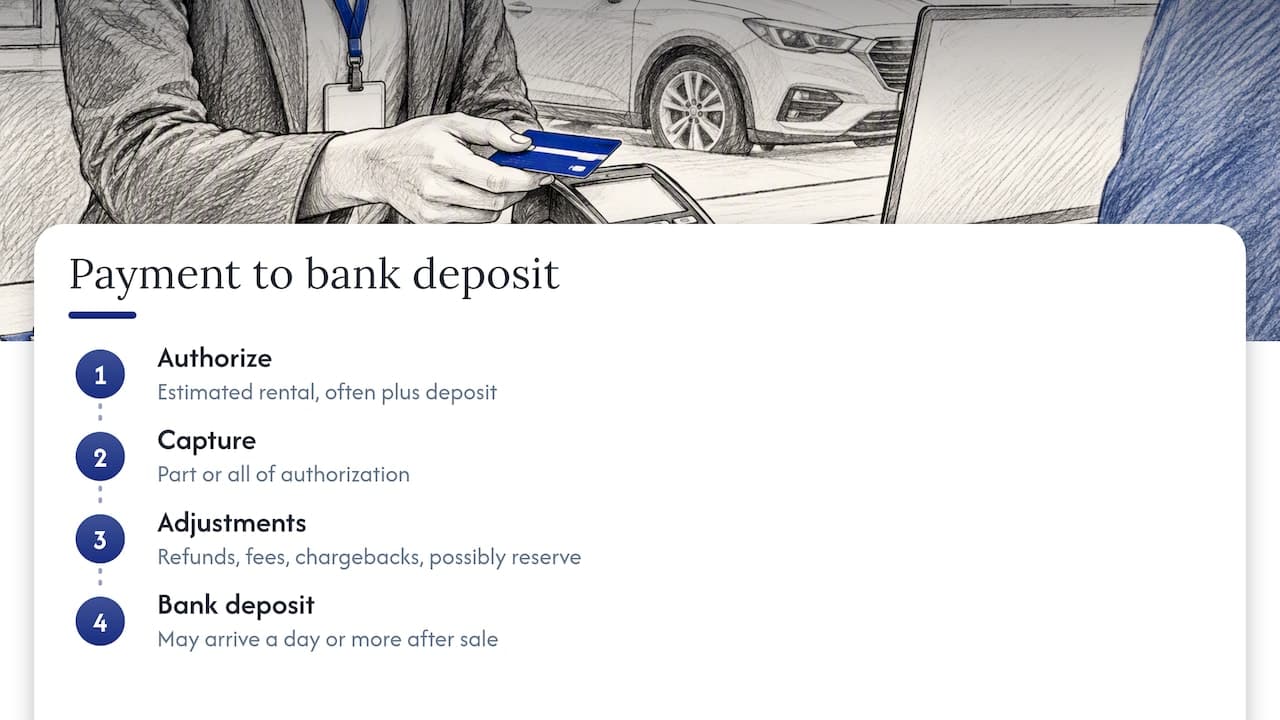
A rental payment passes through several stages before cash lands in your account. At the counter or online, the card is authorized, often for the estimated rental plus a deposit. Later, part or all of that is captured. Refunds, fees and chargebacks come afterward. According to the OCC's merchant processing handbook, third-party processors often net daily merchant and cardholder activity, and ACH settlement is processed in batches. So the deposit you see is a net figure, and it can arrive a day or more after the sale.
That is why comparing one day's bookings with one bank credit fails. A single deposit may contain several days of captures, minus refunds, minus processing fees, minus a chargeback, and possibly minus a reserve. If you want a second view of why automated rental payments and deposits drift apart in practice, this German-language guide to automating payment handling in rental businesses walks through the same mismatch from a different rental segment.
The practical consequence: reconciliation is a control process, not a daily spreadsheet total. Its job is to show that money you earned arrived, money you owe went out, and nothing is hanging open.
The four ledger events you must keep apart
Most reconciliation errors start when staff treat all card activity as "a payment." Keep these separate in your records:
- Authorization: a hold on the renter's available funds. No money has moved to you.
- Capture: the amount you actually charge. This is what settles to your processor.
- Refund: money returned after capture, which reduces a later settlement.
- Reversal or void: a release of an authorization that was never captured, or captured only in part.
The distinction matters for luxury and specialty rentals, where deposit holds can be large. A hold that stays open after the car is back leaves the renter without access to their credit line, even if your revenue is correct. Visa's authorization and reversal best practices for car rental are designed to keep merchants from improperly tying up customer funds. The same document notes that Visa assesses a Misuse of Authorization System Fee on approved authorizations that cannot be matched to a settled transaction within 20 days for car rental and lodging. Open holds are therefore both a customer problem and a cost risk.
For how holds and deposits differ operationally, see our comparison of preauthorization vs deposits.
A step-by-step close for a rental company
Run this daily for holds and exceptions, and weekly or monthly for the full close. Smaller fleets can do the full close weekly. Larger ones should do it daily.
1. Export bookings and payment events
Pull every rental agreement closed or changed in the period, along with all payment events from your processor: authorizations, captures, refunds, voids, fees and disputes. Use the processor's own transaction ID as the key.
2. Group by transaction ID and rental agreement
Every payment event should map to exactly one agreement number. Events with no agreement are your first exception pile. Agreements with no payment events are the second.
3. Separate authorizations from captures and refunds
For each agreement, build a short chain: authorized amount, captured amount, released amount, refunded amount. If authorized minus captured minus released is not zero, a hold is still open.
4. Match captures and refunds to processor settlements
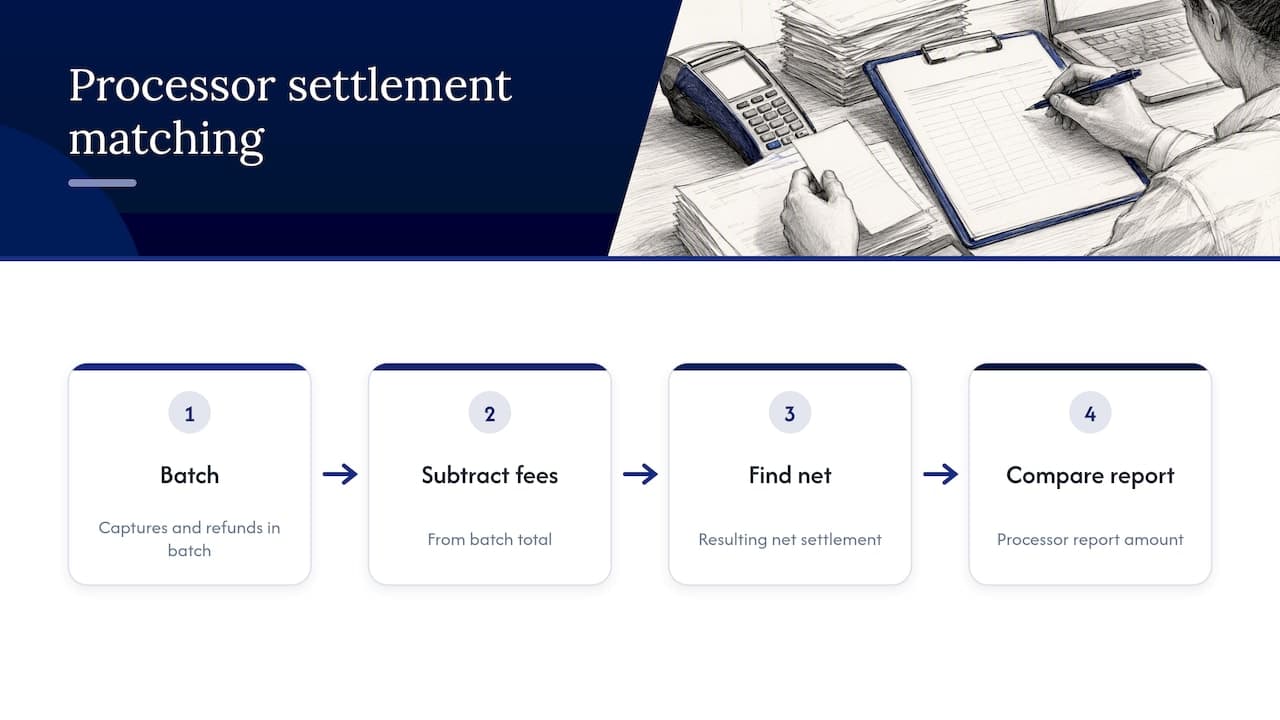
Processors batch transactions into settlements. Total the captures and refunds inside each batch, subtract fees, and compare with the settlement amount on the processor report. This is the layer most small operators skip, and it is where fee variances and chargebacks surface.
5. Compare settlement totals with bank deposits
Now match each settlement to a bank credit. Expect timing differences. The OCC handbook explains that batch ACH settlement makes such gaps normal rather than automatic evidence of missing revenue. Flag only deposits that remain unmatched beyond the processor's normal settlement window.
6. Investigate exceptions
Work the exception list in order of dollar value and age. The table below shows the categories we see most often and the first place to look.
| Exception | Typical cause | First check |
|---|
| Unmatched payment | Payment taken without an agreement ID, or agreement edited afterward | Processor transaction ID and customer name |
| Duplicate charge | Double click, retry after a timeout, or manual and online charge | Two captures on one agreement |
| Wrong amount | Extension, early return or rate change not synced | Final invoice vs capture |
| Missing refund | Refund promised but not issued | Agreement notes and refund log |
| Unreleased hold | Authorization never reversed after return | Open authorizations older than the rental |
| Failed settlement | Bank or processor rejected the batch | Processor settlement status |
| Fee variance | Different card types or rates | Fee line vs expected rate |
| Chargeback | Renter dispute | Dispute reason code and deadline |
| Wrong rental | Payment posted to a similar agreement | Dates, vehicle and renter ID |
7. Retain a dispute-ready evidence pack
Close the period only when each agreement has its documents attached. More on that below.
Review open holds every day
Do not leave holds for the month-end close. Each day, list authorizations tied to rentals that have been returned, and release or reverse them. Visa's car rental guidance, linked above, calls for reversals within 24 hours of checkout or return so the cardholder's available funds are restored.
For a luxury rental, this is a reputation issue as much as an accounting one. A renter who returned a sports car on Sunday and still sees a four-figure hold on Thursday will call you, and may dispute the charge with their bank. Automating release at return, with a manual override for damage review, removes most of this work. Our guide to deposit automation for car rental fleets shows how to set it up.
Build the evidence pack while you reconcile
Reconciliation tells you the money matches. It does not tell you the charge will survive a dispute. The two should be one workflow.
Visa's dispute management guide for merchants is written for the back-office and operations staff who handle reconciliation, fraud monitoring and dispute resolution. Its emphasis is on evidence that the cardholder took part in the transaction, that the service was delivered, and that the agreed terms were followed. A payment match with no operational record is weak protection.
For each rental, keep:
- the signed or electronically accepted rental agreement;
- the authorization record and final itemized invoice;
- vehicle condition reports with timestamped before-and-after photos;
- repair, toll and fuel documentation behind any extra charge;
- customer communications about the charge.
Elavon's car rental chargeback best practices add process points worth training staff on: when to void versus refund, why refunding to a different card, cash or bank account is risky, and why refunding after a chargeback has been raised can mean a double loss. It also suggests a shared dispute inbox so a staff absence does not delay a response.
Additional charges deserve particular care. Chargeback Gurus reports that fees for fuel, tolls, cleaning and damage are a frequent source of auto rental chargebacks, and recommends sending a detailed invoice for incidental charges promptly, ideally within a week of the rental ending. That is practitioner guidance, not a legal deadline, but it is a sensible internal rule. For clause wording and proof by dispute type, see our posts on rental chargebacks and late return policies.
Correct errors without erasing history
When you find a wrong amount or a payment on the wrong rental, do not edit the original record. Post a correcting entry that references it, states the reason and carries the approver's name.
This is standard control practice. North Carolina's statewide accounting policy on customer transaction disputes says disputes should be resolved through the relevant card or electronic-funds-transfer provider, with correcting entries supported by full detail. It also notes that card disputes follow card network rules, while electronic-funds-transfer disputes are governed by ACH rules and Regulation E, and that rights and deadlines depend on payment method and dispute type. It is a state agency policy, not a rule for private businesses, but the audit-trail principle carries over. For deadlines on a specific dispute, check your processor's terms or ask your accountant.
If you also book revenue under ASC 606 or lease accounting under ASC 842, the reconciled ledger is the foundation. We cover the journal entries in car rental accounting for ASC 842 and 606.
What a manual process costs you
Spreadsheets can handle reconciliation for a handful of vehicles. They tend to fail in the same places as you grow:
- Bookings live in one tool, payments in a processor dashboard, and contracts in a folder. Someone retypes numbers between them.
- Extensions, early returns and add-ons change the amount after the first charge, and nobody updates the sheet.
- Holds are tracked by memory.
- Evidence is scattered across email, phone photos and messaging apps, so assembling it for a dispute takes hours.
The fix is less about adding a payment gateway and more about enforcing the controls: one agreement ID on every payment, automatic release of holds, itemized invoices generated from the contract, and a log of every adjustment. Our post on why to automate payment processing for rental businesses goes deeper, and the integrations guide explains how payments, GPS and accounting connect.
Our perspective: software is the nervous system of the close
We build rental management software, so we see the same pattern in rental companies of every size. The payment is rarely the problem. The disconnect is. The booking says one thing, the processor another, the bank a third, and the contract lives somewhere else entirely.
We think of rental software as the central nervous system of the operation. A reservation, a vehicle handover, a payment and a return should be one connected record, not four tasks in four tools. When they are, reconciliation shrinks from a monthly detective job to a daily check of a short exception list. Conflict-free bookings, automated contracts and integrated payments exist in Nomora for this reason: each payment event is tied to the agreement it belongs to from the start.
Our advice is to resist buying on features alone. Ask any system, ours included, three questions. Can I see authorization, capture, refund and release as separate events on one agreement? Can I trace a deposit back to the bookings inside it? Can I produce the signed terms and condition photos for a charge in under a minute? If the answer to any is no, you will still be reconciling by hand.
— Dizzy
Where Nomora fits
Nomora is cloud-based rental management software that combines reservations, fleet management with GPS tracking, automated contracts, payments and customer data. Onboarding is designed to get you operational in 24 to 48 hours, and every plan includes all features.
Published pricing: Starter is €45 per month, Business is €2.80 per vehicle per month, and Fleet is €2.20 per vehicle per month. Enterprise has no published price, and payment processing fees are not published. See the pricing page for current details, or read how automated car rental payments work. If you run a luxury, specialty or corporate fleet, the use cases page shows how teams like yours set it up.
A one-page checklist
- Every payment carries an agreement ID.
- Open holds are reviewed daily and released after return.
- Weekly: captures and refunds matched to processor settlements.
- Weekly: settlements matched to bank deposits, timing gaps noted.
- Exceptions worked by value and age, each with an owner.
- Corrections posted as new entries, never edits.
- Evidence pack complete before the agreement is closed.
- Incidental charges invoiced within a week of return.
FAQ
How often should a rental company reconcile payments?
Review open authorizations and new exceptions daily. Run the full match of captures to settlements and settlements to deposits weekly for small fleets, or daily if volume is high. A full month-end close then becomes a review rather than a rebuild.
Why does my processor show a payment but my bank does not?
Processors commonly net activity and settle in batches, so a captured payment may reach your bank a day or more later, combined with other transactions and net of fees and refunds. Check the processor's settlement report first, then match that batch total to the deposit. Only investigate further if the settlement is overdue.
What is the difference between a void and a refund?
A void or reversal releases an authorization that was not captured, so no money moves. A refund returns money that was already captured and shows up as a deduction in a later settlement. Always return funds to the original card, as Elavon warns that refunding another card, cash or bank account creates risk.
What records help most in a chargeback?
The accepted rental agreement, the itemized invoice, the authorization record, timestamped condition photos, supporting documents for fuel, tolls or repairs, and customer messages. Visa's dispute guidance stresses proof of participation, fulfillment and agreed terms. Assemble these before a dispute arrives, not after.
Sources
Recommended