What Is Revenue Recognition for Car Rental Companies?
Before you touch a ledger, run every new contract or booking through a five-step filter. This is the same triage accounting teams use when a reservation lands, a deposit clears, or a damage charge gets billed weeks after the car comes back.
Start by breaking the contract into its actual components. A single rental agreement often bundles the vehicle itself with mileage terms, a damage waiver, a GPS unit, and a delivery fee, and each of those pieces can follow different rules.
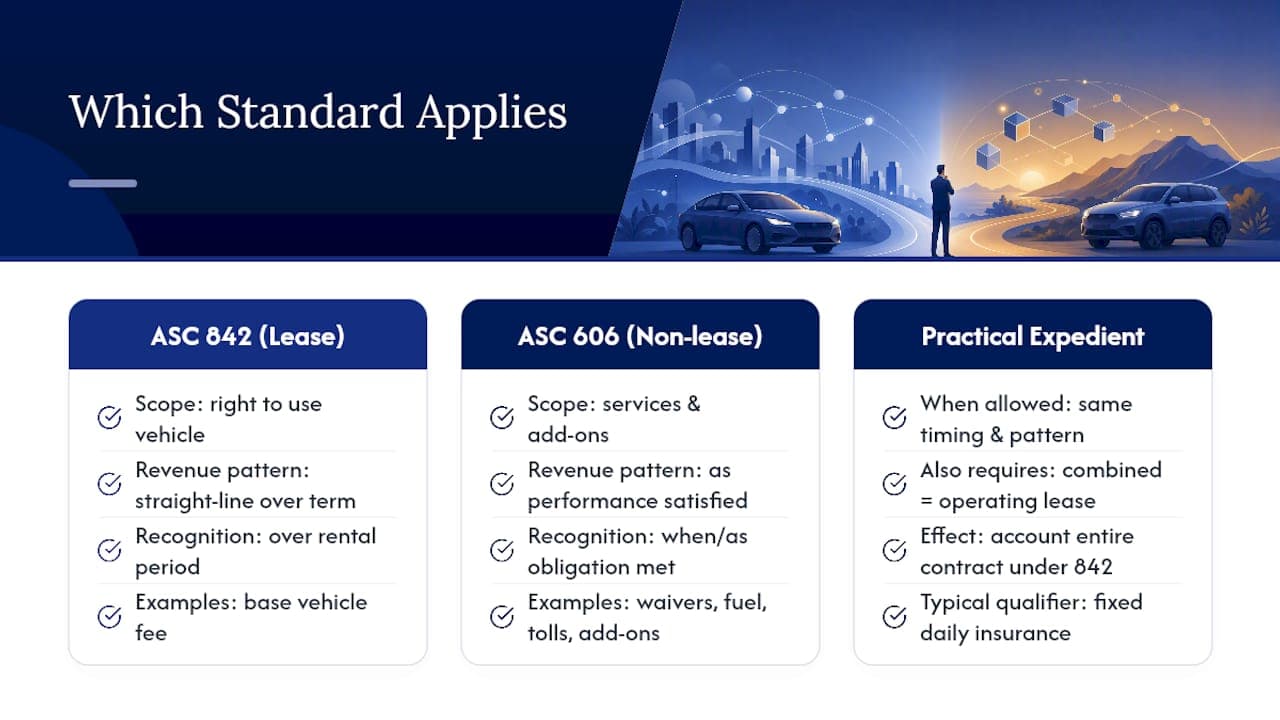
Next, decide which pieces are lease components and which are not. The lessor practical expedient lets you combine a lease component with an associated non-lease component and account for the combined item under ASC 842 when the timing and pattern of transfer are the same. If they diverge, you separate them.
Then look at the cash itself. Is it a prepaid booking, a refundable damage deposit, or a nonrefundable fee? Each of those has a different starting point on the balance sheet, and none of them is revenue on day one.
From there, pick the recognition pattern: straight-line over the rental term for time-based lease revenue, or point-in-time for a distinct service like a one-time delivery. Finally, flag anything variable, tolls, refueling charges, damage assessments, and apply a reasonable estimate rather than waiting for perfect information.
A quick reference for the intake process:
- Break the contract into rental days, mileage, add-ons, protection products, and delivery or pickup fees.
- Classify each component as lease (ASC 842) or non-lease (ASC 606).
- Confirm whether the payment received is prepaid revenue, a refundable deposit, or a nonrefundable fee.
- Choose straight-line recognition for time-based charges versus point-in-time for discrete services.
- Estimate variable consideration (tolls, fuel, damage) at inception and reassess as facts change.
Getting this checklist right at intake saves hours of rework later. Misclassify a damage waiver as lease revenue in month one, and you are unwinding that entry at month-end close instead of moving on to the next contract.
When Does ASC 842 Apply Instead of ASC 606?
The two standards were built to work together, not compete, but knowing which one governs a given dollar changes both the timing and the mechanics of your entries.
ASC 842 governs the lease component of a rental, meaning the right to use the vehicle itself. For most car rental agreements, that lease is classified as an operating lease from the lessor's side, and revenue is recognized evenly over the rental period rather than all at once at pickup or drop-off. Public filings routinely show this straight-line pattern, with an average rental period of a few days used in illustrative calculations, and per-day rates derived by dividing a monthly or weekly rate across the applicable term.
ASC 606 governs everything that is not the vehicle lease: damage waivers, delivery service, fuel and toll recovery, add-on equipment, and loyalty program obligations. Under 606, you recognize revenue when (or as) you satisfy a performance obligation, which might be the moment you hand over a GPS unit or the point at which fuel consumption becomes measurable at return.
The dividing line between the two standards is the lessor practical expedient described in BDO's ASC 842 blueprint. It allows a lessor to combine lease and non-lease components into a single unit of account, accounted for entirely under ASC 842, when two conditions hold: the timing and pattern of transfer for the lease and non-lease component are the same, and the combined lease component would be classified as an operating lease. A rental car bundled with a fixed daily insurance charge often qualifies. A rental bundled with a one-time, upfront delivery fee usually does not, because the delivery happens at a single point while the lease runs for days.
When components stay separate, you allocate the total contract price between them using the standalone selling price approach under ASC 606's allocation guidance, then apply each standard to its respective slice. Variable payments complicate this further. A toll charge that depends on actual road usage or a damage estimate that will not be finalized until inspection both require you to estimate the amount at contract inception and apply the ASC 606 constraint on variable consideration, updating the estimate as better information becomes available, according to EY's technical guidance on the topic.
Auditors pay close attention to this separation decision. The KPMG Leases Handbook notes that lessors need to disclose enough detail about the nature, timing, and uncertainty of revenue for financial statement users to understand what they are looking at, which means your workpapers should show not just the final split but the reasoning behind it. If you combine components under the practical expedient, document why the timing and classification tests were met. If you separate them, document your allocation method. That paper trail is what turns an audit inquiry into a five-minute conversation instead of a two-week fire drill.
How Are Different Car Rental Charges Classified?
Rental agreements rarely involve just one revenue line, and each stream carries its own recognition logic. Getting the classification wrong on any single line item can distort both your income statement and your balance sheet, especially if the error compounds across hundreds of contracts a month.
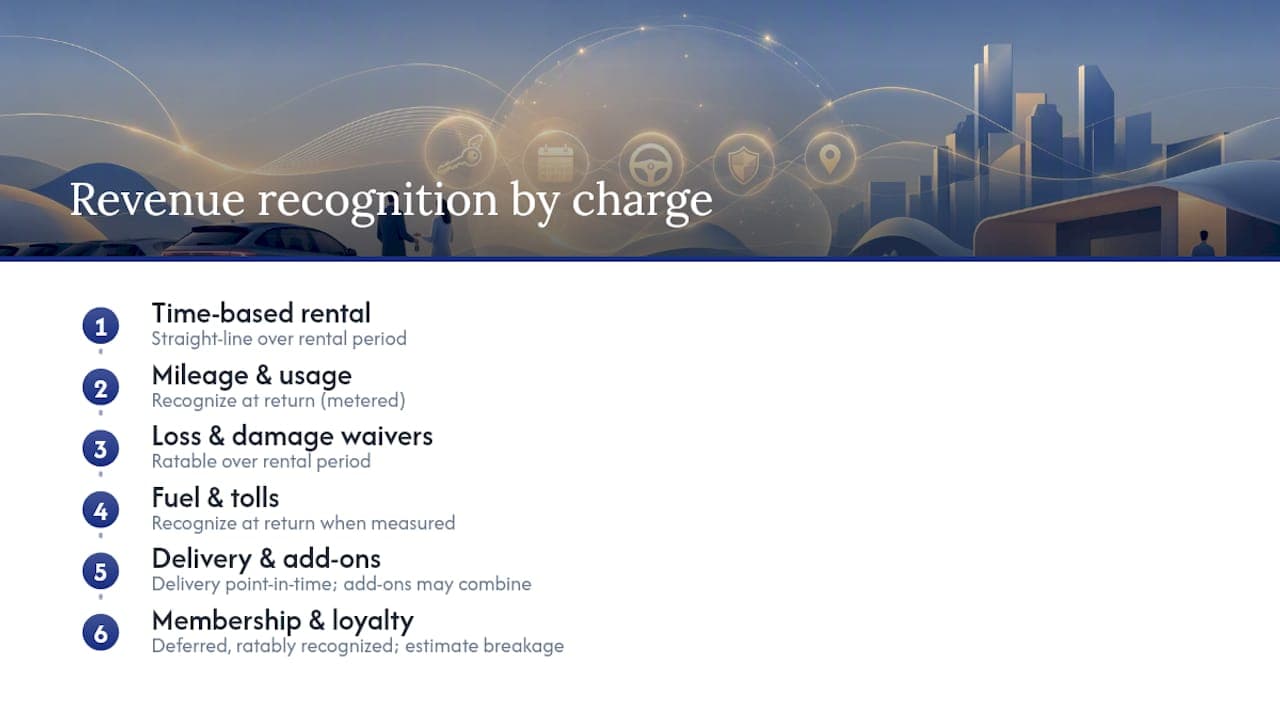
Time-based rental charges make up the core lease component and follow ASC 842's straight-line pattern. If a customer books seven days at $50 per day, you recognize roughly $50 of revenue for each day the vehicle is in their possession, not $350 on the day they pick up the keys. Filings that use a monthly rate for open-ended rentals typically divide that rate to derive a daily equivalent, then true up the final amount when the vehicle is actually returned.
Mileage and usage charges are recognized once the amount is determinable, which is usually at return when the odometer reading confirms actual miles driven. Until then, you can estimate based on historical averages if you need interim figures, but the final number gets trued up against the meter reading.
Loss and damage waivers behave like an insurance product bundled into the rental. Because the waiver protects against a contingent future event rather than transferring a good or service upfront, most rental companies treat it as a distinct non-lease component recognized ratably over the rental period, matching the coverage period to the revenue.
Fuel and toll charges get recognized when consumption is measured or the service is performed, typically at vehicle return once you know the fuel level or toll log.
Delivery, pickup, and add-on equipment rentals (GPS units, child seats, ski racks) require a distinctness test. A one-time delivery fee is usually a point-in-time performance obligation recognized when the car arrives at the customer's location. A GPS unit rented alongside the vehicle for the full rental term often gets combined with the lease component under the practical expedient.
Membership and loyalty fees get deferred at collection and recognized ratably over the membership period, with an estimate for breakage, the portion of points or credits that will never be redeemed, built into the deferral calculation, consistent with how loyalty obligations are described in public company filings.
Pro Tip: Build your chart of accounts around these six streams from day one. Trying to retrofit granular revenue categories after two years of lumping everything into "rental income" turns a one-day cleanup into a multi-week reclassification project.
What Journal Entries Record Rental Revenue Correctly?
Every car rental transaction touches the books at least twice: once when cash changes hands, and again when the earnings process catches up to that cash. Here is the sequence for the transactions that come up most often.
- Prepaid booking received. When a customer pays in advance for a future rental, debit Cash and credit Deferred Revenue (a liability). No revenue is recorded yet, because the vehicle has not been made available.
- Revenue earned as rental days pass. As each rental day occurs, debit Deferred Revenue and credit Rental Revenue for the lease portion, and credit the appropriate non-lease revenue accounts (Damage Waiver Revenue, Add-On Revenue) for anything separated out under ASC 606.
- Refundable security deposit collected. Debit Cash and credit Customer Deposits Liability. This entry never touches revenue, because the deposit is contingent on the vehicle's condition at return.
- Deposit refunded in full. Debit Customer Deposits Liability and credit Cash. This closes the liability with no revenue impact.
- Deposit retained for damage. Debit Customer Deposits Liability and credit Damage Recovery Revenue (or Rental Revenue, depending on your chart of accounts) for the retained amount, then refund any remaining balance with a debit to the liability and a credit to Cash.
- Variable charges billed to the customer (tolls, refueling). Debit Accounts Receivable or Cash and credit the specific variable revenue account once the amount is determinable, typically at return when consumption is measured.
At month-end, reconcile your Deferred Revenue account with a rollforward: beginning balance, plus cash received for future bookings, minus revenue recognized during the period, equals ending balance. Pair that with per-vehicle revenue tracking so you can spot a vehicle that is generating deferred balances but no corresponding recognized revenue, often a sign of a booking that was never closed out in the system. Bookkeeping practitioners who specialize in this industry recommend keeping rental revenue, add-ons, damage recoveries, deposits, and refunds in separate general ledger accounts rather than one blended rental income line, specifically so this reconciliation is possible without manual digging.
Pro Tip: Run your deferred revenue rollforward every month, not every quarter. A quarterly cadence lets classification errors compound for three months before anyone notices, and by then you are explaining a large adjustment to your controller instead of a small one.
How Do You Handle Deposits, Refunds, and Loyalty Breakage?
Deferred revenue and customer deposits look similar on a balance sheet, both are liabilities, but they behave differently and deserve different controls.
A prepaid booking becomes deferred revenue the moment cash arrives, and you split it across the reporting periods the rental actually spans. If a customer books a ten-day rental that straddles a month-end close, you allocate the prepayment proportionally between the two periods based on days elapsed in each.
Loyalty programs need a breakage estimate, the assumption for how many earned points or credits will expire unused. Filings addressing loyalty obligations describe multi-year expiration windows and require companies to update their breakage assumption periodically based on actual redemption patterns rather than setting it once and forgetting it.
Refundable deposits are not revenue until an event resolves the contingency: either you refund the cash, or you retain some or all of it for documented damage, and only the retained portion converts to revenue. Nonrefundable fees, by contrast, are typically recognized once the associated service is delivered rather than held indefinitely as a liability.
Controls matter as much as the mechanics here. Segregate duties between whoever collects deposit cash and whoever authorizes its release, reconcile the Customer Deposits Liability account monthly against open contracts, and set a clear aging policy for deposits tied to closed rentals that have not been refunded or claimed within a defined window. Auditors and the KPMG Leases Handbook both expect footnote disclosure of deferred revenue balances, including the significant judgments behind breakage estimates and the expected timing of recognition.
What Do Auditors Check in Rental Revenue Recognition?
Auditors reviewing a rental company's revenue recognition tend to focus on the same handful of judgment calls every time, because that is where errors and management estimates concentrate.
Expect scrutiny on the split between Topic 842 and Topic 606 revenue, the deferred revenue rollforward from opening to closing balance, and any significant estimate involving variable consideration or loyalty breakage. Disclosure notes should spell out how much revenue came from lease components versus non-lease components, what judgment went into any combined units of account under the practical expedient, and how residual-value exposure on the fleet ties back to depreciation and lease classification.
Three mistakes show up more often than any others. The first is recognizing a deposit as revenue the moment it is collected instead of waiting for the contingency to resolve, which overstates current-period income and requires a restatement if caught late. The second is treating a damage waiver as straight lease revenue rather than applying the separate recognition pattern the non-lease component actually requires. The third is inconsistent treatment across locations or franchise units, where one branch defers a delivery fee correctly and another recognizes it immediately, creating a reconciliation headache at consolidation.
The fix for all three is procedural, not technical. Write a one-page revenue recognition policy that names each revenue stream and its treatment, standardize contract templates so the same components appear in the same order across every location, and run periodic sample testing on a handful of contracts each month to confirm postings match the policy. A consistent rental contract structure also makes it far easier for whoever reviews the books, internal or external, to trace a charge back to its source.
Can Rental Software Automate Revenue Recognition Controls?
Manual revenue recognition breaks down at scale, not because the accounting logic is hard, but because tracking hundreds of contracts, deposits, and variable charges by spreadsheet invites transcription errors and missed reclassifications. This is where a rental-management platform earns its keep.
Nomora is built to handle the operational side of exactly the transactions this article has walked through: reservations, fleet assignments, contract generation, and payment processing in one system rather than scattered across a booking tool, a payment processor, and a spreadsheet. When a contract is generated, the system captures each component (rental days, mileage terms, protection products, add-ons) as a distinct line, which gives your accounting team a cleaner starting point for the lease versus non-lease classification decision instead of parsing a PDF after the fact.
A few specific ways integrated software supports the recognition workflow:
- Splitting rental contract components at booking time, so lease and non-lease revenue streams are tagged from day one instead of reconstructed at month-end.
- Scheduling recognition across the rental term automatically, reducing the manual straight-line calculations your team would otherwise run in a spreadsheet.
- Tracking deposits and refunds separately from revenue accounts, cutting down on the misposting that turns into an audit finding.
- Generating real-time, per-vehicle and per-contract reports that make deferred revenue reconciliations and variable-charge tracking faster to complete.
For a fleet manager weighing whether to build custom tracking sheets or adopt a platform, the deciding factor usually comes down to how many contracts your team processes each month and how much manual reclassification work that volume already creates.
What Finance Teams Should Prioritize First
Most of the revenue recognition errors we see in car rental accounting do not come from misunderstanding ASC 842 or ASC 606. They come from getting the classification wrong at the moment a contract is created and never catching it until close.
That is the priority I would push above all others: build classification into contract setup, not into a month-end review. A clean template that separates lease and non-lease components at booking time prevents ninety percent of the reclassification work that otherwise piles up.
Keep your deferred revenue reconciliation simple enough that a junior staffer can run it without a senior accountant checking every line. And train the people taking bookings and processing returns, not just the accounting team, on the difference between a transaction that creates revenue and one that just moves a liability around. That distinction is where most of the actual mistakes happen.
Cut Recognition Errors With Automated Contract Splitting
Nomora gives rental businesses a faster path to accurate revenue recognition than rebuilding your process in spreadsheets every time a contract type changes. Instead of manually separating lease and non-lease components after the fact, Nomora's contract generation captures each revenue stream at booking, so your deferred revenue schedule and per-vehicle reporting start from clean, structured data rather than a reconstruction project at month-end.
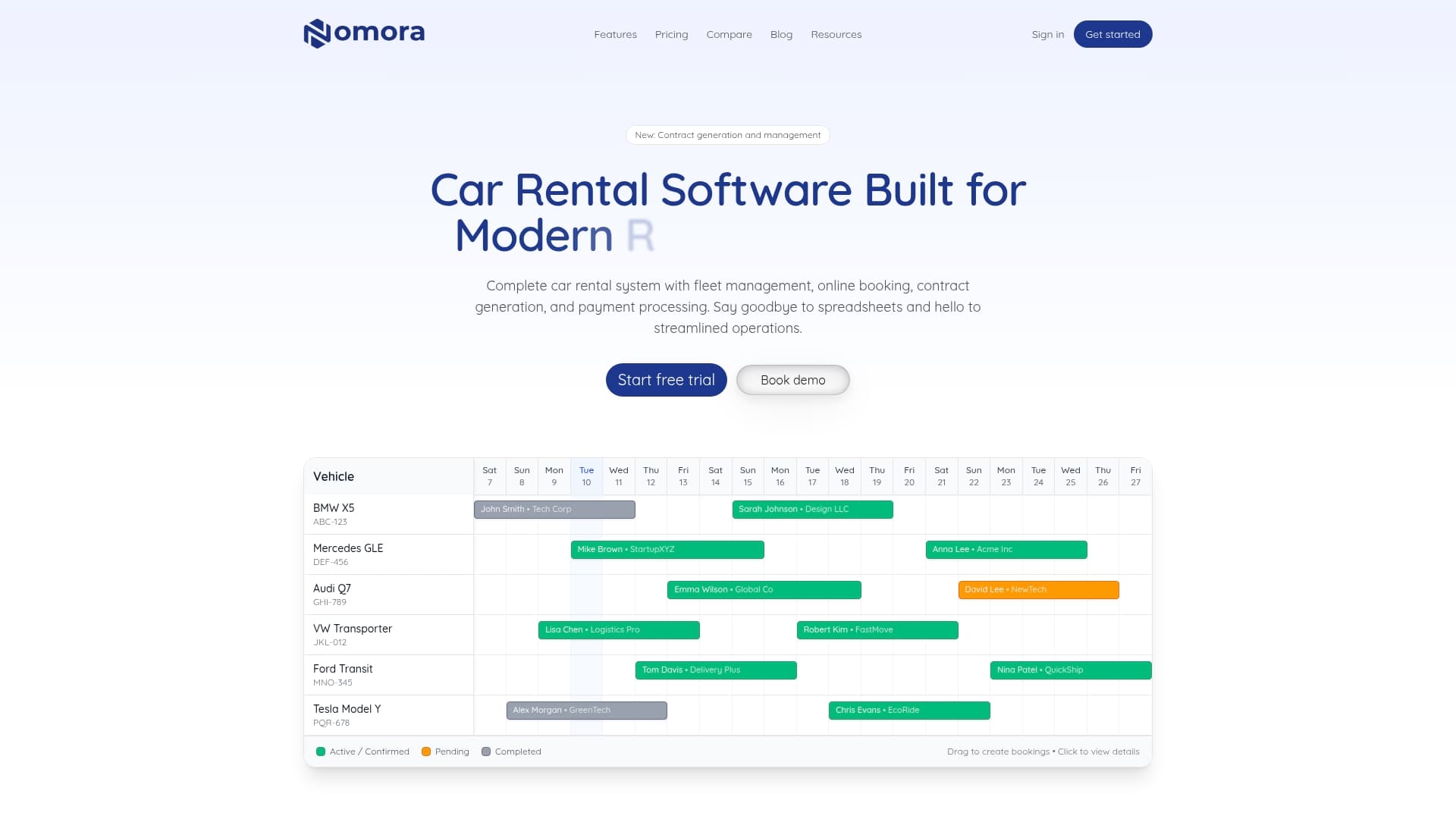
Onboarding is designed to be quick, allowing you to move your revenue recognition workflow onto structured contract data within days rather than months of implementation. The platform also supports deposit collection and refund processing, helping reduce manual reclassification that can create audit friction when deposits and revenue accounts get crossed.
If your team is still tracking deferred revenue and per-vehicle profitability in a spreadsheet, it is worth seeing how Nomora's fleet management tools handle that reconciliation automatically. Explore the available use cases for your business type and request a demo to see how contract-level revenue splitting works with your actual rental terms.
Sources
FAQ
What Triggers Revenue Recognition for a Car Rental?
Revenue recognition is triggered when the rental company satisfies its performance obligation, either by making the vehicle available for the rental period under ASC 842 or by delivering a distinct service, like a damage waiver or delivery, under ASC 606. Cash received in advance does not trigger recognition on its own; it creates deferred revenue instead.
Does Rental Income Count as Revenue?
Yes, but only once it is earned. Rental income collected in advance of the rental period is a liability (deferred revenue) until the vehicle is actually made available to the customer over the contracted days.
What Category Does Car Rental Fall Under?
Car rental charges fall under ASC 842 as lease revenue for the vehicle-use component, while related services like damage waivers, delivery, and fuel recovery fall under ASC 606 as revenue from contracts with customers.
What Are the Five Criteria for Revenue Recognition?
Under ASC 606, the five-step model requires identifying the contract, identifying the performance obligations, determining the transaction price, allocating that price to each obligation, and recognizing revenue as each obligation is satisfied. For car rental companies, the lease component of the same contract is carved out and follows ASC 842 instead of this five-step model.
How Does a Rental Company Handle a Deposit That Gets Partially Refunded?
The retained portion converts from Customer Deposits Liability to revenue (often Damage Recovery Revenue), while the remaining balance is refunded in cash with no revenue impact on that portion.
Recommended