Yes, you can accept ACH payments as a car rental business, but not for the job most operators want it to do. ACH works well for recurring or invoiced charges, such as monthly subscriptions, long-term rentals and corporate accounts. It works poorly for counter-side security deposits, because a bank transfer cannot place a hold on funds the way a card can. This guide shows where ACH fits in a rental operation, where it does not, and what the rules require of you.
TL;DR
- ACH suits recurring and invoiced rental revenue: monthly rentals, subscriptions, corporate accounts and balances due after the trip.
- ACH is a poor fit for security deposits at pickup. It has no hold or instant balance check, and standard settlement takes 1 to 3 business days.
- You need a standalone, documented authorization from each customer before you debit an account, and you must keep the record.
- High return rates create regulatory risk, so validate bank accounts and schedule debits well before the due date.
- Keep cards for deposits and use ACH where timing is predictable. Software that ties both to the booking keeps the books clean.
Table of Contents
Why renters ask about ACH, and why operators hesitate
The demand is real, even if search volume for the phrase is small. Renters who want to avoid card fees, stay under a credit limit, or pay a long-term rental without updating an expiring card all ask whether they can pay straight from a bank account. Business customers ask too, because their finance teams prefer a bank debit or transfer to a card swipe.
Operators hesitate for good reasons. A rental company hands over an asset worth tens of thousands of dollars and gets paid against a risk it cannot see yet: damage, tolls, fuel, late return, cleaning. The payment method has to protect you against that risk. That is why the answer depends on what you are collecting, not on whether ACH is good or bad in general.
What the big rental brands do
The national brands show the market norm. Enterprise lists the forms of payment it accepts in the United States: credit cards, debit or check cards, gift cards and, in limited cases, cash. Bank transfer is not part of that picture. Avis says most U.S. locations accept debit cards carrying the Visa or Mastercard logo, with a hold usually placed on the account. Thrifty publishes a similar list of accepted credit cards and some debit cards.
The pattern is consistent. These companies take payment instruments that support a pre-authorized hold and an immediate answer at the counter. A small or independent operator does not have to copy that policy for every rental, but you should understand the reason behind it before you design your own.
How ACH actually works
The ACH Network is a batch, store-and-forward system. Payments are collected into files, passed between banks and settled on a schedule. That design makes it cheap and reliable for planned payments. It also explains every limitation below.
Settlement is not instant
Standard ACH debits typically take one to three business days to settle. Same-Day ACH exists, and Nacha says it covers nearly all ACH volume, with only international transactions and very large payments excluded. Nacha has also announced that the Same Day ACH per-payment limit will rise to $10 million. Neither fact changes the core issue for a rental counter. Faster settlement is not the same as an instant answer on whether the money is there.
A debit can come back
When a customer's account lacks funds, the debit is returned days after you handed over the keys. By then the car may be across state lines. For a rental company, that gap is the entire risk. A card hold, by contrast, confirms available funds before the customer drives away.
There is no hold
According to Georgia's consumer protection office, debit cards allow pre-authorization holds at the network level. ACH has no equivalent. You can debit an account, but you cannot reserve a portion of a balance for a possible damage claim. For a deeper look at how holds and deposits differ, see our piece on preauthorization versus deposits.
Where ACH fits in a rental business
Split your revenue into types and the picture gets clear.
| Revenue type | ACH fit | Why |
|---|
| Security deposit at pickup | Poor | No hold, no instant balance check, return risk |
| Short daily rental paid at the counter | Poor | Customer leaves before settlement |
| Monthly or long-term rental | Good | Predictable amount and date |
| Corporate or fleet account invoiced monthly | Good | Business-to-business debits are routine |
| Final balance after return (extras, tolls, fees) | Mixed | Works only with prior authorization on file |
| Subscription vehicle programs | Good | Recurring by design |
The strongest use case is recurring billing. If a customer rents for 30 days or more, or a company runs a standing account with you, ACH removes card fees and avoids failed payments caused by expired cards. You still collect a deposit, but you do it with a card hold, and you bill the rental itself by ACH.
A practical split for long-term rentals
- Collect the security deposit by card hold at pickup.
- Take the first period's payment by card or a verified bank debit before handover.
- Set up recurring ACH debits for the remaining periods with a signed authorization.
- Release the card hold after inspection, and settle any extras by the authorized method.
This keeps the protection of a hold where you need it and the savings of ACH where timing is predictable. Our guide to how car rental security deposits work and the overview of deposit types explain the options in more detail.
The rules you must follow
Accepting ACH makes you an originator in Nacha's terms, and that carries obligations. Treat the following as a minimum, and confirm the details with your bank or payment processor and, where needed, a lawyer.
Get proper authorization
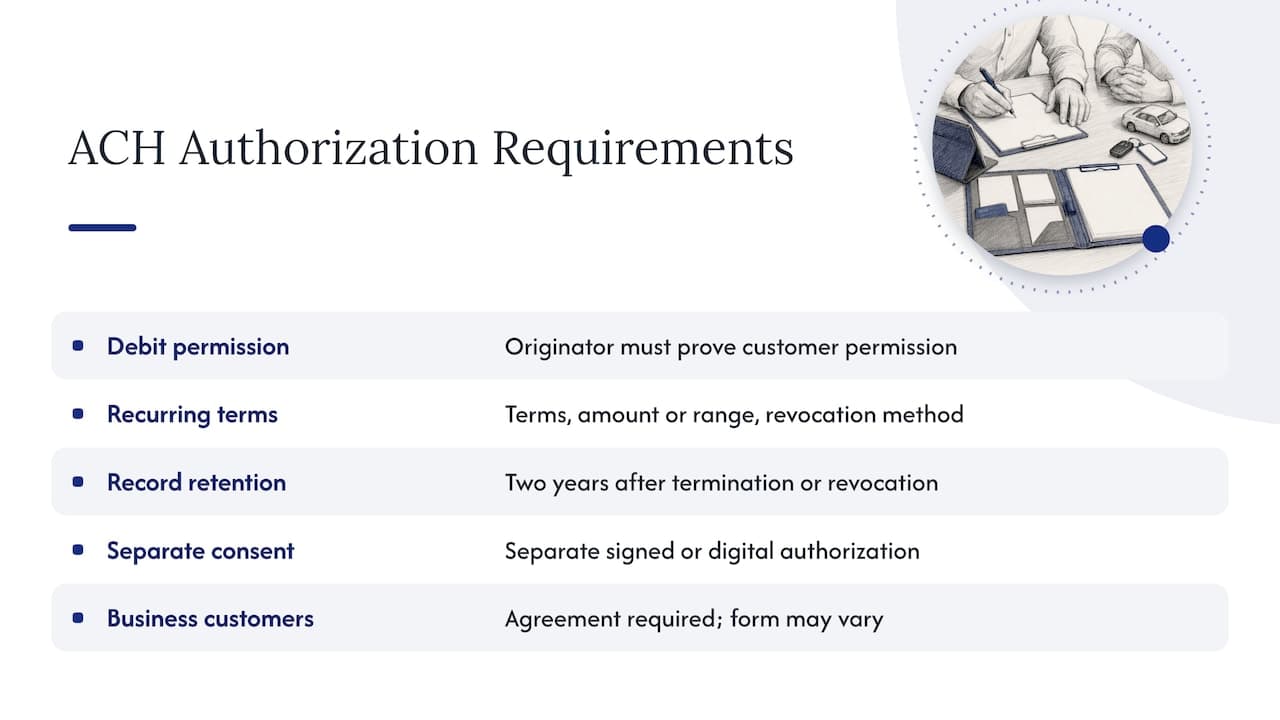
Nacha's originator guide states that originators must receive permission to debit a customer's account, and that the burden of proof sits with the originator. For recurring consumer debits, the authorization should spell out the payment terms, the amount or range of debits and how the customer can revoke it. The same guide says to keep these records for at least two years after termination or revocation.
A clause buried in the rental agreement is a weak foundation. Keep the ACH authorization separate from the rental contract, with its own signature or digital consent, so there is no dispute about what the customer agreed to. For business customers, Nacha's B2B quick start notes that an agreement is still required, though its form can vary.
Know that customers can stop debits
Consumers have real rights here. As helpwithmybank.gov explains, a customer who authorized a debit can revoke it with their bank, generally by giving notice at least three business days before the scheduled transfer. The Consumer Financial Protection Bureau has also published guidance on consumer protections around automatic debits. Plan for revocation. If a renter cancels the authorization mid-rental, you need a fallback payment method already on file.
Watch your return rates
Nacha's originator guide lists unauthorized return codes such as R05, R07, R10 and R29, and sets a threshold of 0.5% of originated entries for unauthorized returns. Exceeding it can lead to enforcement and fines. The guide also treats account validation, through prenotes or micro-deposits, as a reasonable risk practice. If you take ACH, validate accounts before the first debit rather than after the first return.
Setting up ACH in a rental operation
A clean setup has five parts.
- Choose a processor that supports ACH. Check whether it offers account validation and handles return codes for you. Ask about fees for returns, because they add up.
- Write a standalone authorization. State the amount or range, the schedule, the revocation steps and who to contact.
- Validate the bank account before the first charge.
- Schedule debits early. Allow for the one to three business days standard settlement, and do not time a debit to the day the car leaves.
- Store the authorization with the customer record and keep it for the required period.
Then reconcile. ACH payments settle on a different timeline from card payments, and returns arrive later. If you run rentals on spreadsheets, matching a bank debit to a booking, a deposit and a contract becomes slow and error-prone. Our walkthrough of a payment reconciliation close process covers how to keep that tidy.
Reduce risk before the keys change hands
The fewer unknowns you take on, the less you depend on payment method alone. Verified identity and a clear screening process cut fraud, which matters more when funds are not guaranteed at pickup. Look at our steps for identity verification at pickup and the guide to renter background checks and FCRA compliance if you plan to extend credit-like terms to repeat or long-term customers.
Our perspective: payments are the central nervous system problem
We think of rental software as the central nervous system of the operation. A booking, a vehicle, a contract, a deposit and a payment are all one event seen from different sides. When they live in different tools, the gaps show up as refund work, disputed charges and month-end reconciliation that eats a day.
That is why we do not frame ACH as a yes-or-no question. Most operators we speak with would be better served by asking which payment method belongs to which step. A card hold protects the vehicle. A bank debit can lower the cost of recurring revenue. Neither helps if the payment is not connected to the reservation and contract it belongs to.
Our view is simple: use the method that matches the risk of the moment, automate the handoffs, and make sure every payment lands against the right booking without someone retyping it. Manual steps are where errors and late payments come from, and they get worse as your fleet grows. Our article on deposit automation for rental fleets shows what removing those steps looks like in practice.
— Dizzy
How Nomora handles rental payments
Nomora is cloud-based car rental management software that connects reservations, fleet, contracts, payments and customer data in one system. Payments are tied to the booking and the contract, so you see what was charged, what is held and what is outstanding without a spreadsheet. You can read how this works on our automated car rental payments page.
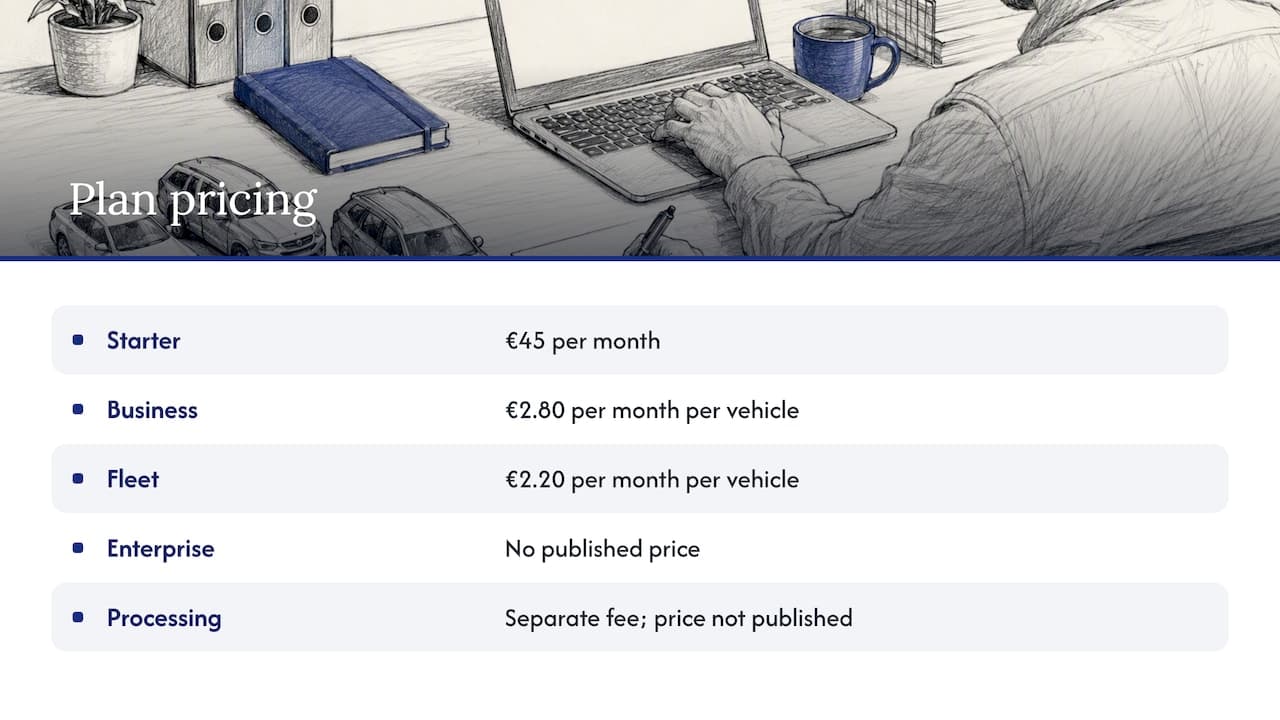
Pricing is published on the pricing page. Starter is €45 per month. Business is €2.80 per month per vehicle, and Fleet is €2.20 per month per vehicle. Enterprise has no published price. Every plan includes all features, and payment processing is a separate fee with no published price. Before you plan your ACH workflow, check which payment methods are available through your chosen processor and our integrations guide.
If you want the broader picture, our car rental software overview explains what the platform covers, and the use cases by business type show how small operators, luxury and specialty renters and corporate fleet managers set it up.
A decision framework you can use today
Ask these questions about each customer segment.
- How long is the rental? Under a week, stay with cards. Over a month, consider ACH for the recurring part.
- Who is the customer? Established business accounts are the safest ACH candidates. First-time consumers are the riskiest.
- What is the exposure? A budget compact and an exotic or luxury vehicle carry very different damage risk. Higher exposure calls for a card hold.
- Do you have a fallback? Always keep a card on file behind the bank debit.
- Can you document consent? If you cannot store a standalone authorization, do not debit.
If the answers point toward ACH, start small. Offer it to a handful of corporate or long-term customers, watch the return rate for a few cycles, then widen it.
Common mistakes to avoid
- Using ACH for the deposit. There is no hold, so you carry the full damage exposure with weaker protection.
- Burying consent in the rental agreement. Use a separate authorization, as the Nacha guidance describes.
- Debiting on the day of pickup. Standard settlement takes days, and the car is already gone.
- Skipping account validation. Prenotes or micro-deposits catch bad account numbers before they become returns.
- Forgetting revocation. Customers can cancel, so have a second payment method on file.
- Reconciling by hand. Late returns and mismatched amounts are hard to trace without a system that links each payment to a booking.
FAQ
Do car rental companies accept ACH for security deposits?
Generally no. Large U.S. rental brands list credit and debit cards as their accepted payment forms, because cards support pre-authorized holds. ACH settles in one to three business days and cannot hold funds, so it does not protect a vehicle at pickup.
Can I rent a car with a debit card instead?
Often yes, though policies vary by company and location. Some brands accept debit cards with a Visa or Mastercard logo, and may ask for extra identification or a return travel itinerary. A hold is usually placed on the account, so check the specific location's policy first.
Is ACH cheaper than cards for a rental business?
It can be, especially on larger recurring payments, but fees vary by processor and you should compare quotes. Also count the cost of returned payments and the admin time to chase them. Cheaper per transaction does not always mean cheaper overall.
What do I need before I debit a customer's bank account?
You need the customer's documented authorization that states the amount or range, the timing and how to revoke it. Keep it separate from the rental contract and store it for at least two years after it ends. Ask your bank or processor to confirm requirements for your situation.
Can a long-term renter pay by ACH?
Yes, this is the best fit. Take the deposit by card hold, then bill monthly by ACH under a signed authorization, with a card on file as backup.
Sources
Recommended