What a car rental chart of accounts should include
A generic chart of accounts, the kind that comes preloaded in most bookkeeping software, was not built for a business where the biggest asset on your balance sheet loses value every day it sits on the lot. Industry guidance recommends building a rental-specific structure that separates rental income, counter product sales, fuel reimbursements, insurance recoveries, and vehicle sale proceeds into their own accounts, according to the American Car Rental Association. Lump those together and you lose the ability to tell whether you made money renting cars or just recovered a gas charge.
Start with revenue. Break it into these lines rather than one generic "rental income" account:
- Base rental revenue — the daily, weekly, or monthly rate charged for the vehicle itself.
- Mileage and time add-ons — extra-day charges, late returns, and per-mile overage fees.
- Ancillary and counter product sales — collision damage waivers, personal accident insurance, roadside assistance, GPS rental, child seats.
- Fees and penalties — cleaning fees, smoking fees, young-driver surcharges, toll administration fees.
- Cost recoveries — fuel reimbursement and refueling charges, which are a pass-through, not true revenue.
- Insurance recoveries — reimbursement from a customer's or your own carrier after an accident.
- Gain on vehicle sale — proceeds from disposing of fleet vehicles, tracked separately from operating income.
Direct vehicle costs come next, and they deserve their own major group, separate from general operating expenses. This is where a car rental accounting system earns its keep, because these costs move with the fleet, not with the office. Include vehicle depreciation, lease or loan interest on fleet financing, vehicle registration and titling fees, physical damage and liability insurance premiums, and telematics or GPS subscription fees. A background finding on rental cost structures makes the same point: fuel, maintenance, insurance, depreciation, and financing costs need their own homes, not a shared "vehicle expense" catch-all.
Operating expenses sit below that: rent for your counter locations, staff wages, marketing, software subscriptions, and administrative overhead. Keeping these separate from direct vehicle costs matters because it lets you calculate a true contribution margin per vehicle, before you factor in the cost of running the office around it.
Last, decide where refunds, bad debt, chargebacks, and deposits live. Refunds and chargebacks should post as contra-revenue accounts under the relevant income line, not as expenses. Bad debt gets its own expense account so you can track how much revenue you are actually failing to collect. Customer deposits are a liability, not revenue, until the rental is complete or the deposit is forfeited.
A sample chart of accounts and numbering system you can copy
Rental and equipment businesses commonly follow a numbering convention with assets in the 1000s, liabilities in the 2000s, equity in the 3000s, revenue in the 4000s, and expenses in the 5000s, a structure confirmed by sample chart of accounts templates for equipment rental companies. That numbering makes it easy to scan a trial balance and instantly know what kind of account you are looking at, and it leaves room to insert new accounts later without renumbering everything.
| Account number | Account name | Type |
|---|
| 1000s | Vehicle assets (fleet) | Asset |
| 1000s | Accumulated depreciation, vehicles | Contra asset |
| 2000s | Customer deposits payable | Liability |
| 2000s | Sales tax payable | Liability |
| 4000 | Base rental income | Revenue |
| 4000s | Ancillary product income (CDW, PAI, GPS) | Revenue |
| 4000s | Fuel reimbursement income | Revenue |
| 4000s | Gain/loss on sale of vehicle | Revenue/other |
| 5000 | Vehicle maintenance expense | Direct vehicle cost |
| 5000s | Fuel expense | Direct vehicle cost |
| 5000s | Depreciation expense, vehicles | Direct vehicle cost |
| 5000s | Location rent and utilities | Operating expense |
Transportation industry examples reinforce the same design, adding rows for permit fees and telematics costs alongside maintenance and insurance, according to Vencru's chart of accounts guide for transportation businesses. Once your fleet grows past a handful of vehicles, create subaccounts by vehicle class (economy, SUV, luxury) or by location, nested under the parent account. That parent-child structure lets you run a rollup report for the whole company or drill into a single branch without maintaining two separate sets of books. Vehicle sale proceeds and insurance recoveries stay out of your operating revenue lines entirely. Equipment rental COA templates consistently recommend recording disposals as a separate gain or loss on sale of asset, so a good year of vehicle trading doesn't inflate your core rental margin on paper.
Setting up your accounting system and automating entries
Moving from a spreadsheet to a structured chart of accounts is mostly a mapping exercise, not a rebuild. Here's the order that avoids the most rework:
- Export your existing categories. Pull every income and expense label you currently use, even the messy ones.
- Map each old category to a new account. Most spreadsheets have three or four revenue tabs that all become subaccounts under one parent revenue group.
- Build parent and child accounts in your software. Create the top-level accounts first, then attach subaccounts for vehicle class or location.
- Turn on class or location tracking. Most accounting platforms support tagging transactions by class, letting you filter a profit and loss statement by branch, region, or fleet segment without duplicating your chart of accounts.
- Connect automated posting. Rental management platforms can post journal entries directly, reconcile payment gateway deposits, and log telematics subscription charges without manual entry, replacing the spreadsheet reconciliation most small operators still do by hand.
- Set a reconciliation routine. Assign someone, whether that's your bookkeeper, controller, or outside CPA, to review postings monthly before you close the books.
Pro Tip: Run a report by location or vehicle class the first month after setup, even if nothing looks wrong. Catching a miscoded account in month one saves you from restating three quarters of financials later.
Export data car rental tools that sync with your bank feed and payment processor cut the manual entry that causes most of these coding errors in the first place. The fewer hands touching a transaction between the counter and the ledger, the fewer chances for a rental fee to land in the wrong bucket.
Controls, common mistakes, and where ASC 842/606 come in
Financial statements for car rentals only stay trustworthy if someone actually checks them on a schedule. Reconcile your daily rental batch against your bank deposit every day, not at month end, since discrepancies compound fast when you're running dozens of transactions a day across multiple counters. Keep cost recoveries, like fuel reimbursement, out of your revenue totals so your margin numbers reflect what you actually earned, not what customers paid back to you.
A few habits separate operators who trust their numbers from those who don't:
- Tag every transaction by location or vehicle class at the point of entry, not after the fact.
- Review chargebacks and refunds monthly as a group, looking for patterns tied to a specific location or staff member.
- Run a vehicle-level profit and loss at least quarterly, not just a fleet-wide summary.
- Automate your depreciation schedule instead of recalculating it by hand each period.
Roughly a third of small business owners handle their own bookkeeping without formal training, which is exactly the population most likely to miscode a security deposit as revenue. If you offer subscription-style rentals, long-term leases, or bundled maintenance contracts, revenue recognition standards ASC 842 and ASC 606 can change when you're allowed to book that revenue, not just how you label it. Nomora's guidance on revenue recognition for car rental contracts covers the journal entry mechanics in more depth. If any of your contracts run longer than a standard rental period or bundle in equipment financing, get a CPA to review your treatment before you build it into your chart of accounts permanently.
Handling prepaid rentals and deposit accounting
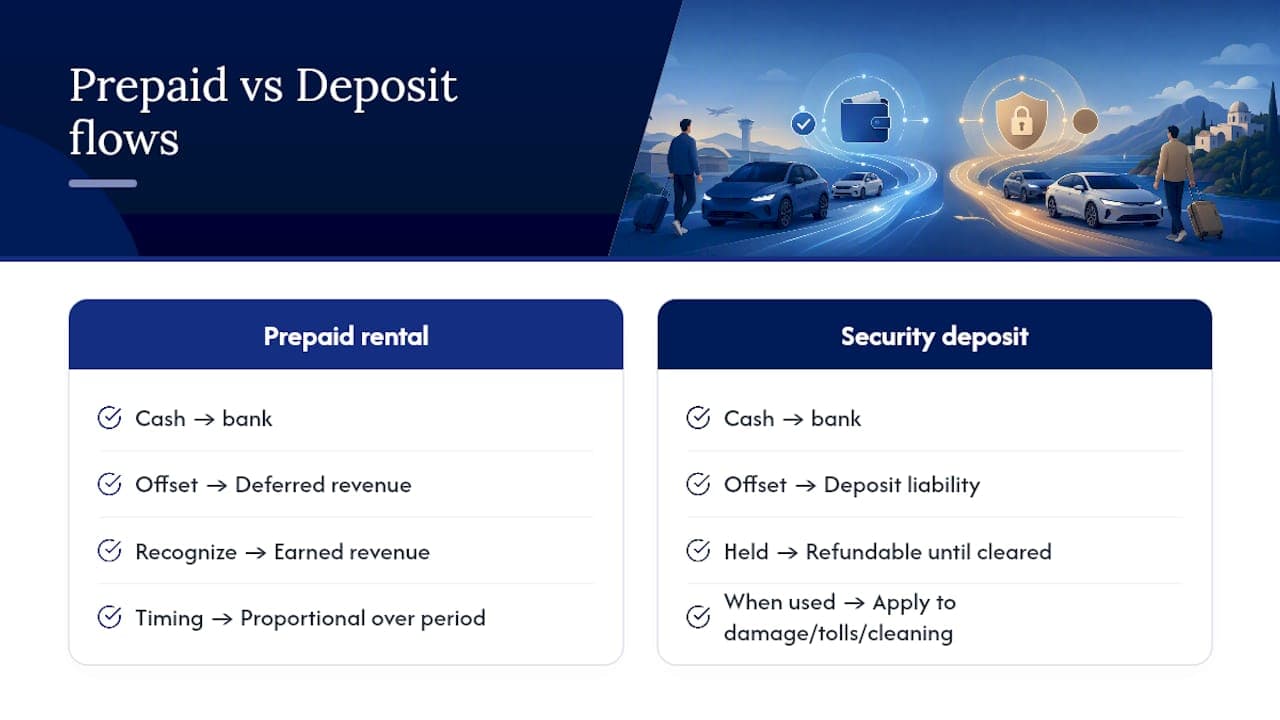
A prepaid rental is not revenue the day the customer pays. It's a liability, specifically deferred revenue, until the rental period actually occurs. Booking a two-week prepaid rental as income on day one overstates that month's revenue and understates the next, which distorts every trend line you're trying to read.
Set up a deferred revenue liability account separate from your customer deposits account. When the customer pays in advance, the cash hits your bank and the offsetting entry goes to deferred revenue, not to a rental income line. As each rental day passes, you recognize a proportional slice of that prepayment as earned revenue. For a short rental, this might happen in one entry at checkout. For a longer prepaid block, spread it across the rental period.
Security deposits work differently and need their own account entirely, separate from deferred revenue. A deposit is refundable by design, so it's a liability from the moment it's collected until you either return it or apply it against damage, an unpaid toll, or a cleaning charge. Never post a deposit directly to revenue when it's collected. When you do apply part of a deposit against a charge, that portion moves from the deposit liability account into the relevant revenue or fee account, and the remainder gets refunded and cleared from the books. Skipping this step is one of the more common reasons a rental company's balance sheet won't reconcile against its bank statement, since deposits sitting in the wrong account make your liabilities look smaller than they actually are.
Tax liabilities and accounts specific to car rental operations
Car rental businesses carry tax obligations that a standard retail chart of accounts doesn't anticipate. Most states levy a sales tax on rental transactions, and a growing number layer on a separate excise or vehicle rental tax on top of that, often collected at the county or municipal level rather than the state. Both need their own liability accounts, kept distinct from each other and from your general sales tax payable account, because the filing schedules and remitting agencies are usually different.
Set up at minimum:
- Sales tax payable for the standard state and local sales tax collected on rental charges.
- Vehicle rental excise tax payable for any local or state-specific surcharge unique to car rentals.
- Airport concession fee payable, if you operate out of an airport location, since those fees are usually collected from customers and remitted separately.
Each of these is a pass-through liability, not revenue, even though the customer pays it to you at the counter. Coding rental tax collections as income is a common error that inflates your top line and creates a real headache during a sales tax audit, since your reported revenue won't match what you actually remitted. Reconcile these liability accounts against your actual tax filings every period, not just at year-end, so a coding error gets caught while it's still a small fix.
Accounting for fleet acquisition and disposal, including trade-ins
Every vehicle you add to the fleet gets capitalized as an asset, not expensed, and depreciation is what spreads that cost across its useful life instead of hitting your P&L all at once in the month of purchase. Set up your vehicle asset account with enough detail to track acquisition cost, in-service date, and depreciation method per vehicle or per class, since you'll need that detail when you sell or trade the vehicle later.
Trade-ins complicate the entry slightly. When you trade an old vehicle toward a new purchase, you're not simply recording the cash paid. You need to remove the old vehicle's cost and accumulated depreciation from the books, record the trade-in allowance as partial payment, and capitalize the new vehicle at its full purchase price, cash paid plus trade-in value. The difference between the old vehicle's book value and the trade-in allowance you received shows up as a gain or loss on disposal, posted to that same revenue-adjacent account you use for outright vehicle sales.
Disposal without a trade-in follows a simpler version of the same logic: remove the asset and its accumulated depreciation, record the cash received, and post the difference as gain or loss on sale. Fleet managers who track depreciation schedules closely tend to have a much easier time here, since they already know a vehicle's book value going into the sale conversation. A closer look at fleet depreciation methods is worth reading if your depreciation schedule hasn't been reviewed in a while, since the method you choose affects both your monthly expense and your eventual gain or loss on every disposal.
Treatment of insurance claims and recoveries
Insurance activity touches a car rental chart of accounts in two directions, and conflating them is a common source of confusion. The first is customer-facing: when a renter damages a vehicle and their insurance, or the CDW they purchased, covers the repair, that reimbursement is an insurance recovery, not standard rental revenue. Post it to a dedicated insurance recovery account so it doesn't inflate your base rental income line.
The second direction is your own fleet insurance. When your carrier pays out on a claim for fleet vehicle damage or a total loss, that recovery also needs its own account, separate from customer-facing recoveries, since the accounting treatment differs depending on whether the vehicle was repaired or written off. A repaired vehicle nets the recovery against the repair expense. A totaled vehicle triggers a disposal entry, similar to a sale, where you remove the asset and its accumulated depreciation and record the insurance settlement as the proceeds, with any gap posted as a gain or loss.
Keep a running log tying each insurance recovery to the specific vehicle and claim number, even if your accounting software doesn't require it. When a state regulator or your own CPA asks why a particular month's repair expense looks unusually low, that detail is what lets you answer in one lookup instead of an afternoon of digging.
What a better chart of accounts actually unlocks
The real payoff of a rental-specific chart of accounts isn't cleaner books, it's better decisions. Once you can see a true per-vehicle margin, buy-versus-retain calls on aging fleet stop being guesswork. Integrated systems tend to beat spreadsheets here by a wide margin: Nomora's internal data on car rental software versus manual management points to a 312% ROI from replacing spreadsheets with automated posting. Start lean, six top-level groups, and add subaccounts only as your reporting needs actually demand them.
— Dizzy
Automate your chart of accounts instead of maintaining it by hand
Nomora replaces the manual coding that turns a good chart of accounts into a monthly chore. Instead of exporting bank data and re-tagging transactions by hand, Nomora posts rental revenue, deposit reconciliations, and payment gateway activity directly against your account structure, tagged by location or vehicle class as they happen.
That means the accounts you set up in this guide, base rental income, fuel cost recovery, depreciation, deposit liabilities, stay accurate without someone reconciling them line by line every week. Fleet managers running multiple locations get per-branch profit and loss without maintaining separate books, and GPS and telematics subscription costs post automatically instead of showing up as a mystery charge three months later. Onboarding typically happens quickly, enabling fleets still running on spreadsheets to start posting clean, coded transactions in a short time. Check the Nomora pricing page for the Starter, Business, Fleet, and Enterprise plans, or look at the car rental software overview to see how the payment and GPS integrations connect directly to the accounts you just built.
Sources
FAQ
Should fuel reimbursements count as revenue?
No. Fuel reimbursement is a cost recovery, not revenue, because you're being repaid for a cost you already covered. Post it to a dedicated fuel reimbursement or cost recovery account, separate from your base rental income lines.
How do I set up depreciation accounts for my fleet?
Create a vehicle asset account and a paired accumulated depreciation contra-asset account, then post monthly depreciation expense against both. Reviewing your depreciation method periodically matters, since the schedule you pick affects both monthly expense and your eventual gain or loss on disposal.
What are classes or locations used for in a rental chart of accounts?
Classes or locations let you tag every transaction by branch, region, or vehicle segment without creating a duplicate set of accounts for each one. This gives you a per-location profit and loss statement pulled from the same chart of accounts everyone else uses.
When should I bring in a CPA for my chart of accounts?
Bring in a CPA whenever your rental contracts include long-term leases, subscription-style pricing, or bundled financing, since those can trigger ASC 842 or ASC 606 revenue recognition timing rules. A CPA should also review your setup once at the start, even for a straightforward daily-rental business, to confirm your account structure matches how your tax filings need to be reported.
Does Nomora help maintain a chart of accounts automatically?
Nomora posts rental transactions, deposits, and vehicle-related costs directly into your account structure, tagged by location or class, instead of requiring manual re-entry. Plans start at $45 per month for Starter, with per-vehicle pricing on the Business and Fleet tiers.
Recommended