A corporate credit limit does not behave at the rental counter the way it behaves at a coffee shop. The rental company places an estimated hold on the card, that hold can grow during the trip, and the final charge can land above the limit you set. If you manage a company card program, you need to plan for the hold, not just the bill. If you run a rental business with corporate customers, you need to set credit terms that account for the same mechanics from the other side.
This guide covers both views: how holds consume a corporate limit, why spending caps are softer than they look, what to set on the card, and how a rental operator can structure corporate accounts so limits stop being a source of declines, disputes and manual follow-up.
TL;DR
- A rental company holds an estimated amount on the card at pickup, so the usable limit drops before any charge is final.
- Incremental authorizations can raise the hold during the rental, and a card cap is not a guaranteed stop on rental spend.
- Pay the final bill with the same card used at pickup, so the hold is released faster.
- Set the card limit to cover the rental estimate plus a buffer, and write the rule into your travel policy.
- Rental operators can replace card-by-card guesswork with account-level credit terms, deposit rules and automated billing.
Table of Contents
Why corporate credit limits and car rentals collide
Most corporate card limits are designed around finished transactions. A rental is different because the final amount is unknown at pickup. Fuel, tolls, extra days, damage and late returns can all change the total, so the merchant asks the card network for an estimate up front.
Visa's merchant guidance says certain merchants, including car rental companies, can obtain an estimated initial authorization when the final amount is not known. That hold is real money against your available credit, even though nothing has been billed.
For a corporate cardholder this has three practical effects:
- Available credit falls at pickup. A traveler with a modest per-card limit may be declined at dinner that same night because the rental hold is using the room.
- The hold outlasts the rental. Release depends on the merchant reversing the authorization and the issuing bank matching it.
- The final bill can exceed the hold. When it does, another authorization is requested.
The FTC lists a block placed by a hotel, rental car company or other business among the reasons a card can be declined, next to expiry and being over the limit. It also advises travelers to ask how much will be blocked and for how long. That is a good line for your travel policy.
How the hold is calculated and when it grows
There is no single national hold amount. Each rental brand sets its own rules, and they vary by location and vehicle class. One major US rental brand explains that credit card holds are typically lower than debit card deposits, but include the estimated rental charges. The same page notes that debit card deposits are commonly around $500 and can range from $200 to $850 depending on location and vehicle class.
The pieces that usually sit inside a hold:
- The estimated rental charge for the booked period, with taxes
- A security deposit or buffer for incidentals
- Add-ons chosen at the counter, such as fuel options or equipment
Incremental authorizations
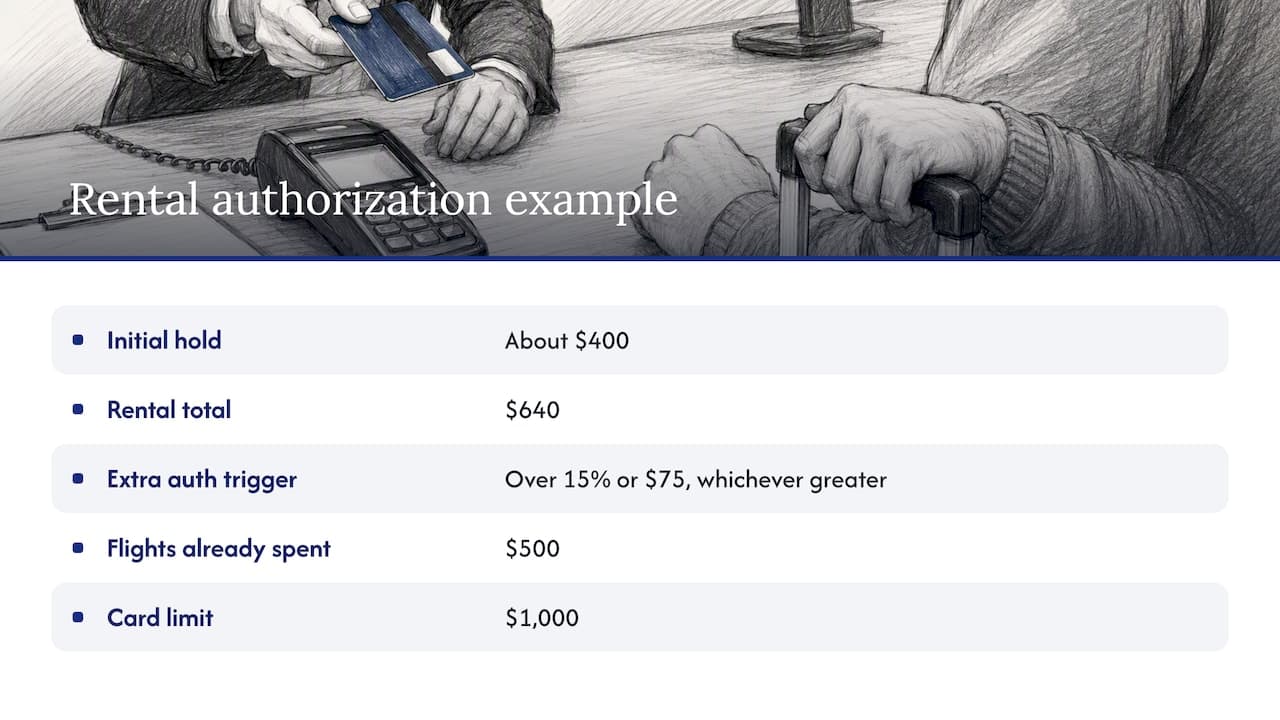
Visa's rules let the merchant top up the estimate. Per Visa's guidance, if the final amount ends up more than 15% above the total authorized, or by more than $75, whichever is greater, an additional authorization is required. Each extra authorization reduces the available credit again.
Here is a worked example with round numbers. A manager books a four-day midsize rental estimated at $400. The initial hold is about that amount. The traveler extends by two days and adds a one-way drop fee, and the bill is heading toward $640. That is more than 15% above $400 and more than $75 above it, so a further authorization is needed for the difference. The card now carries a larger hold than the one the traveler saw at the counter, and a card with a $1,000 limit and $500 already spent on flights may start declining.
Stuck holds after return
Visa's merchant best practices advise processing reversals within 24 hours of the return so the cardholder's credit is restored. When transaction data is coded incorrectly, the issuer may not be able to match the reversal to the original hold, and credit stays tied up for days. That is a merchant-side problem, but your traveler pays for it in lost purchasing power.
Why a spending limit is not a hard stop
Many finance teams assume that a $1,500 card limit means the card can never spend more than $1,500. For rentals that is not always true.
American Express's corporate card guidance warns that spending limits on employee cards are not always absolute. Some rental transactions can bypass the set restriction because of merchant policies, administrative arrangements or system considerations. An employee can therefore exceed the defined limit at the point of sale without any warning.
What this means for your controls:
- Do not treat the limit as your only control. Pair it with pre-trip approval, a maximum daily rate in policy and a review of charges after return.
- Plan for outliers. Finance should expect the occasional rental that lands above the card limit and know who reviews it.
- Use real-time visibility. Corporate card platforms let program administrators review approved and declined charges, which is how you spot a stuck or oversized rental hold early.
Setting the right limit for rental travelers
There is no universal figure, and we will not pretend one exists. Build the number from your own rental pattern.
- Pull your last 12 months of rentals. Find the average and the 90th percentile total, including extensions and fees.
- Add the hold overhead. Take the 90th percentile total and add a buffer for the security deposit and any incremental authorization.
- Add the rest of the trip. Hotels also place holds, and meals and fuel are on the same card.
- Decide who can raise the limit. Travelers stranded at a counter need a fast path to a temporary increase.
- Write it down. Put the rules in your travel policy rather than relying on memory.
For travelers, three habits cut the damage:
- Ask the counter agent for the hold amount and the release timeline before signing.
- Use the same card to pick up and return. The FTC's guidance is that paying the final bill with a different card can leave the first hold in place for up to 15 days, while using the same card typically releases it within a day or two.
- Keep a second payment method for emergencies, so a hold on one card does not strand the trip.
What about debit cards and employee-owned cards?
Debit cards usually trigger stricter conditions and larger deposits, as the rental brand's published policy above shows. Another one of the big US brands says the renter must present a driver's license and a valid major credit card or debit card in the renter's own name, with debit usage subject to additional requirements. If your company card shows only the business name, check the supplier's rules before the trip, because the name usually has to match the renter.
The operator's side: credit limits on corporate accounts
Everything above is the renter's problem. If you run a rental company, the same mechanics create work for your staff: declines at the counter, disputed holds, refund questions and invoices that go unpaid. Corporate customers expect a smoother path than walk-in renters, and your terms decide whether they get it.
A clean corporate account structure usually answers five questions up front:
| Question | What to define |
|---|
| Who pays? | Company card on file, direct invoice or both |
| What is the credit limit? | Total exposure across all open rentals for the account |
| What is held at pickup? | Estimated rental, fixed deposit or preauthorization only |
| Who can rent? | Named drivers or approved employees |
| What triggers a review? | Overdue invoices, extensions, damage or late returns |
We cover the contract side in more detail in our guide to corporate rental agreement structure, and the invoicing side in the software checklist for corporate billing.
Card holds versus deposits
A hold and a deposit look similar to the customer but behave differently for you. A hold is released by reversal, and a deposit is collected and refunded. If a hold is placed and reversed correctly, there is little refund work. If you collect deposits as charges, every return creates a refund to process. Another big rental brand states that the branch refunds the deposit after the vehicle is returned, with timing depending on payment method.
Our pieces on preauthorization versus deposits, how security deposits work and the types of vehicle rental deposits go through the trade-offs. In short, preauthorization limits refund handling, but it ties up the customer's credit, which matters most for the corporate cardholders this article is about.
Limits you can control
You cannot change a customer's card limit. You can control these:
- The size of the hold. Base it on the booked rental and vehicle class, not a blanket figure. A luxury or specialty vehicle may justify a larger hold, and the corporate contract should say so.
- The timing of the release. Reverse authorizations promptly after return and settle on the same card used at pickup.
- Extensions. Tell the customer when an extension will trigger another authorization.
- Late return rules. Clear clauses reduce chargebacks. See our late return policy clauses.
- Account-level exposure. Set a ceiling for unpaid invoices per corporate customer and review it on a schedule.
A perspective from Nomora: the limit is a data problem
We build rental management software, and the same pattern shows up in the operations we see described: credit limit trouble is rarely about the limit itself. It is about information arriving too late. The counter agent does not know the account's open balance. The finance team learns about the oversized rental after return. The customer discovers the hold when the card declines.
Software that works as the central nervous system of a rental operation closes those gaps. When reservations, contracts, payments and customer records live in one place, a corporate account's exposure is visible when the booking is made, not at month end. Conflict-free bookings and automated contract generation mean the terms the customer agreed to are the terms that get applied.
Our view, in three points:
- Decide credit terms per account, not per counter. Staff should not improvise holds.
- Automate the repetitive parts. Deposit handling, reminders and reconciliation are where manual errors and refund queues come from. See how deposit automation cuts that work.
- Show the customer the number. A renter who knows the hold amount and release timeline calls support less.
We also think corporate customers should be shown that the operator understands their side. A fleet manager who has seen an employee declined at the counter will remember which supplier explained the hold in advance.
— Dizzy
What to put in a corporate rental policy
Whether you are the buyer or the supplier, a short written policy prevents most disputes. A workable version covers:
- Payment method: which card or account pays, and whether it must match the renter's name
- Hold disclosure: the estimated hold at pickup and how it can increase
- Release timeline: when the supplier will reverse the hold and what the customer should do if it lingers
- Extension rules: who approves and how additional authorizations are handled
- Insurance: what the card or the company policy covers. The FTC notes that rental companies offer coverage for a fee, but you may already be covered by your own car or homeowner's insurance. Card-based coverage is also governed by its own terms, for example the American Express car rental loss and damage plan lists who counts as the primary renter. Read the specific plan for your card before relying on it, and ask your insurance broker or card issuer about gaps.
- Escalation: a named contact for stuck holds and declines
For the supplier side, our guide to rental security methods and the overview of corporate vehicle rental solutions help you decide which controls fit your fleet.
Where Nomora fits
If you rent to businesses and still track credit exposure in spreadsheets, this is the kind of work our platform replaces. Nomora handles reservations, fleet management with GPS tracking, contract generation, automated car rental payments and customer data in one cloud system, and we aim to have you operational within 24 to 48 hours.
Every plan includes all features. The published plans are Starter at €45 per month, Business at €2.80 per vehicle per month and Fleet at €2.20 per vehicle per month. Enterprise has no published price, and payment processing fees are not published either. See the current details on the pricing page, or browse use cases by business type to see how small operators, luxury and specialty renters and corporate fleet managers use the platform.
Common mistakes to avoid
- Setting the card limit equal to the expected bill. The hold and incremental authorizations need headroom.
- Assuming the cap blocks overspend. Rentals can bypass it, so review charges after the fact.
- Switching cards at return. It can leave the first hold active far longer than necessary.
- Skipping the hold question at the counter. Ask the amount and the duration every time.
- Using one flat hold for every vehicle. It over-holds economy cars and under-protects premium ones.
- Reversing holds late. Visa's guidance is to process reversals within 24 hours of return.
FAQ
Can a corporate card exceed its credit limit on a car rental?
It can. Because rental holds are estimated and can increase, and because some rental transactions may bypass employee spending restrictions, a charge can pass through above the limit you set. Treat the limit as one control among several and review rental charges after each trip.
Why was my card declined after I returned the car?
The most likely cause is a hold that has not been released. The rental company has to reverse the authorization, and your bank has to match it. Paying with a different card than the one used at pickup can also leave the first hold in place for up to 15 days. Call the rental branch first, then your card issuer.
How much will a rental company hold on a corporate credit card?
It varies by brand, location and vehicle class. One major brand says credit card holds are generally lower than debit card deposits and include the estimated rental charges, while debit deposits are commonly around $500. Ask for the exact amount and release timing at the counter.
As a rental operator, how can I reduce disputes over holds?
Disclose the hold amount and the release timeline in the booking and the contract. Reverse authorizations promptly, settle on the same card used at pickup and set a clear account-level credit limit for each corporate customer. Automating deposits and billing removes most of the manual steps where errors occur.
Sources
Recommended