What does a corporate rental agreement structure actually include?
Each clause in a corporate vehicle rental agreement maps directly to an operational field in your rental software. Getting the structure right up front prevents disputes, gaps in liability coverage, and billing confusion later.
Parties and authority go beyond listing names. The company is the tenant of record; the individual occupying or driving the vehicle is a licensee. A Certification and Appointment of Company Authority confirms the signer can legally bind the business, which protects you if a dispute arises over whether the commitment was authorized.
Term and occupancy rotation define how long the agreement runs and who can use the vehicles during that period. For fleet managers, this is where multi-driver language matters most. Occupancy-rotation clauses prevent liability gaps when multiple employees cycle through the same vehicle during a single contract term.

Scope of use sets the boundaries: vehicle class, authorized driver list, mileage caps, and geographic limits. These fields feed directly into your software's booking and telematics configuration.
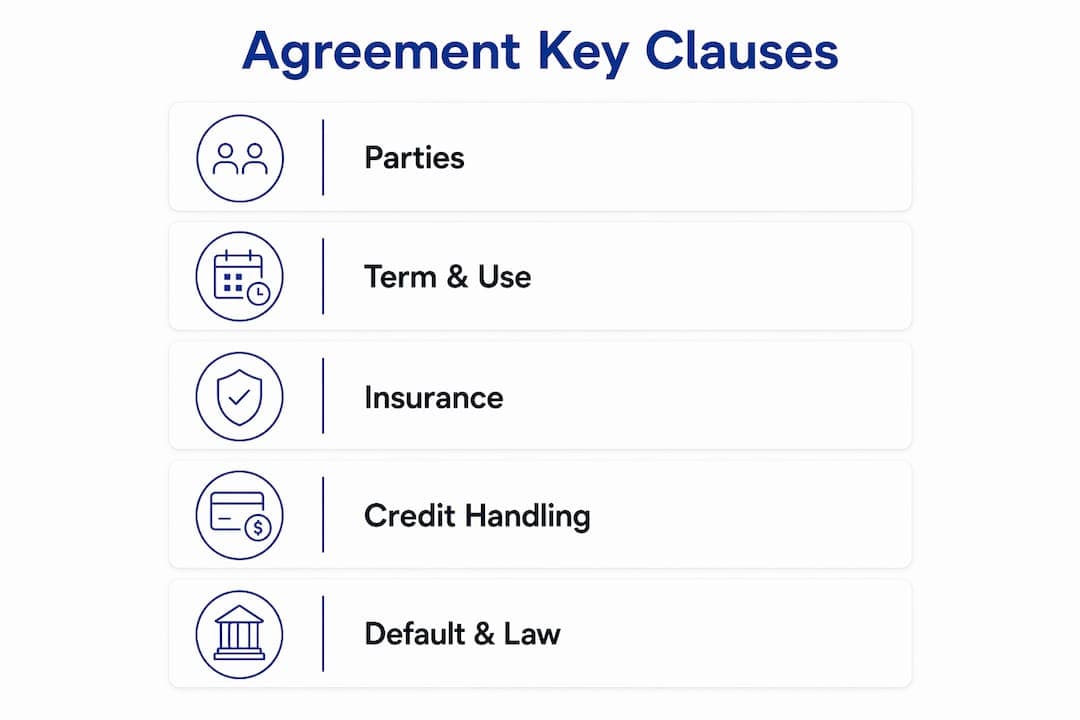
Insurance, liability, and indemnity specify who pays for damage during driver rotations, what minimum coverage the corporate client must carry, and how indemnity flows between parties. Maintenance responsibilities and wear-and-tear standards belong here too. Clear fleet management policies reduce disputes at vehicle return.
Security deposit and credit handling leverage the company's EIN rather than a personal credit score. You may still require a personal guarantee from a company officer, particularly for newer or smaller businesses.
Default, remedies, and governing law set cure periods, collection paths, and the jurisdiction for disputes. For U.S.-based operators, specifying the governing state and a preferred dispute-resolution method (arbitration vs. litigation) avoids ambiguity.
Pro Tip: Always collect the Certificate of Authority, EIN verification, and a Certificate of Insurance (COI) before activating any corporate account in your software. Shifting liability to the organization only works if those documents are on file.
Which billing model fits your corporate fleet accounts?
Billing structure is where corporate agreements diverge most from standard retail rentals. Three models dominate the market.
| Billing Model | What It Includes | Best For |
|---|
| All-inclusive monthly | Base rate + maintenance pass-throughs, insurance, GPS fees in one invoice | Clients who want predictable monthly costs |
| Itemized invoicing | Per-vehicle base rate + mileage, fuel, damage, and add-ons billed separately | High-mileage or variable-use accounts |
| Hybrid | Fixed monthly base + usage-based surcharges above a threshold | Mixed fleets with predictable core use and variable overflow |
All-inclusive monthly billing simplifies corporate accounting because the client's finance team sees one line item per vehicle or per fleet. It bundles rent, maintenance pass-throughs, insurance contributions, and GPS fees into a single payment. The tradeoff is that your software must correctly allocate those bundled costs internally so your own accounting stays clean.
Itemized invoicing gives you more granular recovery of variable costs but increases invoice complexity. It works well for accounts where mileage swings significantly month to month.
The billing model you choose affects deposit sizing, invoicing cadence, and how you configure recurring billing in your software. In Nomora, each model maps to a distinct invoice template: line-item tags for itemized accounts, a single recurring charge for all-inclusive, and a base-plus-surcharge template for hybrid arrangements.
- Set recurring billing schedules to auto-generate on the same day each billing cycle
- Tag each line item (mileage, fuel, GPS) so accounts receivable reports stay sortable
- Tie deposit amounts to the billing model: all-inclusive accounts typically require one to two months' bundled rate as a deposit
Which contract clauses should you prioritize in negotiations?
Not every clause carries equal weight. These are the ones that move the needle financially and operationally.
Early termination is typically the most negotiated point in any corporate vehicle rental agreement. Early termination clauses protect your revenue when a client's project ends early while giving the company the flexibility it needs. A written notice window of about a month is the standard starting point; shorter windows should come with a financial penalty equal to at least one billing cycle.
Appointed representative language reduces communication friction on both sides. Designating a single corporate contact for all notices, billing disputes, and vehicle handoffs means you are never chasing multiple employees for approvals. Define a substitute procedure for when that person is unavailable.
Occupancy rotation and multi-driver liability determine who is financially responsible for damage when drivers change. Tie this clause to your software's check-in/check-out logs so each driver handoff is timestamped and auditable.
Guarantees and credit handling: for established corporations, EIN-based credit is usually sufficient. For smaller or newer entities, a personal guarantee from a company officer adds a recovery path if the business dissolves or defaults.
Default and cure periods: set a realistic cure window (typically 5–10 business days for payment defaults) and specify your remedies clearly, including vehicle recovery rights.
Pro Tip: When a corporate client presents their own standard-form contract, compare it against your requirements before accepting any language. Corporate standard forms are drafted to favor the client's risk profile, not yours.
Industry note: Corporate clients often rotate employees through vehicles on project cycles shorter than the lease term. Without explicit rotation language, you may have no documented basis for attributing damage to a specific driver.
How do you implement corporate agreements in rental-management software?
Your rental-management software is the central nervous system of your corporate account operations. Getting the configuration right at setup saves hours of manual reconciliation later.
Contract template setup: build templates with placeholder fields for the appointed representative's name and contact, EIN, vehicle list, mileage limits, and conditional clauses (early termination, occupancy rotation). Digital rental agreements with e-signature support eliminate paper handling and create a timestamped audit trail.
Billing template configuration: create separate templates for each billing model. Map line-item tags to your chart of accounts so exports to accounting software require no manual cleanup.
Corporate account onboarding workflow: configure a document-upload step that requires the Certificate of Authority, COI, and EIN verification before the account activates. Role-based approvals ensure a manager signs off before any vehicle is released.
Reporting and reconciliation: set up accounts receivable aging reports and contract utilization dashboards. These tell you which corporate accounts are approaching their mileage caps or nearing their term end, so you can proactively reach out about renewals or upgrades.
- Connect GPS/telematics integrations to flag mileage overages in real time
- Automate COI renewal reminders so you are never holding an uninsured vehicle
- Export payment data to your accounting platform on a defined schedule
Pro Tip: Test every corporate account workflow end-to-end with a dummy booking before your first live client. Catching a misconfigured billing template in testing costs minutes; catching it on a live invoice costs credibility.
Sample clause language and a contract checklist
Use these snippets as starting points. Have an attorney review and adapt them for your jurisdiction before finalizing.
Appointed Representative clause:
"The Company designates [Name, Title] as its Appointed Representative for all notices, billing communications, and vehicle handoff authorizations under this Agreement. Notices delivered to the Appointed Representative shall be deemed delivered to the Company. The Company shall notify Provider in writing within 48 hours of any change in Appointed Representative."
Early Termination clause:
"Either party may terminate this Agreement upon 30 days' prior written notice to the other party. If the Company terminates prior to the end of the then-current term, the Company shall pay a termination fee equal to one full billing cycle at the applicable monthly rate."
All-inclusive billing clause:
"The monthly rate of $[amount] constitutes full payment for vehicle use, scheduled maintenance pass-throughs, GPS service fees, and liability insurance contributions as specified in Exhibit A. No additional charges shall apply except for excess mileage, damage beyond normal wear-and-tear, and fuel replenishment."
Occupancy rotation clause:
"The Company may rotate authorized drivers during the term provided each driver is listed on the Company's approved driver schedule and holds a valid license. The Company remains liable for all damage occurring during any driver's use period. Provider shall document vehicle condition at each driver handoff."
Insurance and indemnity snippet:
"The Company shall maintain commercial auto liability coverage of not less than $[amount] per occurrence and shall name Provider as an additional insured. The Company shall indemnify and hold Provider harmless from claims arising from the Company's use of the vehicles."
Corporate account setup checklist
Documents to collect:
- Certificate of Authority (confirms signer can bind the business)
- EIN verification
- Certificate of Insurance (COI) with Provider named as additional insured
- Approved driver list with license copies
Software configuration steps:
- Build contract template with all placeholder fields
- Configure billing template (all-inclusive, itemized, or hybrid)
- Set up document-upload and approval workflow
- Enable automated COI renewal reminders
- Connect GPS/telematics integration
Operational handoff tasks:
- Conduct vehicle condition inspection and photograph at handoff
- Confirm appointed representative contact details are active in the system
- Schedule first invoice generation and confirm payment method
A vehicle rental checklist for your fleet type can supplement these steps with size-specific considerations.
Pro Tip: Never finalize contract language without a legal review. Jurisdictional nuances in U.S. commercial vehicle law vary by state, and a single clause gap can expose you to significant liability.
How long does corporate account setup take, and what does it cost?
Setting realistic expectations for your team prevents bottlenecks when onboarding your first corporate clients.
Typical timeline:
- Account onboarding and document verification: 1–5 business days
- Contract template development and legal review: 1–2 weeks
- Software configuration and testing: 2–5 business days
Legal review is the longest variable. Attorney fees for reviewing or drafting a commercial vehicle rental agreement vary widely by market and complexity; budget accordingly and treat it as a one-time investment that protects every subsequent corporate account.
Recurring overhead includes monthly invoice generation, COI renewal verification, and mileage reconciliation. Without automation, these tasks add up quickly across a multi-account corporate portfolio.
Automation cuts that overhead substantially. Template-driven contract generation and recurring billing schedules reduce per-account administrative time once the initial setup is complete. Nomora's onboarding process is designed to get new accounts live within 24–48 hours after configuration, which means your first corporate client can be active well within the two-week window above.
Setup note: The software configuration phase (2–5 business days) assumes your billing templates and contract placeholders are already defined. Completing the checklist in the previous section before you open the software speeds this phase considerably.
Key Takeaways
A well-structured corporate rental agreement names the business as tenant, designates an appointed representative, and maps every key clause to a software field so billing, liability, and driver rotation are auditable from day one.
| Point | Details |
|---|
| EIN replaces personal credit | Use the company's EIN for credit verification; collect a personal guarantee for smaller or newer entities. |
| Appointed representative is non-negotiable | Designate one corporate contact for all notices and billing to prevent communication gaps. |
| Billing model drives software setup | Choose all-inclusive, itemized, or hybrid billing before building invoice templates in your platform. |
| Early termination needs a financial backstop | A 30-day notice window plus a one-cycle termination fee protects revenue when projects end early. |
| Nomora automates the full workflow | From contract generation and document upload to recurring invoicing and GPS integration, Nomora handles corporate account operations end to end. |
The clause most managers underestimate
The appointed representative clause gets less attention than early termination or billing, but it causes more day-to-day friction when it is missing or vague. When a corporate client rotates employees through vehicles, you can end up with three different people claiming authority to approve an upgrade, dispute a damage charge, or authorize an extension. None of them are wrong from their own perspective. The contract just never said who was right.
The same logic applies to occupancy rotation. Managers often assume the company's general liability covers everything. It usually does not cover the gap between Driver A returning a vehicle and Driver B picking it up if no inspection was logged. That gap is where damage claims go to die.
The fix is not complicated: one named representative, one documented handoff per driver, and a software workflow that enforces both. What makes it hard is that corporate clients push back on the representative clause because it creates accountability they would rather keep diffuse. Hold the line. The clause protects them too when an unauthorized employee makes a commitment the company did not sanction.
Nomora handles the operational side of corporate rental agreements
Corporate accounts generate more revenue per relationship than retail rentals, but they also require more structured administration. Nomora gives vehicle rental managers the tools to handle that administration without adding headcount.
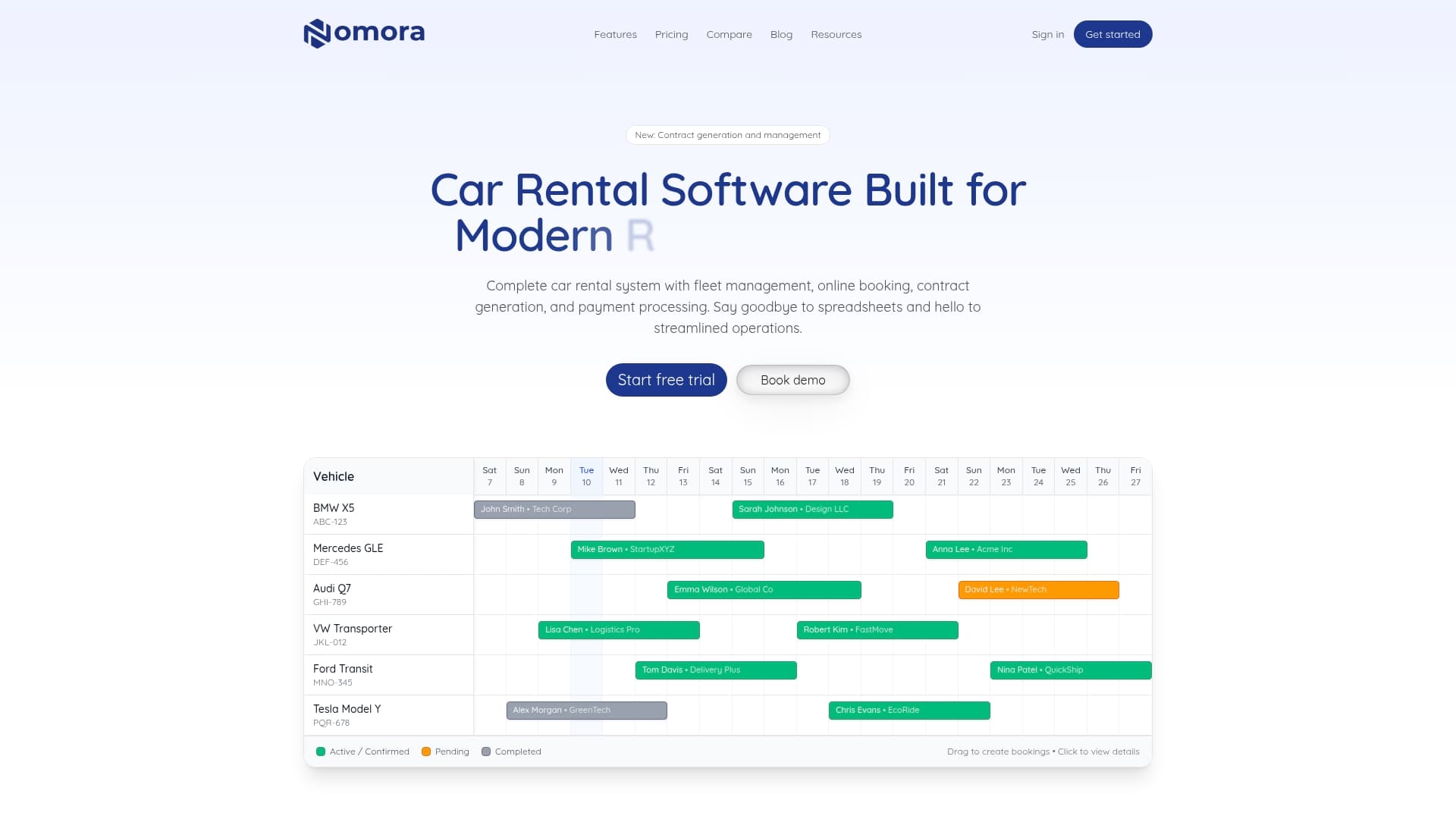
The platform's contract template engine supports appointed representative fields, EIN capture, conditional clauses, and e-signature collection in a single workflow. Billing templates cover all-inclusive, itemized, and hybrid models with automated recurring invoices and line-item tagging. Document upload and approval workflows enforce COI and Certificate of Authority collection before any account goes live. GPS and telematics integrations feed mileage data directly into invoices, so overage charges calculate automatically. For managers evaluating corporate vehicle rental solutions, Nomora's use cases page shows exactly how these features map to real fleet operations. Book a demo to see the corporate account workflow configured for your fleet size.
Useful sources and further reading
The following sources informed the guidance in this article. Review them for additional clause language and operational context, and consult a licensed attorney for jurisdiction-specific advice before finalizing any agreement.
- The Professional Guide to Corporate Housing Lease Agreements — Detroit Furnished Rentals: billing structures, EIN usage, and average stay benchmarks
- Renting to a Corporation: Key Considerations for Property Managers — PM Law Solutions: appointed representative language and Certification of Authority guidance
- Corporate Let: Pricing and Contracts — GuestReady: occupancy rotation clauses and multi-driver liability
- What Does Corporate Lease Mean in Real Estate? — Bay Management Group: negotiating against corporate standard-form contracts
- What Is a Corporate Lease? — Travelers Haven: definitional framework for corporate vs. personal leases
This article provides general operational and informational guidance. It is not legal advice. Consult a licensed attorney in your state to review and finalize any corporate rental agreement language for your specific situation.
Recommended