TL;DR:
- Effective rental security requires understanding applicable risks, implementing documented processes, and maintaining ongoing compliance.
- A strong security architecture, including optimized payment workflows and trained staff, is essential for protecting assets and customer data.
Running a car rental business means you are simultaneously managing physical assets worth hundreds of thousands of dollars, processing sensitive payment data, and verifying the identities of strangers who drive your vehicles away. This rental security methods guide exists because the risks sitting at that intersection, vehicle theft, payment fraud, identity misuse, and data breaches, are growing more sophisticated every year. Small and medium rental operators often bear the same compliance obligations as large chains but with far leaner teams. The steps ahead will give you a practical, regulation-aligned framework to protect your fleet, your customers, and your business.
Table of Contents
Key Takeaways
| Point | Details |
|---|
| Comprehensive security approach | Effective rental security combines vehicle protection, customer verification, data compliance, and staff training. |
| Plan before action | Documenting obligations and assets ensures security measures align with legal requirements and business needs. |
| Payment processing design matters | Outsourcing card data handling reduces PCI compliance complexity and risk. |
| Operational consistency is key | Daily use of checklists and photo inspections protects assets and supports dispute resolution. |
| Sustain security over time | Ongoing audits, training refreshers, and documented vulnerability scans maintain effective protection. |
Understanding your rental security requirements and risks
Before you deploy any tools or write any policies, you need a clear picture of what you are actually protecting against. Rental security is not a single discipline. It spans vehicle protection, customer data handling, payment processing, and counter-terrorism awareness, each with its own regulatory expectations.
In the UK, the RVSS code of practice provides a government-backed benchmark. The UK RVSS code of practice mandates counter-terrorism, fraud prevention, and data protection as key rental vehicle security elements. That means your obligations extend well beyond fitting a GPS tracker. You are expected to have documented security plans, trained staff, identity verification procedures, and active engagement with law enforcement channels.
On the payment side, PCI DSS (Payment Card Industry Data Security Standard) is the governing framework for how you handle card transactions. The compliance burden you face depends heavily on your payment architecture. PCI DSS SAQ eligibility depends on how card payments are handled, which directly influences how much documentation and testing you must complete each year.
Key risk categories for rental businesses
- Vehicle theft and unauthorized use including misuse in criminal or terrorist acts
- Identity and document fraud at the point of rental or online booking
- Payment fraud through stolen card details or chargebacks
- Data breaches exposing customer personal information stored in your systems
- Operational disputes around vehicle condition and damage liability
| Risk category | Primary impact | Regulatory reference |
|---|
| Vehicle misuse | Asset loss, liability exposure | RVSS code of practice |
| Identity fraud | Financial loss, reputational damage | RVSS identity verification requirements |
| Payment fraud | Financial loss, chargeback costs | PCI DSS compliance |
| Data breach | Legal penalties, customer trust loss | GDPR, data protection law |
| Damage disputes | Revenue loss, legal costs | Internal inspection policies |
Pro Tip: Many operators treat these risk categories as separate problems. They are not. A single fraudulent rental can involve a stolen identity, a cloned card, and a stolen vehicle all at once. Your fraud prevention strategies need to address them as interconnected threats.
With the security environment clear, let's prepare your business to meet these requirements effectively.
Preparing your rental business for robust security
Good security does not start with buying software or installing cameras. It starts on paper. NIST advises small businesses to establish documented cybersecurity plans covering legal obligations and critical assets before deploying any tools. That principle applies directly to rental operations, where the variety of assets and data types means a generic checklist will not cut it.
Steps to build your security foundation
-
Document your legal and regulatory obligations. List every requirement that applies to your business, RVSS, PCI DSS, GDPR, and any local licensing conditions. Put names and deadlines against each one.
-
Identify your critical assets. Vehicles are the obvious entry, but your list should also include customer identity documents, payment card data, booking records, and staff access credentials.
-
Design your payment architecture deliberately. PCI SAQ eligibility is optimized by routing card transactions through a validated third-party payment processor, keeping raw card data off your own systems entirely. This can reduce you from a complex SAQ D questionnaire down to a much simpler SAQ A.
-
Write a security delivery plan. This document assigns responsibility for each security measure, sets a timeline for implementation, and creates a review schedule. It is also what you would show a regulator or insurer if questioned.
-
Audit your current staff knowledge. Before training, find out what your team actually knows about fraud indicators, data handling, and suspicious behavior reporting. The gaps will shape your training program.
Staff training priorities
Your team is both your most important security asset and your most common vulnerability. Training should cover:
- Counter-terrorism awareness: Recognizing unusual rental patterns, cash-only payment pressure, or requests for large commercial vehicles with vague purposes
- Fraud detection: Identifying mismatched ID documents, inconsistent customer behavior, or card payment anomalies
- Data protection: Understanding what customer data can and cannot be retained, how to store it, and what to do in a breach scenario
- Escalation procedures: Knowing exactly who to call, whether that is a manager, law enforcement, or a payment processor's fraud team
| Training topic | Delivery method | Recommended frequency |
|---|
| Counter-terrorism awareness | In-person or video module | Annually, plus on hire |
| Fraud detection | Scenario-based exercises | Every 6 months |
| Data protection | Policy review and quiz | Annually |
| Escalation procedures | Role-play drills | Quarterly |
Pro Tip: Use your rental fleet security checklist as the backbone of staff training. When staff practice the checklist in real handover scenarios, security behaviors become routine rather than reactive.
Once prepared, it's time to put practical security methods into action in daily operations.
Executing effective operational security methods
Day-to-day execution is where security plans either hold up or fall apart. This section covers the specific actions that protect your vehicles, your payment environment, and your customers at every transaction point.

Identity verification at vehicle handover
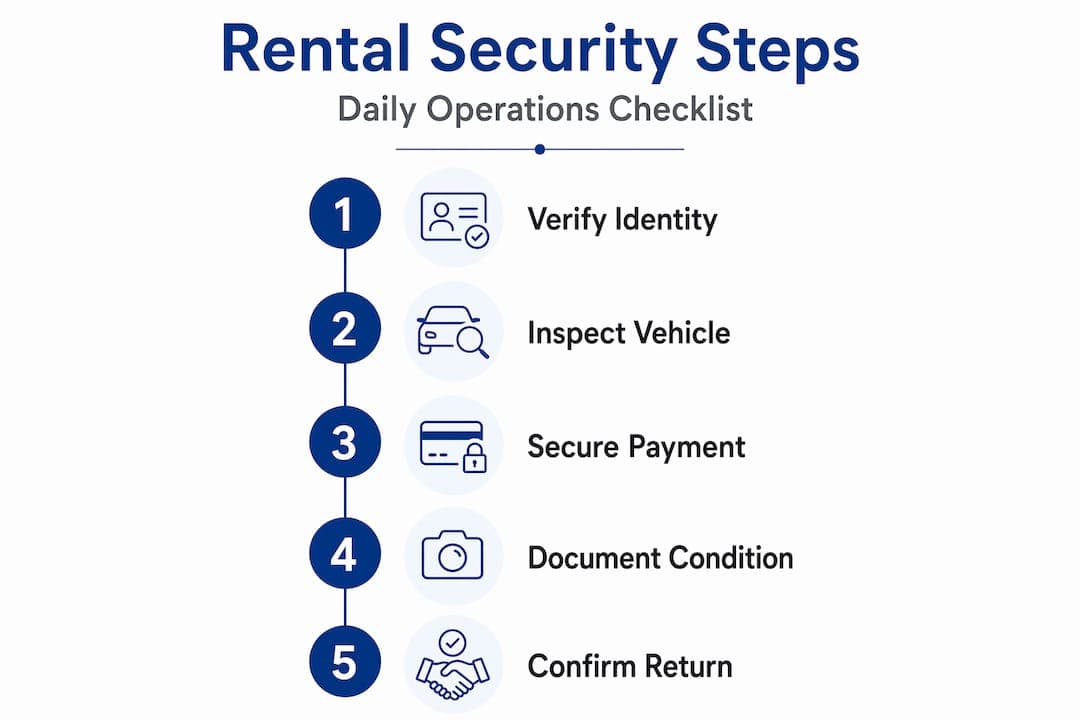
The RVSS code specifies identity verification, security technology installation, and staff vigilance as core methods for mitigating rental risks. Practically, this means:
- Check a valid, unexpired government-issued photo ID against the person standing in front of you. Do not rely solely on online pre-verification.
- Cross-reference the name on the ID with the payment card being used.
- For commercial vehicle rentals, apply enhanced checks including business verification and the purpose of use.
- Record the verification step in your rental management system with a timestamp.
Vehicle security technology
- Immobilizers are a legal requirement in many jurisdictions and a baseline deterrent
- GPS tracking devices allow real-time location monitoring and recovery support if a vehicle is stolen or overdue
- Telematics can flag abnormal usage patterns, high-speed driving outside permitted zones, or ignition activity at odd hours
Payment security in practice
Accept electronic payments only, processed through a PCI-validated third party. Never enter card numbers manually into a system that stores them. If a customer insists on cash for a large rental, treat that as a risk indicator and apply additional identity verification.
Vehicle condition documentation
Photo documentation at vehicle handover and return reduces disputes and strengthens your position in incident response. Your process should be:
- Photograph all four sides of the vehicle plus the interior before rental
- Timestamp and attach photos to the digital rental agreement
- Repeat the same process at return
- Store records against the customer booking for a minimum period aligned with your legal obligations
| Security method | Protects against | Required by |
|---|
| Identity verification | Fraud, misuse | RVSS code |
| GPS tracking | Theft, overdue returns | Best practice |
| Payment via validated third party | Card fraud, PCI breach | PCI DSS |
| Timestamped photo documentation | Damage disputes | Internal policy |
| Staff vigilance reporting | Terrorism, criminal misuse | RVSS code |
Pro Tip: Review your vehicle inspection practices and your digital rental agreements as a paired process. A thorough inspection only protects you if it is captured in a signed, timestamped document the customer has acknowledged.
After implementing these procedures, regular verification and compliance checks maintain security over time.
Verifying and maintaining ongoing rental security compliance
A security plan that you wrote once and never reviewed is not a security plan. It is a liability. Ongoing verification is what separates businesses that stay protected from those that drift into exposure.
What ongoing compliance actually requires
PCI DSS SAQ D requires quarterly external vulnerability scans with documented, auditable results. Even if you are on a simpler SAQ, maintaining evidence of your compliance activities is essential if you ever face a dispute or investigation.
NIST recommends ongoing cybersecurity culture development supported by documentation updates and regular training refreshers, not just an annual policy sign-off.
Ongoing compliance checklist
- Review and update your security delivery plan annually, or immediately after any significant operational change such as a new payment provider or a breach incident
- Conduct quarterly external vulnerability scans if your PCI tier requires it, and keep the reports on file
- Refresh staff training every six months on fraud indicators and every twelve months on data protection and counter-terrorism awareness
- Periodically audit your identity verification processes to confirm staff are following documented procedures and not cutting corners under time pressure
- Log all security incidents, even minor ones, in a centralized record that captures what happened, what was done, and what was changed as a result
Building a continuous improvement cycle
- Record: Log every incident, near miss, and compliance activity
- Review: Monthly check of fraud indicators and fraud prevention audits against booking patterns
- Refresh: Update policies and retrain staff when threats evolve or regulations change
- Report: Summarize security performance for management quarterly
Compliance is not a destination. It is the accumulation of daily, documented decisions that hold up under scrutiny. The rental businesses with the cleanest records are not the ones with the most expensive tools. They are the ones with the most consistent habits.
Pro Tip: Link your ongoing security checklists directly to staff sign-off sheets. When each checklist completion requires a signature or digital acknowledgment, you create an automatic audit trail without any extra administrative effort.
Understanding ongoing compliance requirements sets the stage for our unique perspective on rental security strategies.
Why many rental security strategies fall short and how to truly secure your rental business
Here is the uncomfortable reality most security guides skip: the majority of small and medium rental operators do not have a security problem. They have a security architecture problem. The tools they use are often fine. The gap is in how those tools connect to each other and to the people using them.
The single most overlooked factor in a rental security methods guide is payment architecture design. PCI scope design impacts ongoing compliance complexity and cost in ways that most operators never calculate when they set up their payment process. An operator who chose a payment provider years ago without thinking about SAQ type may be doing ten times more compliance work than necessary. Switching to a fully outsourced payment flow is often a half-day technical task, but it can eliminate months of annual compliance overhead.
The second failure is reactive thinking. Many operators have security procedures, but those procedures only exist in people's heads. Skipping planning and documentation leads directly to misaligned security investments. You end up spending money on cameras in the lot while leaving your customer database accessible to anyone with a staff login and no password policy.
The third failure is treating staff training as a checkbox. A team that completed a counter-terrorism video module eighteen months ago and never revisited it is not a trained team. It is a team with a signed certificate and no retained knowledge. Critical fraud prevention insights only translate into prevented fraud when staff internalize them and practice them in real scenarios.
The businesses that genuinely protect themselves combine three things: documented processes that require no memory to follow, payment architectures designed to minimize the data they ever touch, and staff who treat security as part of the job rather than an annual obligation. Technology is the enabler, not the solution. Think of your rental management software as the central nervous system of your operation: it connects every element, but it cannot substitute for the people and policies that give it direction. Use strategic rental checklists as living documents that evolve with your business, not static PDFs that gather digital dust.
Secure your car rental business with Nomora's software solutions
Knowing what best rental security practices look like is one thing. Having the right system to execute them daily is another. Nomora was built specifically for rental businesses that need to manage security, compliance, and operations without a dedicated IT or compliance team.
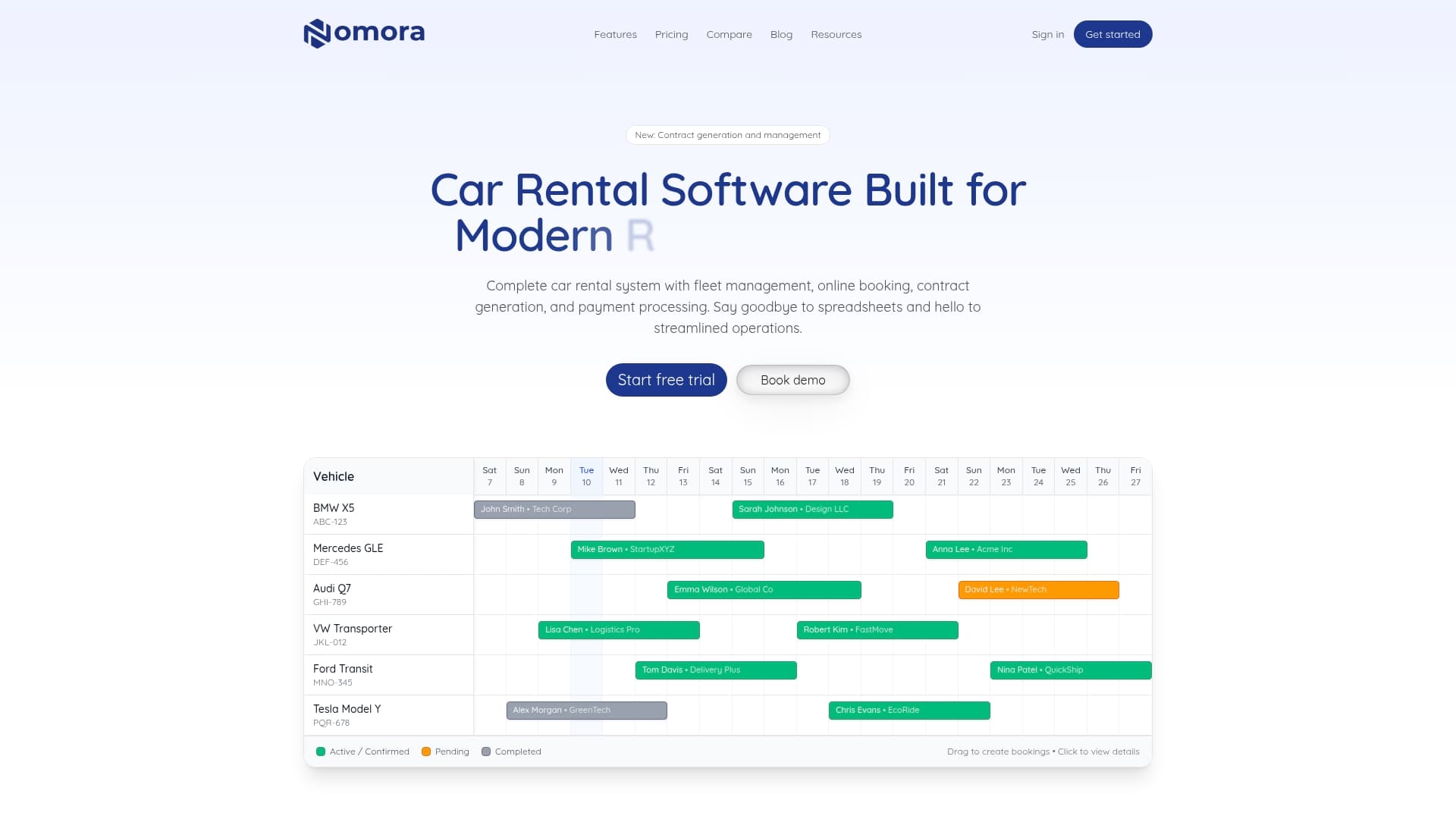
Nomora's platform acts as the operational backbone connecting your booking management, payment processing, vehicle inspections, and customer records in one place. Automated rental payments route transactions through PCI-validated processors, keeping card data off your systems and reducing your compliance scope. Built-in digital agreements and timestamped vehicle inspections create the auditable documentation your security delivery plan requires. Conflict-free booking management prevents double bookings and gives you real-time visibility across your fleet. Explore the full range of Nomora's use cases to see how the platform supports your security methods from day one.
Frequently asked questions
What is the Rental Vehicle Security Scheme (RVSS)?
The RVSS is a UK government-backed code of practice that sets security standards for rental vehicle businesses, requiring staff training, identity checks, security plans, and data protection measures to reduce vehicle misuse in criminal and terrorist acts.
How can rental businesses reduce PCI DSS compliance burden?
By routing all card transactions through a PCI-validated third-party processor, rental businesses can qualify for simpler SAQ A requirements because they never store or transmit raw cardholder data on their own systems, cutting documentation and testing requirements significantly.
What ongoing verification practices improve rental security?
Regular tracking of external vulnerability scans, periodic staff retraining on fraud detection and data protection, and maintaining auditable records of identity verification procedures are the core habits that keep security standards from drifting. Quarterly vulnerability scans with documented results are required under certain PCI tiers and serve as a useful audit baseline regardless of your exact SAQ type.
Recommended
Ready to streamline your car rental business?
Book 30 minutes with the founder. We set up everything in this guide on your own vehicles, and migrate you out of Excel for free.