The most reliable approach combines four elements: a clear contract mileage policy, dependable odometer or telematics evidence, a transparent billing formula, and a documented consent process for any location or vehicle data we collect. Together, these reduce disputes, support fair and auditable charges, and keep enforcement defensible if a customer pushes back.
TL;DR:
- Apply the same 5 to 10 mile grace buffer to every rental, round partial miles down, and prorate allowances when rentals change length.
- Small fleets can pair manual odometer readings with timestamped photos; larger fleets benefit from telematics and automated billing, which reduce transcription errors at volume.
- Show the mileage allowance and overage rate on the reservation page and signed contract, with a worked calculation and consistent rules for extensions.
- GPS tracking requires affirmative, separate customer consent; record its timestamp, collect only billing related telemetry, and retain location history only as long as disputes require.
- Give customers a defined 7 to 14 day window to challenge charges, and preserve pickup and return records together under each rental ID.
Table of Contents
Policy choices operators must make before enforcing mileage limits
Before any monitoring technology comes into play, we need to settle which mileage model fits our fleet and customer base. The choice shapes everything downstream, from how reservations are priced to how front-desk staff explain charges at pickup.
- Included miles with per-mile overage: a set allowance (for example, 150 miles per day) with a flat rate charged per mile beyond that.
- Tiered allowances: mileage caps that scale with rental length or vehicle class, common for weekly or monthly agreements.
- Unlimited mileage with surcharges: no cap, but a premium built into the daily rate to offset higher wear and fuel costs.
- Pure per-mile billing: no included allowance at all, with every mile billed from the odometer reading at pickup.
Each model carries different operational weight. Included-miles plans need clear disclosure of the allowance and the overage rate, while tiered models require staff to calculate the correct tier at booking. Unlimited plans simplify billing but raise the base price, which can affect how competitive a quote looks. Whichever model we choose, grace rules matter: a small buffer (5 to 10 miles) and consistent rounding rules (round down to the nearest mile, never up) go a long way toward cutting disputes before they start.
Monitoring methods: odometer reads, telematics, and photo evidence
Matching the monitoring method to fleet size keeps costs proportional to risk. A ten-vehicle operation does not need the same infrastructure as a two-hundred-vehicle fleet, but both need evidence that holds up when a customer disputes a charge.
- Manual odometer reads: a staff member records the mileage at pickup and return, ideally on a paper or digital form signed by the renter.
- Telematics and GPS: connected hardware logs mileage automatically, flags irregular routes, and can alert staff to possible tampering.
- Timestamped photos: a quick picture of the odometer and dashboard at both ends of the rental, stored with the date and vehicle ID.
Manual reads work well for small fleets with occasional enforcement needs, but they depend entirely on staff diligence and leave room for transcription errors. Telematics scales better: automated logs remove the guesswork and tamper alerts catch odometer rollback attempts before they become billing disputes, though adding GPS tracking means handling consent and data retention with care, a topic we cover in the next section on privacy. Photo-based evidence sits in between: it is cheap to implement and gives a simple backup if a telematics reading is ever questioned.
For most small to mid-sized operations, pairing photo capture with manual odometer reads offers solid defensibility without added hardware costs. Larger fleets get more value from telematics paired with automated billing, since the volume of rentals makes manual tracking error-prone. Our own platform supports driver behavior monitoring alongside GPS integrations, which lets fleets of any size choose the right mix without juggling separate systems.

Pro Tip: Keep at least two forms of evidence for every rental, such as an odometer photo plus a GPS sync, so a single missing data point never leaves a charge undefendable.
Contract wording and billing rules that hold up
A mileage policy only works if the contract spells it out in language a customer can understand before they sign. Vague terms like "reasonable mileage" invite disputes and weaken our position if a charge is contested.
Strong contracts define exactly how a mile is measured (odometer reading, not GPS distance, unless telematics is the agreed method), name the measurement points (at pickup and at return, with time and date), and list any authorized-driver restrictions or exceptions that affect mileage calculations.
- State the included allowance and the per-mile overage rate in the same clause, not in separate fine print.
- Use consistent rounding (always round partial miles down) and apply the same grace threshold across every rental, not just select customers.
- Prorate allowances for extensions or early returns so a three-day rental extended to five days gets the correct recalculated cap.
- Include a short worked example directly on the contract, such as "200 included miles at $0.25 per mile over" with a sample overage calculation.
Disclosure timing matters as much as the wording itself. Mileage limits and overage rates should appear on the reservation page, again before the customer signs, and once more on the printed or digital contract itself. FTC consent order language has historically required that charges and the conditions for avoiding them be disclosed clearly at the time of the rental transaction, and that same standard for clear, upfront disclosure applies directly to how we present mileage terms. Our rental contract essentials guide walks through additional clauses worth including.
Operational workflow from pickup to dispute resolution
Consistency is what makes mileage enforcement defensible. A workflow that staff follow the same way every time, for every rental, removes the appearance of selective enforcement and gives us a clean record if a charge is ever challenged.
- At pickup, record the odometer reading, capture a timestamped photo, and sync the vehicle's telematics unit if equipped.
- During the rental, monitor mileage against the agreed cap and send an automated notice to the customer if they approach the limit, giving them a chance to adjust rather than face a surprise bill.
- At return, repeat the odometer and photo capture, compare the figures against the contract allowance, and generate the invoice automatically from the recorded mileage.
- If disputed, give the customer a defined window (commonly 7 to 14 days) to submit a dispute, supported by the evidence trail collected at pickup and return.
- Internally, assign clear roles so one staff member owns pickup documentation and another reviews disputes, with all records retained for at least the length of the dispute window plus a buffer.
A documented escalation path, so a disputed charge has a clear next reviewer, keeps resolution times short and prevents the same disagreement from bouncing between staff. Our risk checklist for fleet owners covers additional controls worth layering into this workflow.
Privacy and consent when collecting vehicle location data
Collecting GPS or telematics data from a rental vehicle is not a neutral technical choice; good record-keeping and insurance coverage practices can help manage risks around vehicle data collection and usage, as shown in Canadian Limo Operators' risk management strategies. Federal regulators have made clear that location and driving-behavior data require real consumer consent, not a buried clause in the fine print.
The FTC's finalized order against GM and OnStar requires affirmative express consent before collecting, using, or sharing connected-vehicle data, along with consumer pathways to access and delete that data. A related 2025 action against GM would restrict sharing of precise location and driving data with consumer reporting agencies and require opt-out options.
- Build an explicit opt-in step into the pickup process, separate from the general rental agreement signature.
- Record the consent itself, with a timestamp, so it can be produced if questioned later.
- Collect only the telemetry needed for mileage enforcement and billing, and avoid retaining location history beyond what the dispute window requires.
Detecting and preventing odometer fraud or tampering
Odometer tampering is rare but costly when it happens, and the signs are usually catchable with routine checks rather than special investigation.
Watch for mismatches between recorded mileage and fuel consumption, inconsistent wear patterns relative to the stated mileage, or telematics logs that stop recording for unexplained stretches. Tamper-evident odometer stickers, automated tamper alerts from telematics hardware, and periodic cross-checks against fuel and trip logs all help catch issues early rather than after a vehicle changes hands.
- Apply a tamper-evident seal near the odometer at every pickup inspection.
- Cross-reference fuel receipts or fuel-level logs against the mileage reported for the same rental.
- Preserve every piece of evidence, timestamps, photos, telematics exports, in one file per rental so the chain is complete if a dispute or claim arises.
Pro Tip: Store evidence files by rental ID rather than by date, so a single dispute pulls every related record in one search instead of several.
Implementation checklist to start enforcing mileage limits this week
Rolling out mileage enforcement does not require a long project. A focused sequence gets most operators live within days.
- Finalize the mileage model (included miles, tiered, or unlimited) and write the exact contract language.
- Choose a monitoring method that matches fleet size, odometer and photo for smaller fleets, telematics for larger ones.
- Train staff on pickup and return evidence capture, plus the dispute-handling steps.
- Update the reservation flow and contract templates so mileage terms and overage rates appear before signing.
| Task | Owner | Target timeframe |
|---|
| Finalize mileage policy and contract wording | Management | Day 1 to 2 |
| Configure monitoring (odometer, photo, or telematics) | Operations | Day 2 to 4 |
| Train front-desk and return staff | Operations lead | Day 3 to 5 |
| Update reservation and contract disclosures | Admin or marketing | Day 4 to 5 |
Our mileage policy templates give a starting point for the contract language step, so this does not mean drafting clauses from a blank page.
Balancing strict enforcement with customer satisfaction
Clear, visible mileage rules do more for collections than aggressive enforcement ever does. When a customer sees the allowance and overage rate before they sign, a charge at return feels expected rather than punitive, and that single difference is what actually reduces disputes.
Strict enforcement still has limits worth respecting. Minor overages for small reasons like detours are different from frequent or large overages, and treating both the same erodes goodwill for no real revenue gain. Automation handles the volume so staff can spend their judgment on the exceptions that deserve it.
— Dizzy
Automate mileage tracking and billing with Nomora
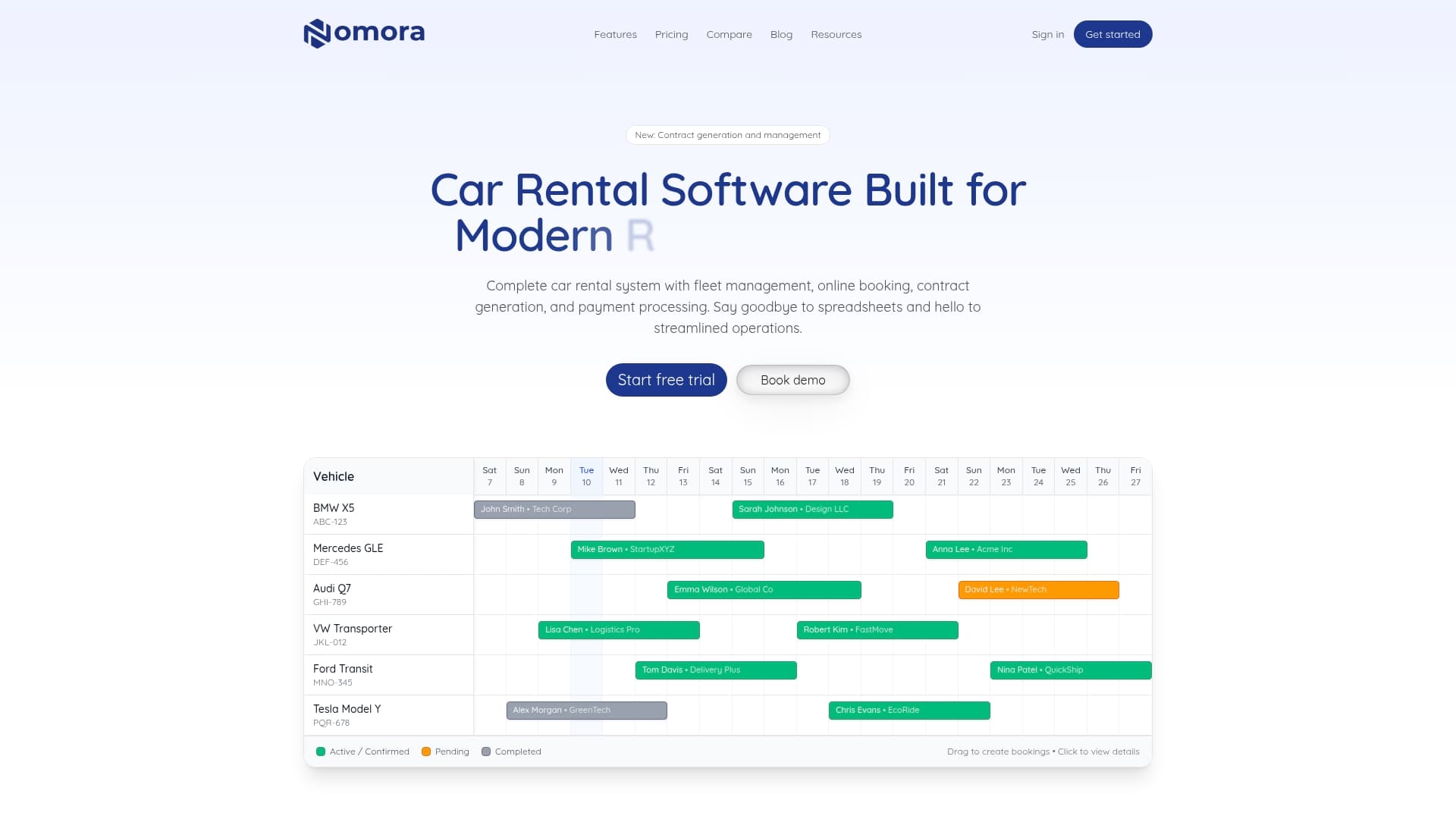
Manually reconciling odometer logs, contract terms, and overage invoices eats staff hours that a connected system handles automatically. Some platforms can generate mileage-aware contracts, sync GPS and telematics data in real time, and bill overages the moment a return is processed, all without a spreadsheet in sight.
- Automated contract generation that pulls mileage terms directly into the customer agreement.
- GPS and telematics integrations that log mileage and flag irregularities without manual entry.
- Overage billing and reporting that calculate charges the moment a vehicle is checked in.
See how this fits different fleet sizes on our use-case page, or check plan pricing to find the tier that matches your fleet today.
FAQ
What is the best way to enforce mileage limits fairly?
The most defensible approach pairs a clearly written contract policy with reliable monitoring evidence, whether odometer reads, photos, or telematics, and transparent billing math shown to the customer before they sign. Fairness comes from consistency: applying the same grace threshold and rounding rule to every rental.
How are mileage limits typically enforced in rental agreements?
Operators enforce caps by recording mileage at pickup and return, comparing the total against the contracted allowance, and billing any overage at a disclosed per-mile rate. Larger fleets often automate this with telematics, while smaller operators rely on manual odometer checks paired with photo evidence.
Do we need customer consent to track vehicle location for mileage enforcement?
Yes. Federal guidance requires affirmative express consent before collecting or sharing connected-vehicle location data, along with a way for customers to access or delete their data. Recording that consent at pickup, separate from the general contract signature, keeps the process defensible.
What should a mileage overage clause include?
It should state the included mileage allowance, the per-mile overage rate, how a mile is measured, and a short worked example of the calculation. Displaying this on the reservation page and again on the signed contract reduces disputes at return.
How does Nomora help with mileage enforcement specifically?
Our platform generates mileage-aware contracts, integrates with GPS and telematics hardware for automated tracking, and calculates overage billing automatically at check-in. Pricing starts with the Starter plan at 45 EUR per month, with per-vehicle tiers available for larger fleets.
Sources
Recommended
Ready to streamline your car rental business?
Book 30 minutes with the founder. We set up everything in this guide on your own vehicles, and migrate you out of Excel for free.