What does a solid checklist for reducing rental risks actually cover?
Vehicle inspection and preventative maintenance sit at the foundation of any fleet risk management program. A missed brake issue or an unrepaired recall is not just a safety problem — it can void the liability protections the Graves Amendment (49 U.S.C. § 30106)) provides, exposing your company to direct negligence claims.
Every pre-rental inspection should cover the LOFR items: Lights, Oil/fluids, Fuel, Rubber (tires and wipers), plus brakes, warning lights, and windshield condition. Post-return inspections follow the same checklist and add a damage comparison against the outgoing photo set.
| Inspection Item | Frequency | Out-of-Service Trigger |
|---|
| Lights and signals | Every rental cycle | Any failure |
| Brake pad depth | Every 30 days | Below manufacturer minimum |
| Tire tread and pressure | Every rental cycle | Below 2/32" tread or 20% under spec |
| Fluid levels (oil, coolant, brake) | Weekly or every 1,000 miles | Any leak or low-critical level |
| Warning lights | Every rental cycle | Any active warning |
| Windshield and wipers | Every rental cycle | Crack in driver's sightline |
| NHTSA recall check | At acquisition + monthly | Any open, unrepaired recall |
Log every inspection against the VIN with odometer reading, technician name, timestamped photos, and any corrective action taken. That record is what insurers want to see when pricing your renewal.
Pro Tip: Set automated maintenance reminders in your fleet management system tied to both mileage and calendar triggers. Integrate a monthly NHTSA VIN batch check so open recalls block the vehicle from new reservations automatically — a small workflow that prevents catastrophic legal exposure.
How should you screen renters to reduce high-risk rentals?
Renter verification is your first line of defense against frequency losses. The Graves Amendment shields rental companies from vicarious liability, but only when the company itself is not negligent. Renting to an unauthorized or high-risk driver can void that protection entirely.
Required checks at every rental:
- Government-issued photo ID captured digitally and matched to the renter's face
- Valid driver's license confirmed for the state or country of issuance
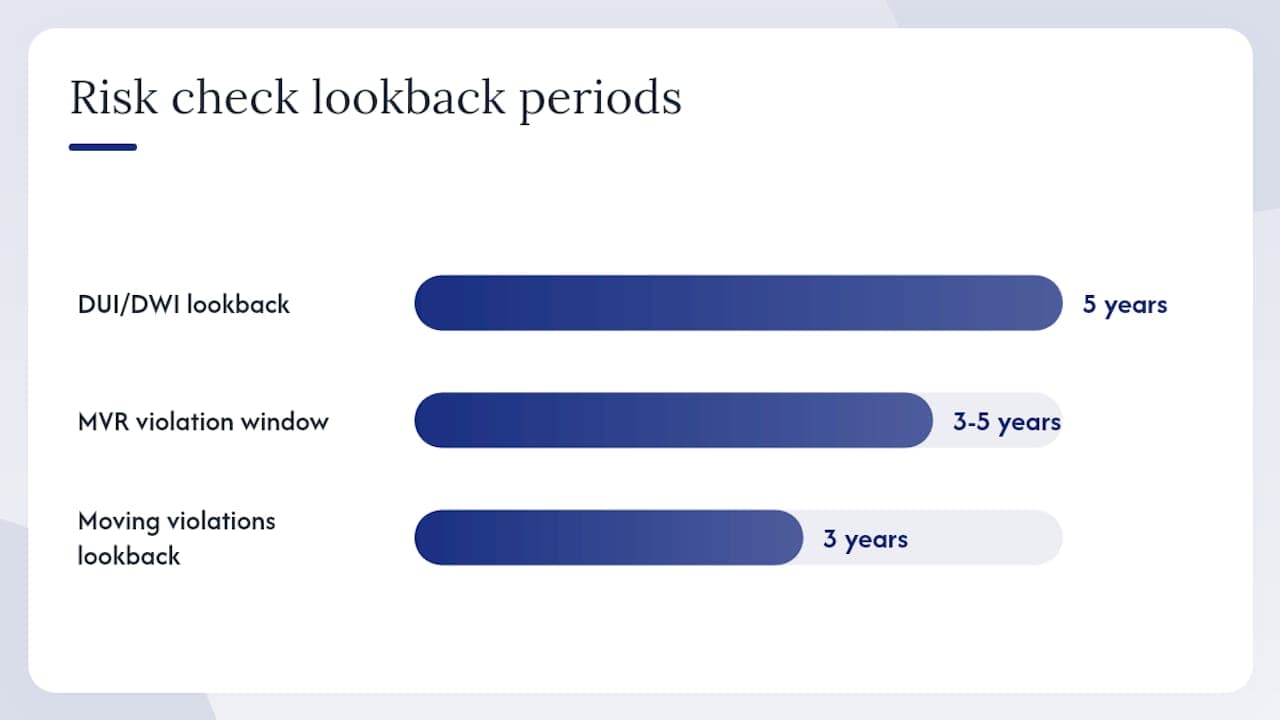
- Motor Vehicle Record (MVR) check for violations within the past three to five years
- Age verification against your policy minimums (typically 21+, with a young-driver surcharge for renters under 25)
| Trigger | Decision |
|---|
| DUI/DWI within 5 years | Automatic reject |
| Suspended or expired license | Automatic reject |
| 3+ moving violations in 3 years | Manual review required |
| Out-of-country license (non-IDP) | Manual review; verify state rules |
| No credit card in renter's name | Require additional deposit |
Deposit holds should scale with vehicle value: a compact might warrant a $300 hold while a luxury or specialty unit warrants $1,500 or more. Document the hold amount and authorization code in the rental record.
Pro Tip: Use real-time license-scan tools that cross-reference the barcode against the photo and flag mismatches instantly. Pair this with fraud prevention workflows that capture the card's EMV chip data at authorization — the combination cuts both identity fraud and chargeback exposure.
What insurance coverage does a U.S. rental fleet actually need?
A complete insurance stack for most U.S. rental operators includes:
- Commercial auto/fleet liability — $1,000,000 combined single limit (CSL) is a common floor; many contracts require higher
- Physical damage — comprehensive and collision on every owned or leased revenue vehicle
- Uninsured/underinsured motorist (UM/UIM) — covers gaps when an at-fault third party has no coverage
- General liability — premises and operations exposure at your lot and office
- Workers' compensation — required in most states if you have employees
- Umbrella/excess — catastrophic injury protection above primary limits
Loss Damage Waiver (LDW) and Collision Damage Waiver (CDW) are contractual products, not insurance policies. Their effectiveness depends entirely on state-compliant disclosures and consistent documentation. A signed waiver backed by timestamped photos holds up in a dispute; an unsigned or undisclosed one does not.
For claims, follow this FNOL sequence: notify your carrier or TPA within 24 hours, secure the vehicle at a preferred repair shop, gather the police report and telematics snapshot, and open subrogation if a third party is at fault. Operators who bring written policies, loss-run history, and telematics data to underwriting conversations consistently get better terms than those who simply shop for lower rates.
Pro Tip: Prepare a one-page underwriting summary before each renewal: fleet schedule (VINs, values, garaging ZIPs), three to five years of loss runs, inspection completion rates, and your MVR-screening policy. That package, not the quote request alone, is what moves your premium.
How do telematics and physical security reduce theft and misuse?
GPS and telematics are among the highest-return investments in fleet security. Core features to deploy on every revenue vehicle:
- Real-time GPS location with geofencing alerts for unauthorized travel zones
- Speed and harsh-braking event logging for driver behavior documentation
- Crash detection with automatic timestamped data capture
- Remote immobilization capability for theft recovery
- Secure, tamper-evident key storage (key cabinets with access logs)
Lot security basics matter too: perimeter fencing, motion-activated lighting, and camera placement covering all entry points and vehicle rows. Review footage retention policies — most insurers want at least 30 days of video available for claims.
Before deploying location tracking, confirm your rental agreement includes a clear telematics disclosure and that your practices comply with applicable state privacy laws. Some states have specific notice requirements for GPS monitoring of vehicles rented to consumers. When in doubt, have counsel review the disclosure language.
Pro Tip: After any accident, pull the telematics snapshot within the first hour. Speed, location, braking data, and crash-event logs are time-sensitive evidence that can accelerate your claim, support subrogation, and counter fraudulent injury claims.
Which rental agreement clauses reduce your liability the most?
Your rental agreement is the legal backbone of every transaction. Weak or missing clauses are the single most common reason operators lose damage disputes and chargebacks.
| Clause Type | What It Protects | Key Language to Include |
|---|
| Liability allocation | Shifts responsibility to renter for at-fault damage | "Renter assumes full liability for damage caused during the rental period" |
| LDW/CDW terms and exclusions | Limits waiver scope; excludes gross negligence, off-road use | "Waiver is void if vehicle is operated in violation of this agreement" |
| Unauthorized use | Prevents subletting or use by unlisted drivers | "Only drivers listed on this agreement are authorized to operate the vehicle" |
| Fuel and mileage | Defines refueling charges and mileage caps | "Vehicle must be returned with the same fuel level; excess mileage charged at $X/mile" |
| Damage reporting | Requires immediate notification of any incident | "Renter must report any accident or damage within 2 hours of occurrence" |
| Smoking and pets | Establishes cleaning fee triggers | "A $250 cleaning fee applies if evidence of smoking or pets is found at return" |
State-specific LDW disclosure requirements vary significantly. California, New York, and Nevada each have distinct rules governing how waivers must be presented, priced, and documented. Have local counsel review your agreement language before you deploy it in a new state.
Store every signed agreement as a timestamped digital record. Physical paper files do not survive audits or litigation as reliably as a digital rental agreement with an electronic signature trail.
Pro Tip: Review your rental contract essentials annually. State legislatures update consumer-protection and LDW rules more often than most operators realize.
How do you protect revenue from chargebacks and payment fraud?
Signed agreements and verified IDs are your primary defenses against chargebacks, but payment controls add a second layer.
Recommended payment controls:
- Pre-authorization holds captured via EMV chip at check-out, sized to vehicle value
- Tokenized card storage for repeat customers to reduce re-entry fraud
- Separate authorization for damage deposits versus rental charges
- Itemized receipts sent digitally at return, with damage photos attached
For disputes, your evidence package should include: the signed rental agreement, the authorization record, check-out and return inspection photos with timestamps, and any telematics data relevant to the dispute. Carriers and card networks both respond faster to organized, timestamped evidence than to narrative explanations.
Keep operating reserves sufficient to cover your highest deductible without disrupting cash flow. A deductible strategy that matches your reserve level avoids the trap of filing small claims that inflate your loss runs.
Pro Tip: Integrate your payment platform with your rental management system so that authorization codes, refund timestamps, and dispute documentation are stored in the same record as the rental agreement and inspection photos. That single-record approach is what wins chargebacks.
What staff SOPs and training actually reduce claims?
Consistent enforcement of your controls depends on staff training and measurable KPIs. Track these at the branch level:
| KPI | Target | Action if Below Target |
|---|
| Inspection completion rate | Most rentals | Retrain staff; add supervisor sign-off |
| Returns with documented damage comparison | All rentals | Audit last 30 returns; identify gaps |
| FNOL filed within 24 hours | Most | Review incident-report workflow |
| MVR checks completed before rental | All rentals | Block rental system until check is logged |
| Underwriting rejects documented | All rentals | Add reject-reason field to system |
Every incident report should capture: date/time, renter name and license number, vehicle VIN and odometer, location, description of event, photos, witness contact information, police report number, and a telematics snapshot reference. Branch audits using a standardized risk-evaluation template — covering security, vehicle condition, ticket auditing, and LOFR status — should run quarterly at minimum.
Pro Tip: Run a 15-minute monthly tabletop drill with counter staff: walk through a simulated accident call, an LDW dispute, and a renter-reject scenario. Staff who have rehearsed the steps make fewer errors when the real event happens.
What U.S. compliance and data-retention rules apply to rental fleets?
Compliance checklist for U.S. operators:
- State business license and rental-specific permits (requirements vary by state)
- Surety bond where required (amounts vary; confirm with your state DMV or licensing authority)
- Limited-lines insurance license if selling LDW/CDW as a product (most states require this)
- State-specific consumer disclosures for LDW pricing and terms
- FCRA compliance for MVR and credit checks used in renter screening
| Record Type | Minimum Retention Period |
|---|
| Signed rental agreements | 5 years |
| Inspection photos (pre/post) | 3 years or until claim closes |
| MVR check records | 3 years |
| Loss runs and claims files | 5–7 years |
| Payment authorization records | 5 years |
| Employee training records | 3 years |
Rental operators that sell LDW or CDW as a counter product are typically required to hold a limited-lines insurance license in each state where they offer the product. Selling without the appropriate license exposes the business to regulatory fines and can void the waiver itself. Confirm requirements with your state's Department of Insurance before offering any waiver product.
This article provides general information, not legal or regulatory advice. Confirm current licensing, bonding, and disclosure requirements with your state's licensing authority or a qualified attorney.
How should you handle roadside emergencies to limit claim severity?
Speed and documentation quality after an incident directly reduce claim cost and fraud exposure. Follow this sequence:
- Confirm renter safety and call 911 if there are injuries
- Instruct the renter to photograph the scene, all vehicles, and any damage before moving anything
- Secure a police report number and officer name
- Arrange tow to your preferred repair shop (pre-negotiated rates and SLAs)
- File FNOL with your carrier or TPA within 24 hours
- Pull the telematics snapshot and preserve it in the claim file
- Send the renter a written summary of next steps and your claims contact
Pre-negotiate towing and roadside SLAs with vendors: response time, maximum tow distance, and per-mile rate caps. For corporate clients, prepare a brief communication template confirming the incident, the vehicle status, and the replacement timeline. Business continuity means having a reserve pool of vehicles or a reciprocal agreement with another operator so a major loss event does not halt revenue.
Pro Tip: Include your roadside assistance number and FNOL instructions on a laminated card in every glove box. Renters who know exactly what to do in the first 10 minutes produce better evidence and fewer inflated claims.
How do you build an audit trail that holds up in court or underwriting?
Every rental record should be a self-contained evidence package. A complete data schema includes:
| Record Element | What to Capture | Storage Requirement |
|---|
| Rental agreement | Signed digital copy, timestamp, renter ID | Encrypted cloud storage, 5-year retention |
| ID capture | Photo of license front/back, facial match log | Encrypted, access-controlled |
| Inspection images | Pre-rental and post-return photos, VIN, odometer, timestamp | Linked to rental record by VIN |
| Telematics snapshot | Trip data, speed events, crash alerts | Synced to rental record at return |
| Payment authorization | Auth code, hold amount, card last four | Linked to agreement and inspection record |
| Incident notes | FNOL timestamp, photos, police report, witness info | Attached to claim file |
Sync telematics, payment, and contract systems to a central record so that any claim or audit can be reconstructed in minutes. Insurers and lenders commonly require a fleet schedule and three to five years of loss runs during underwriting — operators who can produce these on demand get faster binding and better terms.
Pro Tip: Run a quarterly "audit drill": pull a random sample of five rental records and verify that every element above is present and retrievable. Gaps found in a drill are far cheaper to fix than gaps found during litigation.
Your 30/60/90-day plan for implementing these controls
Days 1–30: Foundation
- Pull three to five years of loss runs and categorize claims by type (damage, theft, liability, chargeback)
- Conduct NHTSA VIN recall checks on every vehicle; pull any open-recall units from service
- Implement daily pre-rental and post-return inspection photos logged by VIN
- Draft or update your renter-screening decision matrix and brief counter staff
- Confirm your rental agreements include state-compliant LDW disclosures
Days 31–60: Controls and technology
- Install telematics on all revenue vehicles; configure geofencing and speed alerts
- Set up EMV pre-authorization holds scaled to vehicle value tiers
- Establish a digital rental agreement workflow with electronic signatures
- Run a branch audit using a standardized risk-evaluation template
- Begin tracking the five KPIs in the staff SOPs section above
Days 61–90: Optimization and underwriting preparation
- Compile your underwriting package: fleet schedule, loss runs, inspection completion rates, MVR-screening policy
- Confirm limited-lines licensing for any LDW/CDW products you sell
- Schedule quarterly recall checks and branch audits as recurring calendar events
- Review data-retention practices against the table in the compliance section
- Brief your broker on the controls you have implemented and request a renewal review
For a ready-to-use operational template, the vehicle rental checklist for small and medium fleets provides a structured format your team can assign and track by role.
Key Takeaways
A documented, consistently enforced checklist covering inspections, screening, telematics, contracts, and claims workflow is the single most effective way to reduce losses and improve insurance terms for U.S. rental fleets.
| Point | Details |
|---|
| Inspections with photos | Pre-rental and post-return timestamped photos are your primary defense in damage disputes and underwriting reviews. |
| Renter screening discipline | MVR checks and a written decision matrix prevent high-risk rentals and protect your Graves Amendment shield. |
| Telematics and fast FNOL | Crash data and speed logs filed within 24 hours reduce claim severity and support subrogation recovery. |
| Contract and LDW compliance | State-specific disclosures and signed digital agreements are what make waivers enforceable and chargebacks winnable. |
| Nomora platform | Nomora centralizes inspections, digital agreements, telematics integration, and payment records into one audit-ready system. |
The control most operators skip — and why it costs them the most
The operators who struggle most with insurance costs are rarely the ones with the worst drivers. They are the ones with the best intentions and the worst documentation. A claim that should have been subrogated often remains open for extended periods due to delays in pulling telematics snapshots. A chargeback is lost because the inspection photo exists but is stored in a personal phone rather than the rental record. A renewal comes in 30% higher because the broker cannot produce a clean loss run.
The checklist in this guide is not complicated. What makes it hard is consistency — enforcing the same steps on the 47th rental of the week as on the first. That is an operations problem, not a knowledge problem. The operators who solve it treat documentation as a non-negotiable step in the rental transaction, not an administrative afterthought. They build it into the system so staff cannot skip it, and they audit it quarterly so gaps surface before a claim does.
One habit worth adopting immediately: run a VIN recall check at vehicle acquisition and again on the first of every month. It takes minutes per vehicle and it is one of the few controls that simultaneously protects your Graves Amendment defense, your physical damage coverage, and your customers.
How Nomora helps you put this checklist into practice
Operators who implement these controls manually — across spreadsheets, paper logs, and disconnected payment systems — spend more time managing the paperwork than running the fleet. Nomora acts as the central nervous system of your rental operation, connecting inspections, contracts, payments, and telematics into one cloud-based record that is always audit-ready.
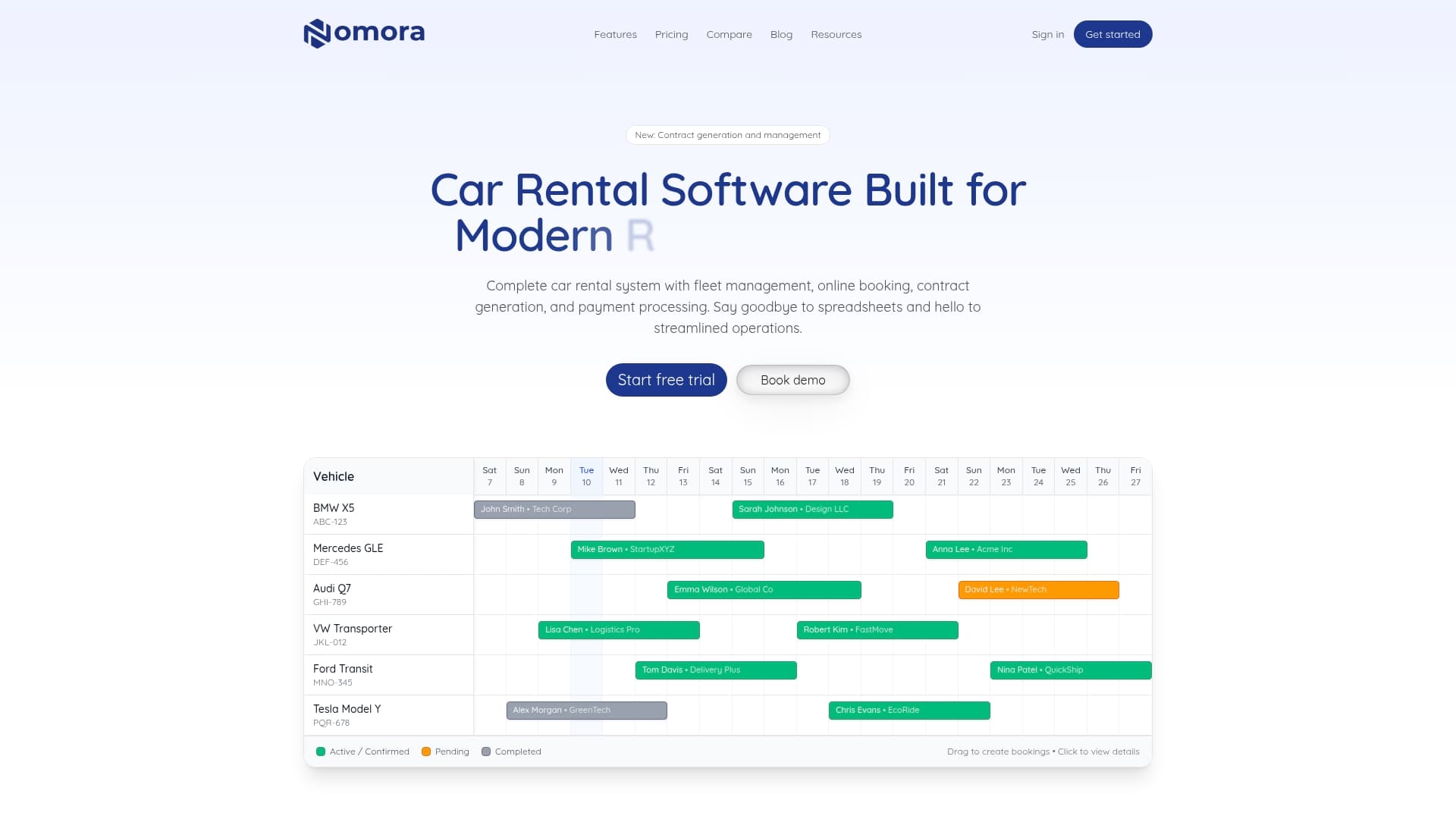
With Nomora, pre-rental and post-return inspection photos attach directly to the rental record by VIN. Digital agreements with electronic signatures are generated automatically and stored with timestamps. Payment authorizations, deposit holds, and refund records link to the same file. When a claim or chargeback arrives, your evidence package is already assembled. Onboarding takes 24–48 hours, and the platform is built to GDPR and data-security standards that satisfy both insurers and enterprise clients.
See how Nomora fits your operation at nomora.io/use-cases, or explore the full feature set at nomora.io/car-rental-software and request a demo.
Recommended