Setting Your Rental Mileage Policy: Unlimited vs. Limited Allowances
The right allowance model depends on vehicle class, rental length, and how much wear you're willing to absorb. Short urban rentals and economy sedans usually tolerate unlimited mileage because daily driving rarely exceeds 100 to 150 miles. Long-distance rentals, vans, and specialty or luxury vehicles need caps, since a single one-way trip can rack up wear that outpaces the rental fee.
- Decide the model first. Unlimited mileage suits short urban and subscription-style bookings; limited mileage suits long-distance rentals, business fleets, and higher-value vehicle classes.
- Calculate the allowance. Use
Total allowance = daily allowance × rental days, or set a flat total-trip allowance for multi-day bookings. A five-day rental with a 100-mile daily cap gives the renter 500 total miles.
- Price the overage rate on real cost, not guesswork: add expected wear cost, fuel differential, and administrative time, then divide by the extra miles you expect an average violator to drive. A rate that's too aggressive invites disputes; a rate that's too soft doesn't cover your depreciation.
- Surface the number everywhere it matters. Show the allowance during booking, again at checkout, and once more in the confirmation email, so nobody discovers the cap at the return counter.
How Do You Capture and Verify Rental Mileage?
Manual odometer capture still works for small fleets with low turnover, but it fails in predictable ways: staff forget to log the number, customers dispute a reading nobody photographed, and busy counters skip the step during peak hours. It's an acceptable baseline for a two or three car operation with tight staff oversight. It becomes a liability once volume rises.
Telematics changes the equation. GPS-based systems capture a continuous odometer feed instead of two isolated snapshots, which makes tampering far harder to get away with. Geotab's rental checklist recommends automatic start and end odometer capture, real-time location tracking, geofencing alerts, and billing integration that pulls mileage straight into the invoice. Providers such as Smartcar handle the vehicle-data API layer, while RentalMatics focuses on continuous monitoring for long-term leases, flagging excess mileage before the contract ends rather than after.
- Manual capture: low cost, higher dispute risk, best for small fleets with consistent staff.
- Telematics/GPS: continuous odometer, geofence history, and fuel-level verification that stand up as evidence.
- Offline data gaps: when a telemetry reading is missing, the safer rule is to skip the surcharge rather than estimate it.
- Required fields for any integration:
start_odo, end_odo, telematics_device_id, timestamps, and geofence flags, synced on a cadence tight enough to catch mid-rental anomalies.
Pro Tip: Sync telematics data at least every 15 minutes during active rentals rather than only at pickup and return. A mid-trip sync catches a geofence breach or odometer jump while there's still time to contact the customer instead of arguing about it after the fact.
Billing and Contract Fields That Prevent Disputes
Your rental agreement needs five fields locked in before the customer signs: starting mileage, included allowance, overage rate, any cap on total overage charges, and the billing currency with its rounding rule. Levy Fleets documents this as included miles per day, a per-mile overage rate, and an optional cap, which covers most fleet configurations cleanly.
The math itself is simple:
Miles driven = end_odo - start_odoExcess miles = max(0, miles driven - included allowance)Surcharge = excess miles × overage rate (capped if a maximum applies)
A short two-day rental with an allowance and miles driven that exceed it owes an overage charge calculated per mile. A longer rental with a higher allowance but also mileage beyond that allowance owes a corresponding overage charge, capped at a contractually agreed ceiling. Show the surcharge line item on the final bill exactly the way it was calculated, round to the nearest cent, and state the cap in plain language on the receipt, not buried in fine print.
Enforcing the Policy Without Starting a Fight
Enforcement lives or dies on what you recorded at handoff. Capture timestamped start and end odometer readings, telematics logs, fuel-level photos, and geofence history every time, whether the rental looks routine or not. That evidence is what settles a dispute in one phone call instead of three.
- Build an automated workflow: threshold alert, customer notification, a short grace window, then bill or waive based on the response.
- Train counter staff on one consistent script for explaining the mileage policy, so two customers never hear two different versions of the same rule.
- Keep the evidence trail centralized so any staff member can pull it up during a dispute, not just whoever handled the original rental.
If you're considering GPS-enabled kill switches or remote disable devices for chronic overage cases, get legal review first. Rules here vary by state and by lender agreement, and a misused disable feature can create more liability than the mileage overage ever did.
Turning Mileage Data Into Maintenance and Reporting
Mileage isn't just a billing input. It's the trigger for your entire preventive maintenance schedule. Set service triggers at fixed odometer milestones (every 5,000 or 10,000 miles) or on a 30/60/90 day cycle, whichever comes first for that vehicle, following the maintenance-timing logic telematics vendors already build around.
- Track miles per rental and monthly miles per vehicle to spot which units are working harder than the rest of the fleet.
- Set high-mileage alerts that flag vehicles approaching resale thresholds before depreciation accelerates.
- Feed odometer data into your fleet reporting dashboard so maintenance timing, downtime, and resale forecasting all draw from the same numbers.
Vehicles serviced on mileage-based triggers spend less time in the shop unexpectedly, and their resale value holds up better because buyers can see a consistent maintenance history tied to actual usage.
A Configuration Checklist and Two Ready-to-Use Templates
Before you publish a new mileage rule, run through this sequence in order:
- Choose the allowance model (unlimited or limited) for each vehicle class.
- Set the overage rate using your real wear and fuel cost math.
- Enable the capture method (manual, telematics, or hybrid) for that fleet segment.
- Map the API fields (
start_odo, end_odo, telematics_device_id, timestamps) into your booking and fleet system.
- Run test scenarios that hit the allowance boundary exactly, not just comfortably under or over it.
- Train staff on the script and the exception process.
- Publish the policy at every booking touchpoint before it goes live.
Template A, city car: daily allowance of 100 miles, telematics recommended but not required, overage billed per mile with no cap, ideal for short urban bookings where trip lengths are predictable.
Template B, long-distance van: total-trip allowance instead of daily, overage capped at a fixed dollar ceiling, customer consent required for continuous telematics tracking, automated pre-notification when the customer hits 80 percent of the allowance.
Pro Tip: Run at least one QA test where the telematics feed is deliberately missing data. If your system defaults to charging a surcharge on incomplete information instead of skipping it, fix that before launch, not after your first angry review.
Handling Exceptions: Off-Road Use, Out-of-State Trips, and Other Edge Cases
Standard mileage math assumes normal on-road driving within an expected geography. Off-road use, cross-border trips, and extended out-of-state travel all break that assumption in different ways, and your policy needs explicit carve-outs rather than silence.
Off-road driving usually voids standard coverage entirely in most rental agreements, separate from the mileage question. If your fleet includes trucks or SUVs marketed for light off-road use, define exactly what counts as permitted terrain and require a separate acknowledgment at booking. Silence here doesn't protect you. It just means the first dispute sets the precedent.
Out-of-state and cross-border use is a mileage and geofencing issue more than a coverage issue. If your telematics setup includes geofence alerts, decide in advance whether crossing a state line triggers a notification, a rate change, or nothing at all. Some operators charge a flat surcharge for out-of-state use regardless of mileage, since recovery and support logistics get harder the farther the vehicle travels. Others simply track it for reporting and let the standard mileage rule apply unchanged.
Corporate and subscription accounts often need a different exception path entirely. A business renting a van for a multi-city delivery route isn't a candidate for a standard daily cap, and forcing one onto that use case creates friction with a customer segment you want to retain. Build a documented exception process: who can approve a custom allowance, what gets recorded, and how the exception is flagged in the booking system so it doesn't get treated as a rule violation later.
Mileage policy and pricing strategy aren't separate systems, even though they're often built that way. A promotional weekend rate that ignores mileage caps can quietly erase your margin if the promo attracts exactly the long-distance bookings your standard allowance wasn't priced for.
When you run a discount or seasonal promotion, decide explicitly whether the mileage allowance scales with it. A common mistake is discounting the daily rate while leaving the allowance untouched, which effectively lowers your per-mile revenue on every promotional booking without anyone noticing until the monthly numbers come in light. If a promotion targets road-trip season, consider raising the allowance slightly rather than leaving it flat, and price that adjustment into the promotional rate itself.
Dynamic pricing tools that adjust rates by demand, season, or vehicle class should treat mileage terms as a linked variable, not an afterthought. A vehicle priced higher during peak season because of demand can reasonably carry a tighter allowance, since higher demand usually means higher urgency and less price sensitivity to a mileage cap. Conversely, off-peak discounts aimed at filling idle inventory can carry a more generous allowance as an incentive, since the marginal cost of extra miles on an otherwise idle vehicle is lower than on one already in heavy rotation.
The core principle: never let a promotion get built and priced in isolation from the mileage rule sitting underneath it. Whoever owns pricing and whoever owns fleet policy need to review the same numbers before a promotion goes live.
Legal and Regulatory Considerations for Mileage Policies
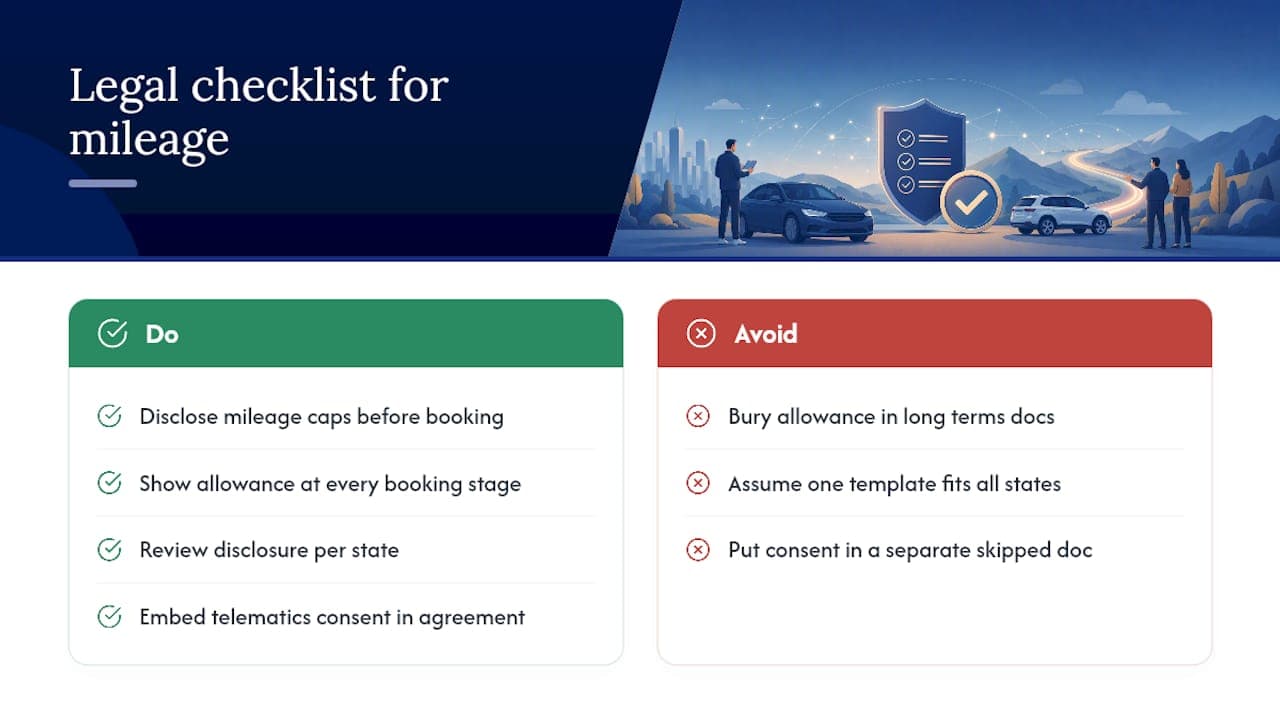
Mileage terms sit inside a rental contract, which means they're subject to the same consumer-disclosure principles that govern any other fee in that agreement. The core legal risk isn't the mileage cap itself. It's failing to disclose it clearly before the customer commits to the booking.
Contract law generally requires that a material term, and a mileage cap with a per-mile overage charge is material, be disclosed in a way the customer can reasonably see and understand before signing. Burying the allowance in a lengthy terms document that nobody reads, when the booking flow never surfaced it, creates exposure to a dispute or a chargeback that a court or a payment processor may resolve against the rental company. This is a large part of why showing the allowance at every stage of the booking flow isn't just good customer experience. It's a defensible paper trail.
State-level consumer protection rules vary, and some jurisdictions treat undisclosed fees more strictly than others. If your fleet operates across multiple states, review your mileage disclosure language against each state's consumer protection statute rather than assuming one contract template covers every location equally. This is a case where a quick legal review before your next policy update is worth far more than the time it costs.
Telematics tracking itself carries a separate legal thread. Continuous GPS monitoring of a rented vehicle generally requires customer consent, and some states have specific notification requirements for vehicle tracking devices. Build that consent language into the rental agreement itself, not into a separate document the customer might skip.
Monitoring Compliance and Enforcing Penalties Fairly
Consistent enforcement depends on treating every customer against the same rule, using the same evidence standard, every time. Selective enforcement, where one customer gets billed for an overage and another with a similar violation doesn't, is one of the fastest ways to generate a dispute that escalates into a chargeback or a public review problem.
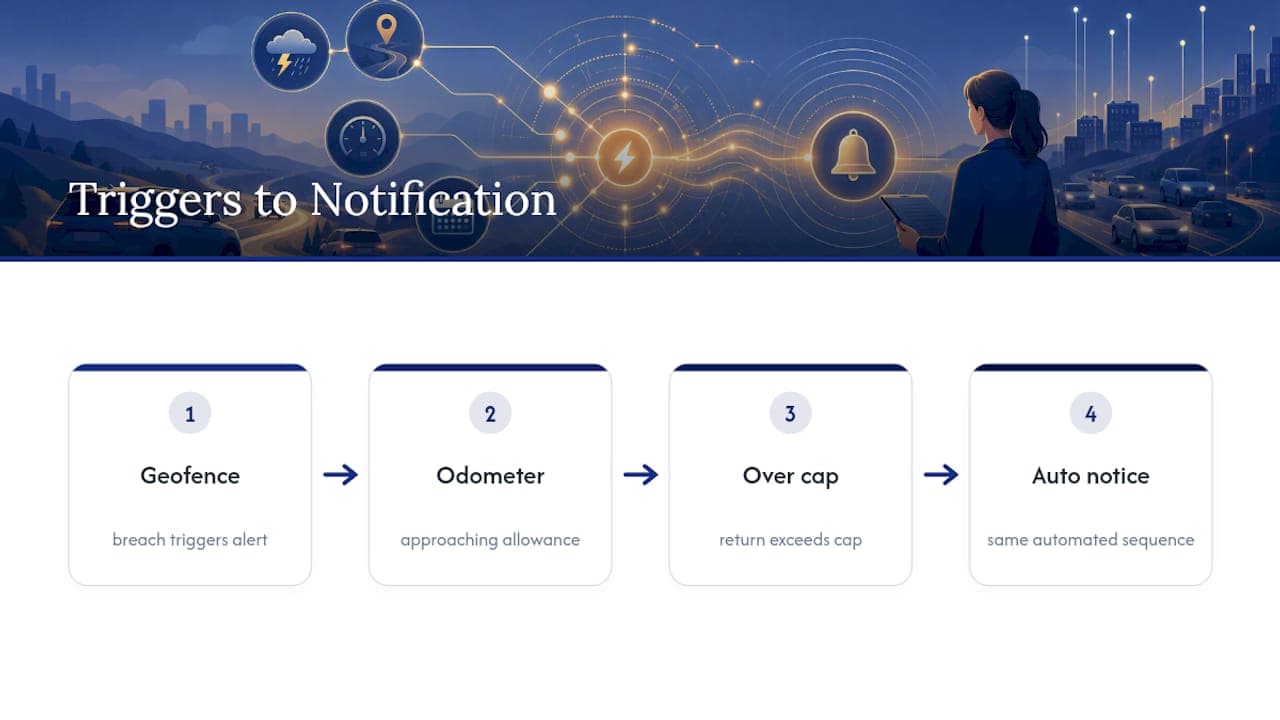
Set a clear threshold for when a compliance alert fires, based on the telematics or odometer data you're already capturing. A geofence breach, an odometer reading approaching the allowance limit, or a return that exceeds the cap should all trigger the same automated notification sequence rather than depend on whichever staff member happens to notice.
Grace windows help here more than strict zero-tolerance enforcement does. A small buffer, five to ten miles over the cap, for example, avoids penalizing a customer for a rounding error or a minor route detour while still enforcing the rule against genuine overage. Reserve the full overage charge for violations that clearly exceed the buffer, and document the buffer in the contract so it's not a surprise exception.
For repeat violators, especially corporate accounts or subscription renters who consistently exceed their allowance, consider a structured escalation: a warning on the first overage, a standard surcharge on the second, and a renegotiated allowance or rate on the third. This protects revenue without treating every customer relationship as adversarial from the first mile over the line.
What Actually Works at the Counter: A Practitioner's View
Automation costs money, but manual disputes cost more in staff hours and bad reviews. For a fleet under ten vehicles, a strict per-mile charge on every minor overage often isn't worth the goodwill it burns. Save telematics investment for repeat offenders, long-distance rentals, or corporate accounts where the mileage math actually matters. At the counter, the simplest script wins: state the allowance, state the rate, and repeat both before the customer signs, not after they return the car.
— Dizzy
How Nomora Puts Your Mileage Policy Into Practice
Some car rental management platforms give rental operators a direct way to run everything covered above without stitching together three separate tools. Renters can configure the allowance model, overage rate, and caps once inside the platform, and those rules apply automatically to every booking, contract, and invoice tied to that vehicle class. Telematics integrations can feed odometer and geofence data straight into billing, so surcharges calculate automatically instead of requiring a staff member to do the math at the counter. Maintenance triggers can fire from the same mileage data, meaning preventive service scheduling and mileage enforcement run off one consistent number instead of two disconnected systems.
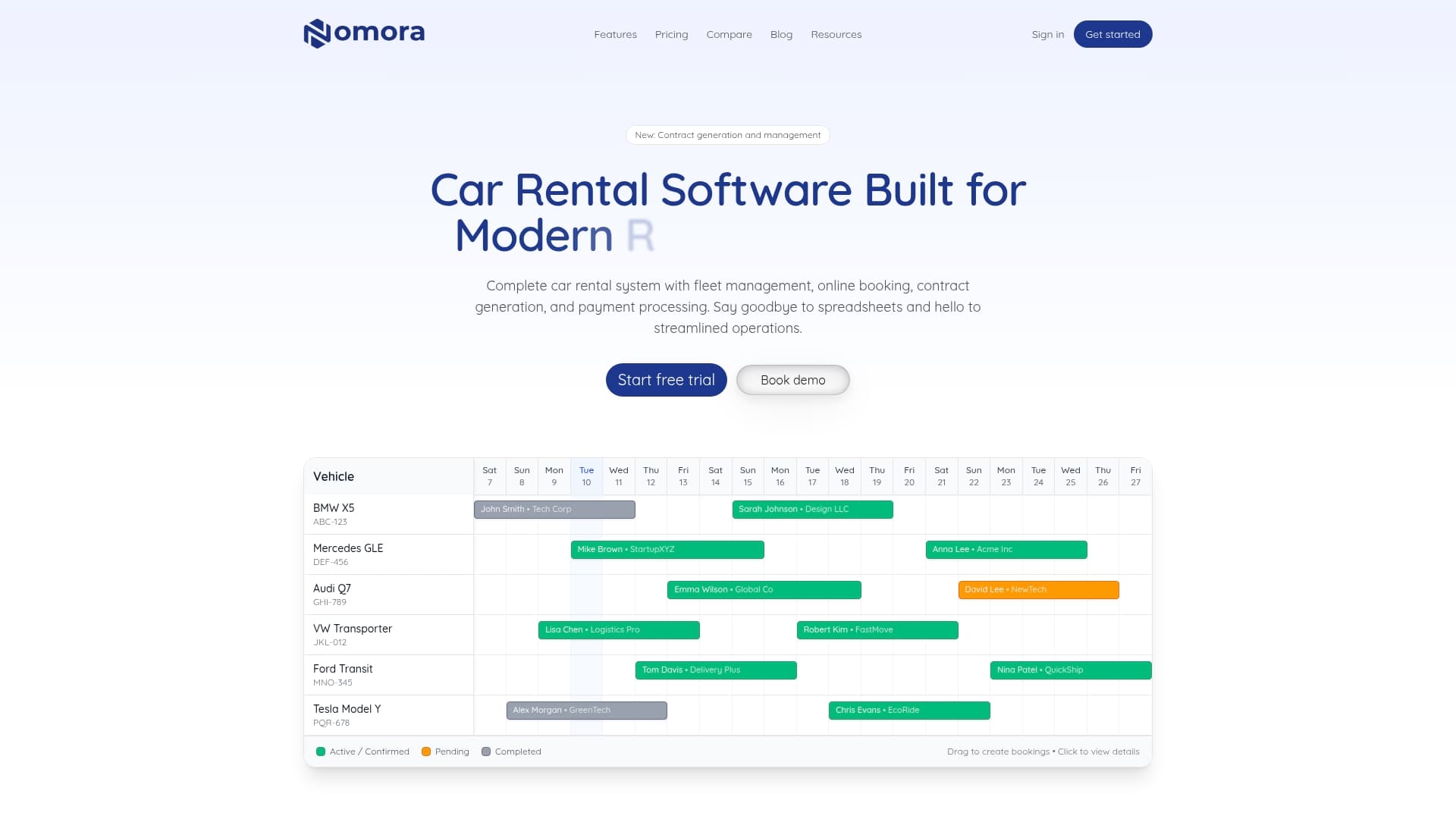
Setup typically runs within a few days for small to medium-sized fleets. Explore how it fits your operation on the car rental software overview or check the use cases by business type to see the configuration that matches your fleet size and vehicle mix.
Sources
FAQ
What Should a Rental Mileage Policy Include?
An enforceable policy needs an allowance model (unlimited or limited), a cost-based overage rate, a defined capture method, and clear disclosure at every stage of the booking flow.
Is Unlimited Mileage Better Than a Limited Allowance?
Neither is universally better. Unlimited mileage suits short urban rentals and lower-wear vehicle classes, while limited allowances protect margin on long-distance trips, vans, and higher-value vehicles.
How Do You Calculate a Mileage Overage Charge?
Subtract the included allowance from actual miles driven, then multiply the excess by your per-mile overage rate, applying any contract cap before finalizing the charge.
What Happens if Telematics Data Is Missing?
The safer practice is to skip the surcharge rather than estimate mileage from incomplete data, since billing on an unverified reading tends to increase disputes.
Can Software Like Nomora Automate Mileage Enforcement?
Yes. Platforms like Nomora let operators configure allowance rules once and apply them automatically across bookings, contracts, billing, and maintenance triggers.
Recommended