Why Rentals Are a High-Risk Target for Chargebacks
Rental transactions sit in a gap that fraudsters and disputing guests both exploit: payment happens well before the vehicle or property is actually used, sometimes days or weeks in advance. That lag gives stolen-credential bookings time to clear fraud screens, and it gives legitimate guests a window to claim they never authorized a charge they now regret.
Several structural factors raise rental exposure above typical card-not-present retail:
- High-value, often three- or four-figure transactions draw more scrutiny from cardholders reviewing statements
- Billing descriptors that don't clearly match the rental brand name trigger "I don't recognize this charge" disputes
- Card-not-present bookings remove the physical card checks available to brick-and-mortar merchants
- Marketplace or third-party booking channels add intermediaries who may not pass along full transaction data
- Deposits and incidental fees charged after checkout look unfamiliar to guests who forgot the original policy
Each of these is addressable with the right controls, but ignoring any one of them widens the attack surface competitors in your category are also fighting.
Common Fraud and Dispute Scenarios Rental Operators Will Face
Recognizing the shape of a dispute before it happens is half the battle. Rental operators tend to see the same four patterns repeat:
- Stolen-card or card-not-present booking fraud. A reservation made with a compromised card, often booked last-minute, for a one-way or long-duration rental, with a shipping or contact address that doesn't match the cardholder's billing address.
- Friendly fraud. The guest genuinely picked up and used the vehicle or unit but disputes the charge anyway, often claiming they didn't authorize it or didn't recognize the descriptor, frequently triggered by a vague charge label or a forgotten deposit hold.
- Not-as-described or quality disputes. The guest claims the vehicle, property, or amenities didn't match the listing, which usually traces back to outdated photos, unclear mileage or condition terms, or a listing that oversold the asset.
- False damage claims or off-platform pressure. A guest disputes a legitimate damage charge, or pushes to settle payment outside your system entirely, both of which remove you from the paper trail that protects your revenue.
Each scenario calls for a different piece of evidence, which is why mapping dispute type to proof in advance saves time when a notification actually arrives.
How Chargebacks Actually Flow and What Counts as Compelling Evidence
A chargeback moves in one direction before it can move back: the cardholder complains to their issuing bank, the issuer passes the dispute to your acquirer, and your acquirer notifies you. From there, you have a limited window, typically averaging 10 to 35 days depending on your acquirer's terms, to submit representment evidence that argues the charge was valid.
Visa groups disputes into four broad buckets that cover almost every rental scenario:
- Fraud (the cardholder says they never authorized the transaction)
- Authorization issues (a problem with how the charge was processed)
- Processing errors (duplicate charges, incorrect amounts)
- Consumer disputes (not-as-described, quality, or service complaints)
Visa's own dispute management guidance notes that most disputes stem from avoidable transaction-handling errors rather than true fraud, which means tighter documentation at booking and checkout closes off a large share of preventable chargebacks before they start.
"Compelling evidence" has a specific meaning to card networks: it must directly address the reason code cited, be submitted in the format the acquirer requests, and arrive before the deadline. A pile of unrelated paperwork doesn't win a dispute, targeted proof does. For first-party misuse claims specifically, Visa's CE3.0 update lets you shift liability back to the cardholder when you can show two prior undisputed transactions, dated between 120 and 365 days earlier, that share matching elements like IP address or device fingerprint with the disputed booking.
Prebooking Controls: Screening, Risk Scoring, and Payment Authentication
The cheapest chargeback to prevent is the one you never accept. Risk scoring at the point of booking flags reservations that deserve a second look before they're confirmed.
Effective rule flags typically include a mismatch between billing and delivery address, a brand-new account booking a high-value or one-way rental, multiple failed card attempts in a short window, and bookings made from a different country than the payment method's issuing bank. Stripe's travel-fraud guidance recommends pairing real-time scoring tools, such as Stripe Radar, with clear cancellation policies and identity checks rather than relying on any single signal.
Payment authentication choices matter just as much as the rules:
- Require 3D Secure for first-time guests, high-value bookings, or any reservation flagged by your risk rules
- Confirm CVV match on every card-not-present transaction
- Use AVS (Address Verification Service) as a baseline check, but treat a partial match as a flag rather than an automatic decline
Preauthorization versus deposit versus full capture should follow booking value. Lower-value, short-duration rentals can often move straight to capture, while higher-value or longer bookings benefit from a preauthorization hold that converts to capture closer to pickup, reducing refund and no-show exposure, a pattern our guide on preauthorization versus deposits covers in more detail. Set a manual review SLA, such as same-business-day review for anything flagged, so risky bookings don't sit unresolved while a pickup date approaches.
Pro Tip: Route any booking with a billing-address mismatch and a brand-new account straight to manual review before you release a confirmation email.
Documentation and Communication That Build a Winning Paper Trail
The single biggest lever against friendly fraud and confusion-driven disputes is a paper trail the guest actually saw and acknowledged. Representment packets built on silent assumptions rarely hold up.
Rental agreements should surface the essential clauses, not bury them: cancellation terms, damage and late-return policy, deposit handling, and mileage or usage limits all belong above the signature line, not in a footer. Our breakdown of late-return clauses offers tested wording you can adapt directly.
A few practices consistently reduce "I don't recognize this charge" disputes:
- Use a billing descriptor that clearly includes your brand name, not a generic processor label
- Send a prearrival confirmation that restates the total charge, deposit amount, and cancellation window
- Send a poststay summary that itemizes any additional charges before they post to the card
- Store every message, signed agreement, and confirmation in one system, timestamped and tied to the booking ID
Mastercard's guidance on disputes notes that keeping messages and signed documents centralized cuts the time it takes to assemble a representment packet, which matters when your response window is measured in days, not weeks. Our cancellation policy guide walks through exactly where that policy language should appear across your booking flow.
Identity Verification and Pickup Evidence That Win Disputes
Handoff is where fraud claims and legitimate disputes diverge, and the evidence you capture at pickup often decides the outcome months later.
- Match the ID presented at pickup against the name on the booking and the card used to pay
- Log a timestamped check-in record and collect a signed pickup receipt acknowledging the vehicle or unit's condition
- Take photos or a short video documenting condition at handoff, and repeat the process at return
- Store every pickup artifact under the same booking ID as the payment and agreement, so nothing has to be reassembled later
Our walkthrough of identity verification steps at pickup covers the practical sequence operators use to keep this quick without slowing down the guest.
Step-by-Step Chargeback Response: Assemble Evidence and Submit Representment
Once a chargeback notification arrives, speed and precision matter more than volume. Follow a consistent sequence:
- Assign an owner immediately. Someone on your team should be responsible for every dispute from notification to resolution, with no ambiguity about who compiles evidence.
- Pull the reason code first. The evidence you gather should map directly to the specific reason cited, not a general defense of the transaction.
- Match evidence to the reason code. A fraud claim calls for AVS/CVV match data, IP address, and device fingerprint; a not-as-described claim calls for the signed agreement and listing details; a friendly-fraud claim benefits from pickup photos and signed receipts.
- Write a short rebuttal letter. Summarize the evidence in plain terms so the reviewer doesn't have to reconstruct your argument from raw documents.
- Submit before the deadline. Acquirer response windows typically run 10 to 35 days, and late submissions are treated as concessions regardless of evidence quality.
Not every dispute is worth fighting. Weigh the transaction value against the staff time required to assemble a full packet, and concede small-dollar disputes where the evidence is thin rather than spending hours on a low-probability win.
Pro Tip: Keep a reason-code-to-evidence template on file so your team never starts a representment packet from a blank page.
Monitoring, Metrics, and Rule-Tuning for a Sustainable Prevention Program
Chargeback prevention isn't a one-time setup, it's an ongoing measurement practice. Visa's merchant guidance recommends tracking dispute rate as a share of total sales, monitoring card-present and card-absent disputes separately, and watching net disputes after representment rather than just the raw count filed.
- Track dispute rate by booking channel to see whether marketplace traffic carries more risk than direct bookings
- Review flagged-but-approved bookings monthly to see if risk rules caught real fraud or just added friction
- Set a manual review SLA target, such as resolution within one business day, and measure against it
- Escalate to your acquirer if your dispute rate approaches network thresholds, since sustained high rates can trigger monitoring programs
A monthly review cycle, where you compare win rates by reason code and adjust screening rules accordingly, keeps the program tuned instead of static.
Centralizing reservations, contracts, payments, and communications in one system removes the scramble that usually follows a chargeback notification. When every signed agreement, prearrival message, and payment record lives under the same booking ID, assembling a representment packet becomes a retrieval task rather than a research project.
Nomora brings reservation data, automated contract generation, integrated payments, and timestamped customer records together in a single cloud platform, which is built to keep that evidence trail intact from booking through return. For rental operators managing disputes across multiple channels, that kind of centralized record keeping is what turns a 35-day deadline from a scramble into a routine task.
Three Operational Priorities Worth Starting This Week
Chargeback prevention works best as an operational habit, not a one-time project. I'd start with three things: tighten your risk-scoring rules so manual review catches the mismatches that matter, confirm your cancellation and damage clauses actually surface where guests will read them, and name one person who owns every dispute from notification to resolution.
None of this should make check-in feel like an interrogation. The controls that work best are the ones guests barely notice, because they're built into confirmations and receipts rather than bolted on as extra friction. Treat your dispute rate as a KPI you review monthly, not a fire you only fight when it flares up.
— Dizzy
Nomora: Centralized Records, Automated Contracts, and Faster Dispute Response
We built Nomora around the exact pillars this guide covers: automated contract generation that keeps signed agreements attached to every booking, integrated payments that log authentication data automatically, and timestamped customer records that stay centralized instead of scattered across inboxes and spreadsheets.
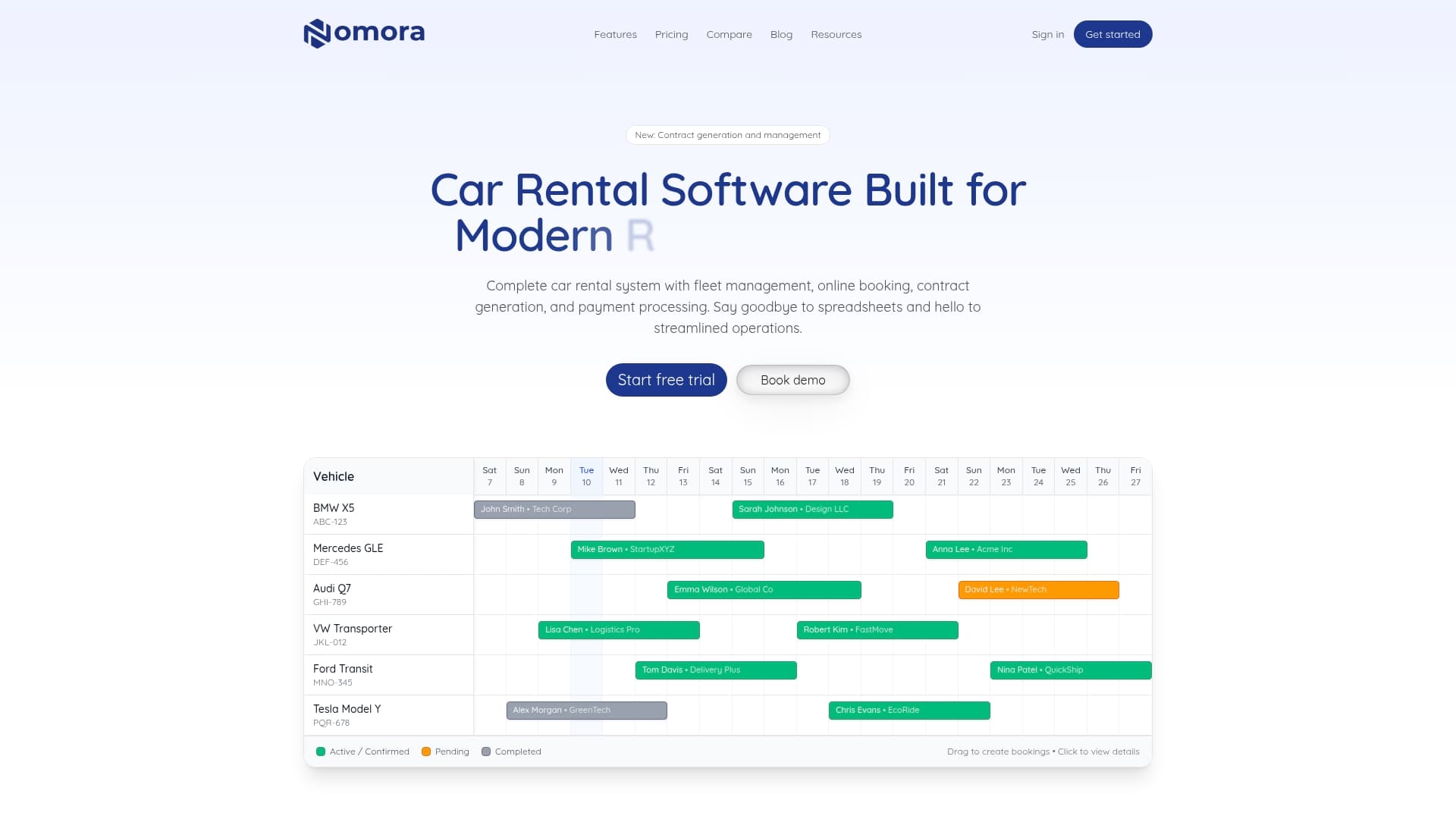
When a dispute lands, that means your team isn't hunting for a signed agreement or a prearrival email, it's already attached to the reservation. We offer plans built for rental businesses of various sizes, with onboarding that can get teams fully operational within a few days. Visit our pricing page to see which plan fits your fleet size, or explore the full platform to see how reservations, contracts, and payments work together.
FAQ
Is There a Way to Prevent Chargebacks?
Yes. Most rental chargebacks are preventable through a combination of prebooking risk screening, strong payment authentication, clear agreements and billing descriptors, and timestamped pickup evidence tied to each booking. Operators who centralize this documentation and respond within acquirer deadlines, typically 10 to 35 days, see the highest representment success.
Can You Go to Jail for False Chargebacks?
Filing a chargeback dispute for a transaction you did authorize, commonly called friendly fraud, can constitute fraud under applicable law when done knowingly and repeatedly. Enforcement varies by jurisdiction and case specifics, so operators who suspect intentional abuse should document the evidence thoroughly and consult their payment processor or legal counsel rather than assume a specific legal outcome.
What Is the 540-Day Rule for Chargebacks?
Card networks generally limit how far back a cardholder can file a dispute, though the exact limit depends on the card network and dispute type rather than a single universal rule. Rental operators should focus less on a specific day count and more on retaining transaction records, agreements, and pickup evidence for at least a year to cover any dispute window that applies.
The most effective approach combines a layered set of tools rather than one standalone service: real-time risk scoring, payment authentication such as 3D Secure and AVS/CVV checks, and a centralized system for contracts and communications. Platforms like Stripe Radar handle real-time fraud scoring, while an integrated rental management system like Nomora centralizes the contracts, payments, and records needed to respond quickly when a dispute does arrive.
Sources
Recommended