Creating a rental contract that protects your business while keeping customers satisfied requires balancing legal precision with clarity. Your rental agreement serves as the foundation for every transaction, defining responsibilities, managing risk, and establishing clear expectations. A well-crafted contract prevents costly disputes, reduces liability exposure, and builds customer trust through transparency. This guide walks you through the essential clauses, damage management strategies, special restrictions, and compliance practices that transform a basic rental form into a comprehensive business protection tool.
rental contract essentials9 min read•
Rental contract essentials for car rental businesses
Learn the essential clauses, damage terms, and compliance practices for creating effective car rental contracts that protect your business and reduce disputes in 2026.
N
Nomora Team
Car Rental Software Experts

Table of Contents
Table of ContentsKey takeawaysCore clauses every rental contract must includeManaging damage and liability in rental agreementsSpecial restrictions and clauses for unique rental situationsCompliance and best practices to reduce disputesOptimize your rental contracts with Nomora softwareFrequently asked questionsRecommended
Key takeaways
| Point | Details |
|---|---|
| Core contract clauses | Include parties, vehicle details, rental period, payments, insurance coverage, and usage restrictions to establish legal enforceability. |
| Damage and liability terms | Define renter responsibilities, reporting requirements, and documentation practices to minimize financial disputes and losses. |
| Special situation clauses | Address late returns, additional drivers, geographic limits, and fees to manage operational edge cases effectively. |
| Compliance best practices | Use plain language, maintain consistent templates, and ensure local legal compliance to reduce disputes and liability. |
Core clauses every rental contract must include
Your rental contract must start with fundamental components that establish the legal framework for every transaction. Essential clauses in car rental contracts create the foundation for protecting your business and managing customer expectations effectively.
Every contract requires these core elements:
- Party identification: Full legal names, addresses, and contact information for both the rental company and renter, including driver's license details
- Vehicle specifications: Complete description including make, model, year, color, license plate number, and vehicle identification number (VIN) for precise asset tracking
- Rental period details: Exact pickup and return dates, times, and authorized locations to prevent confusion and unauthorized extensions
- Payment structure: Itemized rates including daily charges, taxes, fees, deposit amounts, and accepted payment methods with authorization holds
- Insurance provisions: Coverage types, deductibles, exclusions, and optional protection packages with clear cost breakdowns
- Usage restrictions: Prohibited activities such as off-road driving, racing, commercial use, or subleasing that void coverage and violate terms
- Fuel policy: Tank level expectations at pickup and return, refueling charges, and acceptable fuel grades for the specific vehicle
- Return conditions: Required cleanliness standards, mileage limits, and acceptable wear versus chargeable damage definitions
These clauses work together to create a legally binding agreement that courts will enforce. Missing even one critical element can undermine your entire contract during disputes.
Modern car rental contract software automates these essential clauses, ensuring consistency across every agreement while reducing manual errors that create liability gaps. Digital templates also make updates easier when regulations change or your business expands services.

Pro Tip: Create a checklist verifying all nine core clauses appear in every contract before the customer signs. This simple quality control step prevents costly omissions that weaken legal protection.
Managing damage and liability in rental agreements
Damage clauses represent your primary financial protection against vehicle losses and repair costs. Clear liability terms prevent disputes and establish accountability when accidents or misuse occurs.
Damage and liability clauses must specify renter responsibility for collision, theft, vandalism, and misuse while including fees for diminished value and loss of use with precise calculation methods.
Your damage provisions should address:
- Responsibility scope: Explicit renter liability for all damage resulting from collision, theft, vandalism, weather events, or violation of usage restrictions
- Financial consequences: Itemized fees for repairs, diminished vehicle value calculations, and daily loss-of-use charges during repair periods
- Reporting requirements: Mandatory 24-hour accident notification with police report filing obligations and contact procedures for claims
- Documentation standards: Pre-rental and post-rental inspection protocols including photo or video evidence timestamped and signed by both parties
The documentation challenge proves particularly critical given that 58% of rental car damage claims were not caused by renters due to pre-existing damage and documentation gaps. This statistic highlights why thorough condition records protect both your revenue and customer relationships.
"Precise vehicle condition documentation before and after each rental eliminates 'he said, she said' disputes and provides indisputable evidence for insurance claims and customer billing."
Your contract should specify exact dollar amounts or calculation formulas for common scenarios. For example, "Loss of use charged at $75 per day during repair period, maximum 14 days" removes ambiguity and sets clear expectations.
Pro Tip: Implement a digital inspection app that captures timestamped photos with GPS coordinates and customer signatures. This creates legally defensible documentation that courts and insurance companies accept without question.
Explore more risk management strategies through our comprehensive car rental software blog and guides covering everything from fraud prevention to seasonal demand planning.
Special restrictions and clauses for unique rental situations
Beyond standard usage terms, your contract must address edge cases and special circumstances that frequently generate disputes and operational headaches.
Late returns can lead to bans or do-not-rent listings when contracts specify fees and consequences clearly upfront.
Address these critical special situations:
- Late return penalties: Specify grace periods (typically 30-60 minutes), then progressive fees such as half-day charges after two hours and full-day rates after four hours, plus potential future rental restrictions
- Additional driver requirements: List qualification criteria including minimum age (usually 25), valid license duration, and per-driver daily fees ranging from $10-$15 per additional authorized operator
- Young driver surcharges: Define age brackets (21-24 typically) with corresponding daily fees, often $25-$35, to offset statistically higher accident risks in this demographic
- Geographic restrictions: Clearly state prohibited travel areas such as cross-border limitations, off-road zones, or specific high-risk regions with automatic coverage voidance
- One-way rental policies: Outline availability, advance notice requirements, drop-off location options, and additional fees that often range from $50-$500 depending on distance
- Toll and violation responsibility: Establish renter liability for all traffic tickets, parking violations, toll charges, plus administrative processing fees typically $25-$50 per incident
- Mileage limitations: Specify included daily mileage (common ranges: 150-300 miles) and per-mile overage charges, usually $0.25-$0.50 per excess mile
These clauses prevent customers from claiming ignorance about restrictions that protect your fleet and business operations. Plain language presentation ensures renters understand consequences before signing.
Pro Tip: Create a one-page summary sheet highlighting these special restrictions in bold, simple language. Have customers initial this summary separately from the main contract to prove acknowledgment and reduce dispute leverage.
Businesses offering unique vehicle types need specialized contract provisions. Our specialty vehicle rental software includes templates for luxury cars, vans, trucks, and specialty equipment with appropriate restriction clauses built in.
The 42-Point Car Rental Operations Checklist
The exact checks profitable rental operators run every week — free, straight to your inbox.
- Fleet readiness & handover
- Bookings & no-show prevention
- Pricing & revenue reviews
- Contracts & compliance
- Payments & invoicing
- Maintenance & fleet health
One email with the checklist. No spam, unsubscribe anytime.
Compliance and best practices to reduce disputes
Even perfectly written contracts fail when customers cannot understand them or when legal requirements go unmet. Smart compliance practices protect your enforceability while improving customer satisfaction.
Balancing protection with customer-friendliness reduces disputes when plain language summaries help renters grasp their responsibilities without legal jargon confusion.
Implement these proven compliance strategies:
- Plain language writing: Replace legal terminology with everyday words, use short sentences, and provide real-world examples that clarify abstract concepts
- Visual summaries: Create infographics or bullet-point overviews highlighting key responsibilities, fees, and restrictions before the detailed contract text
- Legal review: Consult attorneys familiar with your state's consumer protection laws, vehicle rental regulations, and contract enforceability requirements annually
- Template consistency: Standardize contract language across all locations and vehicle types to ensure uniform protection and simplify staff training
- Digital documentation: Maintain timestamped electronic records with photos, videos, signatures, and GPS data that courts accept as evidence
LLC structure, business licenses, and consistent templates help reduce liability for SMBs by creating professional legal frameworks that withstand scrutiny.
| Contract Type | Pros | Cons |
|---|---|---|
| Paper contracts | Familiar to customers, no technology barriers, works during system outages | Prone to errors, difficult to update, storage challenges, slow processing |
| Digital automated agreements | Consistent templates, instant updates, integrated documentation, searchable records | Requires initial setup investment, customer technology comfort, backup systems needed |
The shift toward digital contracts accelerates as customers expect modern, streamlined experiences. Automation also eliminates the manual errors that create liability gaps in paper systems.
Pro Tip: Conduct quarterly contract audits reviewing 20-30 random agreements for completeness, signature presence, and documentation quality. This quality control catches systematic problems before they become expensive legal issues.
Understand the full financial impact of modernizing your contract process through our detailed analysis of car rental software vs manual management ROI, which quantifies time savings, error reduction, and revenue protection.
Optimize your rental contracts with Nomora software
Implementing these contract essentials manually creates administrative burden and consistency challenges. Technology streamlines the entire process while improving legal protection.
Nomora's car rental contract software generates compliant, customizable agreements automatically, ensuring every rental includes all essential clauses without manual review. The system maintains consistent templates across your entire operation while allowing location-specific customization for state regulations.
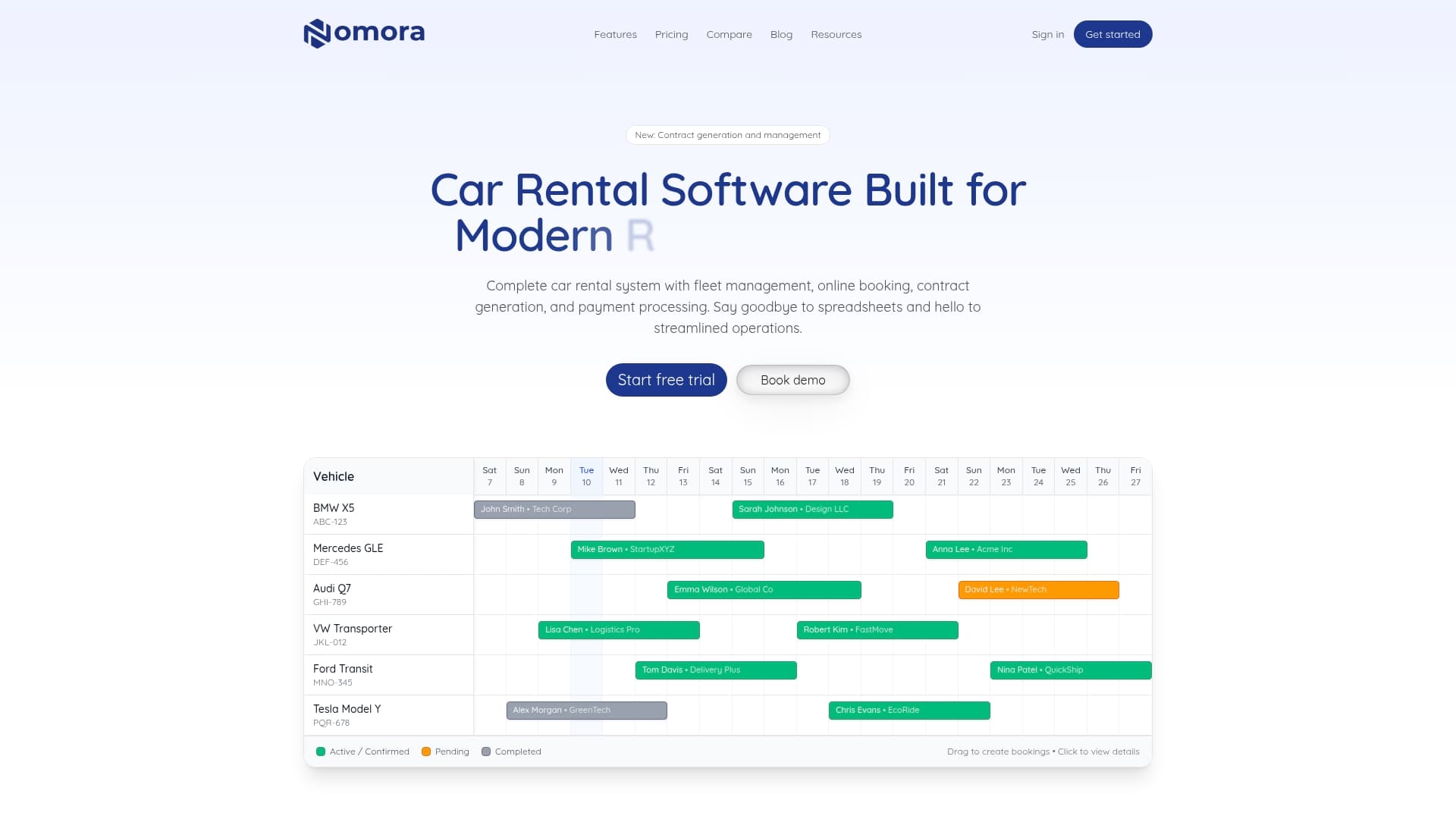
Integrate automated car rental payments directly into your contracts, capturing authorizations, processing deposits, and handling damage charges seamlessly. This eliminates payment disputes and improves cash flow predictability.
Our comprehensive fleet management software connects contract data with vehicle tracking, maintenance schedules, and utilization analytics. You gain complete operational visibility while ensuring every rental transaction follows your documented policies and procedures.
Frequently asked questions
What are the most important clauses in a car rental contract?
The essential clauses include party identification, detailed vehicle specifications with VIN, exact rental periods, payment terms with deposits, insurance coverage details, prohibited usage restrictions, damage liability definitions, fuel policies, and return condition requirements. These nine elements create legal enforceability and operational clarity.
How should I handle damage disputes with customers?
Document vehicle condition thoroughly before and after every rental using timestamped photos or videos with customer signatures. Your contract must specify 24-hour accident reporting requirements, define damage categories clearly, and outline calculation methods for repair costs, diminished value, and loss-of-use fees to eliminate ambiguity.
Do I need different contracts for different vehicle types?
Yes, specialty vehicles require tailored clauses addressing unique risks and usage patterns. Luxury cars need stricter driver qualifications and higher damage deposits. Trucks and vans require commercial use restrictions and load limit specifications. Standardize core clauses but customize restrictions and liability terms for each vehicle category.
How often should I update my rental contract templates?
Review contracts annually with legal counsel to ensure compliance with changing state and federal regulations. Update immediately when you add new services, change insurance providers, or modify fee structures. Maintain version control and document all changes to prove customers signed current terms.
Can I refuse to rent to someone who won't sign my contract?
Absolutely. Rental agreements protect your business assets and establish legal responsibilities. Customers who refuse standard contract terms present unacceptable risk. However, ensure your contracts comply with fair housing and anti-discrimination laws, and apply terms consistently to all customers to avoid legal challenges.
Recommended
Ready to streamline your car rental business?
Book 30 minutes with the founder. We set up everything in this guide on your own vehicles, and migrate you out of Excel for free.