Which integration marketplace model fits your car rental business?
Marketplaces generally offer two ways in, and the choice shapes everything after it. Booking.com, for example, documents two integration models: a redirect flow, and an end-to-end flow that is still labeled Beta, where partners check availability, present terms, preview orders and create reservations.
Redirect (search and redirect). The marketplace shows your inventory and prices in search results, then sends the customer to your own booking page. You provide accurate availability and rates, and you keep the checkout, the payment and the customer relationship. The build is lighter, but you must keep your site's prices in step with what the marketplace displays.
End-to-end. The marketplace owns the whole booking experience, and your system answers each step through the API. The documented sequence runs in this order:
- Search for vehicles in a location and date range.
- Retrieve supplier, depot and vehicle details.
- Check availability for the chosen vehicle.
- Present the terms and conditions.
- Preview the order with the final price breakdown.
- Create the order.
The trade-offs are practical. Redirect gives you control of the booking experience, your branding and your rate logic, but it adds friction when customers hop between sites. End-to-end gives a smoother customer path and more bookings that complete, but you take on reconciliation, refund handling and strict display rules. Approval for end-to-end is often gated, so confirm access with the marketplace's partner team early.
If you run a small fleet with one developer or none, choose redirect. If you already expose clean availability and pricing endpoints, plan for end-to-end as phase two.
What must your listing and booking pages show before launch?
Marketplaces do not only test whether your feed connects. They review what the customer sees. Expedia's launch requirements focus on price breakdowns, payment timing, taxes, fees, security and accurate rental information, because a technically healthy feed can still produce a misleading checkout page.
Your pages should cover these points:
- Total rental price shown clearly, with taxes and fees broken out, including one-way fees.
- Payment timing: whether the customer pays now or at the counter.
- SSL on every page that collects personal data.
- Cancellation policy and terms, visible before the customer commits.
- Vehicle attributes: car class, passenger and luggage capacity, transmission, permitted mileage and fuel policy.
- Pickup and drop-off details: depot address, hours and instructions.
- Traveler country and billing information, collected where the marketplace requires them.
Optional extras need special care. Expedia's documented pricing display treats optional add-ons as paid at the counter, so do not fold them silently into the headline price. Show them as separate, clearly labeled choices with their own cost. The exact obligations vary by rate type and booking channel, so check the current requirements for the channel you are joining.
Some regions add their own disclosures, and marketplaces may ask you to surface them. Do not assume a disclosure from one market carries over to another.
Pro Tip: Screenshot your own checkout from the customer's point of view, then compare it line by line with the marketplace's launch checklist before you request a review.
For a wider look at connecting the other systems around your bookings, our car rental software integrations guide covers payments, GPS and accounting.
What should your supplier onboarding package include?
Most rejected or delayed applications fail on missing data, not on code. Marketplace supplier onboarding commonly asks for business and legal details, real photos of your depots, fleet information and an XML or API integration provider, followed by a production-readiness process. Some supplier forms also limit listings to passenger cars, so commercial vans and heavy trucks may not qualify.
Prepare the package in this order:
- Legal and business documents: company registration, a named contact person, tax or VAT details where required, and confirmation of any branded locations.
- Fleet matrix: every vehicle class with doors, passenger and luggage capacity, transmission, fuel refill rules and permitted mileage.
- Depot data: full addresses, opening hours, after-hours pickup rules and which vehicle types each depot handles.
- Photos: real images of each depot, not stock photos.
- Contract and insurance summaries: short, plain-language versions that a reviewer can read quickly.
- Integration contact: the developer, or the connector partner, who will own the endpoints.
Treat this like a data project. Keep one source of truth for vehicle classes and depot hours, because the same values will feed search, availability and the terms the customer sees. If your classes are named one way in your system and another way in the marketplace's taxonomy, build the mapping table now rather than during testing.
Which API flows do you need to support?
Whether you build directly or use a connector, your system needs to answer the same set of operations. Distribution through GDS-style channels follows the same logic: Sabre's Digital Connect documents car flows built on standard OTA vehicle messages, covering rental location search, car availability search and booking. Enterprise access can involve commercial agreements and provider-specific rules.
The common operations, in the order a booking uses them:
- Location search: find depots near a point or airport.
- Availability: return vehicles and rates for the dates requested.
- Details and price breakdown: vehicle specs, taxes, fees, extras and terms.
- Payment registration or token: capture or reference the payment method.
- Create booking: confirm the reservation and return a booking reference.
- Retrieve booking: look up a reservation by your reference or the partner's.
- Modify and cancel: apply changes and refunds under the stated policy.
Pay attention to the payment boundary. Expedia's Rapid Car API separates payment-token registration from booking, so payment handling and reservation creation are distinct states. That separation simplifies reconciliation: if a booking call fails after a token exists, you can retry or release the token without guessing whether money moved.
Make booking creation idempotent. Expedia's launch requirements call for an affiliate reference ID, and the same ID should be stored with every reservation so that a retried request returns the existing booking instead of creating a duplicate.
Pro Tip: Generate the reference ID on the client side before the first booking attempt, store it, and reuse it on every retry.
If you need to map these operations to exact calls in your own stack, see our car rental API use cases breakdown. For the legacy side of distribution, our note on when to build a GDS integration helps you weigh it against modern REST.
How should you test in a sandbox before production?
A sandbox lets you break things safely, but it behaves differently from production. Sandbox inventory is sample data, and sandbox bookings do not create real reservations, so never use sandbox results for production analytics or pricing decisions.
Run these checks before you ask for a production review:
- Search parity: the same vehicle, dates and depot return the same results in the marketplace and on your own system.
- Price breakdown accuracy: every tax, fee and extra adds up to the total shown.
- Booking creation: a clean booking returns a reference, and a repeated request with the same ID does not create a second one.
- Payment token flow: success, failure and timeout paths all leave a recoverable state.
- Modification and cancellation: refunds and fee rules match the policy shown at booking.
- Retrieval: look up bookings by your affiliate or reference ID.
- Edge cases: one-way fees, optional extras, both payment-timing modes, and any region-specific fuel disclosures that apply.
Remember that reviewers judge the customer-facing display, not only your API responses. Walk through the full checkout as a customer would, on a phone and on a desktop, before you submit.
What does a realistic implementation roadmap look like?
Work through the phases in order, and assign an owner to each.
- Gather data (ops): fleet matrix, depots, legal documents, photos.
- Choose the model (product, a few days): redirect first, end-to-end later, based on developer capacity.
- Map your data model (engineering and ops): vehicle classes, rate plans, taxes, extras.
- Implement endpoints or connect a partner (engineering): the duration depends on the model and the marketplace.
- Sandbox testing (engineering and ops): run every test case above.
- Production review (product): submit, respond to reviewer notes, fix display issues.
- Go-live (everyone): launch with a small set of depots first, then widen.
These durations are planning estimates, not figures from a marketplace. Adjust them to your team size.
After launch, three habits matter most. Reconcile bookings daily between the marketplace and your own records. Monitor rate parity so the marketplace price never drifts from your direct price without intent. Route support requests so staff know which channel a booking came from, and keep a short incident playbook for feed outages.
Pro Tip: Launch with one depot and one vehicle class, watch real bookings, then expand.
Once you are live, our guide to automating rental bookings covers the follow-up automation.
How do you handle data sync and real-time availability?
The hardest part of a marketplace connection is keeping your truth and theirs identical. A channel connection has to synchronize availability, rates, policies, extras, pickup and drop-off details, reservations, modifications and cancellations, not just publish vehicles. Booking.com's API design reflects this: search results are followed by availability checks, terms and an order preview before booking, which guards against stale prices, policies and availability.
Three problems recur. First, double booking when a vehicle sells on two channels at once. Solve it with a single availability ledger that every channel reads, and update it the moment a reservation is created, changed or cancelled. Second, stale rates: schedule rate pushes and verify them against what the marketplace displays. Third, partial failures: if a webhook or API call drops, a periodic reconciliation job should detect and repair mismatches.
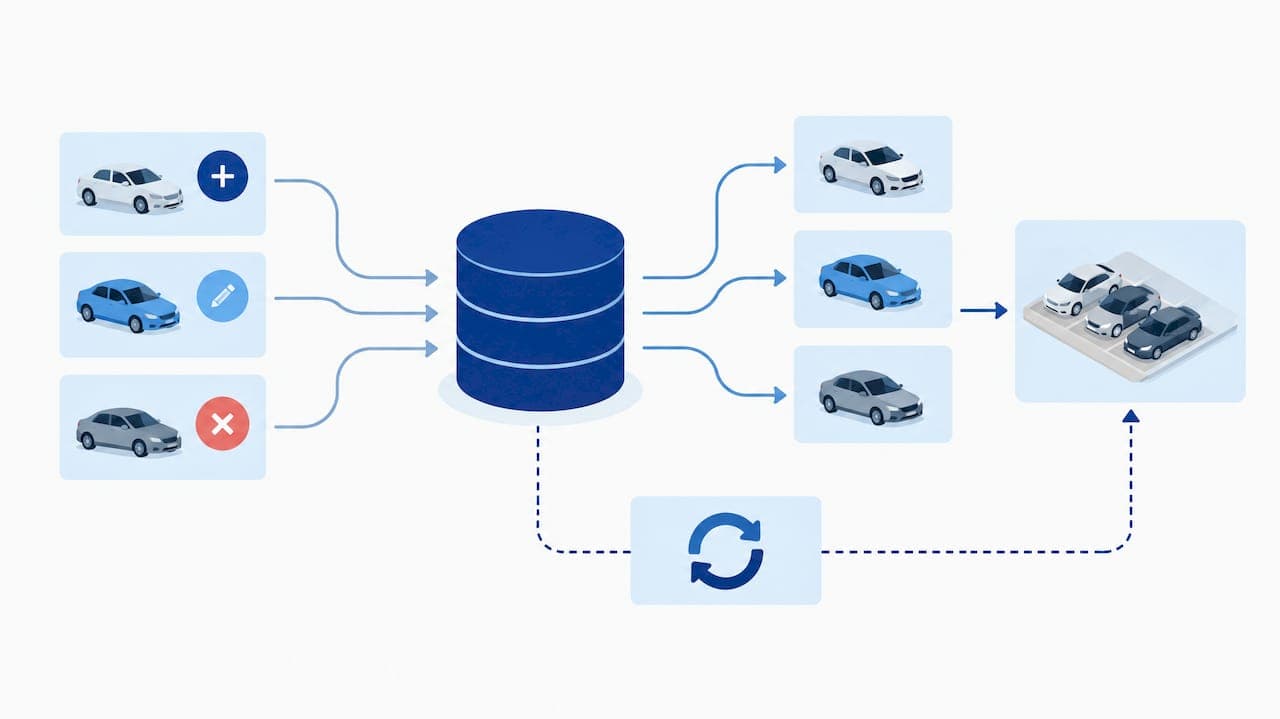
Prefer event-driven updates over nightly batches where the marketplace allows it, and keep a short buffer on high-demand vehicles so a slow sync does not oversell them.
How do you stay secure and GDPR compliant?
Marketplace bookings carry names, contact details, driving license data and payment information, so treat every integration as a data-processing relationship. Serve personal data only over SSL, which marketplaces such as Expedia require on pages collecting it. Send only the fields each partner needs, and never log full payment details or license numbers in plain text.
For data protection, consider documenting what you receive, why you receive it, and how long you keep it. Consider data-processing agreements with partners and connector vendors, role-based staff access, processes for deletion and access requests across synced copies, and a schedule for deleting stale records. Rotate API credentials, store them in a secrets manager rather than in code, and keep an audit trail of who accessed bookings.
If you process payments, consider using a payment provider to handle card data and handle only tokens, which fits the payment-token separation described earlier. Review your setup whenever you add a channel, because each new partner adds a new data flow.
What do successful integrations have in common?
Public, named success stories with verified numbers are rare, so we will not invent any. What the documented launch processes show is a consistent pattern in operators who get through review quickly.
They prepare the onboarding package before approaching the marketplace, with real depot photos and a clean fleet matrix. They pick one model and ship it, rather than building end-to-end on day one. They treat the customer-facing checkout as the product, validating price breakdowns and payment timing the way a reviewer would. And they store a reference ID with every reservation from the start, so duplicates and reconciliation never become a crisis.
For broader context on how these channels fit together, AltexSoft's overview profiles the major car rental APIs, GDSs and OTA integrators, and explains that legacy GDS-style interfaces and modern REST APIs both distribute inventory today. Expedia's own partner program page describes distribution across Expedia, Carrentals.com and a B2B network, though that is the provider's own description of its reach.
Operators usually choose among three routes, and each fits a different team.
Direct API build. You implement the marketplace's endpoints yourself. This gives the most control and the most work, and suits teams with dedicated engineers and a long-term plan for end-to-end booking.
Connector or channel manager partner. A provider already certified with the marketplace handles the protocol, and you supply data. This is the fastest way to a redirect or XML listing and the usual path for small fleets, since marketplaces commonly ask for an XML or API integration provider anyway.
Rental management platform with built-in integrations. Your core system, with reservations, fleet, payments and contracts, exposes the data marketplaces need, so there is one source of truth instead of a bolt-on feed.
Judge any option on the same questions: which marketplaces it is already approved with, how it handles availability sync and idempotent retries, whether it supports your payment flow, who owns production-review fixes, and what it costs per booking or per month. Ask for a sandbox demo before committing, and verify claims against the marketplace's own documentation. Our car rental API integration guide goes deeper on the developer side.
How do you improve the customer experience after launch?
Passing review is the floor. Conversion comes from the details customers notice.
Show the full price early and keep it stable through checkout, since a total that jumps at the last step is the fastest way to lose a booking. Write vehicle names and classes the way customers think, with a plain note on capacity such as how many suitcases fit. Make the fuel policy, mileage allowance and deposit visible without a click. Keep extras optional and clearly priced, and explain what each one does in a single sentence.
Make pickup instructions concrete: where the desk is, what to bring, and what happens after hours. Use real photos of your depots and vehicles. On mobile, keep forms short and let the browser autofill traveler details. Finally, read your bookings and support tickets by channel each month. Repeated questions about deposits or fuel are a sign a listing field is unclear, and fixing it costs far less than repeatedly answering the same ticket.
What I would tell an operator starting today
Speed and control pull in opposite directions, and pretending otherwise wastes months. A redirect integration gets you in front of marketplace demand quickly and keeps your checkout in your hands. End-to-end rewards you with smoother bookings but punishes sloppy data and weak reconciliation. Start with the first, earn the second.
The unglamorous work decides the outcome: accurate data, one reference ID per reservation, idempotent retries and a sandbox pass that mirrors what a customer sees. Most delays I would expect come from a missing depot photo or a mismatched vehicle class, not from clever engineering. Build your onboarding package before you email a partner team, and you will move faster than operators who start with the code.
— Dizzy
How we help you connect to marketplaces faster
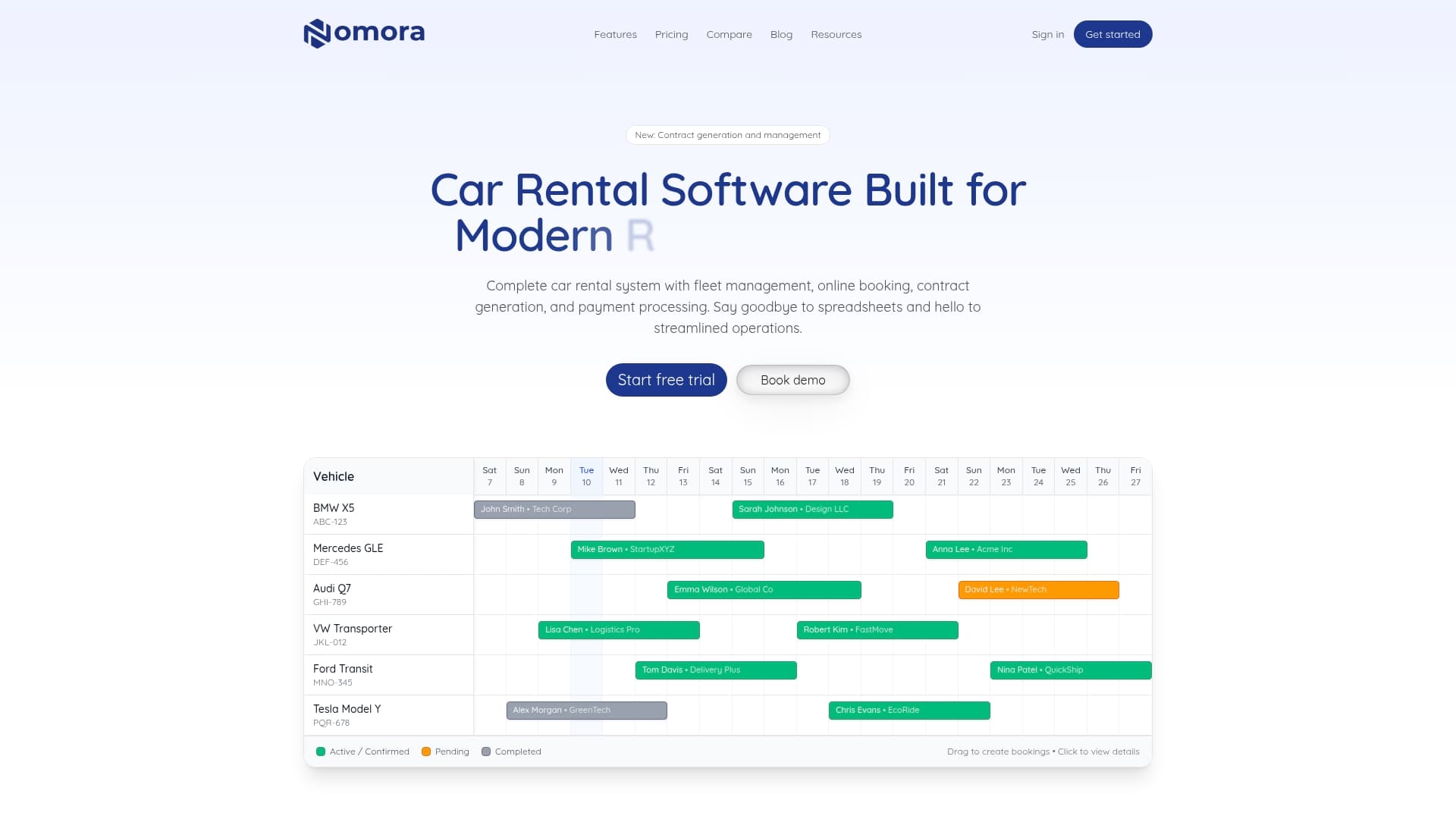
If you would rather not stitch these pieces together yourself, we built Nomora to carry the load. Our cloud platform keeps reservations, fleet data, contracts and payments in one place, so the data a marketplace asks for already lives in a single, current source of truth. You get real-time booking, GPS tracking and integrated payments without maintaining separate spreadsheets.
We onboard operators to help them get fully operational, and every plan includes all features. See what fits on our pricing page, read how the car rental software works, or browse use cases by business type. When you are ready, explore the platform.
FAQ
Which car rental companies should you avoid?
Judge any company on how clearly it states its total price, fees, deposit and cancellation terms before you pay. Vague pricing or hidden counter charges are the warning signs. Marketplace launch rules push suppliers to show taxes, fees and payment timing up front, which is why reading the breakdown matters.
Should I start with a redirect or an end-to-end integration?
Most operators with limited developer time should start with redirect. It keeps your checkout and customer relationship in your hands and needs a lighter build. Move to end-to-end, which Booking.com documents as a search-to-order sequence, once your availability and pricing data are reliable.
What does a rental management system need to connect to marketplaces?
It needs accurate fleet, depot and rate data, plus endpoints or a connector for search, availability, booking, retrieval and cancellation. It should also store a reference ID with each reservation. These requirements follow what Expedia's launch rules ask partners to support.
How can you find a lower rental price?
Compare the total price, not the headline rate, since taxes, one-way fees and counter-paid extras change the final cost. Check whether payment is due now or at pickup, and read the fuel and mileage terms. Marketplaces that follow price-display requirements make these differences easier to see.
Sources
Recommended