What Do Sabre, Amadeus, and Travelport Offer for Car Rental?
Three systems dominate car rental distribution: Sabre, Amadeus, and Travelport. Each documents a similar lifecycle, shop, retrieve, modify, cancel, but the protocols and access models diverge enough to change your build timeline.
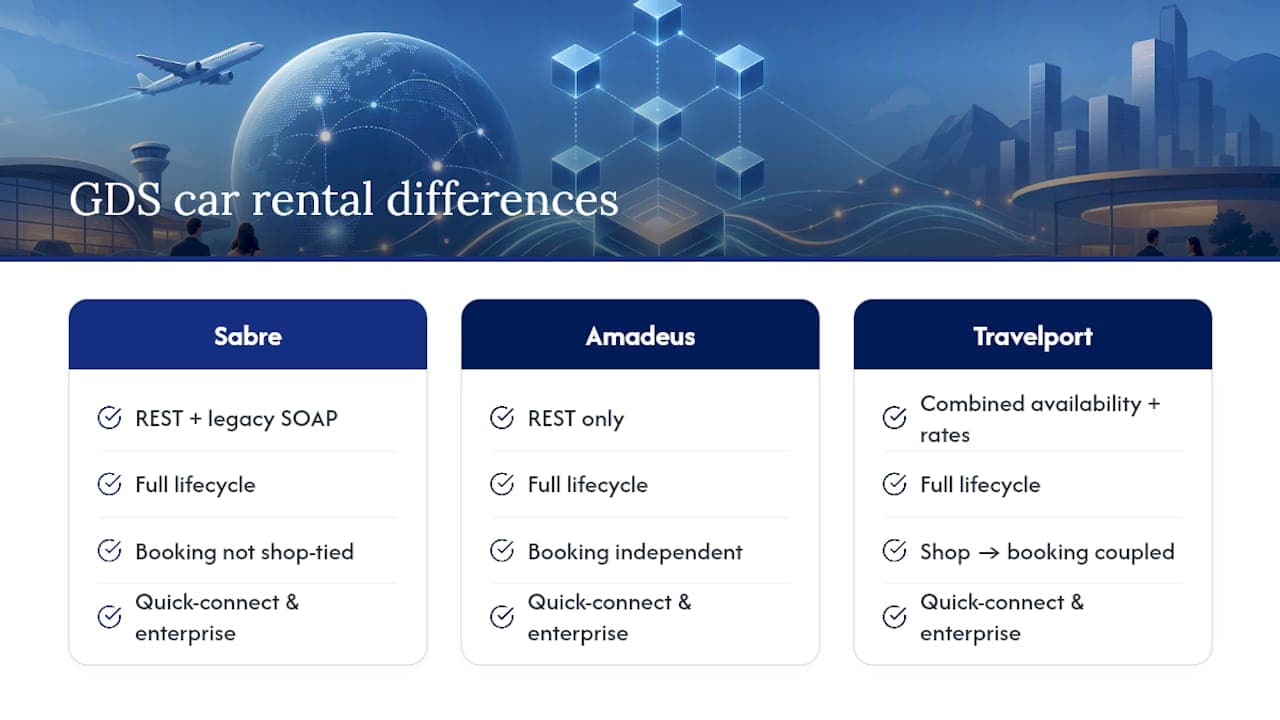
Sabre runs both a modern REST product line and a legacy SOAP stack still in wide use among agencies that never migrated off it. Its Car Reservation developer hub documents the full lifecycle, and the SOAP side still requires WSDL handling if you're connecting to older agency infrastructure. That dual protocol reality is the single biggest source of underestimated timelines in Sabre integrations.
Amadeus takes a cleaner path. Its Cars Quick Connect suite is REST based from the ground up and covers shopping, booking, retrieval, and cancellation in one enterprise product line. Teams that have already built REST clients for flight or hotel APIs on Amadeus tend to onboard car connectivity faster, because the authentication and request patterns carry over.
Travelport structures its car product around combined availability and rate responses that feed directly into booking, according to its car availability and booking documentation. That coupling means your booking call depends on data returned to the shop call, which raises the stakes for how long you persist that response.
All three vendors distinguish between quick-connect access, meant for smaller integrations with limited commercial negotiation, and full enterprise access, which typically requires a signed agreement, a certification process, and dedicated support channels. Expect a developer portal, sandbox credentials, and a certification checklist before any vendor lets you push live bookings.
What API Sequence Does a Car Rental GDS Integration Follow?
Every GDS car rental integration follows the same six-step sequence, even though the exact endpoint names differ by vendor. Sabre's own Car Reservation documentation lays this out explicitly, and Amadeus and Travelport mirror it structurally.
- Get locations (optional): resolve airport codes, rental branches, or geolocation coordinates into a location the vendor recognizes.
- Get location policy (optional): pull age restrictions, deposit rules, or cross-border terms tied to that location before you shop.
- Get Vehicle Availability: search by airport, branch, or geolocation. Sabre's Get Vehicle Availability API returns vehicle classes, rate details, and a rate key that ties the offer to that specific search.
- Price check: revalidate the rate immediately before booking. This is not optional. Sabre's own booking documentation describes the Get Vehicle Availability to Vehicle Price Check to Enhanced Vehicle Book pattern, where the price check returns a booking key used to create the reservation.
- Book: submit the booking key along with renter and payment details.
- Retrieve, modify, cancel: support all three, not just booking. Amadeus explicitly positions its Cars Quick Connect suite as a full lifecycle product, and a design that skips retrieval or cancellation is operationally incomplete the day a customer needs to change plans.
The rate key and booking key are the connective tissue of this whole flow. A rate key represents a specific offer at a specific moment; a booking key confirms that offer survived a fresh price check. Treat both as time-limited tokens, never as stable identifiers you can cache for hours.
Idempotency matters here more than in most travel APIs, because a duplicate booking call means a duplicate car reservation and a real financial exposure. Generate a unique request ID for every booking attempt and store it alongside the response, so a retried call after a timeout doesn't create a second reservation. When a price check returns a changed rate or a sold-out response, surface that to the calling application immediately rather than silently retrying with stale data.
Pro Tip: Log the full price-check response, not just the final price, before every booking call. When a customer disputes a charge weeks later, that stored response is the only record of exactly what rate and terms they agreed to at the moment of booking.
How Do Vendor Data Models and Protocols Differ?
Sabre, Amadeus, and Travelport model the same booking lifecycle differently enough that a canonical layer in your own system isn't optional. Sabre pairs REST endpoints with legacy SOAP support and its rate key and booking key pattern. Amadeus keeps things REST-only through Cars Quick Connect, covering the full lifecycle without a separate legacy track. Travelport ties its car availability directly to the booking step, according to its own documentation, which means offer identifiers from the shop response must survive intact into the booking call or the reservation will fail.
Vehicle-class handling is where a surprising number of integrations break in testing. GDSs return standardized class codes, not guaranteed makes or models, according to Sabre's own car migration guide. A code representing a compact SUV might map to three different vehicles depending on supplier and location. That's why every car rental confirmation says "or similar" instead of naming a specific model, unless the supplier contract explicitly guarantees a make and model. Build your display layer around that ambiguity from day one rather than retrofitting it after a customer complaint about the car they actually received.
What Should Be on Your Pre-Build Checklist?
A GDS car rental software integration fails less often from bad code than from skipped groundwork. Before writing your first request, work through both the commercial and engineering sides.
Commercial groundwork:
- Negotiate enterprise access if you need full lifecycle support beyond quick-connect limits.
- Confirm certification requirements and timelines with each vendor before committing to a launch date.
- Get SLA terms in writing for API uptime and support response times.
Engineering groundwork:
- Define canonical models for reservation, vehicle, rate, location, and policy before touching vendor-specific payloads.
- Set up authentication, IP allowlisting, and TLS configuration for both sandbox and production environments.
- Confirm sandbox credentials and, for any SOAP-based vendor, a WSDL-compatible client. Carnect's OTA2007A getting-started guide documents the SOAP headers, staging URLs, and IP allowlisting requirements typical of this integration style.
Normalization deserves its own line item. Don't collapse a rate response into a single total price. A canonical rate model needs base rate, taxes and fees, mileage and fuel terms, deposit or guarantee requirements, cancellation rules, included extras, and the supplier's own booking identifiers, according to Sabre's car shopping documentation. Collapse that detail early and you'll rebuild your entire pricing layer the first time a checkout total doesn't match what the customer was quoted.
PCI scope and GDPR touchpoints show up wherever payment and renter data cross your system. Even if the GDS handles payment tokenization, your platform still stores renter names, license details, and often partial payment data, all of which need a documented retention policy.
Pro Tip: Store the raw vendor response alongside your normalized model, not just the normalized version. When a supplier's rate structure changes without notice, that raw payload is what lets you debug the mismatch instead of guessing.
How Should You Test and Roll Out a GDS Integration?
Testing a GDS integration for car rental properly means treating the sandbox as a production rehearsal, not a checkbox. Vendors like Carnect explicitly recommend verifying staging cancellations before touching production, per their OTA2007A documentation.
- Sandbox and staging first. Test SOAP or WSDL behavior against sample endpoints, and confirm your sandbox environment actually mirrors production data structures, not just the happy path.
- Build contract tests from real search responses. Capture actual availability and price-check payloads, then use them to force price-change and sold-out scenarios in your test suite rather than relying only on synthetic data.
- Test retry and idempotency logic explicitly. Simulate a timeout mid-booking and confirm your system doesn't create a duplicate reservation on retry.
- Roll out one supplier and one location family at a time. Expanding city by city or supplier by supplier, backed by the contract tests above, isolates failures fast instead of debugging five variables at once. Sabre's own guidance points toward this phased pattern, testing boundary times and non-airport locations before scaling further.
- Reconcile constantly. Match external bookings against your internal fleet inventory daily during rollout, and build a defined process for transactions that land in an uncertain state, confirmed by the GDS but not yet reflected internally, or vice versa.
Monitoring doesn't stop once you're live. Booking volume through a GDS channel can spike unpredictably around fare sales or agency promotions, and a reconciliation gap that goes unnoticed for a week turns into a fleet double-booking that no customer wants to discover at the counter.
Is GDS Integration the Right Choice for Your Business?
GDS connectivity earns its cost when a rental business needs broad channel distribution, OTA presence, and travel agent bookings flowing into one centralized system. For a small operator focused on direct website bookings, the certification overhead and protocol complexity rarely pay for themselves; a direct booking engine or a management-platform integration usually covers the need with far less engineering investment.
Cost and timeline scale with three factors: how many suppliers you're connecting, whether any of them still require legacy XML or SOAP handling, and how much mapping complexity your vehicle and rate models require. A single REST-based Amadeus integration with one supplier is a fundamentally different project than a multivendor build spanning Sabre's legacy SOAP stack and Travelport's coupled availability model.
The operational tradeoff is real in both directions. Distribution reach through a GDS opens booking volume you can't get any other way, but it also means ongoing monitoring, reconciliation, and certification maintenance that a direct-only operation never has to think about.
How Nomora Fits Into a GDS-Enabled Booking Architecture
Once GDS bookings start flowing in, something on the receiving end has to normalize them, reconcile them against your fleet, and keep payments and contracts moving without manual cleanup. That's the role a platform like Nomora's car rental software is built to play: mapping incoming booking payloads into a canonical reservation model, matching confirmed external bookings against real-time fleet availability to avoid double-booking, and handling modify and cancel flows without a spreadsheet in the loop. Integrated payments and GPS tracking sit on the same platform, so a GDS booking and a walk-in reservation get treated with the same conflict-free logic. Nomora's onboarding runs on cloud infrastructure with GDPR-aligned data handling, and most businesses are operational within 24 to 48 hours of setup.
How Do You Handle PNR Data in a Car Rental GDS Integration?
A Passenger Name Record, or PNR, is the record structure GDSs use to store a booking's details: renter identity, itinerary, payment reference, and any special requests. In car rental integrations, the PNR (or its car-specific equivalent) carries the confirmation number, rental dates, location, vehicle class, and the identifiers your system needs to retrieve, modify, or cancel that reservation later.
The practical challenge is that PNR data isn't static. An agency or OTA might modify a rental date or driver detail on their end, and your system needs to detect that change rather than working from a stale copy. That means your integration should support the retrieve call as a first-class operation, not an afterthought bolted on after booking, and should run it whenever there's a reason to suspect the record changed upstream.
Retention is the other half of the problem. PNR data typically includes personally identifiable information, sometimes payment references, which puts it squarely inside GDPR scope for any business serving European customers or handling their data. Store only what you need for reconciliation and customer service, define a retention window, and make sure whichever system holds that PNR data, whether it's your own database or a platform layer, treats it with the same access controls you'd apply to payment information. Losing track of a PNR after a modification is one of the most common sources of the double-booking complaints that surface in GDS integrations.
What Are the Most Common GDS Integration Problems?
Most GDS car rental integration failures trace back to a handful of repeat offenders, and nearly all of them show up in testing if you know where to look.
Stale pricing at booking time tops the list. A rate quoted during the shop call can change by the time a customer confirms, especially during high-demand periods. Skipping the price-check step, or treating it as optional, is the single most common shortcut that causes checkout failures and customer disputes down the line.
Vehicle-class mismatches come next. Because GDSs return standardized class codes rather than guaranteed models, a poorly built display layer sometimes shows a specific car image or name that the supplier can't actually guarantee, generating complaints that have nothing to do with your integration's technical correctness and everything to do with mismatched expectations.
Duplicate bookings from retry logic happen when a network timeout triggers an automatic retry without an idempotency key attached. The booking succeeds twice, once on each attempt, and nobody notices until reconciliation.
Protocol mismatches trip up teams that assume every vendor is REST. Sabre's legacy SOAP stack, and SOAP-based suppliers like Carnect, require WSDL handling, SOAP headers, and staging URL configuration that a REST-only client can't just adapt on the fly.
Location and policy edge cases round out the list: non-airport locations, cross-border drop-offs, and boundary pickup times are exactly where sandbox testing tends to be thin, and exactly where production failures concentrate.
Does GDS Integration Improve Booking Conversion Rates?
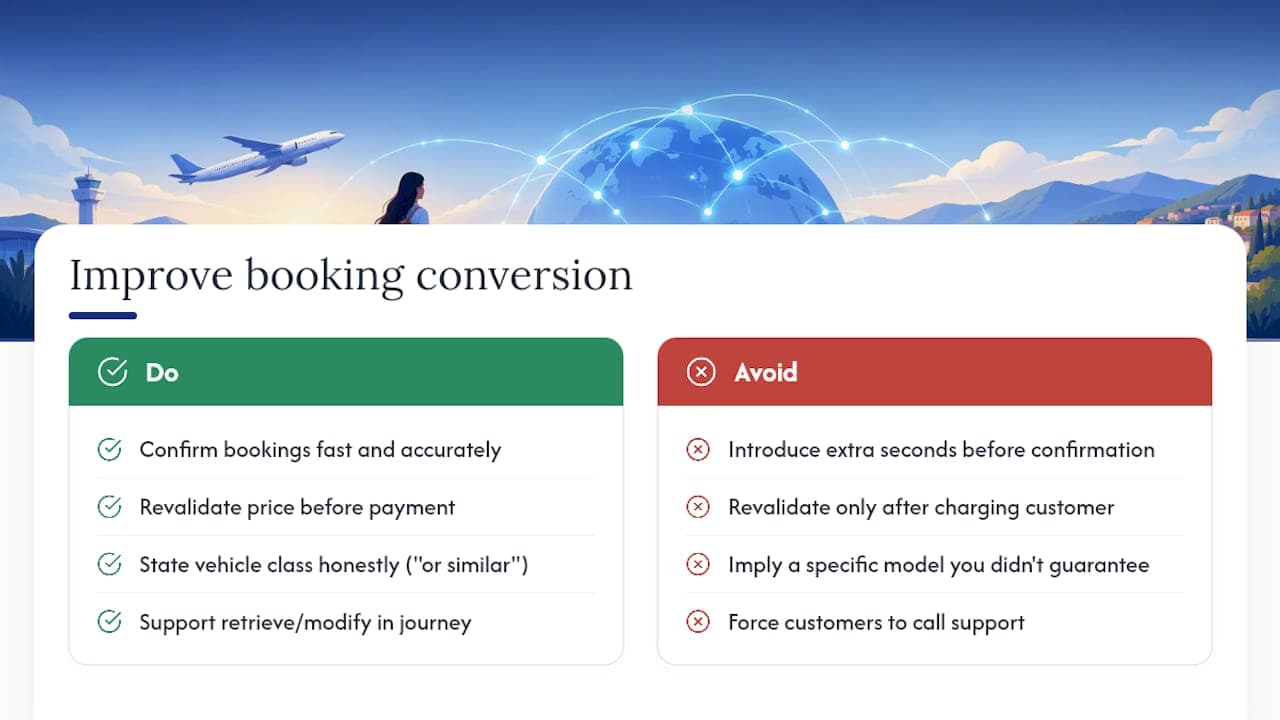
A GDS integration's effect on conversion comes down to one thing: how fast and how accurately your system can confirm a booking the customer already committed to. Every extra second between a customer clicking "book" and receiving confirmation is a chance for them to abandon the transaction or, worse, discover the price changed after they thought they'd locked it in.
Price revalidation done right actually protects conversion rather than slowing it down. A price check that catches a rate change before the customer submits payment prevents the far worse outcome: a booking that fails after payment, or a mismatched charge that triggers a chargeback and a support ticket. Customers tolerate a brief revalidation step. They do not tolerate a canceled booking after they've already been charged.
Vehicle-class clarity matters just as much on the experience side. Confirmations that clearly state "or similar" alongside an honest vehicle-class description generate fewer disputes at the rental counter than confirmations that imply a specific model the supplier never guaranteed. That's not a technical fix, it's a data-handling discipline that starts with how your integration treats the class codes coming back from the GDS.
The businesses that get the most conversion benefit from GDS connectivity are the ones treating retrieve and modify as normal parts of the customer journey, not exceptions. A customer who can check or adjust their reservation without calling support is a customer far more likely to complete that booking and come back for the next one.
What Practitioners Get Wrong About GDS Integration
Most teams treat the booking call as the hard part of a GDS integration for car rental. It isn't. The hard part is everything you do before and after it: revalidating price, preserving supplier identifiers, and handling to modify and cancel calls nobody budgets time for until a customer needs one urgently.
Start small. One supplier, one location family, contract tests built from real search responses, not synthetic fixtures. Prioritize price revalidation and idempotency handling before you optimize anything else, because those two gaps cause the support tickets that actually cost money. And never collapse rate content into a single number. Preserve the supplier's own booking identifiers and the full rate breakdown, or you will rebuild that layer under pressure later.
The engineering takeaway that matters most: a GDS integration succeeds or fails on how well it handles the moments between the calls, not the calls themselves.
— Dizzy
Nomora: Integration-Ready Software for GDS-Connected Fleets
Building GDS connectivity solves distribution. It doesn't solve what happens after a booking lands, reconciling it against your fleet, running payments, generating a rental agreement, and keeping every location's inventory conflict-free in real time. That operational layer is where Nomora fits, giving rental businesses a canonical reservation model that absorbs bookings from multiple channels without the manual cleanup spreadsheets used to require.
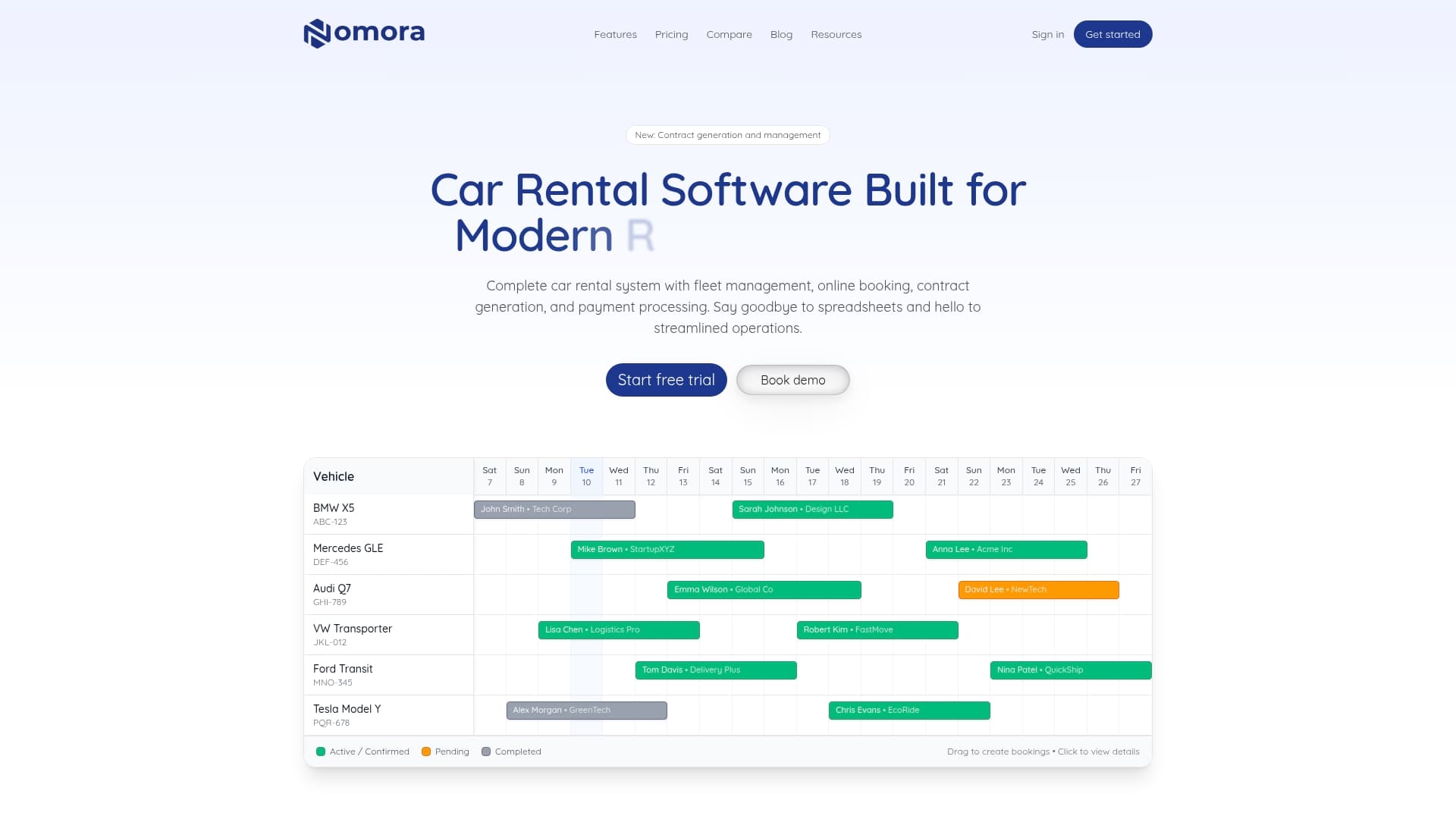
Nomora handles the pieces that sit downstream of a GDS booking: automated contract generation, integrated payment processing through its automated payment tools, GPS-based fleet tracking, and conflict-free booking logic that flags overlaps before they become a counter-side dispute. Plans run from the Starter tier at €45 per month up through per-vehicle pricing on the Business (€2.80/vehicle/month) and Fleet (€2.20/vehicle/month) tiers, with Enterprise pricing available on request, all detailed on the pricing page. If you're weighing whether GDS connectivity makes sense for your business size, the use-cases page is the fastest way to map your operation against the right plan and see what onboarding actually looks like before you commit.
Sources
Start with primary sources: the Sabre Car Reservation hub, Amadeus Cars Quick Connect, Travelport's car booking docs, and Carnect's OTA2007A guide, alongside a broader industry overview of car rental APIs for context on channel coverage.
FAQ
Which GDS Is Best for Car Rental Integration?
There's no single best option; the right GDS depends on your protocol needs and existing infrastructure. Amadeus's Cars Quick Connect suits teams wanting a clean REST-only lifecycle, while Sabre fits businesses that also need to support legacy SOAP-based agency connections through its car reservation platform.
What Car Rental Companies Should Businesses Avoid Partnering With?
This depends entirely on supplier reliability data specific to your market and isn't something a GDS integration guide can generalize. Vet potential rental suppliers on contract terms, cancellation policies, and how completely they support the retrieve and modify calls in their API, since incomplete lifecycle support is a red flag regardless of brand.
What Is the Best CRM System for Car Rental Management?
The strongest fit is usually a platform built specifically for rental operations rather than a generic CRM retrofitted for the industry. Nomora, for example, combines reservation management, fleet tracking, and payment processing in one system designed to reconcile bookings arriving through channels like GDS connections, starting at €45 per month on the Starter plan.
What Is GDS in a Travel Agency Context?
A GDS, or global distribution system, is the network that lets travel agencies and OTAs search and book inventory, flights, hotels, and rental cars, from many suppliers through one connection. For car rental specifically, the GDS handles the shop, price-check, book, and modify/cancel sequence documented in Sabre's developer hub.
How Long Does a Car Rental GDS Integration Take to Build?
Timeline depends on supplier count, whether legacy SOAP support is required, and how much vehicle and rate mapping complexity exists. A single REST-based vendor integration moves faster than a multi-vendor build spanning legacy protocols, and certification requirements from each vendor add their own review time on top of development.
Do I Need GDS Integration if I Only Take Direct Bookings?
Probably not. GDS connectivity earns its engineering and certification cost when a business needs OTA or travel agent distribution; a direct booking engine or a management platform integration typically covers direct-only operations with far less complexity.
Recommended