Car rental APIs let travel and mobility platforms search live inventory, pull vehicle and depot details, create bookings, and receive post-booking updates without manual intervention. The immediate decision that shapes everything else is architecture: pick a redirect integration if you need to validate demand fast, or commit to full-stack if conversion and control matter more than speed to launch. Everything below maps that choice to specific endpoints, tokens, and webhook behavior.
TL;DR:
- Using redirect or widget integrations allows quick market launch and demand validation but offers less control and incomplete attribution data.
- Full-stack API integration provides maximum booking and data control but requires significant development, PCI compliance, and longer deployment time.
- Key steps include caching static depot and vehicle data, handling webhook delays with robust idempotency, and testing full booking flows thoroughly before production.
- Start with demand validation through redirect or widget before moving to full-stack, ensuring enough volume to justify the engineering effort and reconciliation costs.
- Nomora supports operations post-booking, automating fleet management, payments, and customer data, and can onboard small fleets in 24 to 48 hours.
Table of Contents
Car Rental API Use Cases Every Product Team Should Know
Most teams underestimate how many distinct products experiences a single rental API can support. The use cases split roughly into discovery, transaction, and fleet-management categories, and each demands different endpoint sequences and data handling.
- Discovery and comparison in OTAs. Flight-plus-hotel-plus-car bundles rely on parallel search calls against car inventory, often normalized alongside other travel products in the same results page.
- In-platform booking vs. affiliate referral. A full-stack flow keeps the customer on your domain through payment; an affiliate flow hands them to the supplier's checkout, sacrificing conversion for simpler integration.
- Marketplace and aggregator patterns. Platforms pulling from multiple suppliers need offer normalization logic, since price fields, cancellation terms, and vehicle categories rarely match across providers like Sabre, Amadeus, Travelport, and CarTrawler.
- Telematics and carsharing features. Remote unlock, live GPS location, odometer readings, and fuel level typically come through a companion telematics layer rather than the booking API itself.
- Long-term and corporate fleet rentals. These flows need extended date ranges, driver-profile fields, and often invoice-based rather than card-based payment timing.
- Ancillary upsell and payment timing. Insurance, GPS units, child seats, and the choice between pay-now and pay-at-depot all shift how you structure the offer and the checkout payload.
Each of these use cases pulls from the same underlying flow. The difference is which fields you expose and how much of the transaction you own.
Four architecture options exist, and the right one depends on your timeline and how much of the booking journey you need to control.
A redirect or affiliate integration is the fastest path to market. The partner hosts checkout, you avoid PCI scope entirely, and you can be live in days rather than months. The tradeoff is real: you lose the customer at the moment of highest intent, and attribution data often comes back incomplete.
A widget or hosted UI integration splits the difference. The rental flow lives inside an iframe on your page, giving you brand consistency without full payment liability, though full-stack integrations generally increase conversion because nothing pulls the user off-platform.
A full-stack API integration gives you maximum control: custom UI, in-house payment processing, and real-time fleet visibility. It also requires a signed partner agreement, PCI compliance work, and settlement reconciliation you'll need to build or buy.
Hybrid migrations are common in practice. Launch redirect to prove demand, then rebuild the highest-value routes (say, airport pickups in your top five markets) as full-stack once volume justifies the engineering cost.
- Redirect: fastest, lowest control, partner-hosted payment
- Widget: moderate speed, shared UX ownership
- Full-stack: slowest to launch, highest conversion and data ownership
- Hybrid: redirect first, full-stack for proven high-value flows
Pro Tip: Don't commit to full-stack before you have booking volume data from a redirect or widget test. Reconciliation and settlement logic cost real engineering time, and you want proof the traffic converts before you build it.
The End-to-End API Flow, Step by Step
Every major car rental API, from Booking.com's Demand API to Expedia's Rapid Car API, follows a similar sequence. Here's the order engineers should build and test against:
- Search. Send pickup and dropoff location, dates, driver age, and currency. Results are typically bounded, with providers like Booking.com returning up to 200 cars per request.
- Retrieve static details. Pull car ID, supplier name, and depot coordinates once, then cache this data. It changes infrequently and doesn't need a live call on every page load.
- Check availability. Confirm the offer using the search token, and pull the full price breakdown including any optional extras.
- Display terms and conditions. Some jurisdictions and suppliers require explicit traveler acceptance before proceeding, so surface this before the preview step.
- Preview the order. Generate an order token here, and build your UI around its expiry window, typically short so users don't hit a stale preview mid-checkout.
- Create the booking. Submit driver and booker details, a payment token, payment method, and timing (pay now vs. pay at depot), then generate a receipt.
- Handle post-booking actions. Support retrieving order details, processing cancellations and amendments, and reconciling completed transactions against your ledger.
Skipping the caching step in stage 2 is the most common performance mistake teams make. Static depot and car data doesn't need a fresh API call every time a user views a listing.
Webhooks and Post-Booking Sync Best Practices
Webhooks are where most car rental integrations quietly break, usually because teams treat notifications as guaranteed-order events when they aren't.
Providers send order update notifications to a registered HTTPS endpoint, and notifications can arrive delayed or out of sequence. That means your endpoint needs authentication in place before registration, and your processing logic needs to assume messages won't always land in the order they were sent.
- Register your webhook URL with HTTPS and proper authentication before going live.
- Use the
last_modified field and reservation identifiers to prevent an older notification from overwriting newer state.
- Acknowledge every delivery with a 2xx response immediately, then push heavy processing to a background worker.
- Build deduplication logic for repeated deliveries; only call back to the order details endpoint when the webhook payload itself lacks enough information to act.
- Log every delivery for monitoring, set up retry alerts, and run a daily reconciliation job against your booking database.
Pro Tip: A webhook handler that takes too long to respond risks triggering provider retries, which then generate duplicate processing on your end. Keep the handler lightweight, acknowledge fast, and do the real work asynchronously.
Idempotent design isn't optional here. It's the difference between a booking system that stays accurate under load and one that silently drifts out of sync with supplier records.
Search Filters, Response Fields, and Telematics Signals
The fields you expose in search and results directly shape conversion. Most providers support location input by airport code, city ID, or geographic coordinates, with sorting options by price, distance, or review score.
- Vehicle attributes: transmission type, air conditioning, seat count, and mileage policy (unlimited vs. capped).
- Depot metadata: depot type (airport counter, off-site shuttle, city branch), coordinates, contact details, and pickup instructions.
- Pricing fields: payment timing (pay now vs. pay at depot), currency, mandatory fees, and cancellation policy terms visible before checkout.
- Telematics signals: remote unlock, live GPS position, odometer readings, and fuel level, usually surfaced through a separate integration layer with its own consent and access controls rather than the core booking API.
Treat telematics as a distinct technical project. The privacy and consent requirements differ enough from standard booking data that bundling them into the same sprint usually causes delays on both fronts.
How to Evaluate and Choose a Car Rental API
Before committing engineering time to any provider, run through a short checklist that covers business fit, technical readiness, and commercial terms.
- Inventory fit: does the provider aggregate multiple suppliers, or connect you directly to one fleet operator? Aggregator models suit marketplaces; direct connections suit focused regional plays.
- Technical readiness: confirm sandbox access, documented rate limits, sample payloads, and a clear webhook delivery model exist before you scope a sprint.
- Commercial terms: review the partner agreement for settlement timing, liability allocation, and reporting access.
- Acceptance testing: run full booking create, cancel, and amend cycles in sandbox, plus webhook delivery tests, before any production traffic touches the integration.
- Launch metrics to track: conversion rate through checkout, booking failure rate, webhook delivery success rate, and refund/cancellation rate in the first 30 days.
A structured integration approach at this stage saves far more time than it costs, particularly on the acceptance-testing step teams tend to rush.
Where Nomora Fits After the Booking Is Created
An inventory API gets the reservation created. What happens next, contracts, payment capture, fleet assignment, customer records, is where operational software takes over. Nomora handles that layer: reservations, fleet management, automated contract generation, payments, and customer data in one system.
- Webhook ingestion feeds booking updates straight into fleet and reservation records.
- Payment gateway and GPS/telematics connectors sync post-booking financial and vehicle data automatically.
- Onboarding runs in 24 to 48 hours, fitting small independent operators as easily as enterprise fleet networks.
Pairing an API booking layer, whether that's Booking.com's Demand API, Expedia's Rapid Car API, or a GDS connection, with an operations platform built for the reservation-to-return lifecycle closes the loop the booking API was never designed to handle.
First Steps for Teams Integrating Car Rental APIs
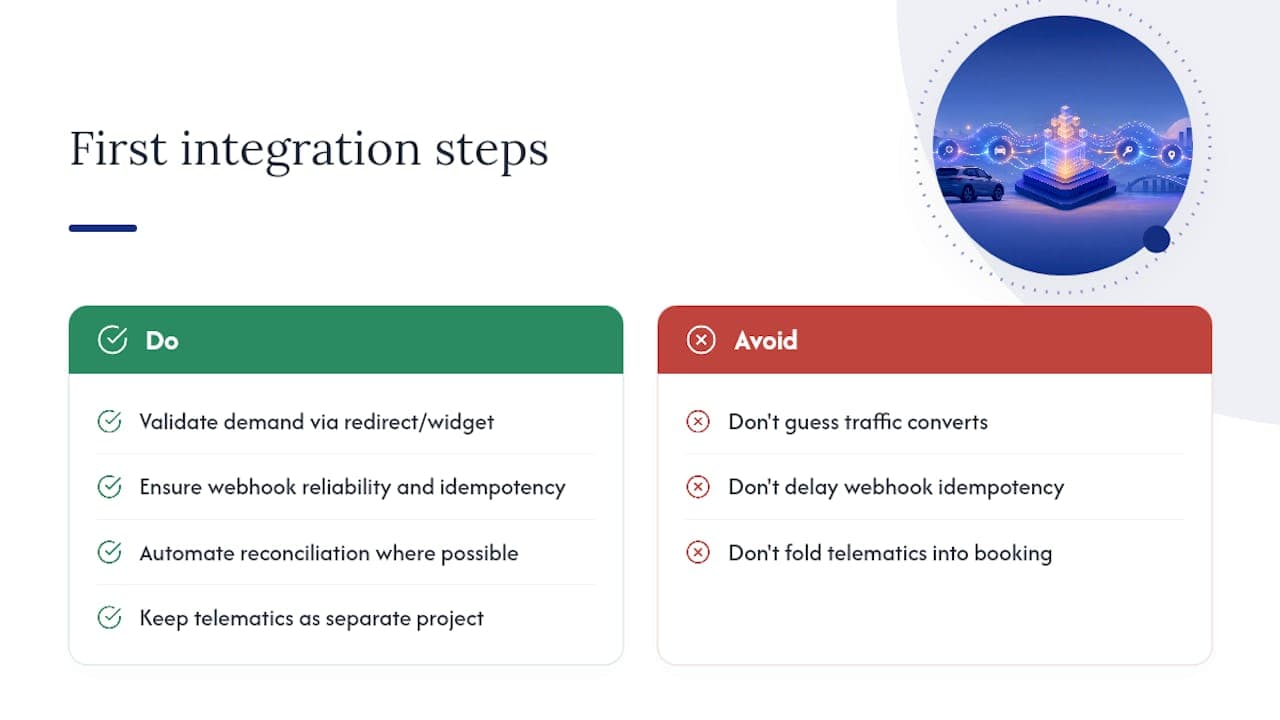
Validate demand with a redirect or widget integration before investing in full-stack. It's cheaper to prove the traffic converts than to guess.
Get webhook reliability and idempotent processing right early. Teams that treat this as a later optimization end up rebuilding reconciliation logic under production pressure, which is a far worse place to discover an edge case. Automate reconciliation wherever possible, and keep telematics as its own project with explicit privacy controls rather than folding it into the booking sprint.
— Dizzy
An operations layer picks up where the booking API leaves off. Instead of stitching together spreadsheets for contracts, payment tracking, and fleet status after every reservation, such systems automate reservations, fleet management, GPS tracking, contract generation, and payments in one cloud-based platform, with features included across plans and no hidden fees.
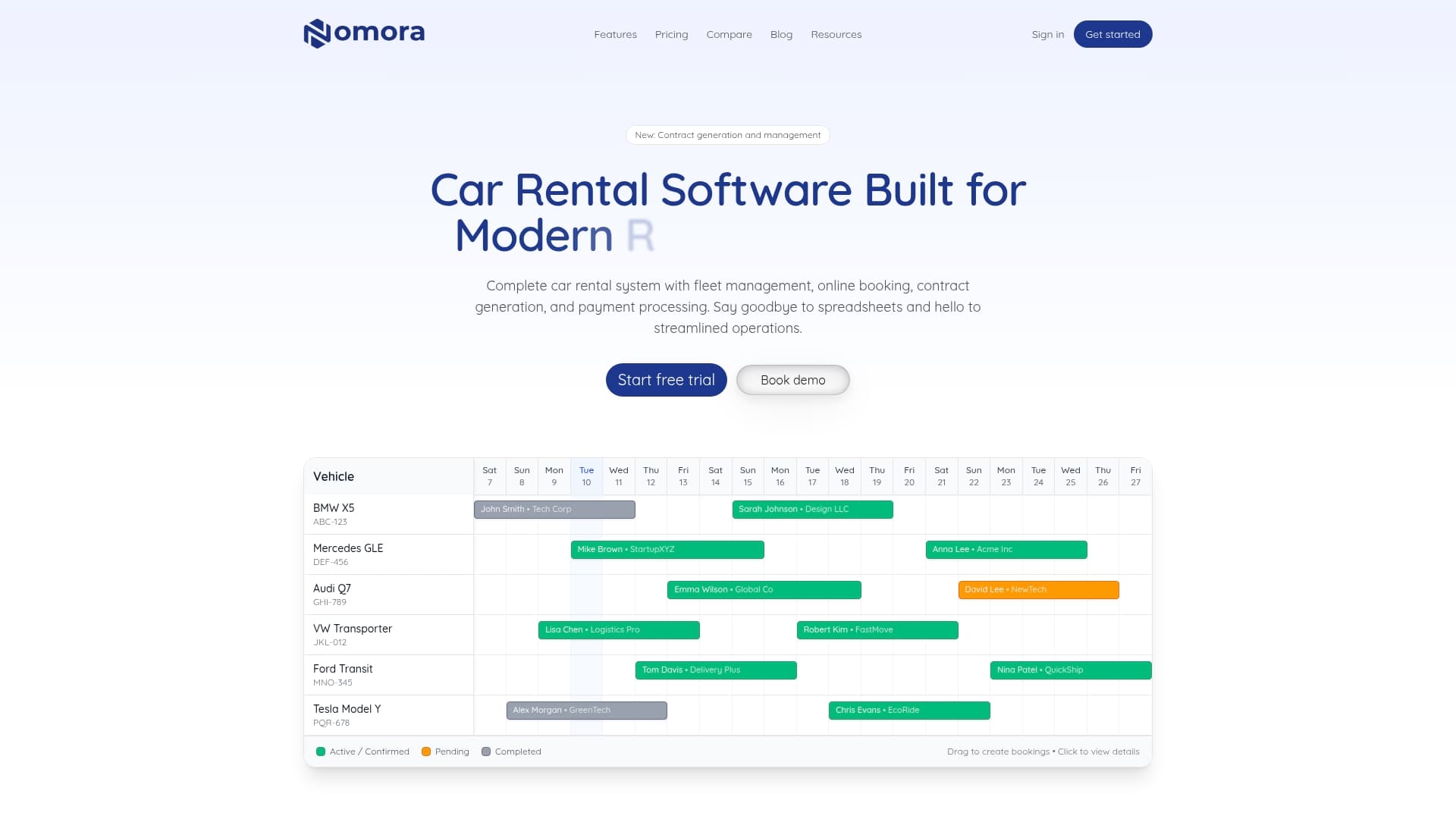
Whether you're running a handful of vehicles or coordinating a corporate fleet network, Nomora gets you operational in 24 to 48 hours rather than weeks. See how the Starter, Business, and Fleet plans map to your fleet size, or check the use-case breakdown by business type to see where your operation fits.
Sources
FAQ
What Can You Actually Build With a Car Rental API?
A car rental API supports search, vehicle and depot detail retrieval, live availability checks, booking creation, and post-booking actions like cancellations and amendments. The exact capabilities vary by provider, but most major APIs follow this same search-to-order sequence.
Should I Start With a Redirect Integration or Full-Stack?
Start with redirect or widget if you need to validate demand quickly, since it requires far less engineering and no PCI compliance work. Move to full-stack once booking volume justifies the investment in payment processing and reconciliation, since full-stack flows typically convert better.
Why Do My Webhooks Arrive Out of Order?
Provider systems can queue and retry notifications independently of the actual event timeline, so delivery order isn't guaranteed. Always check the last_modified field before applying a webhook update, so an older, delayed message can't overwrite newer state.
Which Providers Should I Consider for Inventory?
Options range from GDSs like Sabre, Amadeus, and Travelport to aggregators like CarTrawler and direct APIs from Booking.com or Expedia, plus telematics-focused providers like Smartcar for vehicle-level data. Each fits a different inventory and business model, so the right choice depends on whether you need broad aggregation or direct fleet access.
Does Nomora Replace a Car Rental Booking API?
No. Nomora operates after a reservation is created, handling fleet assignment, contracts, payments, and customer records, while a booking API like Booking.com's or Expedia's handles search and reservation creation. Many teams run both together, with Nomora plans priced per vehicle starting at $2.20 to $2.80 per month depending on fleet size.
Recommended
Ready to streamline your car rental business?
Book 30 minutes with the founder. We set up everything in this guide on your own vehicles, and migrate you out of Excel for free.