The right way to handle car rental API integration is a modular, API-led setup: REST endpoints and webhooks connecting your rental management platform to payments, telematics, accounting, your website, and channel partners, all governed by a single canonical data model. This pattern avoids the tangle of one-off scripts that breaks every time a partner changes a field name.
The payoff is immediate once it's running:
- Real-time booking updates across your website and channel partners, with no double-booked vehicles
- Payments that authorize, capture, and reconcile automatically instead of waiting on manual entry
- Fleet and telematics data flowing into one dashboard instead of five disconnected apps
- Faster monthly close because accounting data arrives structured, not scraped from spreadsheets
If you're ready to move, the next step is simple: request sandbox API credentials from your integration partners and run a structured checklist against each one before writing a line of production code.
Key Takeaways
A modular, API-led integration built on a canonical data model connects payments, telematics, accounting, and channel partners faster and with fewer errors than point-to-point custom connections.
| Point | Details |
|---|
| Pick the right API type per partner | Use REST for payments and bookings, webhooks for async events, and XML/GDS patterns for legacy channel partners like Sabre or Amadeus. |
| Build a canonical data model early | Define one schema for reservations, vehicles, and rates before adding a third or fourth partner integration. |
| Minimize PCI scope with tokenization | Route card data through a dedicated payments endpoint that returns a token, keeping raw card numbers out of your core system. |
| Plan for a 4 to 11 week timeline | Discovery, development, testing, and rollout phases each need dedicated time; rushing testing creates production incidents. |
| Consider a pre-built integration layer | Nomora ships with payment, telematics, and channel integration already built, cutting onboarding to 24 to 48 hours instead of a multi-week build. |
Developer and Integration Docs to Consult Next
Table of Contents
What Are the Main Car Rental API Integration Options?
Every partner you connect to speaks one of a handful of dialects, and picking the wrong one for the job creates maintenance headaches down the line. Understanding the three main patterns lets you match the right tool to each integration target instead of forcing everything through one protocol.
- REST/JSON endpoints handle the bulk of modern integrations: availability checks, reservation creation, and payment token flows. Expedia Group's Rapid Car API is a clean example of this pattern in production, chaining search, vehicle details, a payment token endpoint, and booking creation into one sequence.
- Webhooks handle asynchronous events, things like a reservation update, a cancellation, or a fleet status change that happens outside your direct request. Build retry logic with exponential backoff here, because a partner's webhook delivery will occasionally fail or arrive out of order.
- XML/OTA and GDS-style integrations cover legacy channel partners and the major distribution networks. Sabre, Amadeus, and Travelport still run on structured XML message formats, and enterprise-level access to these systems and to aggregators like Booking.com and Expedia Group often requires direct negotiation rather than a self-serve API key.
Some smaller partners skip APIs entirely, offering white-label widgets or extranet logins instead; services like Let Us Rent Your Sprinter Van provide such partner program models for vehicle rental integrations. Treat those as a fallback, not a first choice, since they limit your control over the booking experience.
Pro Tip: Before committing engineering time to a full REST integration, check whether the partner offers a sandbox environment with realistic test data. A partner without one is signaling their API documentation may not match their actual production behavior.
How Should You Architect a Scalable Integration Layer?
Build in three layers, not one giant point-to-point mess. System APIs talk directly to your core rental platform, payment processor, or telematics provider and expose raw data. Process APIs sit above them, translating that raw data into business logic, like combining a vehicle's GPS location with its maintenance status to decide if it's rentable. Experience APIs shape that processed data for a specific consumer, whether that's your booking website, a channel partner feed, or a mobile app for roadside staff.
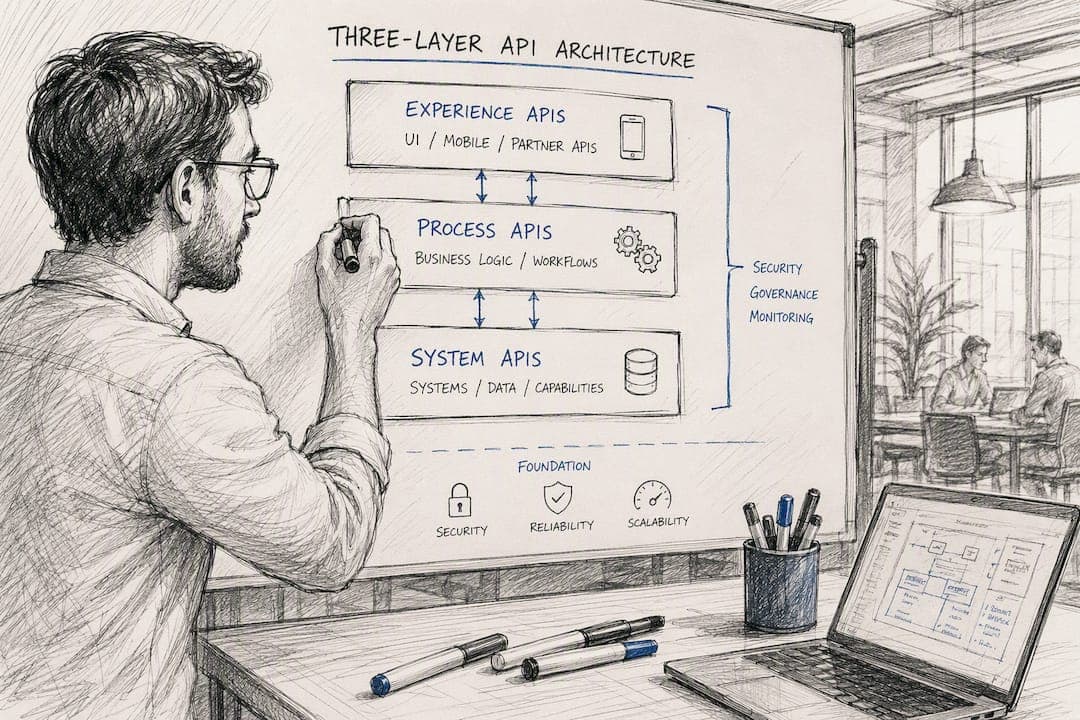
This layering matters because it isolates change. When a payment processor updates its API, you fix the system layer without touching the booking website's experience layer. A global car rental company that restructured 700-plus applications around this exact pattern reduced legacy silos and freed its IT team to build new features instead of patching integrations. That's the practical case for modular architecture over custom point-to-point connections.
A few non-negotiables for the middle layer:
- Define a canonical data model early: one schema for a "reservation," one for a "vehicle," one for a "rate," so every partner maps into the same internal shape instead of forcing your team to translate five different formats on the fly.
- Build a transaction monitoring dashboard from day one. The same case study found real-time visibility into transaction flow was essential for catching failures before customers noticed them.
- Use OAuth2 tokens with short expiration windows and rotate API keys on a schedule, not just when you suspect a breach.
- Route payment data through a dedicated tokenization endpoint so raw card numbers never touch your core reservation system, which shrinks your PCI compliance scope significantly.
Skipping the canonical model is the single most common mistake teams make. It looks faster in month one and costs three times as much in month twelve when a sixth partner joins and nothing maps cleanly.
What Data Fields and Events Do You Need to Map?
Each integration target has its own set of fields and events, and mapping them wrong is the fastest way to create reconciliation nightmares. Here's what actually needs to move between systems.
Payment gateways need a tokenization flow first: your system sends card details once, gets back a payment token, and uses that token for every future charge. Expedia's Rapid Car API models this well, with a dedicated payments endpoint separate from the booking endpoint. Beyond tokens, map authorize versus capture events separately (a hold at pickup differs from the final charge at return), plus refund and void fields, and batch your reconciliation webhooks daily rather than processing them one at a time.
Telematics and GPS providers stream different data than they store. Location pings might arrive every 60 to 90 seconds, while odometer, fuel level, and engine diagnostic codes update on a slower cycle. Map remote command fields (unlock, immobilize) with extra security scrutiny, since these are the highest-risk endpoints in your entire integration stack.
Accounting systems need invoice and settlement payloads with tax fields broken out by jurisdiction, currency codes attached to every line item, and a defined settlement frequency (daily batch versus real-time) that your finance team has actually agreed to.
Your website booking front end needs search and availability endpoints, a structured price breakdown (base rate, taxes, extras, deposits), and contract generation fields that pull customer and vehicle data automatically instead of requiring manual entry at the counter.
Channel partners need availability feeds updated in near real time, booking confirmation webhooks, cancellation flow endpoints, and rate parity flags so your published price matches across every channel simultaneously. Booking.com's Demand API illustrates the split well: some partners only support search-and-redirect, while full search-and-book access requires separate enablement.
What's a Realistic Integration Timeline and Checklist?
A full integration rollout breaks into four phases, and rushing any one of them is how teams end up debugging in production instead of sandbox.
- Discovery (1 to 2 weeks). Pull every partner's API documentation, confirm their SLA commitments, request sandbox credentials, and map their data fields against your canonical model. This is also when you run a security checklist: what data crosses the wire, where tokens live, and who owns key rotation.
- Development (2 to 6 weeks, depending on complexity). Build authentication first, then core endpoints, then your mapping layer, then webhooks with retry and backoff logic. Assign idempotency keys to every write operation so a retried request never creates a duplicate booking or double-charges a customer.
- Testing (1 to 3 weeks). Run unit tests against your mapping layer, then integration tests inside the partner's sandbox, then a full reconciliation run comparing what your system recorded against what the partner's system recorded. A canary release, routing a small percentage of live traffic through the new integration before full cutover, catches issues that sandbox testing misses.
- Rollout. Work through a cutover checklist, set monitoring thresholds that trigger alerts before customers notice a problem, hand off support documentation to your operations team, and schedule a recurring reconciliation cadence, weekly at minimum, for the first month.
Pro Tip: Run your reconciliation report before you announce a successful launch, not after. Teams that skip this step often discover missing bookings three weeks in, when they're much harder to trace back to the original failure point.
Total effort for a single mid-complexity partner integration typically lands in the 4 to 11 week range across all four phases. A payment gateway with a mature sandbox moves faster; a GDS with limited documentation and manual approval steps moves slower.
How Do GDPR and PCI DSS Apply to Rental Integrations?
Two regulatory frameworks govern almost every integration you'll build, and confusing what each one covers is a common and costly mistake.
GDPR governs personal data for European customers, and it applies the moment you collect a name, address, driver's license number, or GPS location tied to an identifiable renter. If your telematics integration tracks vehicle location while a specific customer has that vehicle rented, that location data counts as personal data under GDPR. Build data retention limits into your integration from the start, deleting location and contract data on a defined schedule rather than storing it indefinitely, and make sure any channel partner receiving customer data has a data processing agreement in place.
PCI DSS governs payment card data specifically, and the goal of your integration architecture should be minimizing how much of that scope touches your own systems. A tokenization flow, where your payment gateway or processor handles the raw card number and returns a token, keeps card data out of your reservation database entirely. This is exactly the pattern behind Expedia's payments endpoint design, and it's worth copying regardless of which payment partner you use.
Practical compliance steps that apply across both frameworks: encrypt data in transit with TLS 1.2 or higher, log every access to personal or payment data with a timestamp and user ID, and run a vendor security review before connecting any new partner, not after you've already gone live. Compliance isn't a document you file once. It's a set of habits your integration architecture either supports or fights against every day.
How Do You Handle Multiple Languages and Currencies?
Multi-currency support has to live in your data model, not get bolted on as a display trick. Store every rate, tax line, and payment amount with an explicit currency code (ISO 4217, so USD, EUR, GBP) attached at the field level, never assumed from context. A reservation created through a European channel partner and paid in euros needs that currency code preserved through every downstream system, including accounting, or your settlement reports will silently misstate revenue.
Language support works differently depending on which system you're touching. Your website booking front end typically needs full localization, translated contract language, date formats, and address fields. Channel partner integrations usually handle their own display language on their end. What matters is that your API passes structured data (vehicle class codes, not free text descriptions) so the partner's system can localize it correctly rather than displaying your raw English strings to a customer browsing in French.
Exchange rate handling deserves its own rule: lock the rate at time of booking, not at time of payment capture, and store both the original currency amount and the rate used. This prevents disputes when a multi-day rental spans a period where exchange rates shift, which happens more often than most operators expect. Your accounting integration should receive both figures so reconciliation doesn't require guessing which rate applied.
If you operate across multiple currencies and expect to add more channel partners over time, build the currency field as a first-class part of your canonical data model now. Retrofitting it after five partners are already integrated means touching every single mapping layer you've built.
How Should Rate and Inventory Data Flow Through Your API?
Rate and inventory synchronization is where most booking conflicts originate, and the fix is treating availability as a real-time state, not a nightly batch update. Every reservation, modification, or cancellation should push an immediate update to every connected channel, whether that's your own website or a third-party partner feed. A 15-minute sync delay sounds fine until two customers book the same vehicle for overlapping dates because one channel hadn't refreshed yet.
Rate management needs its own logic layer separate from inventory. Base rates, seasonal pricing, and promotional discounts should flow through a rules engine that calculates the final price at request time rather than storing pre-calculated prices that go stale. Channel partners often require rate parity, meaning your published price can't undercut what they're showing, so your API needs to enforce that rule automatically rather than relying on someone remembering to check pricing across five platforms.
Build your inventory feed around vehicle class and status, not individual VIN numbers, for anything customer-facing. Internally you track specific vehicles; externally, partners generally care whether a "midsize SUV" is available on a given date range, not which exact unit fulfills that booking. This abstraction also makes fleet substitutions (swapping one available midsize SUV for another due to maintenance) invisible to the booking system, which is exactly how it should work.
Set a maximum acceptable propagation delay for availability updates, something under 60 seconds for high-volume channels, and monitor it directly. If a channel partner's feed consistently lags, that's a reconciliation risk worth escalating before it produces a double-booked vehicle and an unhappy customer at the counter.
How Do You Manage Cancellations and Modifications Through the API?
Cancellation and modification flows need the same rigor as the original booking flow, because a poorly handled cancellation creates more reconciliation problems than a poorly handled reservation. Map three distinct events separately: a full cancellation, a date or vehicle modification, and a partial change like adding an extra driver or insurance product after booking.
Each event needs its own webhook payload with a clear reason code and timestamp. A cancellation triggered by the customer looks different downstream than one triggered by your team due to a fleet shortage, and your accounting integration needs that distinction to apply the correct refund policy. Refund logic should live in your process API layer, not scattered across individual partner integrations, so a policy change (say, moving from a 24 hour to a 48 hour free cancellation window) updates once instead of five times.
Modifications are trickier than cancellations because they often touch multiple systems simultaneously. A date change might affect rate (different season pricing), inventory (different vehicle availability), and payment (a different authorization amount) all at once. Sequence these updates carefully: confirm inventory availability first, recalculate rate second, and only then adjust the payment authorization, since reversing the order risks charging a customer for a booking that inventory can't actually support.
Channel partners vary widely in how much cancellation flexibility they expose through their API. Some, similar to how Booking.com's beta booking flow differs from its standard search-and-redirect flow, only support full cancellation through their API and require manual handling for partial modifications. Know these limits per partner before launch, not after a customer calls asking why their modification didn't process.
How Do You Manage API Versioning and Backward Compatibility?
Version every API you expose, even internal ones, using a clear scheme like /v1/, /v2/ in the URL path or a version header. This sounds obvious until your third partner integration breaks because someone added a required field to a production endpoint without warning anyone.
Deprecation needs a real timeline, not an email sent once. When you retire a version, give partners a minimum window (90 days is a reasonable industry default) with the old version still running in parallel, and send automated warnings when a partner is still calling a deprecated endpoint as the sunset date approaches. Breaking a channel partner's integration without warning damages that relationship far more than the technical fix costs.
Backward compatibility comes down to one rule: never remove a field from a response, only add new ones, and never change a field's data type once it's live. If you need to change how a field works, ship it as a new field alongside the old one and deprecate the old one on its own timeline. This is slower than making a clean break, but it's the difference between a smooth partner experience and a support queue full of confused engineers on the other end of your integration.
Document every version change in a changelog that's actually accessible to partner developers, not buried in an internal wiki. The teams integrating with your API on the other end are making the same tradeoffs you are, and clear documentation is often the deciding factor in whether they trust your platform enough to build deeper integrations over time.
Performance problems rarely show up in testing and almost always show up during peak season, which is exactly when you can least afford them. Design for your busiest day, not your average day: a holiday weekend surge in booking volume, telematics pings from a fully deployed fleet, and channel partner rate checks all hitting simultaneously.

Caching is your first lever. Availability data that changes infrequently (a vehicle class that's fully booked for the next month) can be cached aggressively, while data that changes constantly (real-time inventory during a high-demand weekend) needs shorter cache windows or none at all. Getting this balance wrong in either direction either serves stale availability to customers or hammers your database with redundant queries.
Rate limiting protects your system from a single misbehaving partner integration taking down service for everyone else. Set per-partner rate limits based on their actual traffic patterns, and return clear error codes (429, not a generic 500) when a limit is hit, so the partner's engineering team knows exactly what happened and can back off appropriately.
Database query performance matters more than most teams expect at scale. A canonical data model helps here too, since consistent field structures across partners let you optimize indexes once instead of maintaining separate query paths for every integration. Modular, loosely coupled architecture, the same pattern that let one enterprise rental operator scale transaction volume without proportional infrastructure growth, is what makes this kind of optimization possible without a full system rewrite every time volume grows.
Monitor latency at the partner level, not just system-wide. A single slow channel partner integration can create a bottleneck that looks like a system-wide performance issue when it's actually one connection dragging down response times for everyone downstream.
Where Should You Focus First, and Who Owns What?
Prioritize booking and payment integrations before telematics and accounting. Revenue depends on the first two working flawlessly; the others improve operations but rarely halt business if delayed a few weeks. Build direct integrations for high-volume partners; reach for an iPaaS layer when you're juggling many low-volume connections with inconsistent APIs. Assign clear ownership early: someone owns partner SLAs, someone owns retry logic, someone owns refund policy. Ambiguous ownership is where integrations quietly rot.
— Dizzy
Why Nomora Handles This Integration Work for You
Building the modular architecture, canonical data model, and monitoring layer described above from scratch takes real engineering time, time most rental operators would rather spend growing fleet and bookings. Nomora is built as that layer already in place: a cloud-based car rental software platform that connects reservations, fleet and GPS tracking, contract generation, and payments through the same API-led approach this article recommends.
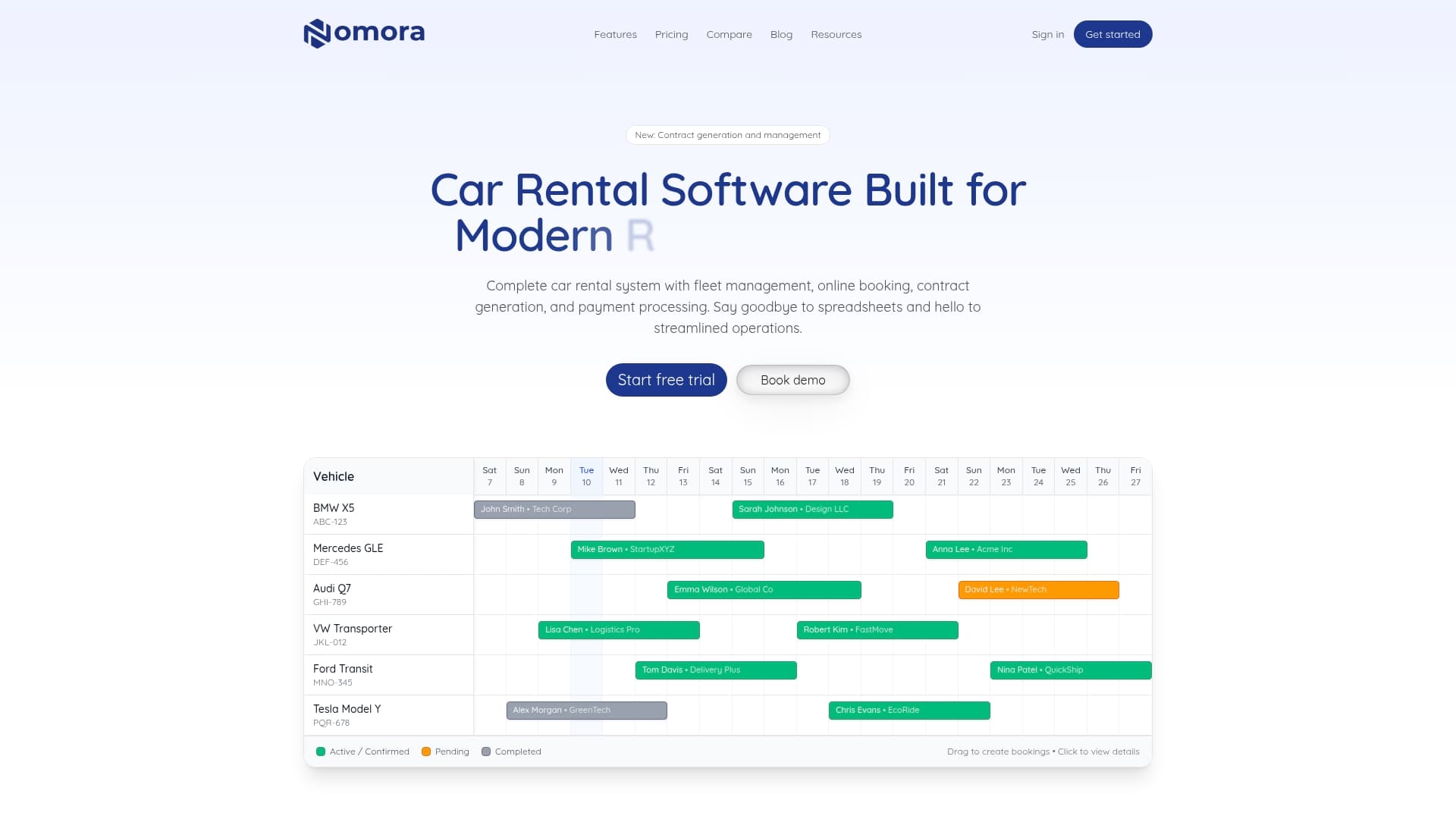
Nomora ships with real-time data visibility and conflict-free booking logic built in, plus extraction options for payment gateways and telematics that would otherwise take weeks to wire together manually. That applies whether you're running a small independent lot or a franchise network across multiple locations, and the use-case breakdown by business type shows how each integration point maps to your specific operation. Onboarding runs 24 to 48 hours rather than the multi-week timeline a from-scratch integration typically demands, with GDPR compliance and cloud accessibility built into the platform from day one.
If your current setup still relies on spreadsheets or disconnected tools for payments and fleet tracking, request a demo and see how quickly Nomora's integration stack replaces them.
Sources
Recommended