Effective rental cancellation management involves enforcing structured policies, automating penalties, and maintaining clear communication to protect revenue and reduce disputes. Implementing tiered refund policies, responding quickly within 2–3 hours, and documenting all interactions significantly decrease chargebacks and guest dissatisfaction. Automating penalty enforcement and rebooking processes ensures consistency, minimizes human error, and allows rapid revenue recovery after cancellations.
Effective rental cancellation management is the practice of enforcing structured penalty rules, documented communication workflows, and revenue recovery tactics to protect income and reduce disputes. When you handle booking cancellations without a clear system, you lose money twice: once from the vacant unit and again from the time spent resolving disputes. This guide covers how to manage rental cancellations by designing tiered policies, automating enforcement, communicating fast, and recovering revenue through smart rebooking. You will leave with a clear framework built for rental operators who need consistency, not guesswork.
How to manage rental cancellations with tiered policies
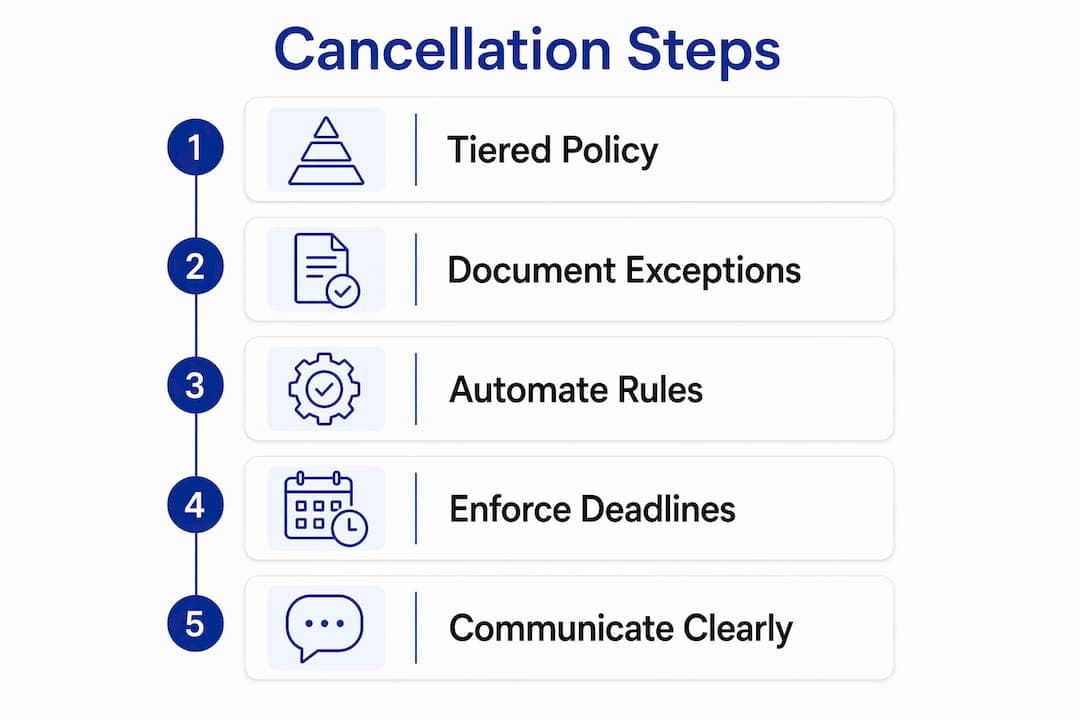
A tiered cancellation policy is the most effective structure for balancing guest confidence with revenue protection. The logic is straightforward: the closer a cancellation occurs to the rental date, the higher the penalty. A three-window refund model — full refund beyond 30 days, 50% refund between 30 and 89 days, and no refund within 30 days — gives guests a fair window to cancel while protecting your income during high-risk periods. Properties using this model report fewer disputes and higher guest satisfaction compared to flat-rate penalties.
The table below shows how a standard three-tier model compares to a flat-rate policy:
Policy Type
Cancellation Window
Refund Amount
Dispute Risk
Tiered (Recommended)
30+ days before arrival
100% refund
Low
Tiered (Recommended)
30–89 days before arrival
50% refund
Low
Tiered (Recommended)
Under 30 days
No refund
Low
Flat-Rate Penalty
Any time
Fixed fee
High
Beyond the basic tiers, you need to account for exceptions. Medical emergencies and documented travel restrictions are the two most common grounds for exception requests. Define your exception criteria in writing before you need them. Vague exception policies create the worst disputes because neither party has a clear reference point.
Automation is what makes tiered policies actually work at scale. Penalty rules tied to time windows — for example, a flat fee or percentage applied starting at 6:00 PM five days before arrival — remove the need for manual calculations and reduce staff errors. Tie these rules to specific rate codes and reservation types so the system applies the correct penalty automatically.
One detail most operators miss: local time zone enforcement on cancellation deadlines. If your cutoff is midnight local time but your system defaults to UTC, guests in different time zones can cancel outside the penalty window without triggering a fee. That is a direct revenue leak you can close with a single configuration change.
Pro Tip:Document every version of your cancellation policy with a date stamp. When a dispute arises, you need to produce the exact policy the guest accepted at booking, not your current version.
What communication workflows prevent chargebacks?
Speed and documentation are the two variables that determine whether a cancellation becomes a chargeback. Responding within 2–3 hours of a cancellation request via on-platform messaging is the standard that reduces negative outcomes. Fast responses are linked to 40% fewer negative reviews. That number reflects a simple truth: guests who feel ignored escalate.
Your communication workflow should follow this sequence:
Acknowledge within 2–3 hours. Confirm receipt of the cancellation request and state the applicable policy clearly.
Send the policy summary. Include the exact refund amount or penalty, the timeline for processing, and the policy version that applies.
Document every exchange on-platform. Use your booking or rental management system as the primary communication channel. Off-platform messages like texts or personal emails do not create the audit trail you need.
Escalate unresolved cases within 24 hours. Assign a senior staff member to any case where the guest disputes the policy or threatens a chargeback.
Close the loop in writing. Send a final confirmation once the refund or penalty is processed, with a reference number.
Scripted responses are not a shortcut. They are a quality control tool. Documented scripts and response KPIs targeting under 30 minutes for initial replies and 24-hour resolution for urgent cases improve consistency across your team. When a new staff member handles a cancellation, they should produce the same outcome as your most experienced operator.
Pro Tip:Build your scripts around the policy, not the apology. Guests respond better to clear, factual explanations of what they are owed than to lengthy expressions of sympathy that delay the answer.
The real-time booking workflows you use for reservations should also handle cancellation communications. Keeping everything in one system means every message, timestamp, and policy reference is stored in the same record.
What contractual elements protect against disputes?
Signed rental agreements and policy disclosure records are your primary defense against chargebacks. Banks decide chargeback outcomes based on evidence quality, and the two most decisive pieces of evidence are the cancellation policy in effect at booking and proof the guest accepted it. High-quality evidence of policy disclosure outweighs volume of documentation every time.
The contractual prerequisites every rental operator needs in place:
Signed rental agreements. Digital signatures via platforms like DocuSign or integrated contract tools count. The key is a timestamped record of acceptance.
Policy version storage. Store the exact cancellation policy text the guest saw and accepted at booking. Your current policy is irrelevant if it changed after the reservation was made.
Policy disclosure at checkout. Require guests to actively check a box or sign a field confirming they read the cancellation terms. Passive disclosure buried in terms and conditions does not hold up.
Automated penalty enforcement logs. Your system should generate a record every time a penalty rule fires, including the rule applied, the timestamp, and the reservation ID.
The car rental contract process matters beyond the legal protection it provides. A well-structured contract sets expectations before the rental begins, which reduces the number of guests who claim they were unaware of the policy in the first place.
Automation is the central nervous system of this entire operation. When your booking platform enforces penalty rules, stores policy versions, and logs every communication automatically, you remove the human error that creates gaps in your evidence trail. Manual processes create inconsistency. Inconsistency loses disputes.
How do you recover revenue after a cancellation?
Revenue recovery after a cancellation depends on how fast you act and how well you have prepared your rebooking infrastructure. Issuing refunds before assessing rebooking success is the most common mistake operators make. Assess your rebooking probability first, then process the refund according to your policy timeline.
The core tactics for minimizing revenue loss:
Adjust pricing immediately. Drop the rate to a competitive last-minute price as soon as the cancellation is confirmed. Waiting 24 hours on a same-day cancellation often means the slot goes unfilled.
Remove booking restrictions. Minimum stay requirements and advance booking windows that protect revenue during peak periods become obstacles when you need to fill a gap fast. Disable them for the affected dates.
Activate your waitlist. Past guests who have rented from you before are your fastest rebooking source. A simple message to a curated list of previous customers converts faster than any paid channel.
Use dynamic pricing buffers.Buffer pricing at 8–12% of annual projections absorbs cancellation revenue loss while keeping your rates competitive. This is not a price increase. It is a built-in margin that accounts for predictable cancellation rates.
Dynamic pricing strategies for fleet profitability go beyond last-minute discounts. The operators who recover the most revenue after cancellations are the ones who have pre-set pricing rules that activate automatically when a booking is canceled. No manual intervention, no delay, no missed window.
Pro Tip:Segment your waitlist by vehicle type and rental duration. A guest who previously rented a cargo van for a week is not a useful lead for a same-day compact car cancellation. Targeted outreach converts faster.
A standardized cancellation decision tree separates automatic penalty enforcement, documented exceptions, and rebooking-based credit offers into distinct paths. When your team knows exactly which path applies to each scenario, they stop making ad-hoc decisions that cost you money and create inconsistent guest experiences.
Key takeaways
Effective cancellation management requires tiered policies, fast documented communication, and immediate rebooking action to protect revenue and win disputes.
Point
Details
Use tiered refund policies
Structure penalties by time window to protect revenue while maintaining guest confidence.
Respond within 2–3 hours
Fast, on-platform communication reduces negative reviews and prevents chargebacks.
Store policy versions at booking
Banks evaluate the exact policy the guest accepted, not your current version.
Automate penalty enforcement
Rule-based systems remove staff errors and create audit-ready logs automatically.
Act immediately on rebooking
Adjust pricing and activate waitlists the moment a cancellation is confirmed.
The 42-Point Car Rental Operations Checklist
The exact checks profitable rental operators run every week — free, straight to your inbox.
Fleet readiness & handover
Bookings & no-show prevention
Pricing & revenue reviews
Contracts & compliance
Payments & invoicing
Maintenance & fleet health
One email with the checklist. No spam, unsubscribe anytime.
The discipline gap in cancellation management
Most rental operators I have worked with have a cancellation policy. Very few have a cancellation system. The policy is the document. The system is what actually happens when a guest cancels at 11 PM on a Friday.
The operators who lose the most money to cancellations are not the ones with weak policies. They are the ones with strong policies and inconsistent enforcement. One staff member applies the penalty. Another waives it because the guest pushed back. A third issues a refund before checking whether the slot was rebooked. That inconsistency is not a people problem. It is a process problem.
What I have found actually works is centralizing the cancellation decision logic so that the system makes the call, not the individual. When your rental management platform enforces the penalty rule, logs the communication, and triggers the rebooking workflow automatically, you remove the variable that creates the most disputes: human judgment under pressure.
The other thing most guides get wrong is treating guest communication and revenue recovery as separate problems. They are the same problem. A guest who receives a clear, fast, policy-based response is far less likely to dispute the charge than one who waits two days for an answer. Communication speed is a revenue protection strategy, not just a customer service metric.
The rental dispute guide Nomora published covers the downstream consequences of poor cancellation handling in detail. The pattern is consistent: disputes that reach the chargeback stage almost always started with a communication delay or a documentation gap, not a policy failure.
Balancing guest experience with business protection is not a compromise. A guest who understands your policy and receives a prompt, professional response will book with you again. A guest who feels ignored or surprised by a penalty will not. The best cancellation management is the kind that leaves both parties clear on what happened and why.
— Dizzy
How Nomora handles cancellation management for rental operators
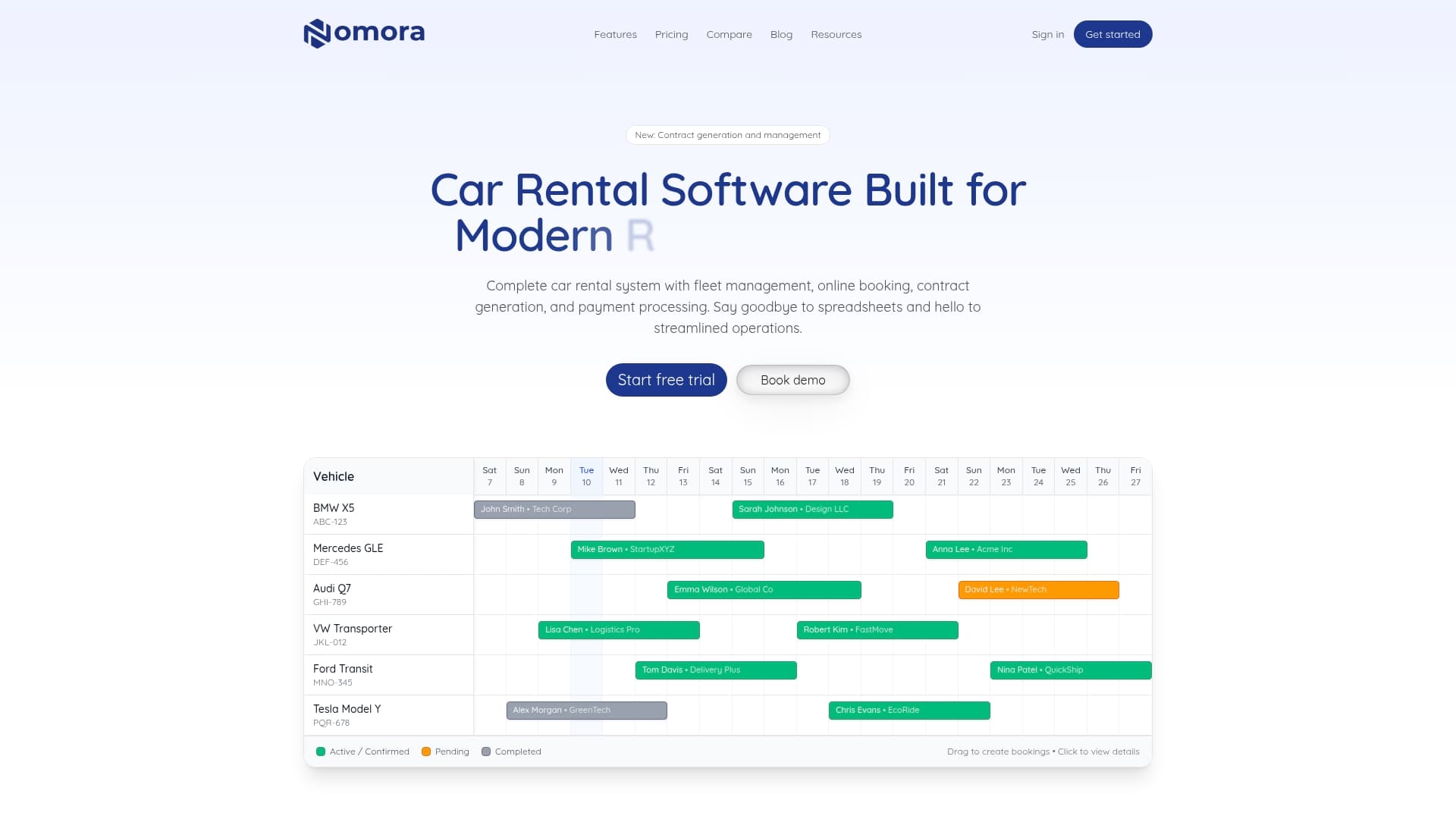
Nomora is built to replace the manual processes that create gaps in cancellation enforcement and documentation. The platform automates penalty rule application by time window and rate code, stores policy versions at the point of booking, and logs every communication in a single record.
When a cancellation comes in, Nomora triggers the correct penalty calculation, updates fleet availability in real time, and initiates the rebooking workflow without staff intervention. The contract management tools keep signed agreements and policy disclosures audit-ready for any dispute. Explore the rental software use cases to see how operators across fleet sizes use Nomora to cut cancellation-related revenue loss and resolve disputes faster.
FAQ
What is a tiered cancellation policy?
A tiered cancellation policy applies different refund amounts based on how far in advance the guest cancels. A common structure offers a full refund beyond 30 days, 50% between 30 and 89 days, and no refund within 30 days of arrival.
How fast should you respond to a cancellation request?
Respond within 2–3 hours via on-platform messaging. Fast responses are linked to 40% fewer negative reviews and create the documented audit trail needed to defend against chargebacks.
What evidence wins a cancellation chargeback dispute?
Banks evaluate the exact cancellation policy version in effect at booking and proof the guest accepted it. A timestamped signed agreement and a policy disclosure record are the two most decisive pieces of evidence.
How do you recover revenue after a last-minute cancellation?
Adjust pricing immediately to a competitive last-minute rate, remove minimum stay restrictions, and contact your waitlist of past guests. A dynamic pricing buffer of 8–12% of annual projections also absorbs predictable cancellation losses.
Should you automate cancellation penalty enforcement?
Automation is the most reliable method for consistent enforcement. Rule-based systems tied to time windows and rate codes apply the correct penalty without staff intervention and generate logs that support dispute resolution.