A prepaid bookings policy tells customers when you charge them, how much, and what happens to that money if plans change. For a car rental company, it should cover five things: the amount collected upfront, the cancellation tiers, the no-show rule, the payment-method match at pickup, and how refunds are handled. This guide shows how to write each part, with US market ranges and wording you can adapt.
It is written for owners and managers of small and mid-sized rental fleets, luxury and specialty operators, and corporate fleet managers. If you are a renter looking for hotel prepayment advice, this is not that article.
TL;DR
- Prepayment collects part or all of the booking fee in advance. Pre-authorization only holds funds on a card. You need to define both, and neither replaces the other.
- Use tiered cancellation terms tied to time before pickup, and state the no-show outcome in plain words.
- Require the card used online to be presented at pickup, with the name matching the driver's license, and verify this at confirmation rather than at the counter.
- Say in your contract that holds are temporary, and decide in advance how refunds are issued, because manual refunds are where the admin work piles up.
- Automate the policy in your booking system so every customer sees the same terms and the same math.
Table of Contents
What a prepaid bookings policy actually covers
A prepaid booking is a reservation where payment is collected before the service is delivered. In rental, that means the customer pays all or part of the rental online, and you commit a vehicle for those dates. The policy is the written contract that balances two things: the customer's flexibility and your revenue.
A large booking platform's guide for operators describes prepayment as collecting all or part of the booking in advance as part of the cancellation policy, and says clear reservation policies reduce last-minute cancellations, protect revenue and set expectations. The guide is written for hotels, but the logic carries over to a vehicle that sits idle when someone fails to show up.
A complete policy answers these questions:
- What is charged at booking: the full rental, a percentage, or a fixed deposit?
- What is refundable, and until when?
- What happens if the customer changes dates or vehicle class?
- What happens on a no-show?
- Which card must the customer present at pickup?
- What additional hold will be placed on the card, and when is it released?
- How and how fast are refunds paid?
Prepayment vs. pre-authorization vs. deposit
Customers confuse these constantly, and so do some operators. Keep the terms separate in your policy.
| Term | What happens | Money moves? | Typical purpose |
|---|
| Prepayment | The card is charged at booking or by a set date | Yes | Secure revenue on non-refundable or partly refundable bookings |
| Pre-authorization | A temporary hold is placed on the card | No, funds are frozen only | Cover possible fees, damage or no-shows |
| Security deposit | An amount held or collected for the rental period | Depends on method | Cover damage, fines, fuel, late return |
The prepayment and pre-authorization distinction matters for cash flow: prepayment captures revenue up front, while a hold protects against damage or no-shows without moving cash. Relying on only one leaves you exposed to either a cash-flow gap or uncollected damages.
For a deeper look at the hold side, see our guides on preauthorization vs. deposits and how car rental security deposits work.
Choosing what to collect upfront
There is no single right answer. The decision depends on your vehicle type, lead time and how often customers cancel.
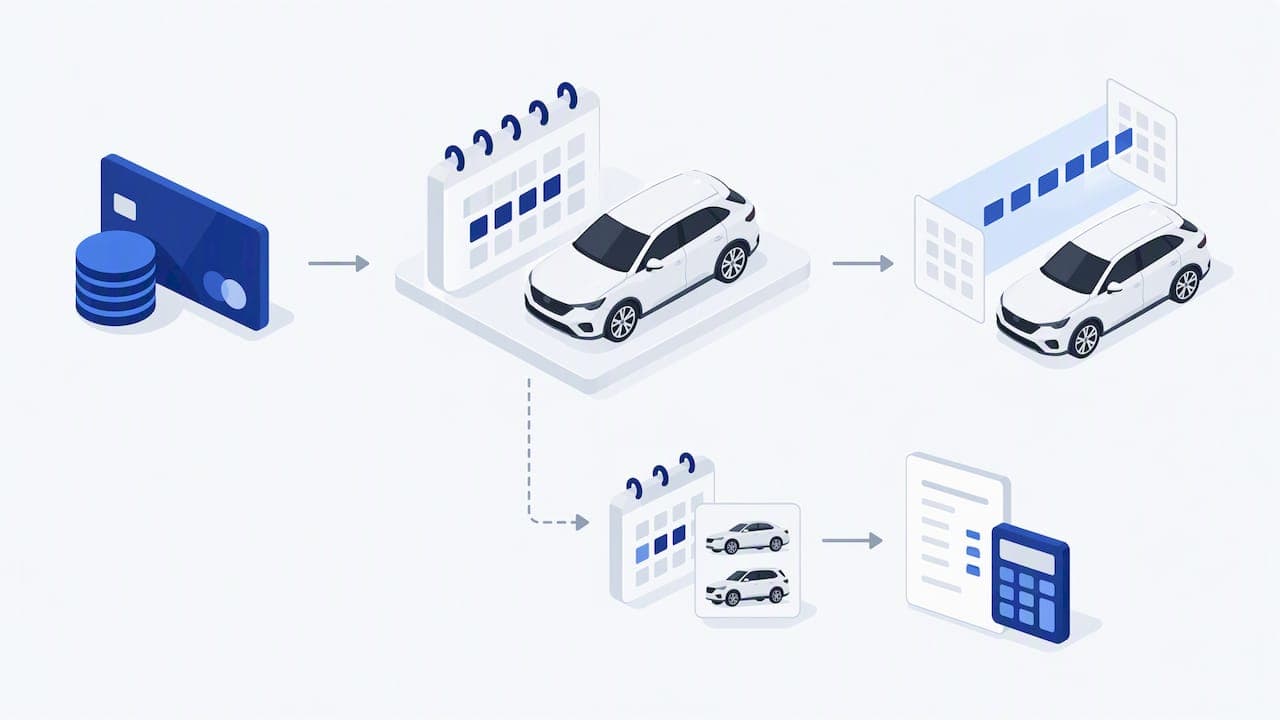
Full prepayment
Best for high-demand vehicles, peak weekends, and luxury or specialty cars where an empty day is expensive. A common model in the US market is a "pay now" rate. One national brand's Pay Now feature offers a discount off the base rate in exchange for paying at booking. The trade-off is rigid terms: your booking flow should say that changing dates or vehicle type may void the prepaid rate or trigger a recalculation.
Partial prepayment
A percentage or the first days of the rental works well for small fleets that want commitment without large refund exposure. It keeps the booking friction lower for first-time customers while still giving you something to retain on a late cancellation.
Card guarantee only
Some operators take no money upfront and simply guarantee with a card. That is the most flexible for the customer, but you carry the cost of no-shows. If you go this route, your no-show fee must be clearly stated and enforceable. Our guide to automating a car rental no-show policy walks through that setup.
Vary the terms by demand
The same booking-platform guidance encourages policies specific to demand, such as different terms for peak seasons or high-demand vehicle types. In practice, you might offer free cancellation on economy cars in winter and non-refundable prepayment on convertibles or vans in July. If you want to anticipate those peaks, our piece on demand forecasting for car rental helps. Operators outside the US also publish useful thinking on adapting prepaid terms to demand (the page is in Italian).
Cancellation tiers: what the US market looks like
Tiered fees based on how close the cancellation is to pickup are the standard structure. Published terms vary by brand and change over time, so check current figures before you copy anything.
Two examples from large US rental companies, as of our research:
A small operator can use a simpler structure. Here is a template to adapt:
| When the customer cancels | Prepaid amount |
|---|
| More than 7 days before pickup | Full refund, minus any payment processing cost you choose to pass on |
| 2 to 7 days before pickup | Refund minus a fixed fee or one day's rate |
| Less than 48 hours before pickup | Refund minus a higher fee, or the first day's rate |
| No-show | Prepaid amount retained |
These numbers are an illustration, not a benchmark. Set them against your own utilization and how quickly you can re-rent a vehicle. For the wider process, see our guide to managing rental cancellations.
The same-name rule at pickup
Most disputes at the counter come from a payment method that does not match the renter. Large US brands require that the card used for an online prepaid reservation be presented at pickup, and a mismatch between the card name and the driver's license can be grounds for refusing the rental. Another brand's Pay Now terms cover the same requirement.
If you adopt the same rule, handle it before the customer arrives:
- State the rule on the booking page, in the confirmation email and in the contract.
- Collect the driver's name separately from the cardholder's name at booking.
- Flag any mismatch automatically at confirmation, so you can offer a fix (a different card, or a cardholder-approved alternative you define) days before pickup.
- Decide what you will do when a parent, employer or spouse pays for someone else. Corporate accounts in particular need an exception route, such as invoicing.
Debit cards deserve a line too. One national brand's page states that its minimum hold for debit card rentals is $100, with different holds on prepaid rentals. Whatever your rule is, write it down.
Explain holds so customers do not call about missing money
Customers see a pending amount on their statement and assume you double charged them. Your contract and confirmation email should say that a hold is a temporary freeze, not a charge, and when it is released. One hotel's published policy is an example of how operators spell out incidental holds; our research suggests holds in the $150 to $250 range are common in lodging. Vehicle rental holds are usually tied to the rental, so state your own figure.
Include these points:
- The hold amount, or how it is calculated.
- Whether it is in addition to the prepaid amount.
- How many business days the bank may take to release it after return. Banks set this timing, so say so rather than promising a date.
- What can be charged against it: fuel, tolls, damage, late return. For late returns, our late return policy clauses may help.
Refunds: where manual handling hurts
A policy is only as good as your ability to execute it. Booking-platform guidance for operators notes that if you manage payments yourself, your systems must handle refunds efficiently, particularly when a guest cancels inside a refundable window. Manual refunds mean spreadsheets, card terminal visits and customer emails.
A practical checklist:
- Issue refunds to the original payment method.
- Tell customers the refund is processed on your side, and that their bank sets the posting time.
- Log every refund against the booking, with the policy tier that applied.
- Reconcile weekly so that unmatched prepayments show up before they become disputes.
For related automation, see our piece on deposit automation for rental fleets.
Our perspective
We think of rental software as the central nervous system of the operation: reservations, fleet status, contracts and payments all send signals through it. A prepaid bookings policy is one of those signals, and it only works if every part of the business receives it at the same time.
The pattern we see in rental operations is that the policy text is rarely the problem. The problem is the gap between the text and the process. A cancellation tier lives in a PDF, a refund lives in someone's inbox, and a name mismatch is discovered at the counter with a customer standing there. Each gap creates admin work and a disagreement that could have been avoided.
Our advice is to write the policy short, make each rule testable (a date, an amount, a name), and let the system apply it. That is also why we include every feature in every plan, rather than gating payments or contracts behind an upgrade: the policy should not depend on which tier you bought.
— Dizzy
Automating the policy with Nomora
If you run the policy by hand today, the weak points are usually the payment link, the contract wording and the refund log. Nomora brings reservations, contracts, payments and customer data into one cloud platform, with automated car rental payments and conflict-free booking, so the terms a customer accepts are the terms applied. Onboarding is designed to get you operational in 24 to 48 hours.
Published plans, from our pricing page:
- Starter: 45 EUR per month
- Business: 2.80 EUR per month per vehicle
- Fleet: 2.20 EUR per month per vehicle
- Enterprise: no published price
Payment processing is a separate fee with no published price. You can see how the platform fits different operators on the use cases page, or look at the whole car rental software offering.
Prepaid bookings also raise the stakes on scheduling. If you collect money for a vehicle, it has to be available, so read our guide on preventing double bookings and the benefits of automated bookings.
A policy template you can adapt
Use this as a starting point and have it reviewed by a lawyer licensed in your state, because consumer protection and payment rules differ by state.
- Payment at booking. "We charge [full amount / X%] when you confirm your booking."
- Changes. "Changing dates or vehicle class may change your rate. Prepaid or discounted rates may not apply to the new booking."
- Cancellation. State each tier as a time window and an amount.
- No-show. "If you do not pick up the vehicle within [X] hours of your scheduled time and have not contacted us, the prepaid amount is retained."
- Payment method. "The card used for payment must be presented at pickup, in the name of the driver."
- Hold. "We place a temporary hold of [amount] on your card. This is not a charge and is released after the vehicle is returned and inspected."
- Refunds. "Eligible refunds are returned to the original payment method. Your bank determines when the funds appear."
Place it in three spots: before payment on the booking page, in the confirmation email, and in the rental contract.
FAQ
What is a prepaid booking?
It is a reservation where the customer pays all or part of the cost before the service is delivered. In car rental, the vehicle is held for the customer's dates, and the policy defines what is refundable if plans change.
What is the difference between prepayment and pre-authorization?
Prepayment is an actual charge collected in advance. Pre-authorization is a temporary hold that freezes funds on the card without taking them. Most rental businesses use both: prepayment to secure the booking and a hold to cover possible extra costs.
Should a rental company require the same card at pickup?
Most large US rental brands do, and it reduces fraud and counter disputes. If you adopt the rule, verify names at booking and give corporate or third-party payers a defined alternative, such as invoicing.
How much should a cancellation fee be?
There is no standard. Our research found prepaid fees at large US brands commonly between $50 and $200, depending on timing. Base yours on how fast you can re-rent the vehicle and your average daily rate.
Sources
Recommended
Ready to streamline your car rental business?
Book 30 minutes with the founder. We set up everything in this guide on your own vehicles, and migrate you out of Excel for free.