How money flows between manager and owner
Money moves in two directions, and the published owner statement decides which one applies in any given period. When revenue exceeds fees, expenses and refunds, you pay the owner. When expenses exceed revenue, you invoice the owner instead.
- Manager to owner (payout): triggered once a statement is published and a payout run is scheduled.
- Owner to manager (payment): triggered when you publish an invoice because the owner owes money, such as repair costs that exceeded the period's income.
- Line items: rent or rental income raises the net distribution, while management fees, maintenance, and refunds lower it.
Say a vehicle earns rental income during a period, with a management fee and a repair expense. The statement nets to the amount left after those charges, and that figure, not the gross, is what the owner receives. Getting gross revenue right comes first, and our revenue per vehicle guide covers that calculation.
What you need in place before the first payout run
Most failed runs trace back to setup, not to the transfer itself. Work through these prerequisites once, and document them so every new owner follows the same path.
- Connect your business bank account, the single source from which payout runs are funded.
- Require each owner to connect and verify their own bank account before their first statement is published.
- Match currency and country rules. Some payment platforms only deliver to accounts in the same country as the sender, so confirm this before onboarding an owner who banks elsewhere.
- Assign a default payout account to each owner so a run never stalls waiting for a choice.
- Write down payment terms and who bears transfer and payment fees, and attach that to the owner agreement.
- Set up an owner portal login so owners can see statements and invoices without emailing you.
Pro Tip: Verify a new owner's account with a small test payout or the platform's own verification step before their first real distribution, not after it fails.
Publishing statements and scheduling payout runs
Publishing the statement is the decision point. Once it is approved and published, you either schedule a payout run to send money to the owner or publish an invoice to collect money from them. A payout run is a single withdrawal from your manager account that is then split into multiple owner distributions, so one funding event covers everyone due that period.
For invoices, set payment terms that match your owner agreement, such as payment due on receipt or another agreed deadline. Owners sometimes settle outside the platform by check or wire. In that case, mark the invoice as paid externally and note the method and date, so your ledger and the owner's statement stay in agreement.
- Review pending refunds and chargebacks before you publish, since they change the net.
- Approve statements first, then schedule the run, so no unapproved figure gets paid.
- Keep the run date consistent each period; owners plan around it.
- Record external payments the same day you receive them.
How long payouts take and what each status means
A payout rarely lands the moment you click send. Two delays stacks: the time your platform waits before initiating the transfer, and the time the banking network needs to move the money. Some platforms initiate payouts 24 hours after check-in, while others wait until the end of the statement period, so the platform window alone can add days or weeks.
ACH transfers often take 3–5 business days, and total payout timing depends on both platform initiation delays and bank processing. Tell owners to count from initiation, not from the day the statement went out.
Read statuses as a map to bank activity. Pending means the platform has queued or initiated the transfer but funds have not settled. Settled means the money has reached the owner's bank. Failed means the bank or platform rejected it, and you should move to diagnostics rather than wait. If your statement closes and the platform initiates the transfer later, an owner may see funds after additional processing time.
Reconciliation and recordkeeping that keeps owner funds separate
Every payout should leave a clean trail in your books. The standard to aim for is the three-way reconciliation, which proves that your bank balance matches your check register and the sum of all individual client ledgers. A mismatch signals cross-funding or an accounting error, so catch it before an owner does.
The process, as described in trust accounting guidance for property managers, runs in this order:
- Balance the bank statement to your accounting software.
- Calculate the adjusted bank balance, accounting for outstanding items.
- Prove that the owner, tenant, and broker ledgers add up to that bank balance.
- Confirm that no individual ledger is negative.
Beyond the reconciliation itself, a few habits make reporting easier:
- Add subaccounts to income or expense accounts to track owner-paid fees and owner-specific transactions.
- Keep each owner's funds separate; trust-account guidance stresses that owners' money must not be commingled.
- Track every reportable payment as it happens. IRS Chief Counsel guidance explains that a property management company that collects rent and pays owners monthly may be required to file Form 1099-MISC for payments of $600 or more to those owners.
- Check the current Form 1099-MISC and 1099-NEC instructions for payor rules and thresholds before each filing season.
Real-time visibility makes these steps faster, which is why we cover reporting in real time separately.
Fixing failed payouts and preventing commingling
When a payout fails, work from the most common cause to the least. Start with the owner's bank details, since a typo or a closed account is the usual culprit, then check account verification status, then currency or country mismatches, then insufficient funds in the manager account.
- Confirm the account number, routing details and account holder name match the owner's records.
- Ask the owner to update their bank details in the portal and re-verify the account.
- Confirm your funding account holds enough to cover the whole run.
- Re-run only the failed distribution, not the entire batch, to avoid double payments.
- Note the failure and the fix in the owner ledger for the audit trail.
Prevention matters as much as repair. Keep separate owner ledgers, write a clear trustee policy, and never cover one owner's shortfall with another's funds. Leveled segregation of owner funds, tenant funds, and security deposits keeps per-property accounting clean.
Pro Tip: Log every manual correction with a date and initials; an audit trail is the quickest way to settle a question later.
Choosing a payout cadence and setting owner expectations
Monthly payouts are the common default because they match statement cycles and keep reconciliation to one clean pass. More frequent runs, such as weekly, help owners who rely on the income, but they multiply the reconciliation work and the transfer fees. Per-run payouts on request give flexibility, though they are the easiest to abuse.
Write the policy down and share it before the first statement:
- A minimum payout amount, with smaller balances rolling forward.
- A fee for extra runs outside the normal schedule.
- A notification window, for example statements published at least two days before the run.
- A short note on each statement explaining unusual items such as large repairs or refunds.
Owners who understand why a number moved rarely call to dispute it.
Resolving payout discrepancies and disputes
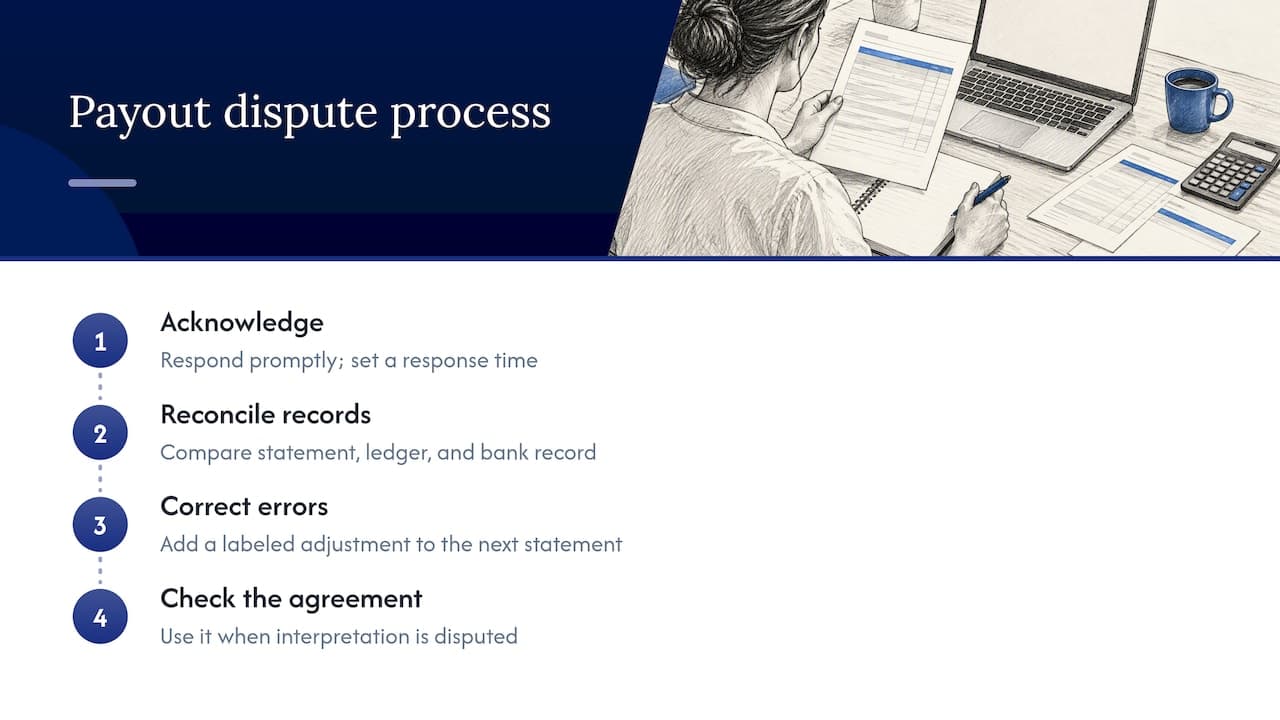
Most disputes are arithmetic or timing questions, not bad faith, so the fastest fix is a transparent paper trail. When an owner challenges a payout, start by pulling the published statement and comparing every line item against your ledger: rental income, fees, refunds and expenses. Often the gap is a refund processed after the statement closed, or an expense the owner did not expect.
A workable process has four stages. First, acknowledge the question quickly and tell the owner when you will respond. Second, reconcile the figure against the statement, the ledger, and the bank record. Third, if you find an error, correct it in the next statement with a clearly labeled adjustment rather than quietly altering history. Fourth, if the disagreement is about interpretation rather than math, return to the owner agreement, which should define fee rates, approval thresholds for expenses, and what counts as a reimbursable cost.
Keep communication in writing so both sides can point to the same record. For larger or repeated conflicts, the agreement can name a mediation step or a neutral accountant to review the books before anyone considers legal action. Never withhold undisputed funds because a separate item is contested; pay what is clearly owed and hold only the amount in question. That single habit protects both the relationship and your fiduciary position.
Legal and contract points that govern owner payouts
Your management agreement is the document that makes payouts enforceable, so it should state what you collect, what you may deduct, when you pay, and how you handle shortfalls. Spell out the management fee, the expense approval limit, the payout schedule, how disputes are resolved, and who holds funds in the meantime.
Several legal threads touch payouts. State rules on trust accounting and licensing vary, so confirm what applies to your business with a qualified attorney or your licensing authority. Federal tax reporting is more uniform: the IRS expects accurate reporting of rental income, and its rental income and recordkeeping tips note that cash-basis taxpayers report income when received and deduct expenses when paid, while accrual taxpayers follow earning and incurring rules.
If you operate through an S corporation, the IRS says you should pay yourself reasonable compensation before taking non-wage distributions, since misclassified distributions risk reclassification as wages. Owners can generally deduct common costs such as management fees and repairs, as Publication 527 lists, and they must keep records to support those deductions. Whether a given payment triggers an information return depends on its type and amount, and the IRS page on filing a Form 1099 lists the categories and thresholds.
Currency and payment method options for owner payouts
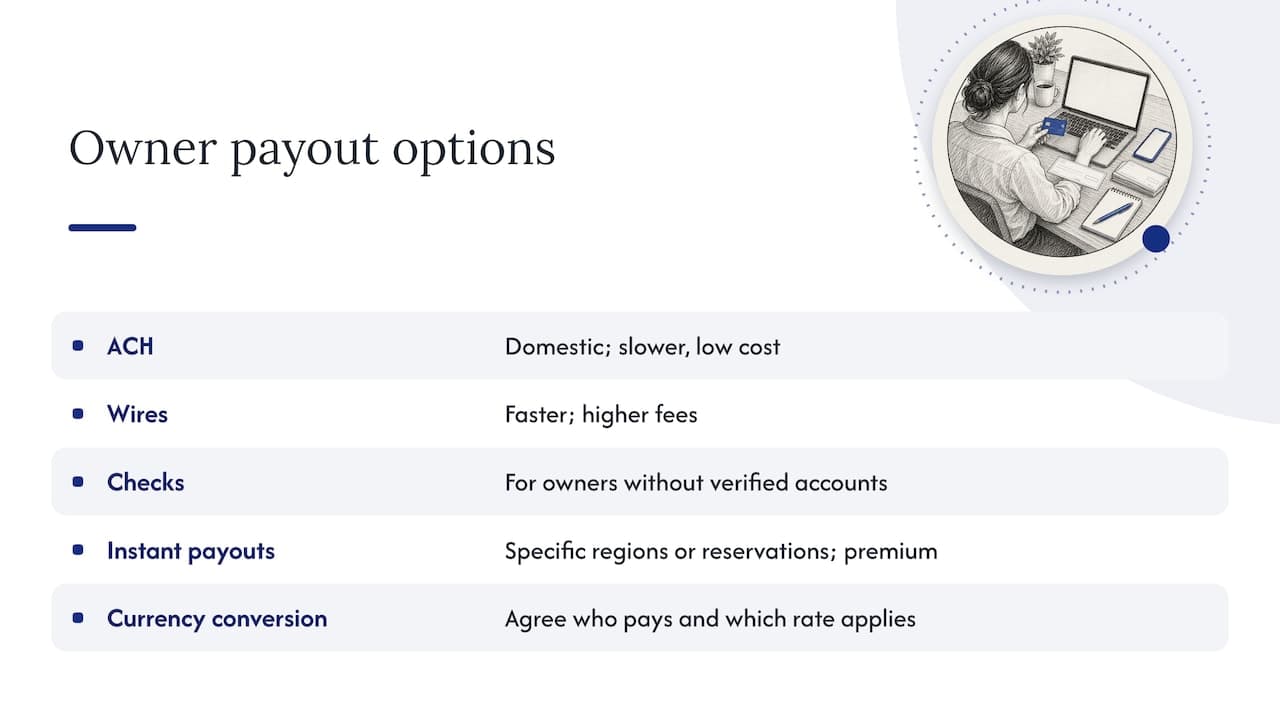
Choose payment methods around where your owners bank and how fast they need funds. ACH is the standard for domestic transfers, slower but low in cost. Wires arrive faster and carry higher fees, so they suit large or urgent amounts. Checks remain an option for owners without a verified account, though they add mailing time and manual reconciliation. Some platforms offer instant payouts in specific regions or for specific reservation types, usually at a premium.
Currency adds a layer. If you collect in one currency and the owner banks in another, decide in the agreement who absorbs the conversion cost and which rate applies, and show the conversion on the statement so the owner can follow the math. Platform corridors may also require same-country accounts, so an owner who banks abroad may need a different method altogether.
Whatever you choose, apply it consistently. Record the method on each distribution so reconciliation can match the bank line to the ledger entry, and keep the owner's preferred method on file as part of their profile. Mixed methods are fine, but undocumented ones are where reconciliation breaks down.
Author checklist for reliable payout runs
A run goes smoothly when the checking happens on both sides of it. Before: confirm every owner's bank account is verified, clear or account for pending refunds and chargebacks, and make sure each statement is approved. After: reconcile the distributions against the bank record, update owner ledgers, and file any required information reports. Skipping the post-run pass is the most common reason small errors compound across months.
I treat the checklist as a control, not paperwork. The managers who struggle are rarely the ones who lack a system; they are the ones who rely on memory when the month gets busy. Automation helps most by removing the steps people forget, which shortens reconciliation and keeps the record consistent.
— Dizzy
How we automate owner payouts at Nomora
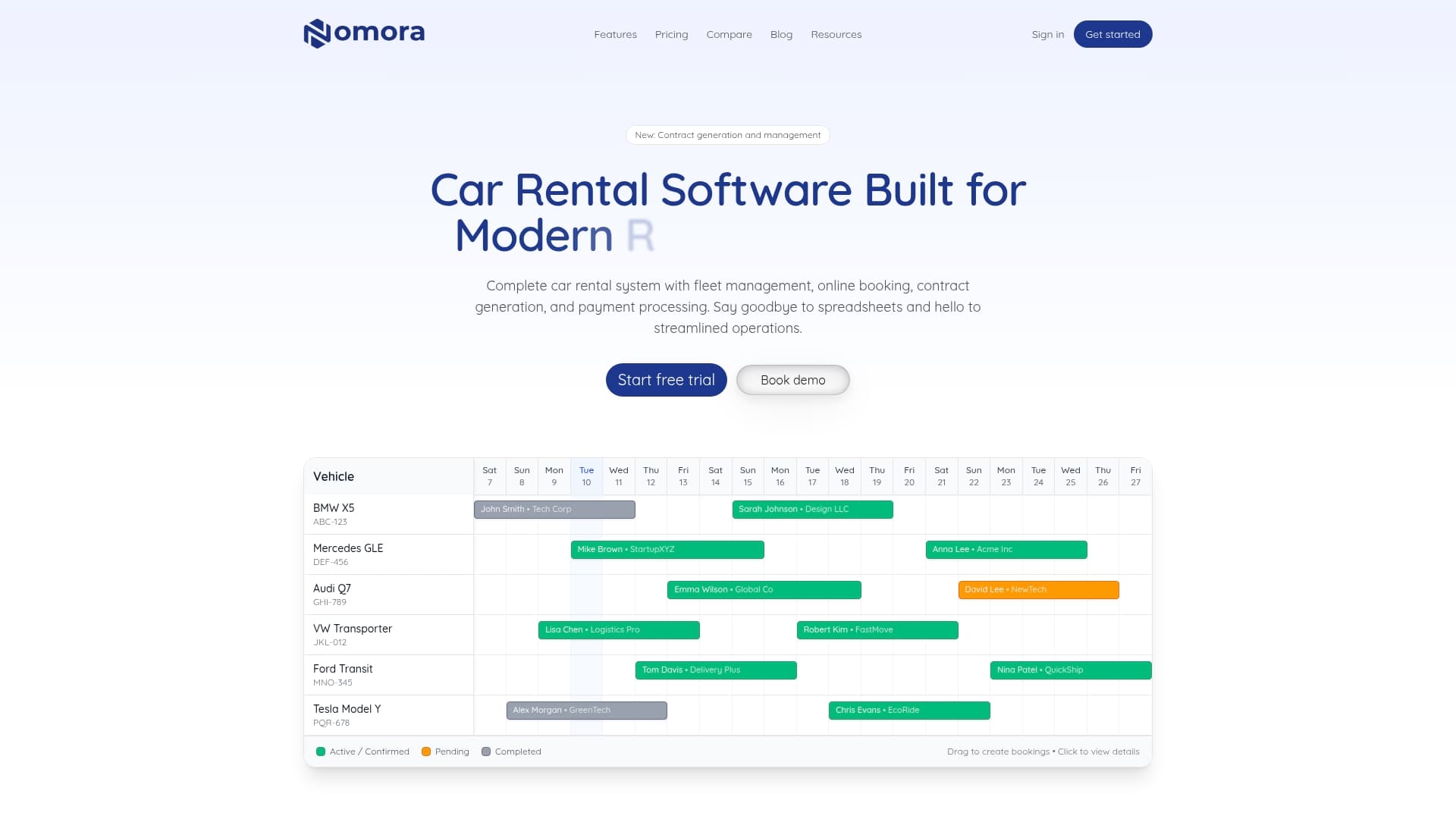
We built our platform to help streamline rental operations. Nomora provides cloud-based car rental management software to help manage rental operations.
- Integrated payment processing
- Reservation management
- Automation to reduce manual work
- Onboarding designed to get you operating quickly
You can see how automated car rental payments work, or check which plan fits on our pricing page, where Starter is 45 EUR per month.
FAQ
How does owner withdrawal work?
An owner withdrawal moves money from the business to the owner, and it is recorded as a distribution rather than an expense. In a rental management setting, it follows a published statement and a scheduled payout run. Keep a record of each one for reconciliation.
Can the owner of an LLC pay himself through payroll?
It depends on how the LLC is taxed. The IRS says owners of S corporations should pay reasonable compensation through payroll before taking non-wage distributions. Check your tax classification with an accountant.
How should I decide how much to pay out each period?
Pay the net on the published statement: income minus fees, expenses, and refunds. Hold back only amounts that are genuinely disputed or needed for approved reserves. Document any hold in the owner ledger.
Do I need to file a 1099 for owner payouts?
Possibly. IRS guidance says a property management company paying owners monthly may need to file Form 1099-MISC for payments of $600 or more. Confirm current thresholds in the IRS instructions.
Sources
Recommended