Key Takeaways
| Point | Details |
|---|
| Dynamic demand factors | Car rental demand shifts by both time and location, requiring granular forecasting for accuracy. |
| Benefits of forecasting | Effective forecasting helps optimize fleet, pricing, and customer satisfaction. |
| Tools drive better results | Modern forecasting software saves time and improves accuracy compared to manual methods. |
| Proactive decisions matter | Using forecasts enables managers to make proactive, profitable business moves ahead of competitors. |
Defining demand forecasting in car rental
Demand forecasting is the practice of predicting future customer demand for rental vehicles based on historical data, market conditions, and behavioral patterns. In a car rental context, it means anticipating how many cars of each type you will need, at which locations, and during which time windows, before that demand actually arrives.
The importance of getting this right cannot be overstated. Car rental inventory is perishable. An unrented vehicle on a Tuesday afternoon is revenue that can never be recovered. At the same time, an overbooking situation damages customer trust and creates operational chaos. Forecasting sits exactly between those two failure modes.
Here is what effective demand forecasting delivers for your operation:
- Inventory control: Match fleet size and vehicle mix to anticipated demand so you are not overstocked in slow periods or understocked during peaks.
- Pricing optimization: Set rates dynamically based on expected demand levels, capturing higher revenue during high-demand periods without leaving money on the table in slow ones.
- Customer satisfaction: Ensure the right vehicles are available when customers want them, reducing no-availability incidents that drive customers to competitors.
- Maintenance scheduling: Plan vehicle servicing during predicted low-demand periods so your fleet is in top condition when it matters most.
- Staff planning: Align staffing levels with expected booking volumes to control labor costs without sacrificing service quality.
The complexity here is real. Demand does not behave uniformly across your entire operation. A location near a convention center will spike on specific dates. An airport location follows flight schedules. A downtown branch responds to local events and business travel cycles. As IEEE research on spatiotemporal forecasting confirms, demand forecasting can be done at granular spatiotemporal levels, reflecting that demand varies across time and locations and may require location-level modeling. That granularity is what separates a useful forecast from a rough guess.
"Demand forecasting at granular spatiotemporal levels reflects that demand varies across time and locations and may require location-level modeling." — IEEE research on car rental demand patterns
Operators who work with a solid demand forecasting software guide understand that the goal is not a single prediction but a layered model that accounts for multiple variables simultaneously. Pairing that with fleet optimization examples shows how forecasting translates directly into fleet decisions. And for businesses ready to tie it all together, a thorough revenue management guide connects forecasting to pricing strategy in a way that directly impacts your bottom line.
How demand varies: time and location factors
Now that we have defined demand forecasting, let's explore the variables that can make or break your accuracy. Two categories drive nearly all meaningful demand variation: temporal factors (when demand occurs) and spatial factors (where it occurs).
Temporal demand shifts include weekday versus weekend patterns, holiday surges, school break periods, local event calendars, and even weather cycles in certain markets. For example, a rental company in a ski resort town sees demand spike on Friday evenings and collapse on Sunday nights with near-perfect predictability. A business travel focused operation sees weekday demand vanish over major holidays. These patterns are knowable. The problem is that most operators track them loosely, if at all.

Spatial demand variation is equally significant. Airport locations often see compressed, high-volume demand tied to flight arrivals. Urban locations serve a mix of business travelers, tourists, and local residents, each with distinct booking behaviors. Suburban or neighborhood locations may depend heavily on local events or service industry needs. Research on spatiotemporal travel patterns confirms that demand varies so distinctly by location that each branch may require its own forecasting model rather than a single company-wide estimate.
Here is a simplified view of how demand patterns differ across common location types:
| Location type | Peak demand period | Low demand period | Key demand driver |
|---|
| Airport | Friday evening, Sunday night | Tuesday midday | Flight schedules |
| Downtown urban | Monday to Thursday | Weekends (some markets) | Business travel |
| Resort or leisure | Weekends, school breaks | Off-season weekdays | Tourism and events |
| Suburban branch | Saturday morning | Weekday evenings | Local errands, service needs |
Ignoring these distinctions creates real operational problems. Imagine sending your SUV inventory to a downtown branch the same week a major outdoor festival fills every hotel near your suburban location. You have the wrong vehicles in the wrong place, and no amount of last-minute maneuvering fully corrects that.
Proactive operators track local event calendars, school schedules, and historical booking data to build richer forecasts. They also use rental data analytics to identify subtle patterns that are not obvious from memory alone, such as a consistent bump in compact car rentals every time a nearby university holds graduation weekend.
It is also worth noting that vehicle condition plays a role in customer satisfaction during high-demand peaks. Keeping your fleet well-maintained through regular care, as outlined in fleet detailing best practices, ensures you are not losing bookings to avoidable mechanical issues when demand is at its highest.
Pro Tip: Build a demand calendar that maps at least 12 months of historical booking data against local events, holidays, and weather patterns. Review it quarterly. Even simple pattern recognition at this level will noticeably improve your inventory positioning before high-demand windows arrive.
Operators who want to see how these principles apply to specific business types can explore real-world software use cases that demonstrate how location-level forecasting adapts across different rental models.
Forecasting methods and technology for car rentals
Understanding the drivers of demand, let's move on to the tools that help forecast and manage it effectively. Not every forecasting approach is created equal, and the right choice depends on your business size, data maturity, and operational complexity.
The three primary approaches most car rental businesses use are:
| Method | Accuracy | Setup effort | Best for |
|---|
| Manual intuition | Low | None | Micro-businesses with 1 to 2 locations |
| Spreadsheet models | Moderate | Medium | Small operators with basic data tracking |
| AI-powered software | High | Low (with onboarding) | Growing businesses with multiple locations |
Manual intuition means a manager decides fleet allocation based on memory, experience, and gut feel. It is better than nothing, but it scales poorly and introduces significant human bias. Managers tend to remember dramatic events (the time you ran out of minivans at spring break) more vividly than quiet periods, which skews planning toward over-preparation for rare spikes while missing consistent moderate-demand patterns.
Spreadsheet-based models represent a meaningful upgrade. You import booking history, tag records by location and vehicle type, and build formulas that project forward based on year-over-year trends. The limitation is that spreadsheets are static. They cannot respond to real-time data, and they require significant manual upkeep to stay accurate. One missed data entry can corrupt weeks of projections.
AI-powered car rental software is where the real gains happen. These platforms ingest historical bookings, integrate external signals like local event data and weather, and produce continuously updated forecasts at the location and vehicle-class level. This matches exactly what spatiotemporal demand research recommends: granular, location-specific models that account for both time and place simultaneously.
Implementing a software-driven forecasting approach follows a clear sequence:
- Audit your existing data. Gather at least 12 to 24 months of booking records, including pickup location, vehicle category, rental duration, and cancellation rates.
- Choose a platform built for car rental. General business analytics tools miss the industry-specific patterns that matter. Purpose-built car rental software solutions understand the nuances of your business model.
- Integrate data sources. Connect your booking system, payment processor, and any GPS fleet tracking you already use.
- Configure location-level models. Do not rely on a single aggregate forecast. Set up separate models for each branch or vehicle category where demand patterns differ meaningfully.
- Review and refine regularly. Run monthly comparisons between your forecasts and actual demand. Use the gaps to improve model inputs and assumptions over time.
The payoff from this kind of structured approach is significant. Businesses that move from spreadsheet management to purpose-built vehicle fleet management platforms consistently report fewer lost bookings, better fleet utilization rates, and reduced last-minute scrambling during peak periods. The technology does not replace your operational judgment. It gives your judgment something real to work with.
Applying demand forecasts to optimize operations
Having looked at forecasting methods, let's see real ways these forecasts can transform daily operations. A forecast that lives in a spreadsheet and never influences decisions is worthless. The value is in how you act on it.
Fleet allocation is the most direct application. When your forecast shows a 40% demand increase at your airport location over a long weekend, you can reposition vehicles from your slower downtown branch in advance. That kind of proactive move prevents the two worst outcomes in car rental: empty vehicles sitting idle somewhere demand is low, and unavailable vehicles turning away customers where demand is high.
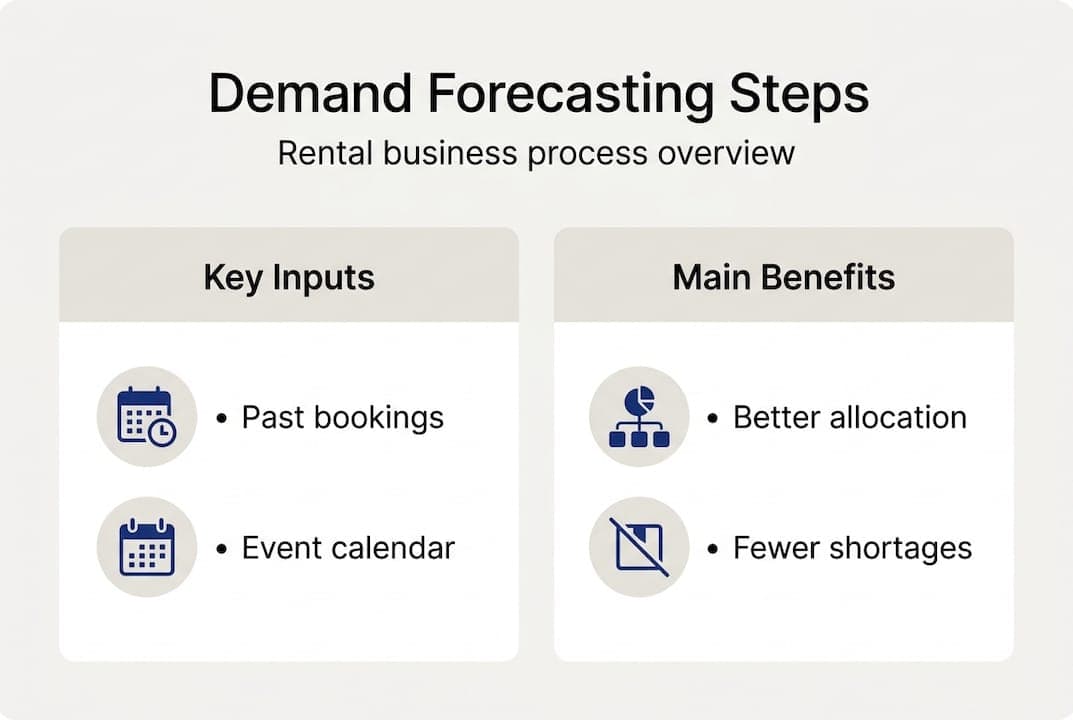
Accurate demand-based fleet allocation at the location level is what makes the difference between a reactive operation and a proactive one. The former spends the weekend apologizing to customers and scrambling for vehicles. The latter is already staffed and stocked before the first booking comes in.
Here is how strong demand forecasts improve specific operational areas:
- Dynamic pricing: Raise rates during confirmed high-demand windows. Lower them strategically to stimulate bookings during confirmed slow periods instead of letting vehicles sit.
- Booking availability windows: Open or restrict booking availability in advance based on forecast confidence. Avoid overbooking by capping reservations when vehicle supply is tight.
- Cross-location vehicle balancing: Move cars between branches based on predicted demand gaps. Prevent the buildup of idle inventory at low-demand locations.
- Customer communication: Proactively notify customers of upcoming availability constraints, encouraging earlier booking and reducing same-day cancellation stress.
- Upsell planning: Know in advance when demand for premium vehicles will outpace supply and prepare upgrade offers for standard-class bookings.
Integrating forecasts with your rental inventory management process adds another layer of value. When your inventory system knows what demand is coming, it can flag conflicts before they become booking problems, not after.
Maintenance scheduling is another area where forecasting pays off in ways operators often overlook. If you know your fleet will be at 90% utilization next Friday through Sunday, you schedule servicing on Wednesday and Thursday, not Saturday. Resources like fleet maintenance planning guides show how proactive scheduling extends vehicle life and reduces emergency repair costs, both of which compound over a full fleet.
Pro Tip: Connect your demand forecast directly to your maintenance calendar. If your software allows it, flag vehicles for service during predicted low-demand windows automatically. This single change alone can reduce unplanned downtime during peak periods by a meaningful margin.
The cumulative effect of applying demand forecasts across fleet allocation, pricing, availability, and maintenance is substantial. You will find the car rental blog guides at Nomora filled with real operator strategies for turning forecast insights into measurable revenue improvements.
Why the real value of demand forecasting is proactive decision-making
Most operators who underuse demand forecasting are not unaware of the concept. They simply default to intuition because acting on data requires building new habits, and intuition feels faster in a busy operation.
Here is the uncomfortable truth: intuition is usually right about the big obvious patterns and wrong about the subtle ones. It is the subtle patterns, the consistent Tuesday uptick near a local hospital, the annual corporate booking surge that peaks two weeks earlier than last year, that compound into real profit or real loss over a year.
We have seen operators transform their businesses not by investing in more vehicles, but by making better use of the fleet they already have. Data analytics insights reveal those patterns clearly when you know where to look. The operators who build a forecasting culture, where managers trust the data and act before demand arrives rather than after, consistently outperform competitors of similar size and fleet capacity.
Forecasting is not a reporting exercise. It is a decision-making framework. The businesses that treat it that way are the ones growing faster and more profitably than their reactive counterparts.
Demand forecasting only delivers results when it is connected to a system that acts on it. Understanding patterns is step one. Having the tools to respond in real time is what turns forecasting into profit.
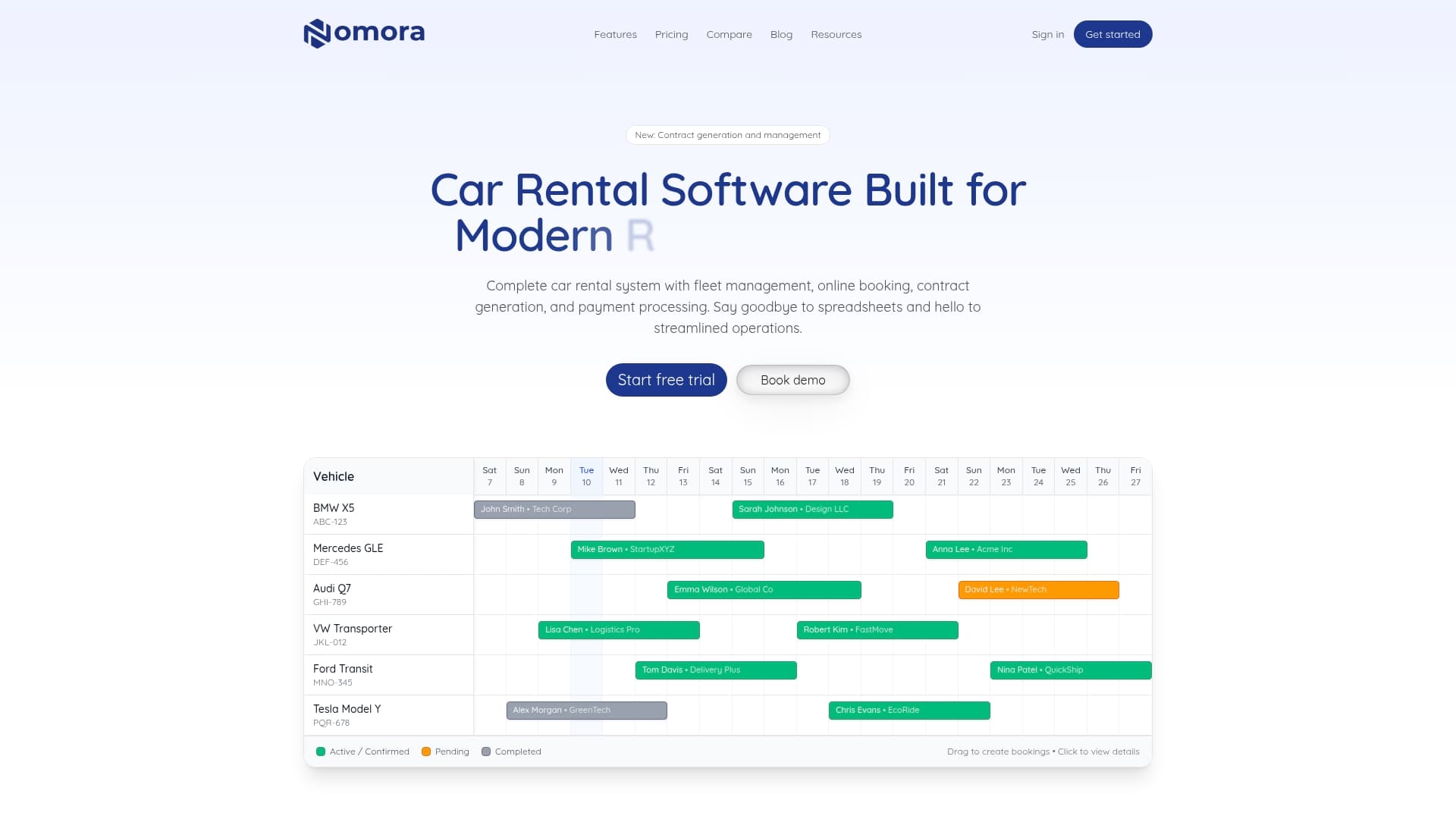
Nomora is a cloud-based car rental management platform built to give operators exactly that connection. From automated reservations and real-time fleet visibility to conflict-free bookings and integrated payment processing, Nomora functions as the central nervous system of your entire operation. Explore real-world use cases to see how businesses like yours use Nomora's forecasting and management tools to stay ahead of demand. You can also discover how Nomora helps prevent double bookings and supports automated payment solutions to reduce admin overhead while improving customer experience.
Frequently asked questions
What is demand forecasting in car rental?
Demand forecasting in car rental is predicting how many customers will want vehicles at specific times and locations, using that prediction to optimize inventory and pricing. As spatial and temporal research confirms, accurate forecasts require location-level modeling rather than single aggregate estimates.
How can car rental companies use demand forecasting to improve profits?
By anticipating demand peaks and slow periods, companies can reposition fleet vehicles, apply dynamic pricing, and prevent both overbooking and underutilization, all of which directly improve revenue and reduce wasted capacity.
Specialized car rental management platforms and data analytics tools automate demand forecasting with significantly greater accuracy than manual or spreadsheet-based methods, particularly at the location and vehicle-class level.
Why does demand change at different locations or times?
Car rental demand responds to local travel patterns, event calendars, business travel cycles, and seasonal factors that vary by geography. IEEE research on demand patterns shows these variations are significant enough to require separate forecasting models at the individual location level.
Recommended