Why overbooking matters for car rentals and what it costs
Every reservation that never turns into a pickup leaves a vehicle idle for the period it was held. Multiply that across a fleet and a season, and unused inventory becomes one of the largest leaks in a rental business. Overbooking is the deliberate acceptance of more reservations than you have vehicles, based on the expectation that some customers will cancel or not show up.
The trade-off is easy to state and hard to tune. Accept too few bookings and cars sit idle. Accept too many and you face customers standing at the counter with no car. A published optimal overbooking model frames this as a cost minimization problem with three components, plus a human cost that no spreadsheet captures.
- Opportunity cost: revenue lost when a car goes unrented because a booked customer did not show.
- Outsourcing cost: what you pay to source a vehicle elsewhere, such as borrowing from a partner or another location, when you cannot supply one yourself.
- Upgrading cost: the margin you give up when a customer receives a higher class than the one they paid for.
- Reputational and human cost: a stranded customer, a negative review, a lost corporate account. This rarely appears on a ledger but shapes future demand.
Car rental has complications that airlines and hotels face less often. Your fleet is heterogeneous: an economy car can be upgraded into a midsize, but not the other way around. Return times are uncertain too, because overstays and early returns change what is available at any hour. Unlike airlines, you often cannot rebalance inventory across a network quickly, so a shortage at one branch is not automatically solved by spare cars at another.
The research supports a disciplined approach. A 2020 study in the Journal of Revenue and Pricing Management reports that using an optimal model instead of a naive method can reduce total costs by approximately 67%. That is a result from a modeled setting, so treat it as a sign of the size of the prize rather than a promise for your branch. For related thinking on how idle capacity connects to profit, see our guide to rental inventory management and fleet utilization.
Data you need and forecasting methods for show-up rates
A model is only as good as the records behind it. Before you pick any method, make sure each reservation carries enough detail to explain why some customers show up and others do not. Most rental systems already hold these fields; the work is usually in cleaning and joining them.
Collect these at the reservation level:
- Booking channel (direct website, phone, online travel agency, corporate portal)
- Lead time between booking and pickup
- Pickup date, day of week, and time
- Vehicle class and pickup location
- Customer flags such as corporate account, loyalty member, or repeat renter
- Prepayment or deposit status
- Final outcome: picked up, canceled (and when), or no-show
Cancellations and no-shows are different events and should be recorded separately. Cancellations are often more frequent than no-shows, and a customer who cancels two days ahead lets you resell the car, while a no-show at the counter does not. Our guide on managing rental cancellations covers how to capture that distinction cleanly.
Choosing a forecasting method
Start simple and add complexity only when it earns its keep.
- Historical averages. Calculate the show-up rate for each class, location, and day-of-week combination over a rolling window. This is a solid baseline and easy to explain to branch managers.
- Time-series models. Use these when seasonality is strong, such as holiday weekends, summer peaks, or local events. They help forecast total demand and total pickups.
- Logistic regression for show-up probability. Each reservation receives a probability of showing up based on channel, lead time, and customer flags. Summing those probabilities across all reservations for a day gives an expected pickup count and, with variance, a range.
- Machine learning classifiers. Gradient-boosted trees or similar models can capture interactions, for example that long-lead-time online travel agency bookings on holiday weekends behave differently from the same bookings midweek. Use them when you have enough history to avoid overfitting.
Large operators already combine these techniques. Europcar's Opticar system integrates forecasting, simulation, and optimization to anticipate fleet demand up to six months ahead. You do not need that scale to benefit from the same layering: forecast first, then test decisions against the forecast. For a software-side view of forecasting tools, read our demand forecasting and pricing software guide.
Segmenting without starving your data
Segment by vehicle class and booking channel first, because those two dimensions usually drive the largest differences in show-up behavior. Small locations rarely generate enough volume to model on their own. Pool them into regional groups until you have a stable sample, then split them out later if their behavior diverges. Use rolling windows that give more weight to recent weeks, so the model reflects current customer behavior rather than a pre-change era.
Reminders also change the behavior you are trying to predict. Automated confirmations and nudges tend to reduce no-shows, as this partner article on automated reminders discusses for transport bookings. If you launch a reminder sequence, expect your show-up rates to shift and refit the model afterward.
Pro Tip: Log the reason and timing of every cancellation from day one. A cancellation made well ahead of pickup and a no-show at the counter look identical in a simple "did not rent" flag, but they call for very different overbooking limits.
Modeling approaches: optimal models, regression, and simulation
Once you can forecast show-ups, you need a rule that turns the forecast into a booking limit: how many reservations above physical capacity will you accept for a given class, location, and date?
The optimal overbooking model
The academic approach treats the limit as the solution to a cost minimization problem. The objective is to choose the overbooking level that minimizes the sum of three expected costs. As the published car rental model describes it, those costs are opportunity cost (empty cars), outsourcing cost (sourcing a replacement), and upgrading cost (giving a higher class). The model treats booking and show-up levels as joint random variables, since they move together: a strong booking day often has different show-up behavior than a weak one.
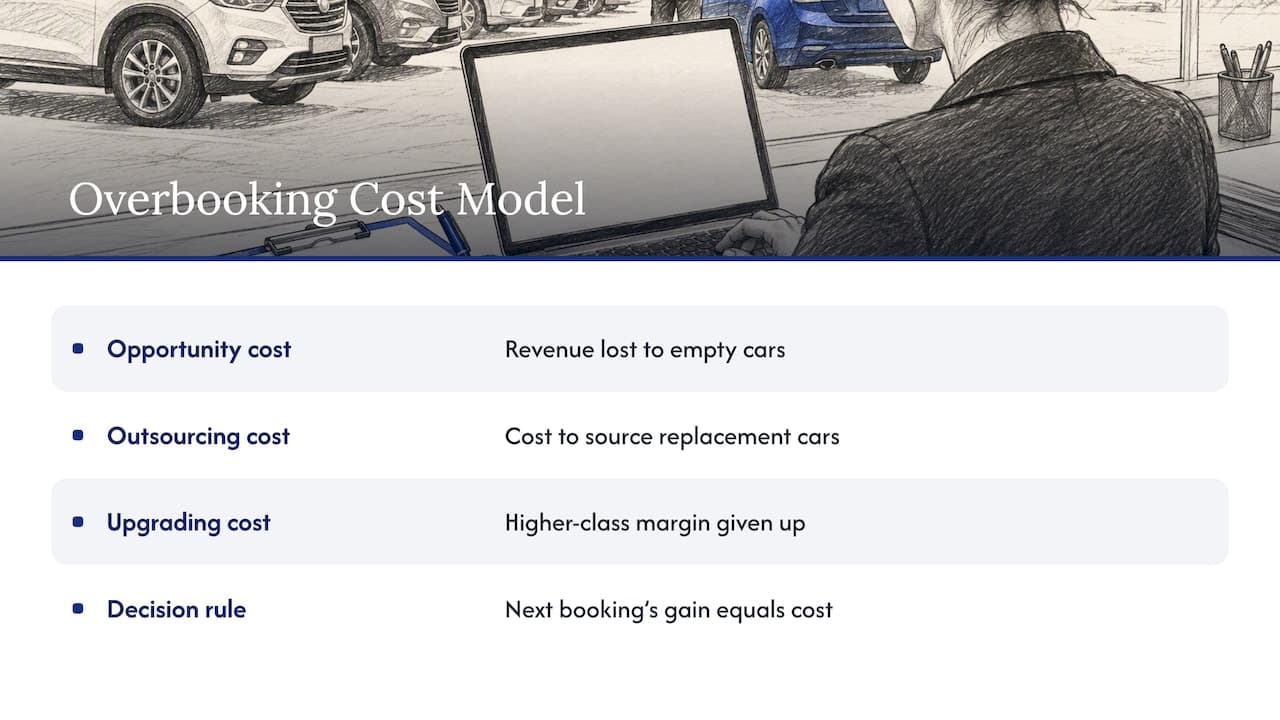
The intuition is a balance point. Each additional accepted reservation adds expected revenue from the chance that a no-show frees a car, and adds expected cost from the chance that everyone shows up and you must recover. The optimal limit sits where the next booking's expected gain equals its expected cost. When your recovery options are cheap, such as a spare higher-class car you would otherwise leave idle, the limit rises. When recovery is expensive or reputationally risky, it falls.
Regression simplifications
Running a full optimization for every class and location each day is impractical for many operators. The same body of research proposes regression models that approximate the optimal answer from a few inputs such as expected show-up rate and cost ratios. The reported accuracy is strong: according to the 2020 journal study, regression-based models achieved an adjusted R-squared of 72.8% to 90.10% for two-class vehicle models, and the total-cost gap between optimal and regression solutions was around 3.2% to 14.09%. An earlier 2018 paper on stochastic cancellation reports an adjusted R-squared of at least 83.40% for single-class models.
A regression-based overbooking model can recover most of the benefit of a full optimization: the research reports total-cost gaps of roughly 3.2% to 14.09% against the optimal solution, versus about 67% lower total cost than a naive method.
In plain terms, a well-fitted regression can give you most of the value with far less computing and far fewer moving parts. These figures come from specific modeled scenarios, so validate any simplified rule against your own history before trusting it.
When to simulate
Formulas assume a simplified world. Discrete-event simulation lets you replay a day or a week with realistic randomness, so you can test a limit before you apply it. Reach for simulation when:
- You run a multi-class fleet where upgrade chains interact (an economy shortage pulls from compact, which pulls from midsize)
- Vehicle transfers between locations take time and capacity
- Rare events matter, such as a flight cancellation wave or a local event that spikes demand
- Overstays and late returns make same-day availability uncertain
Europcar's approach, which combines forecasting with simulation and optimization, shows the pattern: let the forecast set expectations, let the optimizer propose a decision, and let the simulation stress-test it.
A practical sequence for most operators:
- Begin with a historical show-up rate per segment and a conservative fixed overbooking percentage.
- Move to a regression rule that adjusts the limit by expected show-up rate and recovery cost.
- Add simulation for your busiest locations and your most complex class structures.
- Run sensitivity checks on every rule before you rely on it (more on that below).
Operational playbook when a reserved car is unavailable
Even a well-tuned limit will sometimes leave a customer without the class they booked. The difference between a recoverable moment and a lost customer is how fast and how honestly your team responds. Build the playbook before you need it, and make sure every counter agent can execute it without calling a manager for routine cases.
Follow this sequence at the counter:
- Acknowledge the problem immediately. Tell the customer the car they reserved is not ready, apologize once, and move straight to options. Do not make them ask.
- Check for an immediate upgrade. If a higher class is available, offer it at the booked rate. This is usually the cheapest and fastest fix, and it is why upgrading cost is part of the model.
- Give a realistic wait time. If a car is due back, check the actual return status and quote a time you can meet. A short, honest estimate beats an optimistic one that slips.
- Offer a transfer. If another branch holds a suitable car, arrange delivery or offer to move the customer there at your cost.
- Use a vetted outsourcing partner. When no internal vehicle exists, source one through a pre-agreed partner at a known rate. Agree on terms in advance so you are not negotiating in front of an unhappy customer.
- Provide a controlled recovery gesture. Depending on severity, this could be a discount on the current rental, a credit toward a future booking, or a referral to a competitor with your team arranging it. Set firm limits on what an agent can grant.
- Document the incident. Record the class, location, cause, and cost so the data flows back into your limit calculation.
Escalation thresholds keep decisions consistent. For example, let agents approve upgrades and small credits on their own, require a shift manager for outsourcing, and require an operations lead for competitor referrals or large credits. Define the trigger clearly, such as an excessive wait or any case without an internal vehicle.
To calculate recovery cost for each incident, add the upgrade margin given up, any outsourcing fee, and the value of the gesture you offered. Track the total per incident and across your rental activity. That figure is the real-world counterpart of the cost terms in the model, and it tells you whether your limit is too aggressive.
Pro Tip: Pre-authorize your counter agents with a written menu of recovery options and dollar caps. Customers are more likely to forgive a problem solved quickly than one that drags on after multiple hand-offs.
Practitioners often caution that overbooking is riskier for rental companies than for airlines, since rental networks cannot always rebalance inventory quickly. Treat that as a reason to invest in your playbook, not to avoid overbooking altogether. The playbook also reduces reputational damage, which is the cost most operators underestimate.
Implementing overbooking controls in reservation systems
A policy that lives only in a manager's head will fail on a busy Friday. The controls need to live in your reservation system so that every channel and every agent follows the same rules. Here is what to set up.
Inventory controls
- Per-class overbooking pools. Set a separate overbooking allowance for each vehicle class rather than one fleet-wide number, because show-up behavior and upgrade options differ by class.
- Location hard caps. Give each location a maximum overbooking allowance that cannot be exceeded regardless of what the model suggests, as a safety stop for small or constrained branches.
- Return-time-aware hold windows. Count a car as available only when its expected return time leaves enough buffer for cleaning and handover. A car due back at noon cannot serve a 12:15 pickup.
Conflict-free booking logic
- Real-time availability checks. Every booking, whether online, phone, or walk-in, should hit the same live inventory so two channels cannot sell the same unit at once. Our article on preventing double bookings walks through the common failure points.
- Agent visibility of pending returns. Counter staff should see which vehicles are due back, which are late, and which are already assigned, so they can make honest promises.
- Rules for auto-upgrades. Define when the system may upgrade a booking automatically, which classes it can upgrade into, and whether the customer is notified. Automatic upgrades keep recovery fast but need guardrails so premium vehicles are not given away needlessly.
Automation
- Scheduled recalculation of booking limits. Refresh limits on a set cadence using the latest forecast rather than leaving them static for a season.
- No-show scoring. Assign each reservation a risk score from the show-up model, so your sums reflect the actual mix of bookings and not just a flat average.
- Reminder sequences. Send confirmations and pre-pickup reminders that make it easy to cancel, since an early cancellation is far better for you than a no-show. Our no-show policy guide covers how to pair reminders with clear terms.
A good test of your setup: pick a busy date next month and ask whether the system, without human intervention, would prevent a same-unit double booking, enforce the location cap, and trigger the right reminders. If any answer is no, fix that before you raise any overbooking limit.
Monitoring, KPIs, and sensitivity analysis
Overbooking is not a setting you configure once. Customer behavior drifts, markets shift, and the same limit that was profitable in spring can hurt you in peak season. Monitoring turns overbooking from a gamble into a managed process.
Track these core KPIs by class, location, and channel:
| KPI | What it tells you | Typical action when it worsens |
|---|
| Show-up rate | Whether your forecast matches reality | Refit the forecast, review segments |
| Denied-service incidents | How often the limit is too aggressive | Lower the limit or add a hard cap |
| Upgrade frequency | How often recovery relies on upgrades | Review class mix and upgrade rules |
| Incremental revenue per booking | Whether overbooking is paying off | Check pricing and the recovery cost trade-off |
| Customer recovery cost per incident | Real cost of failures | Revisit the recovery menu and partner rates |
Review these weekly during peak periods and monthly otherwise. Trends matter more than any single day: a slow climb in denied-service incidents is a warning even if each day looks fine.
Running sensitivity checks
A limit that is optimal under one set of assumptions can be fragile under another. The research on car rental overbooking proposes sensitivity analysis as a core part of choosing a policy, and the practice is straightforward:
- Take your current show-up and cancellation rates and cost parameters as the base case.
- Move each one up and down by a reasonable margin, for example a few percentage points on show-up rate or a meaningful change in outsourcing cost.
- Recompute the best overbooking limit for each variation.
- Choose a limit that performs well across the range, not just in the base case.
If a small drop in the show-up rate would push you into frequent denied service, pick a more conservative limit. If your costs barely change the answer, you have a robust policy and can afford to be less cautious.
Recalculation cadence
Plan limits monthly or weekly well ahead of the date, then refresh more often as pickup approaches. Recalculate daily in the final window, when you know the most about who is likely to arrive. The closer to pickup, the smaller the uncertainty and the tighter the limit can safely be. Pair this cadence with a review of the incident log so that real recovery costs feed back into the parameters.
Policy language, communication templates, and staff checklist
Consistent wording prevents arguments at the counter. Have your legal counsel review all policy text before use; the samples below show structure and tone, not legal advice. Consumer-facing transparency about charges and terms is also a theme in ACRISS booking guidance, which encourages operators to publish clear conditions.
Sample policy clauses
- Vehicle class reservations are guaranteed to the extent of availability. If your reserved class is unavailable at pickup, we will provide a vehicle of equal or higher class, or an agreed alternative.
- Pickup times are estimates. If a vehicle is delayed by a late return, we will update you with the expected ready time.
- Our liability for an unavailable vehicle is limited to the remedies stated in these terms, such as an upgrade, a transfer, or a credit.
Customer message templates
- SMS reminder: "Your rental pickup is tomorrow at 10:00. Reply C to cancel or tap here to adjust your booking."
- Delay notice: "Your vehicle is being prepared and will be ready by 10:40. We are sorry for the wait and will have a gift ready when you arrive."
- Alternative offer email: "We could not ready your booked class, so we have reserved a higher class at your original rate. No action is needed."
Staff checklist
- Confirm who may approve upgrades, outsourcing, and credits, and the dollar limit for each.
- Keep an escalation contact list at every counter, with names and phone numbers.
- Review the recovery menu at the start of each peak season.
- Log every incident with class, cause, and cost.
- Run a short role-play each quarter: one agent plays an upset customer, another practices the scripts and options.
Most overbooking failures we see described are not model failures. They are workflow failures: two channels selling the same car, a late return nobody flagged, a counter agent who could not see what was coming back. This is where an integrated platform earns its place, because the forecasting, the limits, and the recovery steps only work if everyone is looking at the same live picture.
At Nomora, our reservation workflows run against real-time inventory, and our conflict-free booking tools keep a single unit from being sold twice. Fleet visibility helps agents make informed decisions. Because we onboard operators quickly, you can pilot these controls without a long implementation project.
A practical pilot path looks like this:
- Run your forecasts and establish baseline show-up rates by class and channel.
- Enable a small overbooking pool in one class at one location, with a hard cap.
- Watch the KPIs closely for several weeks, including every denied-service incident.
- Adjust the limit using sensitivity checks, then extend to more classes and locations.
Start small, learn from your own data, and expand only when the numbers support it.
What the research supports, and what most operators get wrong
Here is our editorial judgment after working through the evidence. The models are not the hard part. The reported gap between a regression shortcut and a full optimization is modest, which means the extra effort of a perfect model is rarely where your money is. The money is in the two things most operators skip: honest recovery costing and disciplined monitoring.
Conventional advice treats overbooking as a pricing trick, a number to push up until it hurts. That framing is backwards. The right question is how cheaply and gracefully you can recover when you are wrong, because that cost sets how aggressive you can afford to be. An operator with spare upgrade inventory and a trusted outsourcing partner can safely run a higher limit than one with neither.
Also overrated: chasing a more sophisticated machine learning model before your data is clean. A simple logistic regression on well-recorded cancellations and no-shows will beat a fancy model fed messy outcomes.
What to do first: fix your outcome logging, write the recovery playbook, set hard caps, and start with a small pool. Raise the limit only after the incident log tells you it is safe.
— Dizzy
Put controlled overbooking to work with Nomora
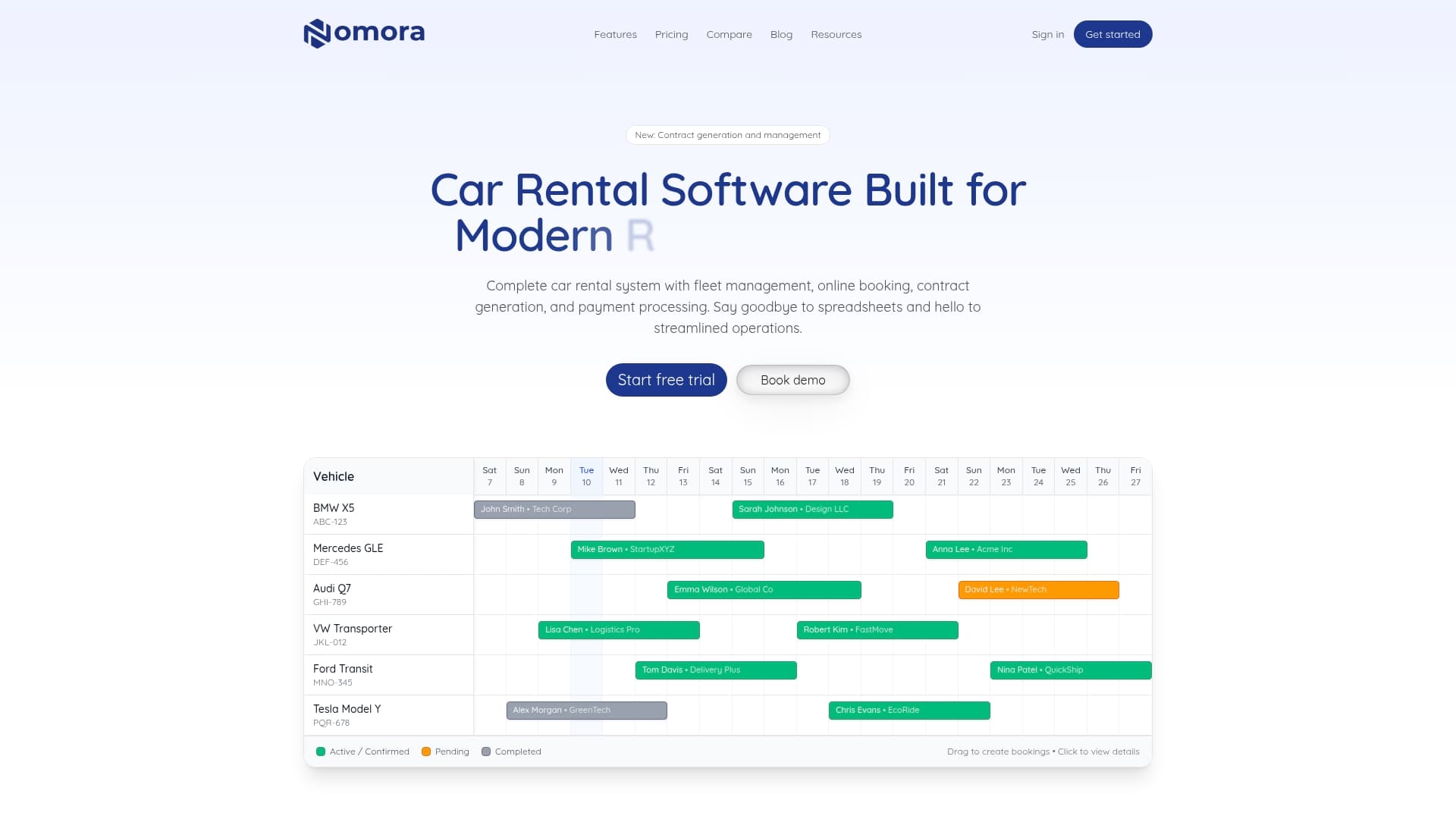
If you want to apply these controls without stitching together spreadsheets and separate tools, we built Nomora for exactly this kind of operational discipline. Our car rental software centralizes your reservations, fleet, and contracts so your team works from one live source of truth.
Here is what that means for controlled overbooking:
-
Conflict-free bookings that stop the same vehicle from being sold twice across channels
-
Real-time fleet visibility to help agents make informed decisions
-
Cloud access from any device, so branch managers can act on limits and incidents anywhere
You can browse use cases by business type to see how operators like you set things up, review our pricing plans to find the right fit, or explore how Nomora could support a small overbooking pool in your operation.
FAQ
What to do if all rental cars are sold out?
Check whether a higher class is available and offer it at the original rate, then look at transfers from nearby locations. If nothing is available internally, use a pre-agreed outsourcing partner or help the customer find an alternative. Record the incident so your overbooking limit reflects the real cost.
What is an overbooking strategy?
It is a planned approach to accepting more reservations than available vehicles, based on forecast cancellations and no-shows. A sound strategy combines a forecast, a tuned booking limit, and a recovery plan, as described in research on optimal overbooking for car rental. It is monitored and adjusted continuously.
How do I set a safe overbooking limit?
Start from your historical show-up rate for each class and location, then keep the limit conservative until you have incident data. Test the limit against changes in show-up rates and recovery costs, and put a hard cap on small or constrained locations.
How often should I recalculate overbooking limits?
Plan limits monthly or weekly well ahead of the date, then refresh them more often as pickup approaches. Daily recalculation in the final window works best, since you know the most about who is likely to arrive.
Sources
Recommended