Yes, a US rental company can usually add a credit card surcharge, but only inside three sets of limits: card network rules, state law and the FTC's price transparency rules. The fee must stay at or under the network cap, it can never touch debit or prepaid cards, and it has to be disclosed before the customer commits. Get one of those wrong and the penalty is not a small fee. It can be a fine, a customer complaint or a terminated merchant account.
This guide is for owners and managers of car, specialty, luxury and corporate fleet rental operations. It explains what the rules say, where rentals get caught, and how to build a surcharge workflow that survives an audit. It is general information, not legal advice. Before you switch anything on, confirm your state's rules with a licensed attorney or your payment processor's compliance team.
TL;DR
- Card networks allow credit card surcharges, capped at the lesser of your actual acceptance cost or 3% for Visa and 4% for Mastercard. In practice most operators treat 3% as the ceiling.
- Debit and prepaid cards cannot be surcharged. Rental customers often pay with debit, so card type detection matters.
- Connecticut, Maine and Massachusetts restrict or ban surcharges, and several other states cap or condition them.
- Notify your acquirer in writing at least 30 days before you start, and disclose the fee at the website, the counter and the booking summary.
- Keep a fee-free payment option available, and never apply a percentage to a security deposit hold.
Table of Contents
What a surcharge is, and what it is not
A surcharge is an extra fee a merchant adds to a bill when the customer pays with a particular form of payment. It is different from three things that rental owners often blur together:
- A discount for cash. Offering a lower price for cash or check is generally treated differently from adding a fee to cards. Check your state's wording before you rely on that distinction.
- A convenience fee. A flat fee for booking online or by phone is a separate charge, with its own disclosure duties, and it is not a card surcharge.
- A deposit. A security deposit is a hold or a refundable amount, not a fee. We come back to this below because it is where rental software most often goes wrong.
Why do operators bother? Typical credit card processing costs run roughly 1.5% to 3.5%. On a fleet doing steady volume, that is a real line item. A $600 weekly rental costs you somewhere between $9 and $21 to accept by card. Multiply by hundreds of bookings a month and the question is fair.
The card network rules
The networks, not the government, set the strictest everyday limits. Following a settlement of US merchant class litigation, Mastercard modified its rules so US merchants may apply a surcharge to customers who pay with its credit cards. Visa's rules work the same way, with these main points:
| Rule | What it means for a rental business |
|---|
| Cap | The lesser of your actual cost of acceptance or the network maximum: 3% for Visa, 4% for Mastercard |
| Card type | Credit cards only. Debit and prepaid cards are off limits |
| Notice | Written notice to your acquirer at least 30 days before you begin |
| Disclosure | Clear notice at the entrance (or website landing page) and at the point of sale |
| Receipt | The surcharge must appear as its own line on the receipt |
Because you cannot usually split Visa and Mastercard amounts in a practical way across one checkout, a single flat rate at or below 3% is the common approach. The "lesser of" language matters too. If your effective cost is 2.4%, charging 3% breaks the rule even though 3% is the headline cap.
The 30-day notice
The notice step is the one owners skip. Many assume a surcharge is a toggle in the terminal or booking software. It is not. Under Visa's published Q&A, you notify your acquirer ahead of time, and processors and networks can penalize merchants who skip it. Network procedures have changed over the years, so ask your processor in writing what they require today, and keep their reply on file.
Debit and prepaid cards
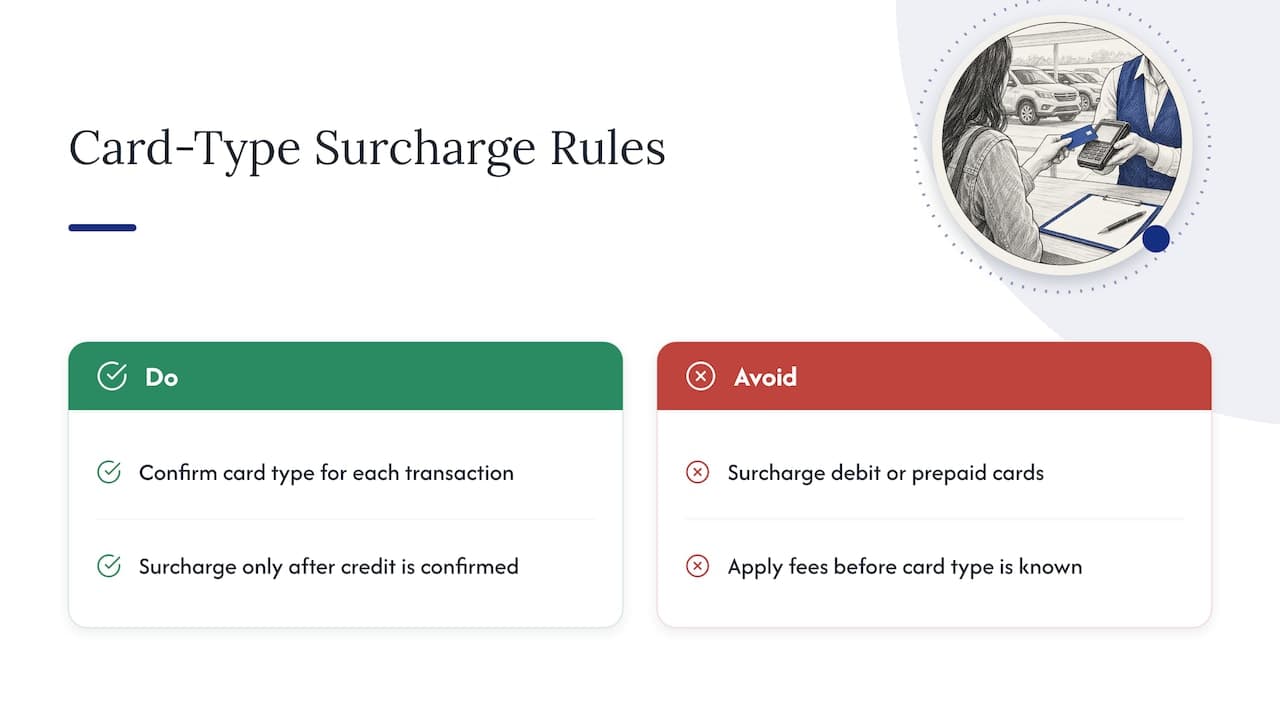
Surcharging debit or prepaid cards is prohibited under network rules. This is a real hazard for rentals. Many renters, especially younger drivers and people renting while their own car is in a body shop, pay with debit. If your system adds 3% at booking before it knows the card type, you have charged a prohibited fee. The safe design is to apply the surcharge only after the card type is confirmed as credit, and to apply it per transaction, not per booking.
State law: a patchwork you must check
The state picture changes, so treat any list, including this one, as a starting point. According to a 2026 state-by-state summary, surcharges are banned in three states, legal with caps or conditions in about ten more, and the remaining states have no specific surcharge law, which leaves network rules as the only limit.
- Banned or heavily restricted: Connecticut, Maine and Massachusetts, according to the same summary. Another state roundup also lists Puerto Rico.
- Allowed with caps or disclosure rules: states such as Colorado, Kansas and New York.
- Historic bans that courts have undercut: California and Texas both had laws against surcharges, but that roundup notes federal courts ruled the bans unconstitutional. California's own Department of Justice still publishes consumer guidance on the topic, so read the current version before relying on any summary.
Two practical points for rental operators. First, a multi-location business follows the rules of the state where each location operates. Second, your renters may come from anywhere, but the state of the rental counter or the booking entity is what matters for most rules. If you serve customers across state lines, ask counsel which state's law governs your online bookings.
For a neutral reference to start from, the National Conference of State Legislatures keeps an overview of credit and debit card surcharge statutes, and some states publish their own consumer pages, such as Michigan's guidance on card surcharges.
The FTC and the price you advertise
This is the part that has changed most recently, and it is the one that most affects how you display prices.
The FTC's Rule on Unfair or Deceptive Fees focuses on hiding mandatory charges until late in the buying process. Its FAQ page is worth reading in full, and note that the rule's formal coverage centers on live-event tickets and short-term lodging. That means you should not assume it applies to a car rental word for word. But the direction of travel is clear. If a customer has no way to pay without the fee, regulators are likely to view it as a mandatory charge that belongs in the displayed price, not something that appears at the last click. Ask your attorney how the rule and your state's consumer protection law apply to your business.
City and state agencies are moving the same way on rentals specifically. In August 2026, New York City announced enforcement against rental car companies after inspectors found that most businesses failed to post required price signs or disclose prices. The lesson for any operator, in any state: show the full price early.
Keep a fee-free way to pay
The most common mistake we see described by compliance specialists is offering no alternative. If every payment method carries the fee, it stops looking like an optional surcharge and starts looking like a hidden price increase. Offering a fee-free method, such as cash, a check, or a debit card, is the usual way to keep the structure defensible. Debit works well here because you are barred from surcharging it anyway.
If you run an online-only operation where cash is impractical, talk to your counsel about whether to build the processing cost into your base rate instead. For many small fleets that is the cleaner answer.
Disclosure: where the fee has to appear
A line in your terms and conditions is not enough. Even large equipment renters publish their policy in terms, but regulators and networks expect more. Plan for disclosure at four points:
- Entry point. A notice on your website's booking page, and a sign at the counter or pickup desk if you have one.
- Quote stage. The rate shown to the customer should make clear whether card payments carry a fee and how much.
- Booking summary. The surcharge as its own line before the customer confirms.
- Receipt and contract. The same amount again, itemized, and consistent with what was charged.
The rate you state must match the rate you charge to the cent, and it must be calculated on the correct base. That brings us to deposits.
Security deposits and holds: do not surcharge the hold
Rental is not retail. A customer typically has three money events: the booking payment, the security deposit hold, and the final settlement after return, with extras like fuel, tolls or damage. Each needs its own treatment.
- A deposit hold is an authorization that ties up part of the customer's credit line. It is not a sale. Applying a percentage surcharge to a $500 hold is wrong, and it becomes a refund headache if the final bill is lower.
- The final settlement is the transaction that actually captures money. If a surcharge applies, it applies to the captured amount, and only when the card is credit.
- Refunds should reverse the surcharge in proportion to the refunded amount. Make sure your process does that, and document it.
The FTC's consumer advice on renting a car warns renters that advertised rates may not show the real final price once fees are factored in. That is the complaint you want to avoid generating. For a full walkthrough of how holds work, see our guide to car rental security deposits and our overview of the types of vehicle rental deposits. For a clear explainer on keeping authorization holds apart from the fees on the final charge, this guide to securing card payments is a useful read, although its examples come from UK retail.
A worked example
Say you run a 30-car regional fleet in a state with no surcharge law, and your processor confirms your effective cost is 2.7% on credit cards.
- Weekly rental: $700.00
- Surcharge rate you choose: 2.7% (the lesser of your cost and the 3% Visa ceiling)
- Surcharge on a credit card payment: $18.90
- Total charged: $718.90
- Same rental on a debit card: $700.00, no surcharge
- Security deposit hold: $500.00, no surcharge at authorization
- Final settlement after return: the rental total plus any extras, with 2.7% applied only if the card is credit
The pieces that make this defensible: the acquirer was notified 30 days earlier, the rate is posted on the booking page and at the desk, the quote shows the fee, the receipt itemizes it, and debit is accepted at the plain price. Remember that Mastercard allows up to 4%, but a single rate above the Visa cap would breach Visa's rule.
Surcharge or build it into the rate?
Not every business should surcharge. Compare the options on what matters to a rental operator:
| Approach | Strength | Risk |
|---|
| Surcharge credit cards | Passes cost to the customer who chooses the costly method | Strict rules, state bans, disclosure duties, debit errors |
| Cash or debit discount | Simple to explain | State rules vary on how a discount must be worded |
| Absorb the cost in the rate | No compliance exposure, one clear price | Margin pressure, and cash payers subsidize card payers |
| Flat convenience fee | Predictable | Still a fee that must be disclosed up front |
For a high-ticket luxury or specialty rental, a 3% fee on a $4,000 weekend is $120, and a customer will notice it. In that segment, many operators prefer the simpler all-in rate. For a budget fleet with thin margins and many debit users, a clearly disclosed credit surcharge can make sense. The right answer depends on your state and your mix of customers.
Our perspective: software is the nervous system of compliance
We think of rental software as the central nervous system of the operation: reservations, contracts, deposits and payments all pass through it. That is exactly why surcharge mistakes are rarely a policy problem. They are a workflow problem. A surcharge rule that lives in a manager's head, or in a spreadsheet note, will be applied inconsistently, and a rule applied inconsistently is the one an auditor finds.
From what we see in how rental businesses work, the trouble starts at the seams. The quote says one thing, the contract says another, the card terminal adds a third amount, and the deposit hold gets mixed in with all of it. When those steps live in separate tools, nobody owns the total. When they live in one system, the same price, the same fee line and the same itemized receipt can flow from booking to contract to payment.
So our advice is to decide your policy first, with your processor and counsel, and only then ask whether your software can carry it out. Ask your vendor, including us, these questions:
- Can the system show the final price, including any fee, at the first quote?
- Can it keep a deposit hold separate from the captured payment?
- Can it apply a fee by card type, so debit is never charged?
- Does the receipt itemize the fee, and does a refund reverse it correctly?
If the answer to any of those is "manually," plan for errors. For more on how we approach payments, see our pages on automated car rental payments, payment security for rentals and PCI compliance for car rentals.
— Dizzy
A compliance checklist before you switch it on
- Confirm your state. Check whether your state bans, caps or conditions surcharges, and ask counsel about any location in more than one state.
- Calculate your real cost. Get your effective credit card rate from your processor statement. Your surcharge cannot exceed it.
- Notify your acquirer. Do it in writing, at least 30 days ahead, and keep the confirmation.
- Choose one rate. Stay at or under 3% if you accept Visa.
- Offer a fee-free option. Debit, cash or check, depending on how you operate.
- Update every touchpoint. Website, quote, booking summary, contract, counter sign and receipt.
- Exclude holds. Never apply the percentage to a deposit authorization.
- Test with real cards. Run a credit card, a debit card and a prepaid card through your flow and read each receipt.
- Train staff. Counter agents should be able to explain the fee in one sentence and offer the alternative.
- Review every year. Rules, networks and local enforcement move quickly. Recheck at least annually.
Where Nomora fits
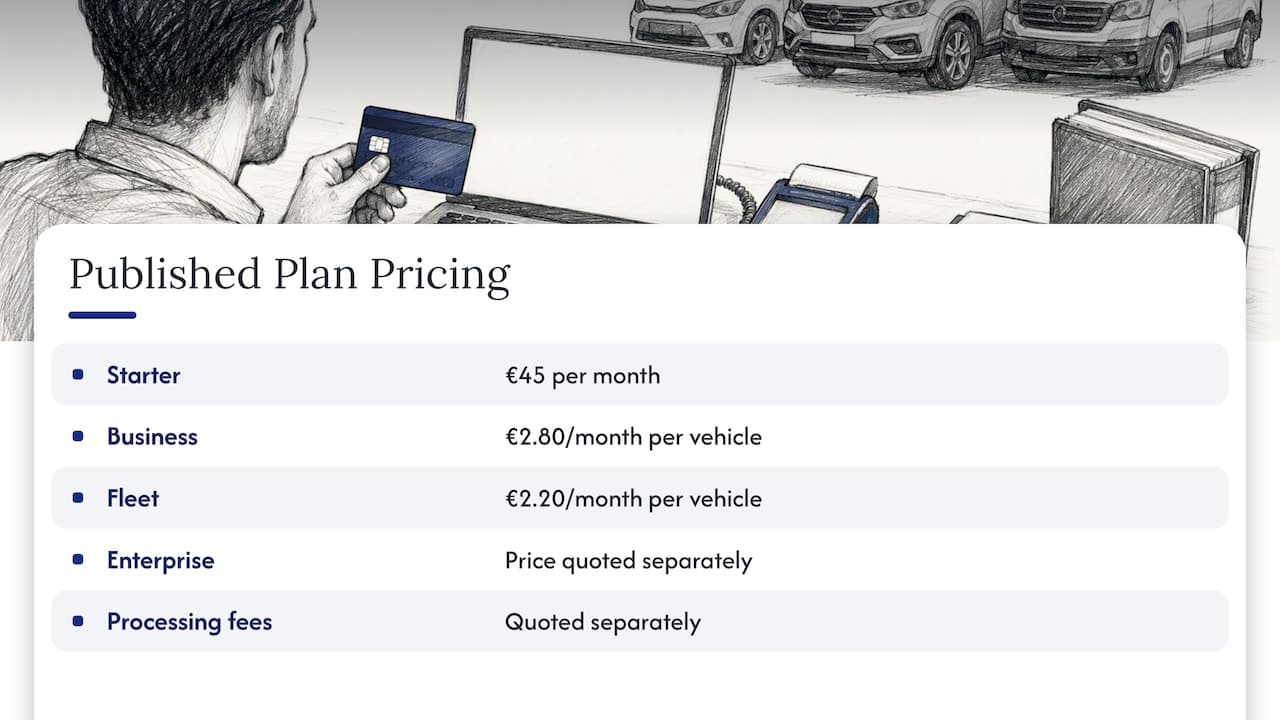
If you are still tracking bookings, deposits and card fees across spreadsheets and a standalone terminal, a surcharge policy is hard to enforce. Nomora is cloud-based rental management software that brings reservations, contracts, payments, fleet data and customer records into one place, so the price a customer sees can stay consistent from quote to receipt. Every plan includes the full feature set. Pricing is published: Starter is €45 per month, Business is €2.80 per month per vehicle, and Fleet is €2.20 per month per vehicle. Enterprise and payment processing fees are quoted separately. See the plans and pricing, or look at our car rental software overview to see whether it fits your operation.
FAQ
Is it legal to charge a 3% credit card fee on a rental?
In most states, yes, as long as it is no more than your actual cost of acceptance, it is disclosed clearly, and you have notified your acquirer. It is banned or heavily restricted in places such as Connecticut, Maine and Massachusetts, so check your state first.
Can I surcharge debit cards?
No. Surcharging debit or prepaid cards is prohibited under network rules, and a 2026 state summary says debit surcharges are barred everywhere. Your system must confirm a card is credit before it adds any fee.
Do I need to tell customers before they pay?
Yes. Disclose the fee on your website or at the entrance, in the quote and booking summary, and itemize it on the receipt. Mentioning it only in your terms and conditions is not enough to count as clear notice.
Should the surcharge apply to my security deposit?
No. A deposit hold is an authorization, not a sale. Apply any surcharge only to the amount actually captured at final settlement, and only if the card is credit.
Sources
Recommended