TL;DR:
- Payment security in rentals involves practices, technologies, and compliance standards that protect income, data, and transaction integrity from fraud and unauthorized access. Most property managers prioritize payment security above other trust measures, relying on PCI DSS compliance, tokenized gateways, and fraud monitoring as the industry standard. Implementing ACH bank transfers, PCI-compliant gateways like Stripe, encryption, and clear policies is essential for building a secure, trustworthy rental operation.
Payment security for rentals is defined as the set of practices, technologies, and compliance standards that protect rental income, customer data, and transaction integrity from fraud, chargebacks, and unauthorized access. Over 72% of property managers rank payment security above all other trust measures, which signals how central it is to running a viable rental operation. The industry standard for secure rental payments centers on PCI DSS compliance, tokenized payment gateways like Stripe, and systematic fraud monitoring. If you manage a car rental fleet or any rental business, these practices are not optional extras. They are the foundation of a sustainable operation.
1. What are the safest payment methods for rental businesses?
The gold standard for safe payment methods in rentals is ACH bank transfer combined with a PCI-compliant payment gateway. ACH transfers move funds directly between verified bank accounts, which eliminates the card-not-present fraud risk that plagues credit card transactions. Platforms like Stripe, which 65% of rental hosts rely on, process card payments at 2.9% plus 30 cents per transaction while providing built-in fraud detection and chargeback management.

Peer-to-peer apps like Venmo and Zelle are the wrong choice for rental payments. P2P apps lack mechanisms for preventing chargeback abuse and are frequently used in triangle scams, where a fraudster uses stolen credentials to pay you while defrauding a third party. Once funds clear through Zelle, recovery is nearly impossible.
Here is a quick comparison of common rental payment methods:
- ACH bank transfer: Low fees, high security, slow clearing (2–3 days), best for recurring rent
- PCI-compliant card gateway (e.g., Stripe): Instant processing, fraud tools included, transaction fees apply
- Paper checks: Expose account information publicly, susceptible to theft, no audit trail
- Money orders: Safer than checks but require manual handling and offer no digital record
- Venmo/Zelle/Cash App: Convenient but carry significant scam and chargeback risk for rental operators
- Digital wallets (Apple Pay, Google Pay): Tokenized and secure, but require gateway integration to use effectively
The practical takeaway is straightforward. Choose platforms that sit inside a regulated payment infrastructure. Convenience should never override compliance.
2. How to use technology to strengthen transaction security
The technical backbone of secure online rental transactions is tokenization combined with strong encryption. Tokenization replaces sensitive card data with a randomized token that is useless to a thief even if intercepted. AES-256 encryption and tokenization provide bank-level security and create legally defensible audit trails, which matters enormously when you need to contest a dispute or eviction proceeding.
3D Secure 2 (3DS2) is the authentication standard you should require for all card-not-present transactions. It adds a real-time verification step between the customer's bank and your payment gateway. 60% of renters actively prefer 3DS2 because it signals that the operator takes security seriously. That preference translates directly into lower payment abandonment rates.
Beyond the payment gateway itself, your internal software controls matter just as much. PCI DSS compliance requires ongoing controls, not just a one-time setup. That means limiting which employees can access payment records, enforcing strong password policies, and conducting regular security reviews of your management software. Role-based access control (RBAC) is the practical tool here. It restricts each team member to only the data their job requires, which shrinks your attack surface significantly.
Cloud-based rental management platforms serve as the central nervous system of a secure operation. They log every transaction automatically, timestamp every action, and store records in a format that holds up in court. That kind of automated audit trail is something a spreadsheet or manual ledger simply cannot replicate.
Pro Tip: When evaluating rental management software, prioritize platforms that generate automated payment reports on a set schedule. Manual reporting creates gaps. Automated reports catch anomalies before they become costly disputes.
3. What policies prevent rental payment fraud before it starts?
Clear written policies are the first line of defense against rental payment fraud. Every lease or rental agreement should explicitly state which payment methods are accepted, the due date, the late fee structure, and the dispute resolution process. Ambiguity in payment terms is where fraud finds its opening.
When you roll out a new payment system, give tenants or customers a transition period of at least 30 days. Abrupt changes create confusion, and confused customers make mistakes that look like fraud but are actually just friction. Communicate the change in writing, explain why the new system is more secure, and provide step-by-step instructions.
Here is a numbered framework for building fraud-resistant payment policies:
- Define accepted methods in writing. List every approved payment channel in the rental agreement and remove any ambiguity about cash or P2P apps.
- State fees and penalties clearly. Publish late fees, returned payment fees, and processing surcharges before the customer signs.
- Establish a dispute resolution timeline. Specify how long you have to respond to a payment dispute and what documentation you require.
- Educate customers on secure checkout. Explain that your platform uses encrypted, verified payment processing. Transparent checkout experiences build trust and reduce payment abandonment.
- Require written confirmation for all payment changes. Never accept a verbal request to switch payment methods or accounts. This is a common social engineering tactic.
- Document every exception. If you ever accept a non-standard payment, log it with a reason, a timestamp, and a signature.
Tenant education is not a soft skill. It is a fraud prevention tool. Customers who understand why you use a specific payment system are far less likely to route payments through an insecure channel or fall for a phishing attempt that impersonates your business.
4. Which monitoring strategies protect rental businesses long-term?
Ongoing monitoring is what separates rental businesses that catch fraud early from those that absorb losses quietly. The practice of reviewing monthly payment reports is the minimum standard. You are looking for patterns: late payments clustering around specific customers, duplicate transactions, or refund requests that do not match any documented complaint.
Automated payment reminders and integrated accounting reduce missed payments and support legal compliance. That combination matters because a missed payment that goes unnoticed for 60 days is far harder to recover than one flagged at day three. Automation removes the human lag from that detection process.
Fraud detection software integrated directly with your payment gateway adds another layer. These tools flag transactions that deviate from a customer's normal pattern, such as a payment from an unusual location or a sudden change in payment method. Many PCI-compliant gateways include basic fraud scoring at no additional cost.
Here is a comparison of key monitoring features rental operators should look for:
| Feature | What it does | Why it matters |
|---|
| Automated audit logs | Records every transaction with timestamp and user ID | Provides legal defense in chargebacks and disputes |
| Fraud scoring | Flags high-risk transactions in real time | Stops suspicious payments before they clear |
| Delinquency alerts | Notifies you when a payment is overdue | Prevents small arrears from becoming large losses |
| Role-based access logs | Tracks which staff accessed payment records | Limits internal fraud and unauthorized changes |
| Chargeback documentation | Stores signed agreements and payment receipts | Defends against friendly fraud and chargeback abuse |
Successful property managers maintain compliance by securing data residency, using automated audit logs, and verifying accounts on a regular schedule. That three-part practice is the operational standard worth adopting. You can also explore Nomora's vehicle rental fraud prevention guide for a deeper look at fraud patterns specific to car rental operations.
Key takeaways
Secure rental payments require a combination of PCI-compliant gateways, tokenized transactions, written policies, and continuous monitoring to protect both revenue and customer data.
| Point | Details |
|---|
| Choose compliant payment methods | Use ACH transfers or PCI-compliant gateways like Stripe; avoid P2P apps for rental transactions. |
| Implement tokenization and 3DS2 | AES-256 encryption and 3D Secure 2 authentication reduce fraud risk and build customer trust. |
| Write clear payment policies | Define accepted methods, fees, and dispute processes in every rental agreement before signing. |
| Monitor payments automatically | Use automated audit logs and fraud scoring to catch anomalies before they become losses. |
| Educate customers on secure checkout | Transparent payment processes lower abandonment rates and reduce social engineering risk. |
Why most rental operators are still one step behind on payment security
I have spent years watching rental businesses invest heavily in fleet management and booking software while treating payment security as an afterthought. The pattern is consistent. An operator runs on Venmo or manual checks for years without incident, then absorbs a chargeback or a triangle scam that wipes out a month of profit. The loss is not just financial. It is the time spent in dispute resolution, the legal exposure, and the erosion of customer trust that follows.
The shift that actually moves the needle is not buying a new tool. It is changing the mental model. Payment security is not a compliance checkbox. It is a revenue protection strategy. When you move from P2P apps to a dedicated rental payment platform, you are not just reducing fraud risk. You are building a documented transaction history that protects you in every dispute, every eviction proceeding, and every audit.
What surprises most operators is how much tenant behavior changes when the payment experience feels professional and secure. Customers pay on time more consistently when they trust the platform. That is not a soft observation. It is a direct result of transparent checkout flows and clear communication about how their data is protected.
The operators who get this right do not treat security and convenience as opposing forces. They find platforms that deliver both, and they build their payment policies around those platforms rather than the other way around. That is the standard worth holding yourself to.
— Dizzy
How Nomora handles payment security for rental businesses
Nomora is built specifically for rental operators who need payment security and operational efficiency in one system. The platform integrates with PCI-compliant payment gateways, automates transaction logging, and generates audit trails that hold up in disputes.
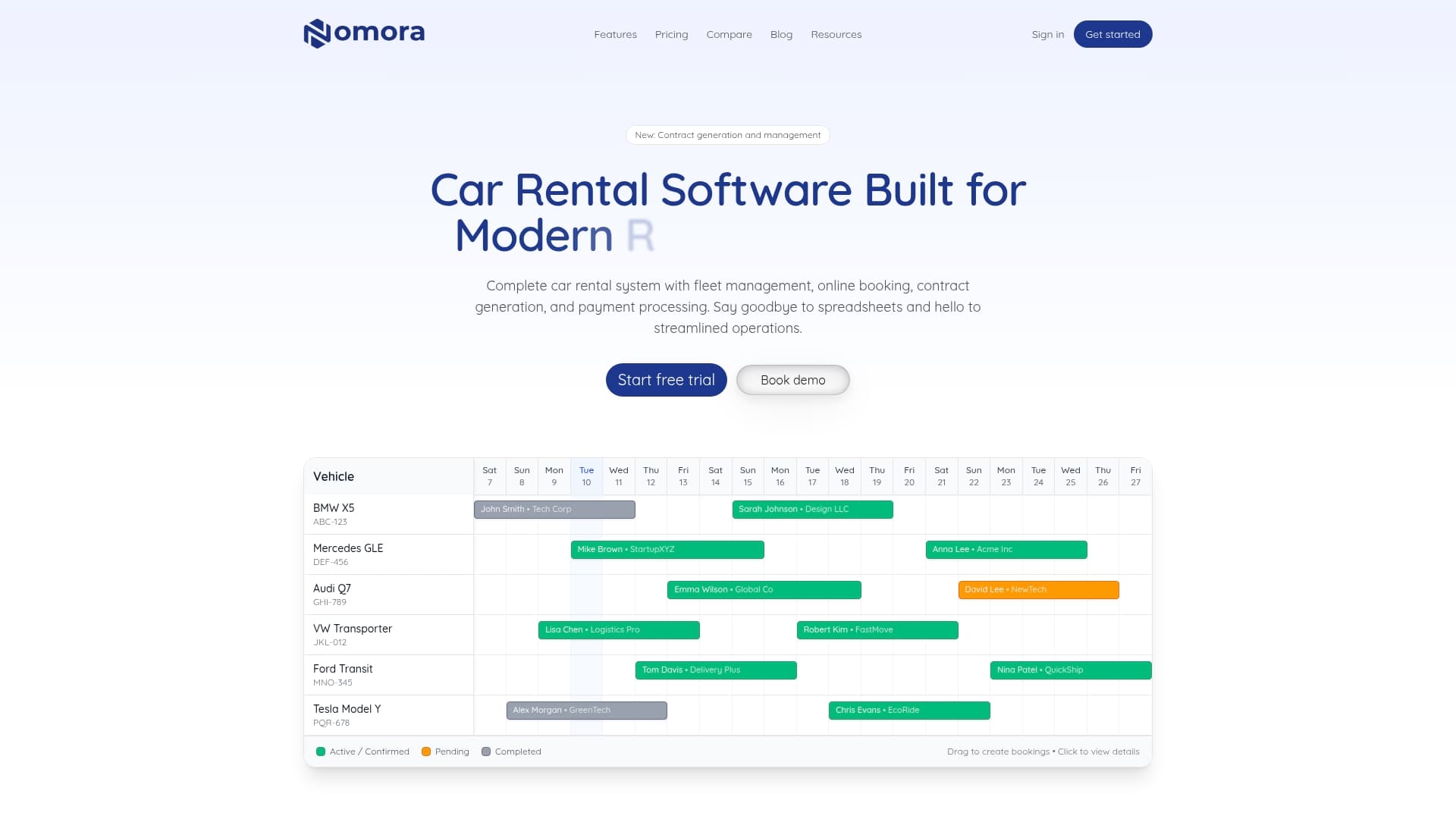
Nomora's automated payment software handles everything from invoice generation to payment confirmation, with role-based access controls and real-time reporting built in. Whether you run a small independent fleet or a multi-location operation, Nomora's rental software use cases show exactly how the platform adapts to your business type. If you are ready to replace manual processes with a system that protects your revenue and your customers, Nomora is the place to start.
FAQ
What is the safest payment method for rental businesses?
ACH bank transfers and PCI-compliant card gateways like Stripe are the safest options. They provide encryption, fraud detection, and audit trails that P2P apps cannot match.
Why should rental operators avoid Venmo and Zelle?
P2P apps lack chargeback protection and are frequently exploited in rental scams. Once a fraudulent payment clears through these platforms, recovery is rarely possible.
What does PCI DSS compliance require for rental payments?
PCI DSS compliance requires ongoing controls including role-based access, strong passwords, regular security reviews, and encrypted storage of payment data. It is not a one-time setup.
How does 3D Secure 2 protect rental transactions?
3D Secure 2 adds a real-time authentication step between the customer's bank and your payment gateway. It reduces card-not-present fraud and is preferred by the majority of renters.
What records should rental businesses keep for payment disputes?
Keep signed rental agreements, timestamped payment receipts, automated transaction logs, and any written communication about payment changes. These records are your primary defense against chargeback abuse.
Recommended
Ready to streamline your car rental business?
Book 30 minutes with the founder. We set up everything in this guide on your own vehicles, and migrate you out of Excel for free.