Pricing a rental vehicle is one of the most consequential decisions you make as a fleet manager or rental company owner. Set rates too high and your cars sit idle. Set them too low and you fill every slot while leaving real money on the table. Even a $5 shift in your average daily rate, multiplied across hundreds of rentals per month, can swing annual profit by tens of thousands of dollars. This guide walks you through the most effective, data-backed pricing strategies available today, from foundational benchmarks to advanced levers, so you leave with a clear framework for building a more profitable operation.
Table of Contents
Key Takeaways
| Point | Details |
|---|
| Know your numbers | Always calculate breakeven, RevPAC, and utilization before adjusting pricing. |
| Leverage dynamic pricing | Real-time rate optimization can boost revenue and utilization significantly. |
| Use advanced levers | Strategic surges, rate fences, and upsells add meaningful new profit streams. |
| Manage risk carefully | Overbooking and edge-case strategies require good data to avoid losses. |
| Test and automate | Iterative testing plus rental software delivers the fastest ROI for pricing upgrades. |
Key criteria for effective rental pricing
Before you adjust a single rate, you need to know your numbers. Pricing decisions made without solid cost and performance data are little more than guesswork, and guesswork is expensive in this industry.
The essential metrics every fleet manager should track include:
- Utilization rate: The percentage of your fleet generating revenue on any given day. Target utilization between 70-85% for strong profitability.
- Average daily rate (ADR): Your average revenue per rented vehicle per day.
- RevPAC (revenue per available car): Total revenue divided by total available car days. This is your single most important top-line metric.
- Fixed and variable costs: Insurance, financing, maintenance, and overhead must all be factored into your breakeven calculation.
- EBITDA margin: Healthy rental operations typically target profit benchmarking in the 15-25% EBITDA range, with RevPAC between $40 and $80.
Here is a practical illustration of why rate and utilization must be balanced together. A fleet running at $75 ADR with 70% utilization generates more revenue than the same fleet at $55 ADR with 95% utilization. Chasing occupancy at the expense of rate is a common trap. Data analytics tools make it far easier to spot this imbalance before it erodes your margins.
Pro Tip: Before changing any prices, run a full cost audit. Centralize your fleet costs, utilization data, and revenue figures in one place. You cannot optimize what you cannot clearly see.
1. Dynamic pricing: real-time rate optimization
With your benchmarks in hand, dynamic pricing is the logical next step. It is the foundation of modern vehicle rental revenue management and the single most powerful tool available to fleet operators today.
Dynamic pricing adjusts rates in real time based on demand signals, competitor rates, fleet availability, seasonality, local events, and booking lead time. It uses either rule-based triggers or more advanced algorithms to move prices automatically.
The core benefits are well documented:
- Revenue lift: Dynamic pricing boosts revenue 5-30% depending on market conditions and implementation quality.
- Better utilization: Optimized pricing keeps utilization in the 65-85% sweet spot rather than swinging between extremes.
- Competitive responsiveness: Rates adjust to market shifts without requiring manual intervention every day.
- Demand forecasting integration: Pairing dynamic pricing with demand forecasting tools sharpens accuracy significantly.
For smaller operations, you do not need sophisticated AI to get started. Simple rule-based tiers work well. For example, if utilization crosses 85%, trigger a 10-15% rate increase automatically. If availability is high and bookings are slow, drop rates by a defined percentage to stimulate demand. You can explore dynamic pricing options for SMEs that fit your budget and fleet size.
Pro Tip: Start with a single utilization rule: when fleet availability drops below 15%, increase rates by 10-20%. This one rule alone can meaningfully improve revenue during peak periods without any complex setup.
2. Static and seasonal pricing: predictability versus flexibility
Not every rental business is ready for dynamic pricing, and that is perfectly fine. Static and seasonal pricing models have real advantages, particularly for smaller fleets or operations with limited technology resources.
Static pricing sets a fixed rate for a vehicle category regardless of demand fluctuations. It is simple to communicate, easy for customers to understand, and requires no ongoing management. The tradeoff is that fixed pricing misses peak demand windows, often leaving utilization stuck in the 55-65% range rather than pushing toward the 70-85% target.

Seasonal pricing is a middle ground. You set defined rate tiers for high season, shoulder season, and low season, adjusting in advance rather than in real time. This approach captures some of the upside during holidays and summer peaks while remaining manageable without specialized software for pricing management.
When static or seasonal pricing makes sense:
- Small fleets of fewer than 20 vehicles where complexity outweighs the benefit
- Markets with highly predictable seasonal patterns and limited competition
- Operations where customer trust and rate transparency are a primary selling point
- Businesses in early stages that need simplicity before layering in more advanced tools
"Avoid panic pricing and uniform vehicle pricing. Charging the same rate for a compact and an SUV, or slashing rates across the board during a slow week, destroys margin without solving the underlying demand problem." Pricing strategy insights
3. Advanced pricing levers: surge, rate fences, and ancillaries
With foundational strategies in place, advanced levers are where serious margin gains happen. These tools let you fine-tune pricing at a granular level and capture revenue that basic models leave behind.
- Surge pricing: Charge a premium during peak demand periods. Surge pricing delivers 20-50% premiums on weekends, local events, and holidays. Apply it to high-demand vehicle categories first.
- Rate fences: Segment your pricing by booking window, customer type, or vehicle class. Early bookers get a lower rate; last-minute bookings carry a premium. Corporate accounts get negotiated rates separate from leisure customers.
- Ancillary upsells: Add-ons such as insurance waivers, GPS units, child seats, and EV charging bundles are high-margin revenue streams. Ancillaries add over $6,000 per year per location on average.
- Fleet mix optimization: Shifting your fleet composition toward SUVs and luxury vehicles improves margins by 15-20% compared to economy-heavy fleets.
| Advanced lever | Best scenario | Revenue impact | Complexity |
|---|
| Surge pricing | Events, holidays, peak weekends | High (20-50% premium) | Low to medium |
| Rate fences | Mixed customer segments | Medium to high | Medium |
| Ancillary upsells | All rental types | Medium ($6,000+/year/location) | Low |
| Fleet mix shift | Growing or refreshing fleet | High (15-20% margin gain) | Medium to high |
Pro Tip: Ancillaries are often the fastest win available. If you are not actively offering insurance waivers, GPS, and child seats at checkout, you are leaving predictable, high-margin revenue uncollected on every single rental.
For guidance on handling no-shows and protecting ancillary revenue, integrating these levers into your booking workflow is essential.
4. Managing risk: overbooking and edge case strategies
Beyond profit levers, risk management is a critical part of any pricing strategy. Overbooking, weather events, and EV-specific considerations all require deliberate planning.
Overbooking in vehicle rental works similarly to the airline model. Because a percentage of reservations will result in no-shows or last-minute cancellations, accepting slightly more bookings than available vehicles can recover otherwise lost revenue. Overbooking rates of 5-15% are standard practice, calibrated against your historical no-show data.
Key considerations for overbooking:
- Only overbook when your no-show data is reliable and based on at least 90 days of history
- Set minimum rental periods during peak events to prevent short-duration bookings from blocking higher-value reservations
- Have a clear customer communication plan if you need to fulfill a booking with an upgraded vehicle
- Monitor managing no-shows patterns by season and booking channel separately
Edge case pricing covers scenarios that standard models do not address well. SUV demand spikes during winter weather events, for example, justify a weather-triggered surge. EV rentals benefit from bundled pricing that includes charging costs and total cost of ownership transparency, removing customer hesitation about range and fees.
| No-show data reliability | Recommended overbooking rate | Risk level |
|---|
| Less than 90 days of history | 0-3% | Low |
| 90-180 days of history | 3-8% | Medium |
| 180+ days, consistent patterns | 8-15% | Manageable |
"The biggest pricing mistake is not underpricing or overpricing. It is making rate decisions without reliable data. A race to the bottom driven by fear, not facts, is the fastest route to margin collapse."
5. Implementation playbook: steps for fleet managers and SMEs
Now, pull it all together with a practical playbook to roll out and optimize your upgraded pricing approach.
- Audit your costs and metrics first. Calculate your true breakeven daily rate by adding financing, insurance, maintenance, and overhead per vehicle. Establish your current ADR, RevPAC, and utilization baseline.
- Set your pricing rules. Define utilization thresholds that trigger rate changes, seasonal tier dates, and any rate fences by customer segment or booking window.
- Run A/B tests on a single segment. Test a new pricing rule on one vehicle category or one location before rolling it out fleet-wide. This limits risk and generates real data.
- Centralize data via fleet software. Manual spreadsheets cannot support dynamic pricing at scale. Implementing new strategies requires a centralized platform that connects bookings, fleet status, and pricing in real time.
- Track ROI metrics and adjust. Monitor RevPAC, utilization, and EBITDA weekly during the first 90 days. Tracking performance with consistent metrics is what separates operators who improve from those who stagnate.
- Scale what works. Once a pilot delivers results, apply the same logic across your full fleet. A successful rollout typically delivers a 15-25% revenue lift within three to six months.
Pro Tip: Start your pilot with your highest-demand vehicle category. The data comes in faster, the results are clearer, and the revenue impact is immediately visible. Use the SME rental checklist to make sure nothing gets missed during rollout.
Summary table: strategy fit and results at a glance
For a side-by-side look, this table summarizes how each approach aligns with common business needs and expected outcomes. Dynamic pricing boosts revenue 5-30% while static pricing delivers predictability but not peak capture. Advanced levers drive incremental margin on top of either base model. Use this as a quick reference when deciding which strategies to sequence first. You can also review fleet optimization examples to see how other operators have applied these approaches.
| Pricing strategy | Best fit | Revenue impact | Complexity | Main risk |
|---|
| Static pricing | Small fleets, low-tech setups | Low to medium | Low | Misses peak demand |
| Seasonal pricing | Predictable seasonal markets | Medium | Low | Requires advance planning |
| Dynamic pricing | Mid to large fleets, tech-ready | High (5-30%) | Medium to high | Volatility if unmanaged |
| Surge pricing | Event-driven markets | High (20-50% premium) | Medium | Customer backlash risk |
| Rate fences | Mixed customer segments | Medium to high | Medium | Complexity in communication |
| Ancillary upsells | All rental types | Medium | Low | Requires staff training |
| Overbooking | Data-rich operations | Medium | Medium | Fulfillment risk |
The right sequence for most SMEs is to start with cost auditing and seasonal tiers, add utilization-based dynamic rules next, and layer in surge pricing and rate fences once your data infrastructure is solid.
Moving forward: software to streamline your pricing edge
Ready to put these strategies into practice? The gap between knowing the right approach and executing it consistently comes down to the tools you use. Nomora's cloud-based platform acts as the central nervous system of your rental operation, connecting reservations, fleet status, pricing rules, and reporting in one unified system.
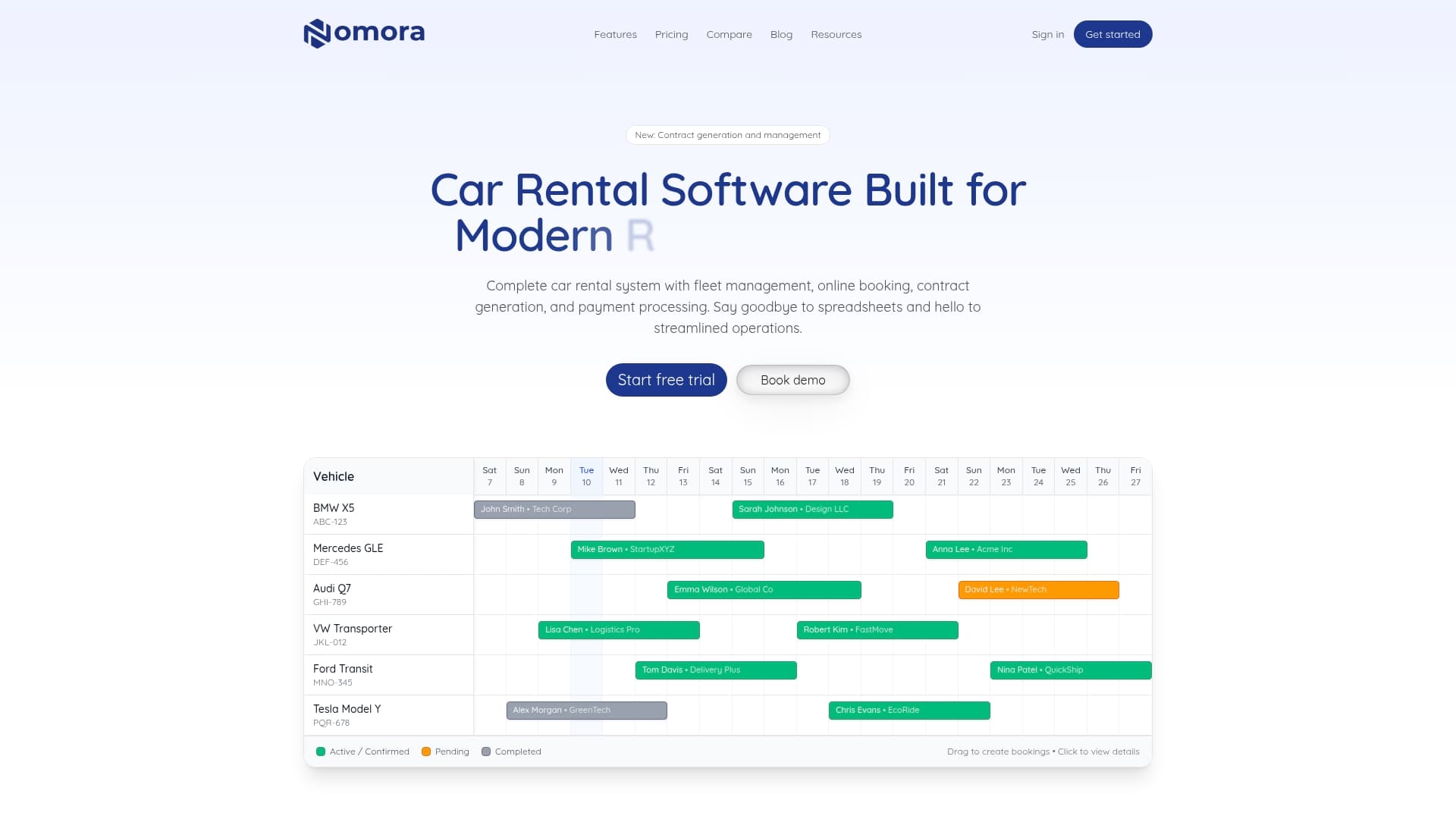
With Nomora, you can automate dynamic and seasonal pricing rules tailored to your specific fleet and locations, eliminating the manual work that slows most operators down. The platform integrates booking management, GPS tracking, payment processing, and performance analytics so every pricing decision is backed by real data. Whether you manage 10 vehicles or 500, Nomora's rental software use cases cover the full range of fleet types and business models. Explore fleet management software built for operators who want results, not more spreadsheets. See Nomora in action and get your operation running at full capacity.
Frequently asked questions
How does dynamic pricing improve vehicle rental profits?
Dynamic pricing boosts revenue 5-30% by adjusting rates in real time based on demand, competitor activity, and fleet availability, ensuring you capture maximum value during peak periods rather than leaving money on the table.
What is the recommended utilization rate for a profitable rental fleet?
Aim for a fleet utilization rate of 70-85% to balance strong revenue generation with enough availability to handle demand spikes without turning customers away.
Is fixed pricing ever better than dynamic pricing?
Fixed pricing offers predictability and simplicity that suits small fleets or low-tech operations well, but it consistently underperforms dynamic pricing during peak demand windows where rates could be significantly higher.
What is a rate fence in vehicle rental pricing?
A rate fence is a pricing rule that segments offers by vehicle class, booking window, or customer type, allowing you to charge different rates to different segments without appearing inconsistent to any single customer group.
Recommended
Ready to streamline your car rental business?
Book 30 minutes with the founder. We set up everything in this guide on your own vehicles, and migrate you out of Excel for free.