Reduce booking abandonment by stripping hidden fees out of the checkout summary, cutting visible form fields down to the essentials, enabling autosave so an unfinished reservation can resume where it left off, and deploying one automated recovery email within hours of a dropped booking. Checkout research from Baymard ties long, complicated forms to a measurable share of lost reservations, and experimental research on triggered emails shows they recover revenue that would otherwise disappear. Start this week with a funnel audit and one recovery email live within 24 to 48 hours.
TL;DR:
- Reducing checkout form fields to essential information and showing the full price early can significantly lower abandonment caused by complexity and hidden fees.
- Implementing autosave, clear progress indicators, and fixing mobile date pickers can improve the user experience and recover more reservations quickly.
- Sending targeted recovery emails within six hours of abandonment, along with onsite retargeting, can boost revenue and recover lost bookings.
- Ensuring booking system integrity with conflict-free reservation locking and automated payment retries prevents technical failures from driving abandonment.
- Focusing on price transparency and conflict messaging is more effective than discounts, as trust issues cause most abandonment in rental bookings.
Table of Contents
Why Do Rentals Get Abandoned? The Evidence Behind the Drop-Off
Not every abandoned reservation is a fixable problem. Some visitors are comparing prices across three tabs and never intended to book today, and that kind of browsing behavior sits outside what any checkout redesign can solve. What matters is isolating the share of abandonment caused by friction you control, because that share responds directly to change you can ship this quarter.
The most common fixable causes we see across rental booking flows line up closely with general e-commerce checkout research:
- Checkout forms that ask for too much, too soon, before the renter has committed to the reservation
- Total price that only appears at the final step, after taxes, deposits, and add-ons are added
- Vehicle listings with vague specs or low-quality images that leave renters unsure what they're actually booking
- Payment errors or declined cards with no clear next step
- Unspoken anxiety about double-booked vehicles, especially for last-minute or peak-season rentals
A notable share of shoppers abandon checkout specifically because the process feels too long or complicated, according to Baymard's cart abandonment research, which also found that an ideal checkout needs roughly 12 form elements against an industry average above 23. That gap alone explains a meaningful chunk of lost reservations before fees or pricing even enter the picture.
Quick Wins You Can Ship This Week
Treat this as a sequence, not a wish list. Each step is cheap to build and easy to measure against last week's baseline.
- Cut visible form fields to the essentials. Ask only for name, dates, and contact details up front, and move license, insurance, and billing details to a later step.
- Show the full price before the last screen. Taxes, deposits, and mandatory add-ons belong in the summary the renter sees when they pick a vehicle, not at the final click.
- Fix the mobile date picker. Calendar widgets that require pinching or scrolling on a phone screen are a common point where renters simply give up.
- Turn on autosave and resume. A reservation in progress should survive a closed tab, a dropped signal, or a renter who steps away to check their calendar.
- Add a visible progress indicator. Renters who can see "step 2 of 4" tolerate a longer flow better than renters facing an open-ended form.
- Rebuild the payment error flow. A declined card should produce a clear, specific message and an easy retry, not a dead end that forces the renter to start over.
Each fix has a simple validation metric: watch the step-level abandonment percentage for that specific screen before and after the change, rather than judging success only by overall conversion.
Pro Tip: Pair form reduction with progressive profiling: collect the minimum at booking, then capture license details, loyalty information, or add-on preferences after the reservation is confirmed, so you still gather the data without front-loading the form.
Our guide to designing reservation flows walks through how to sequence these screens without losing the data your operations team needs downstream.
Building a Repeatable Testing and Measurement Workflow
Quick wins buy you an early lift, but a rental business that wants sustained gains needs a workflow it can run every quarter. That starts with instrumentation: name every step of the funnel (landing, vehicle selection, details, payment, confirmation), track abandonment by step and by device, and record a baseline conversion rate before touching anything.
From there, the analysis layer tells you where to focus. A/B testing isolates which specific change moved the number. Session recordings and heatmaps show where renters hesitate, re-enter information, or abandon mid-field. Segmenting by mobile versus desktop and organic versus paid traffic often reveals that one segment is driving most of the drop-off while another is already converting well.
A sound experimentation playbook follows a fixed shape: write a hypothesis, estimate the sample size needed before declaring a winner, roll changes out gradually rather than to 100% of traffic at once, and set guardrails so a test can't accidentally cause a double booking or charge a card twice.
| Funnel stage | What to track | Common friction source |
|---|
| Vehicle selection | Step abandonment rate | Unclear pricing or vehicle specs |
| Renter details | Field-level drop-off | Excess form fields |
| Payment | Error and retry rate | Declined cards, no clear retry path |
| Confirmation | Completion rate | Session timeout, lost reservation data |
None of this works if the technical layer underneath it is shaky. Inventory locking during checkout, idempotent payment processing that won't double-charge on a retry, and clear conflict messaging when a vehicle becomes unavailable all prevent the kind of midbooking failure that pushes a renter to abandon and never come back. Our integrations guide covers how payment gateway and GPS integrations reduce exactly this kind of friction.
Recovering Abandoned Reservations Before They're Gone for Good
A completed funnel audit still leaves renters who started a booking and didn't finish. Recovering them is a separate workflow with its own timing and content rules.
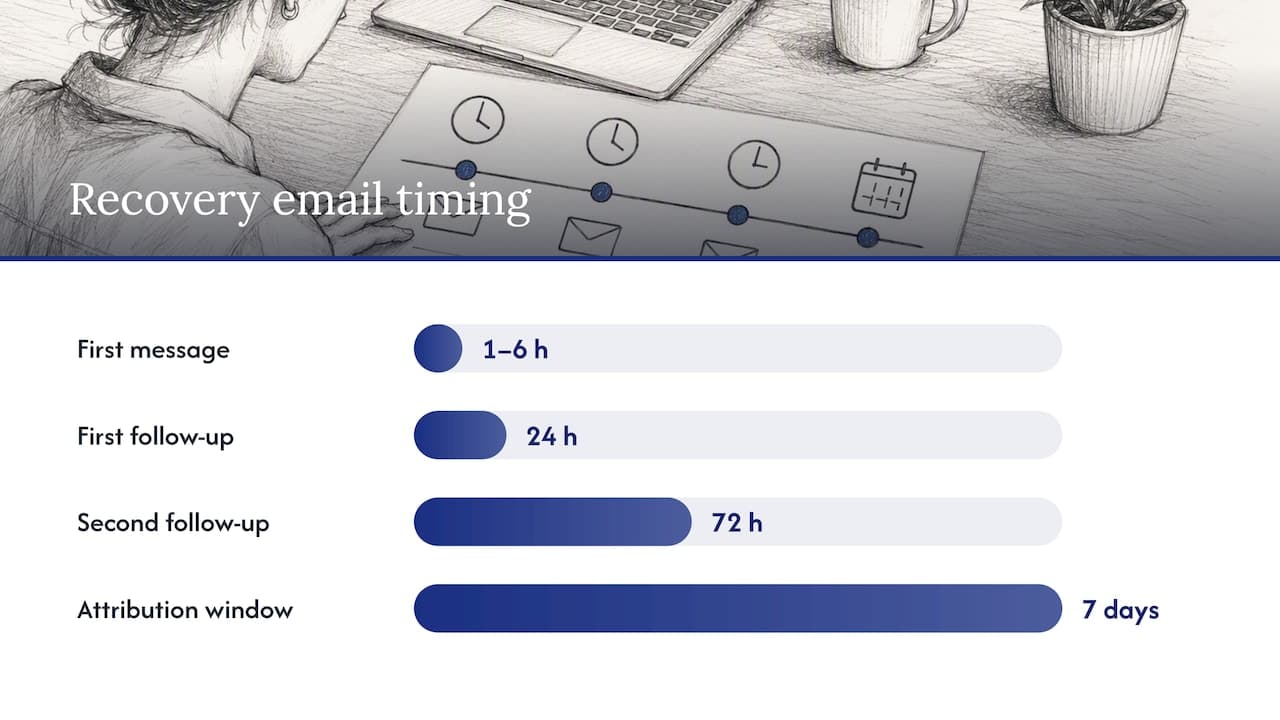
- Send the first recovery email within 1 to 6 hours of abandonment, while the vehicle and dates are still fresh in the renter's mind.
- Follow up at 24 and again at 72 hours if the first message goes unopened or unclicked.
- Include the reservation summary, a photo of the vehicle, and one clear call to action, not a wall of options.
- Use expire-by messaging ("your rate is held until...") rather than an unexpected discount, which trains renters to wait for a deal next time.
- Pair email with onsite retargeting: an exit-intent overlay or a personalized banner that returns a visitor directly to their unfinished reservation.
Triggered abandonment emails measurably increase revenue compared with sending no message at all, according to experimental research published in the Journal of Interactive Marketing, and the effect grows stronger with better targeting and personalization.
Track recovered conversion rate and revenue per recovered user separately from your main funnel, and set an attribution window (commonly 7 days) so a recovery campaign gets credit for the bookings it actually influenced.
Running these fixes by hand across spreadsheets and a patchwork of tools is where most of the plan above stalls out. An integrated rental management platform turns each tactic into a feature rather than a manual project.
- Conflict-free reservation logic prevents the double-booking anxiety that drives some renters to abandon mid-checkout, since the system locks inventory the moment a reservation starts.
- Integrated payment processing with automated retries shortens the payment step and removes the dead-end error screens that cause card-related drop-off.
- Autosave keeps a reservation intact if a renter closes the tab or loses signal, so they resume instead of starting over.
- Onboarding that reaches full operation in 24 to 48 hours, as Nomora states on its own pricing page, means an operator can test these fixes within days rather than waiting on a long implementation cycle.
Our guide to automating rental bookings covers the reservation-locking and autosave mechanics in more depth for operators ready to implement.
What the Data Actually Supports, and What Doesn't Matter as Much
The industry conversation around booking abandonment leans heavily on discount codes and exit-intent pop-ups offering a percentage off, and that instinct is largely backward. Research on triggered emails shows targeting and personalization drive the uplift, not the size of a discount, and a rental business that trains renters to expect a coupon at checkout is quietly teaching them to abandon on purpose next time.
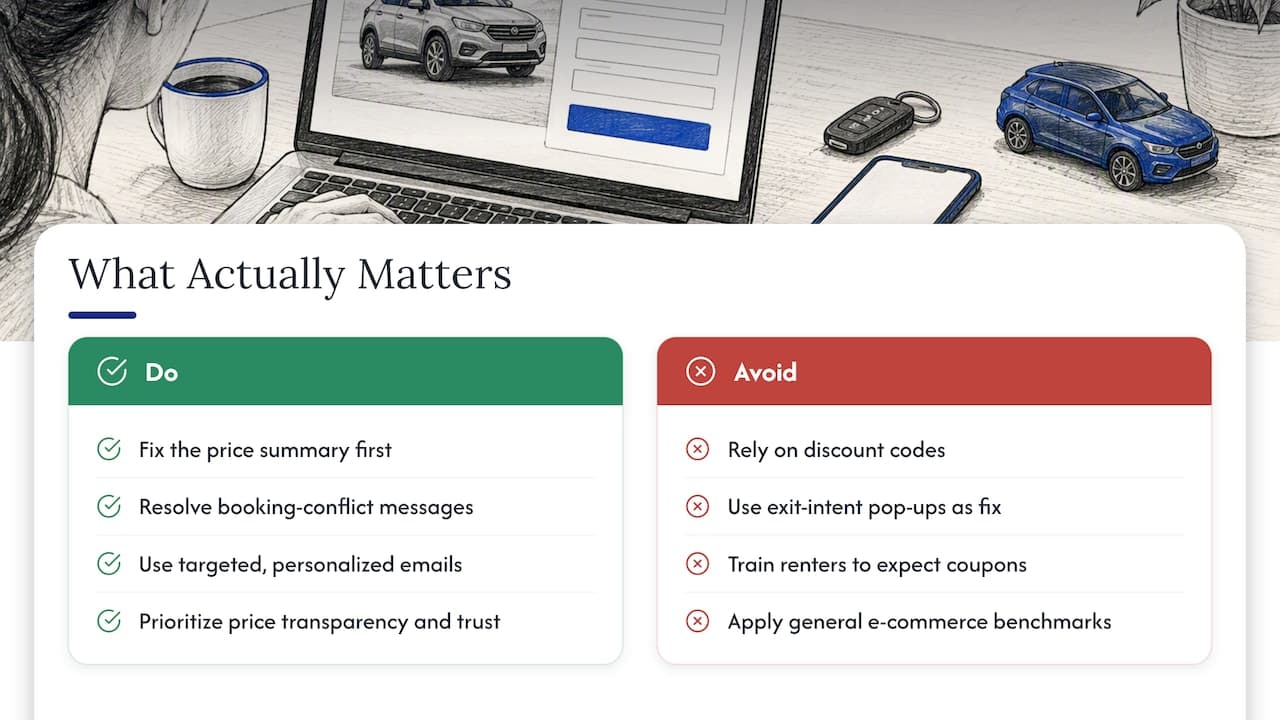
The bigger gap is between operators and e-commerce. A rental reservation involves dates, a specific vehicle, deposits, and sometimes insurance decisions, all of which carry more hesitation than a retail cart ever does, so checkout benchmarks built on general e-commerce sites understate how fixable rental-specific friction really is. Price transparency and conflict-free booking matter more here than almost any other lever, because a renter who gets a surprise fee or a double-booking warning at the final step doesn't just abandon, they lose trust in the brand entirely.
If you take one thing from this: fix the price summary and the booking-conflict messaging before you touch anything else. Everything else on this list compounds that trust once it exists.
— Dizzy
See These Fixes Running in Your Own Booking Flow
We built Nomora around the exact friction points covered above: conflict-free reservations, integrated payments, and autosave that keeps a renter's progress intact instead of forcing them to start over. 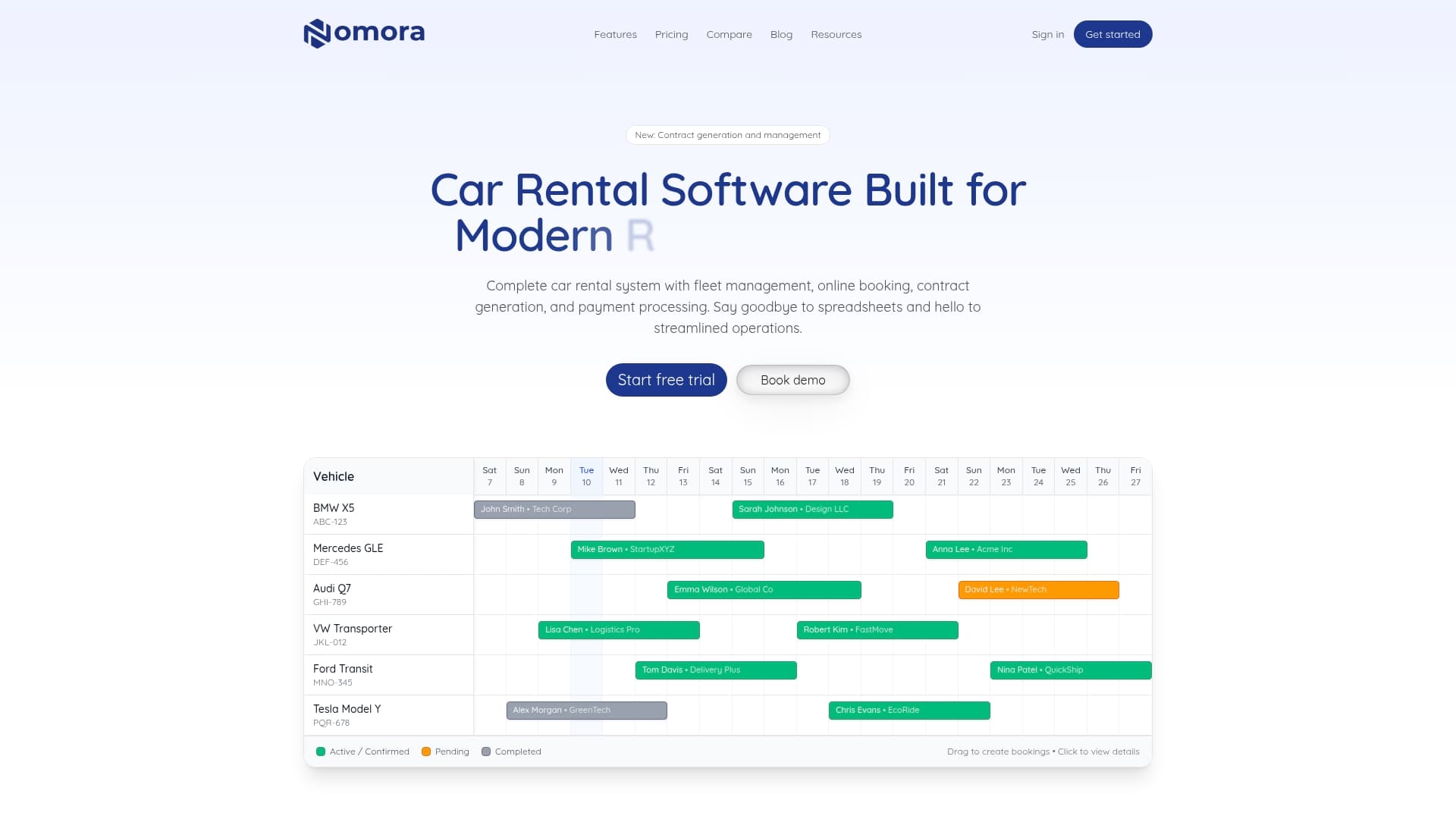
- If hidden fees or late-stage pricing are costing you reservations, our automated checkout keeps the full price visible from the start.
- If double-booking anxiety is part of your abandonment problem, our reservation locking removes it at the system level rather than relying on manual checks.
- If you want to see these fixes in your own booking flow, our pricing page lays out the Starter, Business, Fleet, and Enterprise plans so you can find the right fit and get set up within 24 to 48 hours.
FAQ
What is a normal booking abandonment rate for a car rental business?
There's no rental-specific published benchmark, but general checkout research from Baymard tracks a global cart abandonment rate around 70.19%. Rental operators should treat that as a rough reference point rather than a fixed target, since travel and rental bookings carry more decision points than a typical retail cart.
How long should I wait before sending a booking abandonment email?
Send the first recovery email within 1 to 6 hours of the abandoned reservation, while the vehicle and dates are still top of mind, then follow up at 24 and 72 hours if needed. Experimental research confirms triggered emails increase revenue compared with sending nothing at all.
Shorter forms address one of the most cited causes of checkout abandonment: 17% of shoppers abandon checkout because it feels too long or complicated, and an ideal checkout runs around 12 form elements against an industry average above 23. Combining fewer fields with progressive profiling lets you collect the rest of the data later without losing the booking up front.
Should I offer a discount to recover an abandoned car rental booking?
Discounting isn't what the research points to as the main driver of recovery success. Targeted, well-timed messaging with clear reservation details tends to outperform generic discount offers, and expire-by urgency around a held rate is generally a better lever than an unexpected price cut.
How does Nomora help reduce booking abandonment specifically?
Nomora addresses the technical side of abandonment through conflict-free reservation locking, integrated payment processing with automated retries, and autosave that preserves an unfinished booking. Full onboarding typically takes 24 to 48 hours, according to Nomora's pricing page, so operators can start testing these fixes quickly.
Sources
Recommended
Ready to streamline your car rental business?
Book 30 minutes with the founder. We set up everything in this guide on your own vehicles, and migrate you out of Excel for free.