A rental company reduces PCI scope by making sure card numbers never touch its own systems, staff inboxes or phone recordings. In practice that means taking payments through a validated hosted payment page or terminal, replacing stored card numbers with tokens, and documenting what is left. Scope reduction shrinks your compliance workload. It does not remove it: you still validate compliance every year and still answer for your payment providers.
This guide is for owners and managers of small and mid-sized rental companies, luxury and specialty fleets, and corporate fleet managers. It covers what "scope" means in a rental operation, how to map it, which controls shrink it and what stays on your desk afterward.
TL;DR
- Scope is every person, process and system that stores, processes or transmits card data, or that can affect its security. Fewer touchpoints mean fewer requirements.
- The biggest levers for a rental business are a hosted payment page or validated terminals, and tokens instead of stored card numbers for deposits and incidentals.
- Outsourcing payments does not end your duties: you still validate compliance, keep written agreements with providers and review them at least annually.
- Your eligible questionnaire (SAQ) depends on how card data reaches the processor. One script or payment element served from your own site can push you from SAQ A to the much longer SAQ A-EP.
- Re-confirm your scope at least every 12 months and after any significant change, such as a new booking channel or software.
Table of Contents
What "scope" means for a rental company
PCI DSS is the card industry's security standard. Its scope is the set of people, processes and technologies that store, process or transmit cardholder data, plus anything that could affect the security of those systems. The more of your business sits inside that boundary, the more requirements you must meet and prove.
Rental businesses collect card data in more places than most owners expect. A rental counter, a booking website, phone reservations, a security deposit hold, a damage charge weeks later and a refund all involve a card. Guidance for hotel and travel businesses lists the typical scope: booking engine and channel manager, reservations office and call recording, property management system, POS, payment terminals, back-office PCs and their shared network. A rental company has the same shape, with a reservation system and a counter or delivery handover in place of the front desk.
The same guidance names four recurring mistakes that apply directly to rentals:
- Treating the reservation system as an operations tool rather than a payment system.
- Forgetting email inboxes where customers or agents send card numbers.
- Keeping call recordings that contain spoken card details.
- Assuming a franchisor's or broker's systems cover your own network and terminals.
Any of these puts your office network, laptops and staff in scope. The fix is rarely to harden everything. It is to stop card data from getting there.
Why scope tends to grow on its own
Practitioners at Crowe observe that scope tends to spread outward as companies discover how many components support the card environment directly or indirectly. A component is out of scope only if it does not store, process or transmit card data, is not on the same network segment as in-scope systems and has no connection to them. A shared Wi-Fi network between the counter terminal and the back-office PC fails that test.
Step 1: Map where card data actually goes
You cannot reduce what you have not found. Start with a short working session including whoever runs the counter, reservations, accounting and IT, even if IT is one outside contractor.
For each way a card enters your business, record where it comes from, where it goes, who handles it and why. CyberVantage360 suggests noting the source, destination, transport, data elements and owner of every movement, and for each place data rests, how long it stays, who can reach it and how it is deleted. Include paper, recordings and images, not just databases.
For a rental company, walk through these flows:
- Online booking: does the customer type the card number into a page your site serves, or into a page the processor serves?
- Phone and email bookings: does an agent type the number into the system, a separate terminal or a notebook? Are calls recorded?
- Counter and delivery handover: which terminal takes the card, and is it connected to your general network?
- Deposits and holds: is the card number stored for later charges such as fuel, tolls, tickets or damage?
- Refunds and chargebacks: who sees the card data while disputes are handled?
- Third parties: brokers, aggregators, GPS or telematics vendors, your reservation software and your IT contractor.
The PCI standard expects this to be documented. According to the scope documentation guidance for PCI DSS 4.0.1, scope must be confirmed at least every 12 months and after significant change, with data flows identified for authorization, capture and settlement, chargebacks and refunds, across card-present and card-not-present channels.
Map control as well as data
Data flow is half the picture. CyberVantage360 warns that identities, workstations, deployment tools, cloud consoles and supplier connections that can change a payment environment are in scope because of their authority, and that a separate network address does not establish exclusion if shared administrative privileges cross the boundary. If one admin account manages both your payment page and your office PCs, you have not separated them.
Step 2: Remove card data from your own systems
The most reliable scope reduction is not to hold the data at all. Three controls do most of the work in a rental setting.
Hosted payment pages and validated terminals
If customers enter card details on a page served entirely by a PCI DSS compliant payment provider, your website never sees the number. Card-present payments work the same way when the terminal is a validated device that encrypts the card at the point of capture.

Point-to-point encryption (P2PE) is the strongest terminal option. A validated P2PE solution encrypts card data from the terminal to the processor. One industry white paper puts the effect at up to a 90% reduction in applicable PCI DSS requirements. Treat that as the upper bound for a fully validated setup, not a promise for every business.
Tokenization for deposits and incidentals
Rental companies need to charge a card after the customer has left: a fuel top-up, a toll, a damage fee. That does not require storing the card number. A token is a substitute value that is useless to a thief but lets your payment provider charge the right card.
The PCI Security Standards Council states in its tokenization guidance that tokens should replace card numbers wherever possible, and that any system that can retrieve the original number stays in scope. Tokenization does not eliminate compliance. It can simplify validation by cutting the number of in-scope components, provided you confirm the number cannot be retrieved from anything you remove from scope.
If you keep card-on-file data for guarantees, deposits and incidentals, it should be kept only as long as needed, and security codes must never be stored after authorization. Assessors typically look for purge records, searches across shared drives and the reservation system, masked numbers on screen and the tokenization settings.
Closing the leaks: inboxes, notes and recordings
Outsourcing the payment page does little if agents still copy numbers from emails. Set a rule that card numbers are never accepted by email or chat, redirect those customers to a secure payment link and delete any numbers already sitting in mailboxes. For phone bookings, either send the customer to a secure link during the call or use a process that keeps card digits out of recordings.
Step 3: Pick the right questionnaire
Most small merchants prove compliance with a Self-Assessment Questionnaire (SAQ). Which one you qualify for depends on how card data reaches the processor, and the difference in workload is large.
| SAQ | Typical rental fit | Workload |
|---|
| A | Card-not-present bookings where every payment page element comes from a compliant provider | Shortest |
| A-EP | Your own website serves part of the payment page, such as the script that loads a provider's form | Far longer |
| B / B-IP | Counter with standalone validated terminals only | Moderate |
| C-VT | Staff key card details into a provider's web terminal, one transaction at a time | Moderate |
| P2PE | Validated P2PE terminals | Short |
| D | Everything else, including stored card data | Longest |
The PCI Council's SAQ instructions say that for e-commerce, SAQ A requires that all payment page elements originate only and directly from a compliant provider, and that your site is not susceptible to script attacks that could affect the payment system. If any payment-page element comes from your own website, SAQ A does not apply and SAQ A-EP may apply instead. The practical lesson: a plain redirect or fully hosted page keeps you on the short form, while a custom checkout that embeds provider code in your own page may not.
The SAQ is also not a permanent label. Your acquirer or processor tells you which validation they require, so confirm with them, and revisit the choice whenever you add a channel.
Step 4: Know what stays with you
The most common misunderstanding is that outsourcing payments transfers all responsibility. The PCI Council says otherwise. A merchant that outsources all processing and never touches card data must still validate compliance, usually with SAQ A, ensure the provider is compliant, keep a written agreement acknowledging responsibilities (Requirement 12.8.2) and monitor the provider's compliance at least annually (Requirement 12.8.4).
In practice, keep a one-page responsibility matrix for every provider that touches payments: your reservation platform, payment processor, terminal supplier, telematics vendor and IT contractor. For each, note who operates which control, who holds the evidence and when you last collected their compliance status. Sterling points out that because the acquirer holds the merchant to account regardless of who operates the systems, the matrix should name who runs each control requirement by requirement.
Vendor access
Providers that can reach your payment environment need tighter handling. The Council's guidance for connected-to service providers asks you to do due diligence before engagement, understand what access each provider needs, verify that the access is necessary before granting it and be aware of any subcontractors with remote access. Minimum controls include multi-factor authentication for all remote access, strong access controls and logging of provider activity. The same discipline applies to any system holding customer and vehicle records, including workshop software for vehicle businesses that your team or a contractor logs into remotely.
What changed recently
PCI DSS version 4.0.1 is the current version of the standard. Requirements that were originally labeled future-dated best practices became mandatory on March 31, 2025, so they now apply to everyone assessed. Two changes matter most to small rental merchants: the e-commerce payment page and script requirements that shaped the SAQ A eligibility test above, and stronger access controls, including multi-factor authentication.
What this means for you: if your last assessment predates 2025, do not copy last year's answers. Reconfirm your SAQ type, check your payment page against the script eligibility criterion and update your data-flow diagram. Your acquirer can confirm the validation requirements that apply to you.
A short worked example
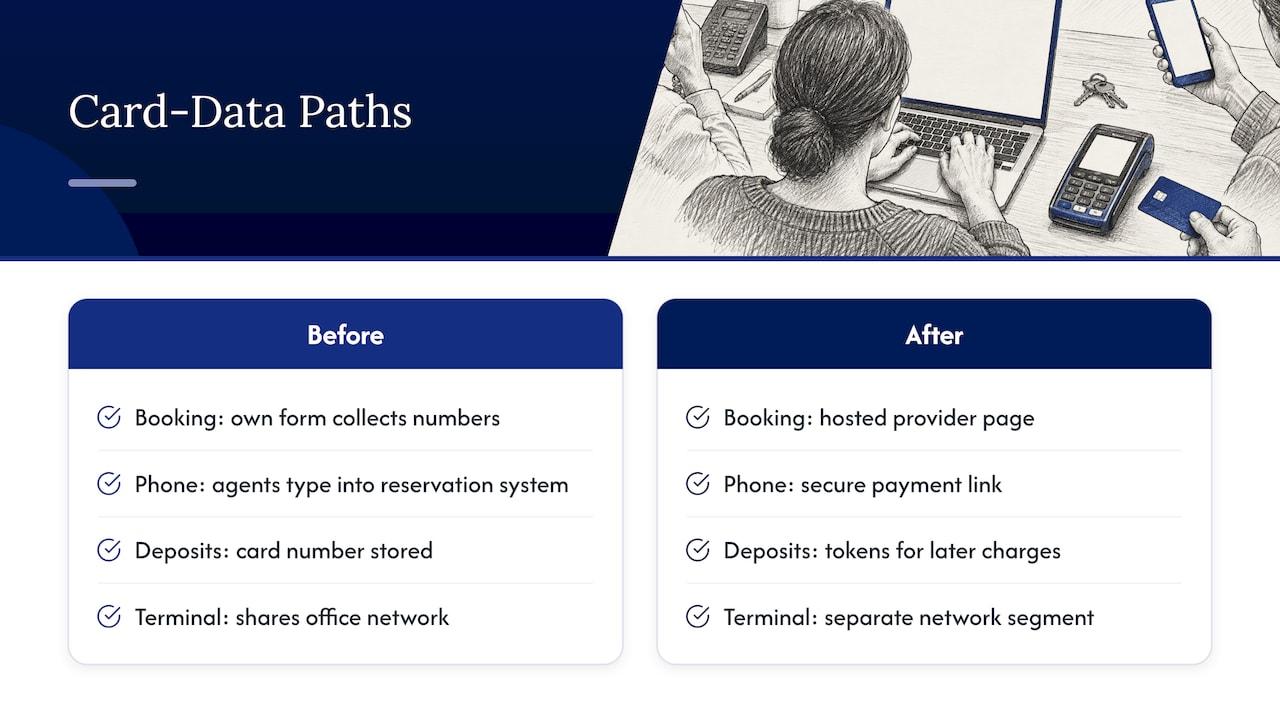
Take a 40-car regional rental company. Before scoping, its booking site collects card numbers into its own form, agents type phone bookings into the reservation system, deposits are held by storing the card number and the counter terminal shares the office network.
After a mapping session, it makes four changes: moves online payment to a fully hosted provider page, sends phone customers a secure payment link, switches deposits and later charges to tokens and puts the counter terminal on its own network segment. The website, agents' PCs and reservation database no longer touch card numbers. The company has moved toward the short questionnaire, and its yearly work shrinks to confirming the setup, collecting its providers' compliance evidence and reviewing its scope diagram. The exact SAQ still depends on the acquirer and the final design, which is why the confirmation step matters.
How the right software helps
Rental software sits in the middle of this picture, because reservations, deposits, contracts and payments all pass through it. Whether it keeps card data out of your environment depends on how its payment integration is built, which is why payment flow should be a first question when you choose a platform. Our guides on payment security for rentals, choosing the right SAQ for a car rental and integrations go deeper on each part.
We built Nomora around a simple idea: a rental platform should work like the central nervous system of your operation, with reservations, fleet, contracts and payments all connected in one place instead of spread across spreadsheets, inboxes and notebooks.
That matters for PCI because every spreadsheet and inbox where a card number ends up is a system you must account for. When reservations, contracts and payments live in one cloud platform with integrated payment processing, there are fewer places for card details to travel and a single place to see what happened to a booking.
Our advice is to scope before you buy anything. Map your flows, decide which channels you really need, and choose a platform whose payment integration fits the questionnaire you want to complete. We also think the paperwork should be boring: every plan includes all features with no hidden fees, so compliance-related capability is not locked behind a higher tier.
Dizzy
Bring payments, bookings and contracts into one system
If card details currently pass through spreadsheets, shared inboxes and several tools, consolidating them is the fastest way to shrink the environment you have to defend. Nomora's automated car rental payments connect payment processing to reservations and contracts, and onboarding is designed to get you fully operational in 24 to 48 hours. Plans are published on the pricing page: Starter is €45 per month, Business is €2.80 per vehicle per month and Fleet is €2.20 per vehicle per month. Enterprise and payment processing have no published price.
A yearly scope-review checklist
Use this list at least once every 12 months and whenever you add a channel, supplier or location.
- Update the data-flow diagram for every channel: web, phone, counter, delivery, partner bookings.
- Search mailboxes, shared drives and the reservation system for stray card numbers and delete them.
- Confirm that stored card data is tokenized and that security codes are not retained after authorization.
- Re-check that your payment page elements come only from your provider, and that your network segments are still separate.
- Refresh your inventory of terminals, systems and service providers.
- Collect each provider's current compliance evidence and update the responsibility matrix.
- Confirm your SAQ type with your acquirer or processor and complete it.
FAQ
Does using a payment processor mean my rental company is out of PCI scope?
No. You still have to validate compliance, typically with SAQ A if you never touch card data. You are also responsible for confirming your provider is compliant, keeping a written agreement and reviewing its status at least annually. Scope reduction lowers the number of requirements, not the obligation.
What is the easiest way to reduce PCI scope for a small rental business?
Stop card numbers from reaching your own systems. Use a fully hosted payment page for online bookings, validated terminals at the counter and tokens instead of stored card numbers for deposits and later charges. Then stop accepting card numbers by email or in call recordings.
How often do I need to review my PCI scope?
At least every 12 months and after any significant change, such as a new booking channel, a new payment provider or a new location. Documented data-flow diagrams and inventories should be updated at the same time.
Why would my website push me from SAQ A to SAQ A-EP?
SAQ A requires that all payment-page elements come directly from a compliant provider. If your own site serves any part of the payment page, such as a script that loads the form, SAQ A does not apply and the longer SAQ A-EP may. Your acquirer can confirm which questionnaire fits your setup.
Sources
Recommended