A rental fleet needs a registration reminder for every vehicle, sent about 90 days before expiration to one named person. It should carry the plate, VIN, expiration date and the documents the state asks for, and it should end with a saved confirmation. States do send their own notices, but the law still puts the duty to renew on you. The reliable setup is one cloud record per vehicle, not a spreadsheet that someone has to remember to open.
This guide is for owners and fleet managers of small and mid-sized rental companies. It shows the routine step by step, where it breaks, and how state rules change the details.
TL;DR
- A missed state notice is not a defense: Oklahoma states that not receiving a reminder does not relieve the owner of timely renewal.
- Start your internal alert about 90 days out. Fleet systems can generate renewal notifications 90 days in advance, which leaves time for inspections and paperwork.
- Every reminder should list the plate, VIN, expiration date, title number, insurance proof, emissions status and the person responsible.
- Rules differ by state, so store the state, the inspection requirement and the renewal channel on each vehicle record.
- Close the loop: download and file the new registration and receipt, and only then clear the reminder.
Table of Contents
Why a registration reminder matters more for a rental fleet
A private driver has one car and one sticker. A rental company has dozens of vehicles that turn over, move between branches, get bought at different times and may be registered in different states. Expiration dates scatter across the calendar, so there is almost always a renewal due somewhere.
The deadline is strict. California DMV says every registration expires at midnight on its assigned date, and the owner must renew or file planned nonoperation on or before that date to avoid a late penalty. Oklahoma adds that late renewal results in delinquent registration penalties, whether or not a notice reached you.
For a rental business the cost goes beyond the penalty. A car with an expired registration cannot be rented with confidence. If it is already out with a customer, you have a roadside problem, an unhappy renter and a vehicle that may be pulled from service. Renters who are handed such cars often end up posting about it on public forums, which is not the reputation a rental brand wants.
The point of a reminder system is simple: no vehicle should reach its expiration date without a person having known about it for weeks.
What each registration reminder should contain
A reminder that only says "renew soon" creates more work, because someone then has to look up the details. A good one lets the recipient start the renewal immediately.
Oregon's fleet-registration rule is a useful model because it lists what the DMV expects. The application must identify the fleet operator, billing address and registration contact, and, where applicable, each vehicle's plate, expiration date, VIN, title number, proof of insurance and emissions compliance. Other states ask for similar things in different forms. Build your reminder around that list:
- Vehicle identity: plate number, state, VIN, make, model and year.
- Expiration date: the exact day, plus the number of days left.
- Responsible person: a named owner for this renewal, not a team inbox alone.
- Documents needed: title number, current insurance proof, and emissions or inspection results where they apply.
- Fees and channel: the expected fee and how the state accepts renewal (online, phone, mail or terminal).
- Status: open, in progress, waiting on inspection, renewed, or confirmed.
Add the branch or location, because the state often decides inspection and emissions rules by where the vehicle is based.
When to send reminders, and to whom
Do not rely on the state's notice
States do notify owners, but on their own schedule. California DMV must notify vehicle owners at least 60 days before renewal, and if it does not, fees become delinquent 67 days after the notification date. Oregon sends the fleet-registration contact a billing list of vehicles due about 60 days before expiration.
Sixty days is enough to pay a fee. It is tight if the vehicle needs an emissions test, a replacement insurance card, a lienholder document or a trip to another state. Notices also go to the address on file, which may be an old office or a former employee.
A practical alert schedule
A schedule that fits most small and mid-sized fleets:
- 90 days out: first alert to the responsible person, with the document checklist. This matches the lead time fleet technology commonly offers, 90 days ahead.
- 60 days out: check that any state notice arrived and that inspections are booked.
- 30 days out: escalate to the owner or manager if the status is still open.
- 14 days out: final warning, and a decision on whether to take the vehicle off the rental calendar.
- After renewal: a confirmation task, covered below.
Who should receive it
Give each renewal to one named person, with a manager copied on the later alerts. When everyone gets the email, nobody owns it. If your state allows a shared mailbox for registration contact, use one so a departure or vacation does not silence the notices, but still assign the task to an individual.
How state rules change the details
There is no national registration calendar. Each state sets its own renewal period, inspection rules and paperwork, and some treat rental vehicles as their own category. The research below shows how much the details vary, which is why your vehicle record should hold the state's requirements and not just a date.
| State | What the official source says | What to store on the vehicle record |
|---|
| Washington | Rental-vehicle registration is renewed annually. The rental-business registration number must appear on the registration, and the owner name must match the business name on the master license. | Rental-business number, exact owner name |
| New Jersey | The registration application asks whether the vehicle will be used as a rental and requires insurance information. Inspection obligations vary by vehicle type, fuel and weight. | Rental-use flag, insurance details, inspection type |
| Delaware | An out-of-state renewal needs safety and emissions inspections, fees, a valid Delaware insurance card and a completed inspection form returned to DMV. | Inspection form status, insurance card |
| Nevada | Emissions inspections apply to specified vehicles based in Washoe or Clark Counties, with exemptions such as vehicles within two years of manufacture. | Base county, fuel, weight, vehicle age |
| Utah | Required emissions or inspection tests must be completed before renewal, which uses the plate number and the last eight VIN digits. | Test completion date, plate, VIN |
The lesson is that the reminder date is only one field. Whether a vehicle needs a test first can add weeks to the process. A 90-day alert is useful precisely because it catches those vehicles early.
Leased vehicles and cars used across state lines
Many small rental businesses lease part of the fleet or move cars between locations in different states. Those cars need extra attention in the reminder system.
- Out-of-state renewals. Delaware's form shows how involved it can get: inspection, insurance, supporting documents, and mailing to the vehicle's current out-of-state location. Allow extra lead time for any vehicle that is not physically in the state that registered it.
- Leased cars. Record who holds the title and who receives the state notice. If the lessor handles registration, your reminder becomes a check that it was done, not a renewal task.
- Apportioned vehicles. If you run heavier vehicles that qualify for apportioned registration, Pennsylvania's FAQ requires daily trip records with equipment number, date, origin and destination, odometer readings and routes, and summaries of distance by jurisdiction. That record keeping runs all year, not just at renewal.
Most light-duty rental fleets will never touch apportioned rules, but a specialty or moving-truck operator might. Flag those vehicles separately.
Confirming the renewal and keeping the record
A reminder is only half the system. The other half is evidence that the renewal went through. Official fleet portals show what a good confirmation looks like:
- Utah's process displays owner, vehicle and fee information for verification, then provides a confirmation screen where you can print the registration certificate and receipt.
- Arizona's fleet portal lets operators view or print receipts and registration documents. A vehicle that fails to renew because of emissions or missing insurance does not get its expiration date updated, so a payment alone is not proof.
- Wisconsin requires operators to download certificates of registration after a fleet renewal, recommends saving the PDF, and offers a transaction report with VIN, plate, status and date.
So the closing task should do three things: attach the new registration document and receipt to the vehicle, update the expiration date, and confirm the status reads as renewed. If the date did not change, the reminder stays open. Also make sure a current copy of the registration is in the vehicle or available to the branch, since that is what the renter or an officer may ask for.
Building the routine step by step
- List every vehicle with its registration data. Pull plate, state, VIN, title number and expiration date into one place. Where it goes wrong: dates kept in different files for different branches.
- Add the state's requirements. For each vehicle note inspection, emissions and insurance needs, using the state's official page.
- Set the alert ladder. Use 90, 60, 30 and 14 days, each to a named person.
- Collect documents early. Insurance proof and test results are the usual cause of last-minute delays.
- Renew through the state's channel. California, for example, offers online, phone, self-service terminal and mail renewal, with requirements such as a current address and, for phone renewal, a renewal identification number.
- Confirm and file. Save the certificate and receipt, update the date, close the task.
- Review monthly. Look ahead three months, and check any vehicle added or sold since last time.
Pair this with your regular rental vehicle inspection routine and the vehicle rental checklist for small and medium fleets, so registration, inspection and service dates sit in one view. Our fleet management guide covers the wider record keeping around it.
Why a spreadsheet is the weak point
The seven steps above work on paper. The failure comes from where the data lives. A spreadsheet does not warn anyone when it is not opened, it is easy to overwrite, and it sits apart from the booking calendar. That means a car can be rented the day after its registration lapsed, because nothing connects the two.
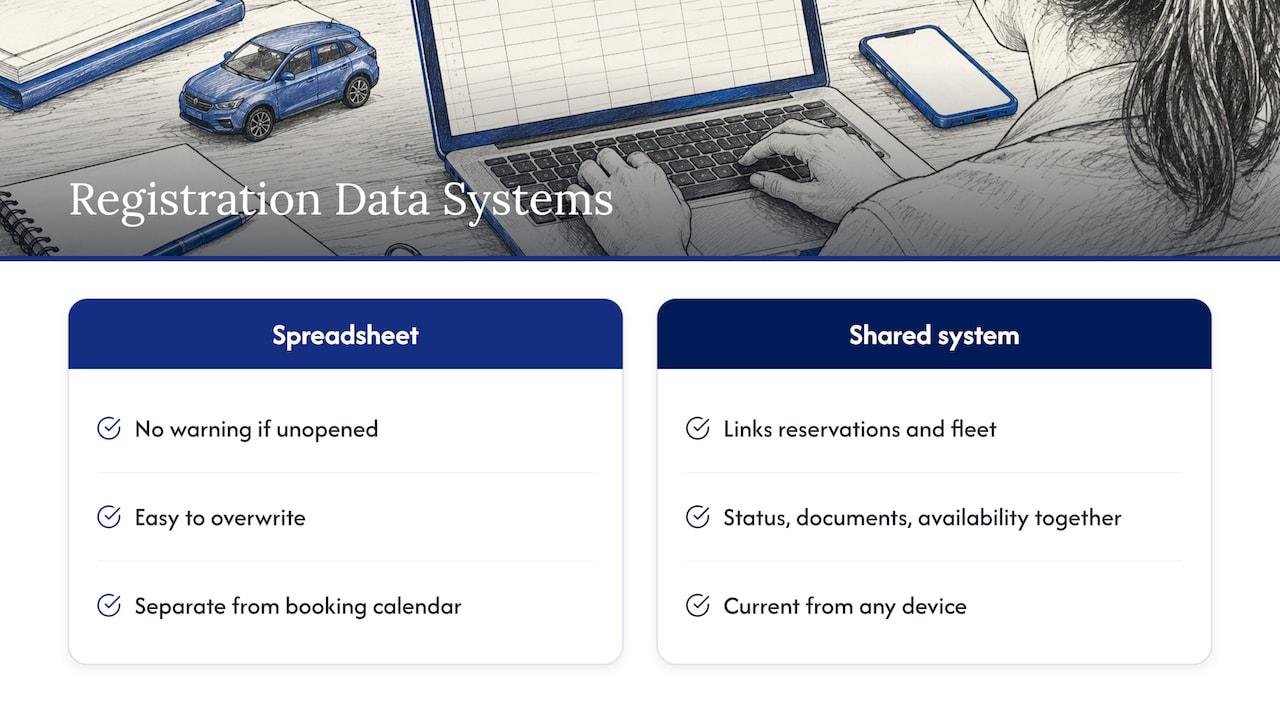
The fix is to keep registration data in the same system that holds your reservations and fleet. Then the vehicle's status, its documents and its availability are one record, and what you see is current from any device.

Fleet management software for registration records
Nomora is a cloud-based car rental management platform that replaces spreadsheets and manual processes with one system for reservations, fleet management, contracts, payments and customer data. Fleet data is visible in real time and reachable from any device, and bookings are conflict-free. The platform includes GPS tracking and, according to our onboarding promise, businesses are fully operational in 24 to 48 hours.
Pricing is published on the pricing page: Starter is €45 per month, Business is €2.80 per month per vehicle, and Fleet is €2.20 per month per vehicle. Every plan includes all features with no hidden fees. Enterprise has no published price, and payment processing has no published price either. Small fleets can start with the software for 5 to 15 vehicles, and growing ones can look at the medium fleet option for 15 to 50 vehicles. To see the whole product, visit the car rental software overview.
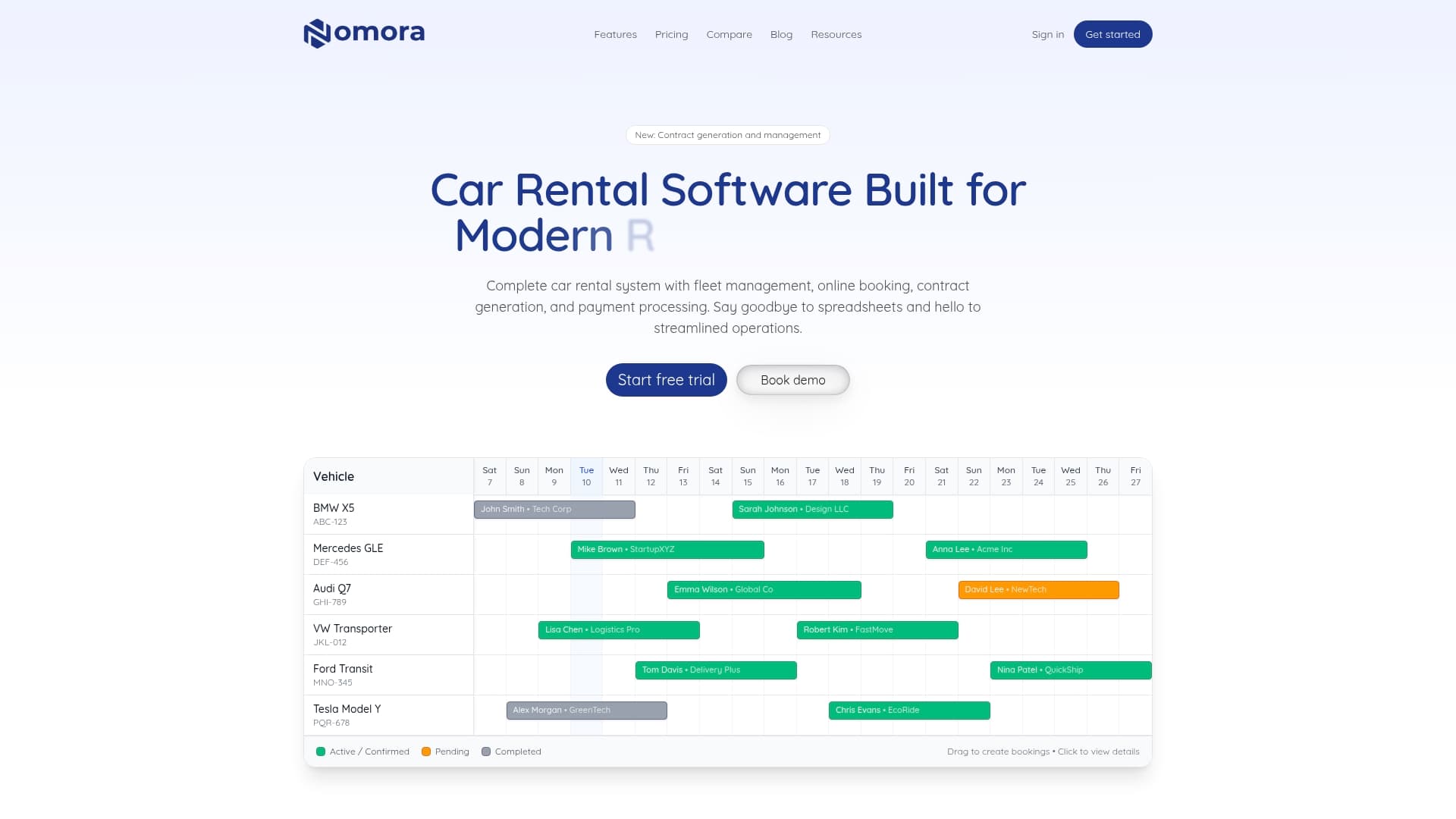
If your registration dates still live in several files, moving your vehicles into one fleet record is the first step. Everything above, from the alert ladder to the confirmation step, is easier when the vehicle data is in the same place as your bookings.
Our perspective
A rental software program is the central nervous system of the operation. Registration is a good test of that idea, because it touches everything: the vehicle record, the calendar, the documents and the person responsible.
We see the same pattern in rental businesses of every size. The renewal itself is rarely hard. What goes wrong is that the date, the paperwork and the booking calendar are kept in three places, and nobody sees them together until something has expired.
That is why we built Nomora around one shared record for each vehicle, with fleet data in real time and reachable from any device. Replacing spreadsheets removes the manual steps where dates get lost, and a fleet that is organized this way finds registration, inspection and utilization easier to manage side by side.
Our advice is to treat registration as part of fleet management, not as an annual chore. Put the vehicle first, attach everything that belongs to it, and let the calendar reflect its real status.
Dizzy
FAQ
How far in advance should I set a registration reminder for a rental car?
Start at about 90 days, which is a common lead time for fleet systems. That leaves room for inspections, emissions tests and documents before the state deadline. Then repeat at 60, 30 and 14 days.
Do I still need my own reminder if the DMV sends a notice?
Yes. The state's notice may go to an old address, arrive late or not arrive, and Oklahoma is explicit that a missing reminder does not excuse a late renewal. Your own schedule is what protects the fleet.
What should a registration reminder include?
Include the plate, VIN, title number, expiration date, insurance proof, emissions or inspection status, fees and the person responsible. These are the items states such as Oregon list for fleet applications. Add the vehicle's base location, since inspection rules often depend on it.
How do I know a renewal is actually complete?
Check that the new expiration date is updated and that you have the registration certificate and receipt. Arizona's portal notes that a vehicle failing emissions or insurance checks keeps its old expiration date. Save the documents to the vehicle's record.
Sources
Recommended
Ready to streamline your car rental business?
Book 30 minutes with the founder. We set up everything in this guide on your own vehicles, and migrate you out of Excel for free.