TL;DR:
- Choosing the right fleet management integrations is crucial for reducing manual errors, improving vehicle utilization, and increasing profitability. Real-time data synchronization, ease of setup, scalability, and predictive maintenance support are key criteria to evaluate when selecting solutions. Effective integration strategies, tailored to fleet size, and phased implementation based on defined KPIs, significantly enhance operational efficiency and revenue.
With so many integration options competing for your budget, choosing the right ones to streamline your fleet and maximize profitability is genuinely difficult. Manual processes, spreadsheet errors, and siloed systems cost car rental businesses real money every single day. Missed maintenance windows ground vehicles unexpectedly. Billing disputes eat up staff time. Underutilized cars sit idle while demand goes unmet. The good news is that modern fleet management integrations address each of these problems directly, and this guide gives you a clear, practical framework for selecting and implementing the ones that will drive measurable results for your operation.
Table of Contents
Key Takeaways
| Point | Details |
|---|
| Integration reduces errors | Smart fleet integrations cut manual work and mistakes by up to 90 percent for car rental operators. |
| Boosted profits and fuel savings | Deploying real-time telematics and automation can add 20-35 percent revenue and save 20 percent or more on fuel costs. |
| Choosing the right tech matters | Matching integration technologies to your fleet size and business needs delivers the fastest ROI and fewer headaches. |
| Pilot, then scale | Starting with a pilot rollout and tracking KPIs leads to smoother, more successful integration across your entire fleet. |
How to evaluate fleet management integrations
To choose the right integrations, you first need smart criteria. Let's break down what truly matters before you commit budget or bandwidth to any new technology.
The most important factor is real-time data synchronization. When your telematics platform, rental management software, and billing system all share live data, you eliminate the lag that causes double bookings, inaccurate mileage invoices, and missed maintenance alerts. According to a detailed Fleet Telematics & Maintenance Integration Guide, well-implemented integrations can reduce manual entry errors by up to 90% and drive revenue increases of 20 to 35%. Those are not marginal gains. They represent the difference between a struggling operation and a profitable one.
Beyond data sync, your evaluation checklist should include:
- Error reduction capability: Look for automated mileage tracking, fuel monitoring, and smart alerts that flag anomalies before they become expensive problems.
- Ease of setup and onboarding: A powerful integration that takes six months to deploy offers little short-term value. Prioritize platforms with documented API libraries and responsive vendor support.
- Scalability: Your integration stack needs to grow with your fleet. A solution that works for 20 vehicles should also handle 200 without requiring a full rebuild.
- Cost per vehicle: Pricing varies widely. GPS telematics platforms typically run $5 to $25 per vehicle per month, so understanding your total cost of ownership early prevents budget surprises later.
- Predictive maintenance support: Integrations that connect vehicle diagnostics to your maintenance schedule can save significant sums. Fleet-wide predictive maintenance programs have saved operators more than £10,000 per year by catching failures before they happen.
- Remote management features: Remote immobilization, geofencing alerts, and driver behavior monitoring are no longer optional for competitive rental fleets.
For a broader view of what a connected rental system should include, the integration guide from Nomora is a strong starting point. You will also find practical examples in this overview of streamlining with integrations that many fleet managers reference when auditing their existing tech stack.
Pro Tip: Prioritize real-time integrations for anything that affects live operations, such as GPS tracking, vehicle availability, and payment processing. Batch or scheduled sync is perfectly acceptable for non-urgent tasks like reporting or end-of-month reconciliation.
Top real-world examples of fleet management integrations
Now that you know what to look for, see how real businesses have made integration work for them. The results from leading rental fleets make a compelling case for acting decisively.
Geotab is one of the most widely deployed telematics platforms in the rental sector. Its GPS tracking and diagnostics capabilities integrate directly with rental management software to enable real-time vehicle tracking, automated mileage-based billing, geofencing, and proactive maintenance scheduling. The documented outcomes across rental operators are striking:
- Europcar used Geotab integrations to optimize fleet operations and improve theft recovery rates across its large European network.
- Swift Ride reported zero vehicle thefts after deploying Geotab, achieved 95% fleet utilization, and generated over $400,000 in annual savings.
- Moove Cars recorded more than £3 million in annual savings and a 30% improvement in fuel and CO2 performance after integrating Geotab telematics into its fleet management workflow.
- Wanacars implemented a keyless vehicle access integration alongside telematics tracking and achieved a 20% reduction in fuel costs through smarter idle management and route optimization.
"Predictive maintenance saved £10,000+ in one year for a mid-size rental fleet." This figure reflects not just repair cost avoidance but also the revenue protected by keeping vehicles in service rather than sitting in a garage.
These are not outliers. They represent what becomes possible when you connect your fleet data to the right systems and act on the insights they produce. To understand which key rental software features enable these results, and to explore specific profit-boosting integrations, reviewing both resources will help you map your own path forward.
The integration types delivering these results fall into five main categories: telematics and GPS tracking, automated billing and mileage calculation, predictive maintenance and diagnostics, keyless access and remote control, and channel management and distribution. Each serves a distinct operational purpose, and the most effective fleets combine several of them in a coordinated stack.

Popular integration technologies and how they work
Knowing integration examples is great. Understanding the technology behind them helps you make the right choice for your specific fleet and technical environment.
There are four main technologies that power fleet management integrations:
-
REST APIs (Application Programming Interfaces): REST APIs allow two software systems to exchange data over the internet in real time. They are flexible, widely supported, and form the backbone of most modern telematics integrations. Geotab and other leading platforms publish detailed REST API documentation, making it straightforward for rental software vendors to build native connections. The key advantage is real-time data flow. The potential downside is that your vendor controls API access and can change endpoints, which is worth accounting for in contracts.
-
Webhooks: Webhooks are event-driven notifications. Instead of your system constantly asking a telematics platform for updates, the platform pushes a notification the moment something happens, like a geofence breach or low fuel alert. This is efficient and reduces API call costs, but it requires your system to handle incoming data reliably, including building retry queues for failed deliveries. As case study research on ERP sync confirms, phased pilots with exception handling are essential for managing the edge cases that always appear in live deployments.
-
Cloud middleware platforms: Middleware sits between your rental management system and your telematics hardware, normalizing data from multiple sources into a single format. Platforms like flespi are specifically designed to handle mixed fleets where some vehicles use OEM telematics and others use aftermarket OBD-II devices. Middleware solves the data fragmentation problem that plagues fleet managers running diverse vehicle brands.
-
OEM data feeds: Some manufacturers now provide native telematics data streams directly from the vehicle. Geotab's recent integration with Polestar vehicles into its OEM telematics network is a strong example. This approach eliminates the need for aftermarket hardware installation, reducing upfront cost and setup time. The limitation is that OEM feeds only cover vehicles from supported manufacturers, making them insufficient for mixed-brand fleets without supplemental solutions.
For a complete breakdown of how each layer fits together in a car rental context, the vehicle management guide walks through fleet architecture in practical terms.
Pro Tip: When managing a mixed fleet, use middleware to normalize data across OEM and aftermarket devices before it reaches your rental management platform. This prevents the data conflicts that commonly cause billing errors and reporting inaccuracies.
Comparison: Side-by-side integration feature matrix
With the technologies defined, let's see how they measure up against each other for critical rental business needs.
The table below compares four major integration approaches across the dimensions that matter most to fleet managers and rental operators.
| Feature | Geotab (OBD-II) | Wialon (Cloud API) | OEM telematics | Cloud middleware |
|---|
| Hardware required | Yes (OBD-II, $15-25) | Yes (various, $5-10/mo) | No | No |
| Cost per vehicle/month | $15-25 | $5-10 | Included in vehicle | Variable |
| Real-time tracking | Yes | Yes | Yes | Depends on feed |
| Mixed fleet support | Strong | Strong (2,500+ devices) | Limited to OEM brand | Excellent |
| Vendor lock-in risk | Low (open API) | Low (open API) | Medium to high | Low |
| Predictive maintenance | Yes | Yes | Limited | Depends |
| Geofencing | Yes | Yes | Sometimes | Yes |
| Utilization reporting | Advanced | Advanced | Basic | Aggregated |
| Setup complexity | Moderate | Moderate | Low | High |
| Best for | North America fleets | European/global fleets | Single-brand fleets | Diverse tech stacks |
Sources: Geotab OEM integration announcement and fleet telematics benchmarks.
A few observations worth noting. Wialon's pricing advantage of $5 to $10 per vehicle per month makes it a compelling choice for operators in Europe and markets with tighter margins. Geotab's broader device ecosystem and advanced utilization analytics give it an edge for larger North American operations. OEM telematics is an excellent fit when you run a homogeneous fleet of supported vehicles and want to minimize hardware complexity. Cloud middleware is the right call when you have already accumulated a mix of devices and need a unifying data layer without ripping out existing hardware.
For a broader breakdown of integration options, including payment gateways and channel managers alongside telematics, Nomora's overview covers the full landscape.
Matching integrations to your business needs
Finally, here's how to turn these options into real wins for your business, no matter your fleet size.
The practical reality is that a 15-vehicle independent rental operator has very different needs from a 500-vehicle franchise network. The right integration stack is not the most expensive one. It is the one that fits your current scale while leaving room to grow.
For small fleets (under 30 vehicles): Start with a single, well-supported telematics platform like Wialon to control costs. Focus your first integration on GPS tracking and automated mileage billing, since those deliver the fastest return. Avoid overbuilding your tech stack before you have the team capacity to manage it.
For mid-size fleets (30 to 150 vehicles): You have enough scale to justify adding predictive maintenance integrations and channel management connectivity. A phased rollout approach (pilot on a subset of vehicles, measure KPIs, then expand) consistently outperforms big-bang implementations. Track metrics like fuel cost per kilometer, vehicle utilization rate, and billing error frequency from day one.
For large fleets and franchise networks: Middleware becomes essential at this scale. Multi-location coordination, consolidated reporting, and role-based user management all require a normalized data foundation. The 20 to 35% revenue lift documented from channel expansion integrations becomes meaningful at volume, and the investment in a more sophisticated stack pays off faster.
When selecting integrations, use this checklist:
- Does this integration solve a problem I can quantify in dollars or hours?
- Can my current team manage the ongoing data and exception handling it requires?
- Does the vendor offer adequate support and a clear API roadmap?
- What is my exit strategy if this vendor changes terms or pricing?
- How does this integration connect with my existing rental management platform?
For operators managing vehicles across multiple sites, the multi-location strategies guide addresses fleet coordination challenges that become critical above a certain scale. The fleet utilization advice resource is equally useful for identifying which gaps in your current operation integrations can realistically close.
Having compared your options, let's talk about what truly drives success with fleet management integrations. And the honest answer might surprise you.
The businesses that extract the most value from telematics and rental software integrations are rarely the ones with the most sophisticated tools. They are the ones with the clearest plans. A phased rollout using a straightforward platform, paired with consistent KPI monitoring and frontline staff involvement, consistently outperforms a complex multi-system deployment that no one fully understands or maintains.
Most integration projects that underdeliver share a common pattern: the technology was selected before the problem was fully defined. A fleet manager reads about another operator's $400,000 in savings and fast-tracks a deployment without mapping their own data flows, exception handling requirements, or team capacity. The integration goes live, data mismatches appear, staff revert to manual workarounds, and the expected ROI never materializes.
The better approach is almost boring in its simplicity. Define your top three operational pain points. Identify the integration that directly addresses the most expensive one. Pilot it on a small subset of vehicles, measure the actual impact against your baseline KPIs, then expand methodically. This is exactly what the integration implementation advice from Nomora supports: a structured, iterative process rather than a single transformative leap.
Normalizing your data is equally important and frequently overlooked. Mixed fleets generate inconsistent odometer readings, fuel data in different formats, and maintenance records from different systems. Without a normalization layer (whether middleware or a rental platform with smart data mapping), you end up with reports you cannot trust and billing disputes you cannot resolve. Involve your frontline staff early. They will catch edge cases that no technical specification document ever anticipates, and their adoption determines whether any integration actually changes day-to-day operations.
Take your fleet integration strategy further with Nomora
Ready to turn insights into action? See how Nomora streamlines fleet integration for rental businesses.
Nomora is built specifically for car rental operators who want to replace disconnected systems with a single, integrated platform. From GPS and telematics connectivity to automated payment processing, Nomora connects the operational layers that matter most for fleet efficiency and revenue growth.
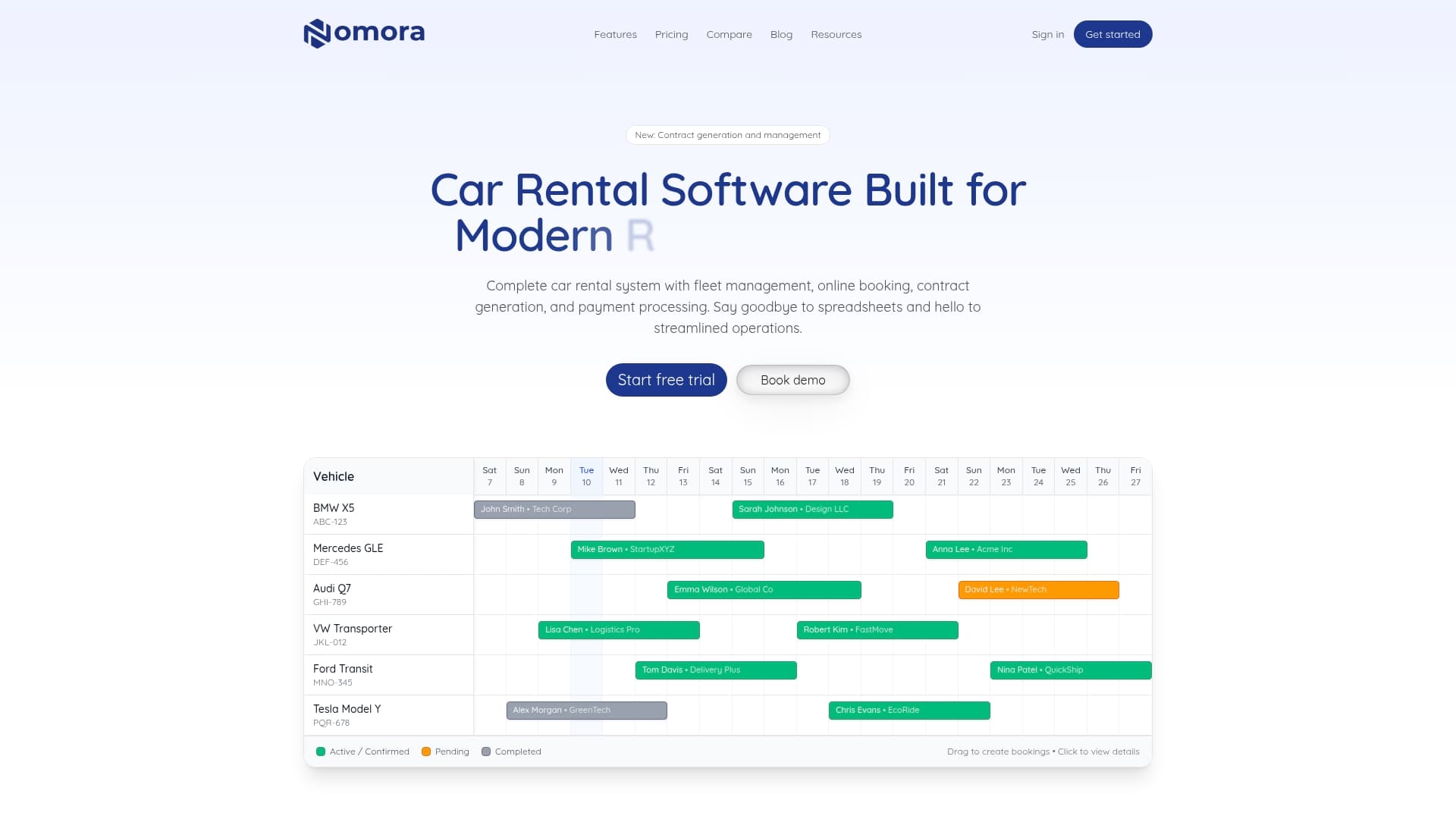
Explore the full range of integration use cases to see how rental businesses of different sizes are using Nomora to reduce errors, improve utilization, and scale their operations. If automated payments are on your roadmap, Nomora's payment gateway integrations remove a significant source of manual work and billing friction. Setup takes 24 to 48 hours, and the platform is designed to grow with your fleet from day one.
Frequently asked questions
What is the fastest way to reduce errors with fleet management integrations?
Real-time API integrations cut manual entry errors by up to 90% compared to manual or batch update methods, making them the highest-priority investment for error-prone rental operations.
Which integration is most cost-effective for a small rental fleet?
Platforms like Wialon offer pricing as low as $5 to $10 per vehicle per month, making them accessible for smaller fleets that need real-time tracking without a large upfront investment.
How do fleet integrations improve profitability for car rental businesses?
Effective integrations can boost revenue by 20 to 35% through higher vehicle utilization, automated billing accuracy, and reduced administrative overhead across reservations and fleet operations.
What's the best approach for integrating a mixed-brand fleet?
Using middleware platforms to normalize data across different OEM and aftermarket systems gives you the flexibility to support multiple vehicle brands without rebuilding your integration stack each time you add a new manufacturer.
Recommended