Key Takeaways
| Point | Details |
|---|
| Start with clear goals | Define your business objectives to guide every pricing decision. |
| Use data and segment fleet | Analyzing historical data and categorizing vehicles boosts pricing accuracy. |
| Implement dynamic strategies | Combining rule-based approaches with automation maximizes revenue without sacrificing control. |
| Monitor and adjust regularly | Tracking key metrics helps refine strategies and avoid profit leaks. |
What you need to create a winning rental pricing strategy
With the stakes set, let's start by gathering everything you'll need for a solid pricing foundation.
Before you adjust a single rate, you need the right information in front of you. Think of your pricing system as the central nervous system of your rental operation: without clean data flowing through it, decisions become guesswork. Most small and medium operators underestimate how much preparation goes into a reliable pricing strategy. They jump straight to changing numbers, then wonder why results are inconsistent.
Essential prerequisites to collect before you start:
- Fleet data: Vehicle make, model, age, depreciation cost, maintenance cost per vehicle per month, and current availability by category
- Cost structure: Fixed costs (insurance, facility, software) and variable costs (cleaning, fuel recovery, mileage-based wear) broken down per rental day
- Historical booking data: At least six months of reservations, cancellations, revenue per vehicle, and average rental duration
- Market demand data: Local event calendars, seasonal trends, airport traffic volumes, and corporate account patterns
- Competitor pricing data: A regular snapshot of base rates from other local operators across your main vehicle categories
- Booking system access: The ability to update rates in real time, ideally through an integrated platform rather than manual spreadsheets
The tools you use at this stage matter too. Many operators start with spreadsheets, which work for basic tracking but quickly become unmanageable once you factor in dynamic changes, multiple vehicle classes, and seasonal adjustments. A better starting point is rule-based dynamic pricing, where you set specific conditions (for example, rates increase 15% when utilization crosses 80%) and the system responds automatically. This is far more reliable than fully manual pricing, and it's far more practical for smaller operators than advanced AI-driven revenue tools.
A common mistake is focusing on utilization as the headline goal. Filling 90% of your fleet sounds great until you realize many of those bookings were made at below-cost rates. The metric that actually matters is contribution margin, which measures how much revenue each rental contributes after variable costs. As industry analysis confirms, small and medium operators should prioritize contribution margin over raw utilization and integrate pricing rules with their booking system to enable real automation. You can also learn more about preparing your tech stack through this car rental integration guide.
| Data type | Why it matters | Minimum requirement |
|---|
| Historical bookings | Reveals seasonal patterns and demand cycles | 6 months minimum |
| Cost per vehicle per day | Anchors your floor pricing | Full cost breakdown |
| Competitor base rates | Positions your rates in the market | Weekly snapshot |
| Fleet utilization by category | Highlights over and underperforming segments | Monthly average |
| Cancellation rates | Affects revenue forecasting accuracy | Rolling 90-day view |
Pro Tip: Gather at least six months of rental and pricing data before making any significant changes. Seasonal swings can easily mislead you if you're only looking at a single month in isolation.
Step-by-step rental pricing strategy for car rentals
Once your foundation is in place, you can build out your pricing strategy step by step.
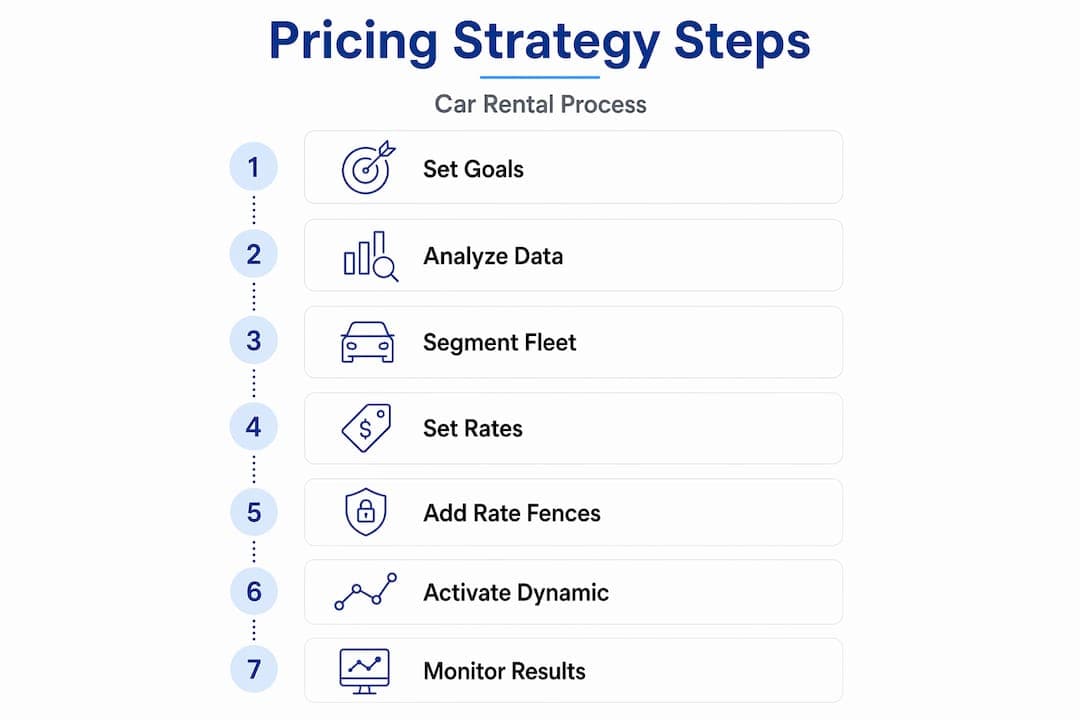
A structured approach removes the guesswork and gives you a repeatable process you can refine over time. Here is a practical sequence that works for most small and medium car rental businesses.
Step 1: Define your business goals and pricing objectives
Every pricing decision should serve a specific goal. Are you trying to grow market share in a new vehicle segment? Protect margins on your premium fleet? Increase bookings during shoulder seasons? Knowing your objective shapes everything else. A market penetration goal calls for different pricing than a profitability protection goal.
Step 2: Analyze historical data and segment your fleet
Break your fleet into meaningful categories: economy, midsize, SUV, luxury, cargo, and so on. For each category, identify peak booking periods, average rental duration, and average revenue per day. Look for patterns in how different customer types (leisure travelers, corporate accounts, local renters) behave. This segmentation allows you to price each category based on actual demand rather than applying a single flat rate across everything. Refer to a rental pricing optimization guide for more detail on fleet segmentation approaches.
Step 3: Set baseline rates using market and cost data
Your baseline rate must cover all fixed and variable costs with a meaningful margin built in. Start with your cost floor, then check competitor rates for comparable vehicles in your market. Your rate should sit at a position that reflects your value proposition. If you offer better vehicles, more flexibility, or superior service, you can justify a slight premium. If you're trying to build volume in a new market, a slight discount against the baseline may make sense short term.

Step 4: Implement rate fences
Rate fences are structured conditions that justify different prices for different customers without creating confusion or unfairness. There are two types. Physical fences include vehicle type, vehicle age restrictions, and mileage limits. Non-physical fences include advance booking discounts, cancellation policies, and loyalty tier pricing. For example, a customer who books 21 days in advance and accepts a non-refundable rate gets a lower price than someone who books same-day with full flexibility. This approach, outlined clearly in revenue management strategies for car rentals, allows you to capture value from price-sensitive customers without giving that same discount to customers who are willing to pay more for convenience.
Step 5: Activate dynamic pricing
Dynamic pricing (adjusting rates automatically based on demand signals) is where significant revenue gains come from. The simplest version is rule-based: if your SUV category crosses 75% utilization for the next 14 days, rates increase by 10%. More advanced versions use demand forecasting software to predict demand shifts before they happen. Start simple and add complexity as you get comfortable reading the outputs.
Step 6: Monitor impact with clear metrics
Every pricing change should be evaluated. Track revenue per day before and after a rate adjustment. Monitor whether utilization changed and in what direction. If both revenue and utilization drop after a rate increase, you've overshot the market. If revenue grows and utilization holds steady, you've found a better rate position.
| Approach | Effort level | Speed of adjustment | Best for |
|---|
| Manual flat rates | Low setup, high maintenance | Slow (days or weeks) | Very small operators |
| Rule-based dynamic pricing | Medium setup, low maintenance | Fast (hours) | Small to medium operators |
| AI-driven revenue management | High setup, medium oversight | Real time | Large fleets with clean data |
Pro Tip: Before rolling out a new pricing rule across your entire fleet, test it on one vehicle category for two to three weeks. This limits your risk and gives you real data to validate the approach.
Common mistakes and troubleshooting tips
With your strategy launched, it's vital to safeguard against common errors and fine-tune as you go.
Even a well-built pricing strategy can leak revenue if you're not watching for predictable mistakes. These are the most common pitfalls operators encounter and how to address them.
Top mistakes to avoid:
- Ignoring contribution margin: Filling your fleet at below-margin rates creates activity without profit. Always know your cost floor before setting any rate.
- Blind trust in automation: Rule-based or AI pricing tools are only as good as the parameters you set. If your rules were built on outdated data or wrong assumptions, the output will reflect that.
- Skipping rate fences: Without rate fences, you're offering the same price to every customer regardless of their flexibility, booking lead time, or willingness to pay. This leaves money on the table from higher-value segments.
- Failing to review anomalies: Every week, your data will show something unexpected. A vehicle category with a sudden drop in bookings, a rate that isn't converting despite good utilization, a cancellation spike. These are signals worth investigating.
- Copying enterprise pricing models without adapting them: Large national brands have enormous data sets, dedicated revenue teams, and tools purpose-built for scale. Applying their tactics directly to a 30-vehicle independent fleet often produces poor results.
Learning to automate the right parts of your operation, such as automating rental bookings, frees up time for the human review that automation cannot replace. And improving your review habits directly supports profitability strategies over the long term.
"Automation and AI tools can surface opportunities and respond at speed, but human oversight sets the guardrails, catches the exceptions, and applies judgment that no algorithm can replicate. The blend of technology and experienced decision-making is what separates high-performing operators from those who set and forget."
Pro Tip: Schedule a 20-minute weekly review of pricing anomalies. Pick one exception each week, investigate it, and document what you find. Over time, this habit builds a remarkably detailed understanding of how your specific market behaves.
Evaluating your results: Metrics and benchmarks
After rolling out and correcting your approach, it's time to measure what matters and benchmark outcomes.
Without clear metrics, you can't know whether your pricing strategy is actually working. Here are the four key performance indicators every car rental operator should track.
Key performance indicators explained:
- RevPAR (Revenue per Available Rental): Total revenue divided by total available rental units in a period. This reflects both rate and utilization together.
- RevPAV (Revenue per Available Vehicle): Similar to RevPAR but normalized per physical vehicle in the fleet, useful for comparing performance across different fleet sizes.
- RPD (Revenue per Day): The average revenue generated per rental day. This is one of the most direct indicators of pricing effectiveness.
- Utilization rate: The percentage of your available fleet days that are actually rented. Target ranges vary, but 70 to 85% is typically considered healthy for most market types.
| Metric | Definition | Healthy target range |
|---|
| RevPAR | Revenue divided by available rental units | Improving month over month |
| RevPAV | Revenue per physical vehicle in fleet | Above your cost-per-vehicle baseline |
| RPD | Average revenue per rented day | At or above your market benchmark |
| Utilization rate | Percentage of fleet days rented | 70-85% for most market types |
During peak periods such as summer travel season, major local events, or holiday weekends, operators who apply dynamic pricing well can see revenue surges of 20 to 50% compared to baseline. This benchmark reflects what's achievable when demand is high and pricing responds appropriately.
Simple steps for monthly performance reviews:
- Pull RPD and RevPAV for the prior month and compare against the previous three months
- Check utilization by vehicle category to spot under and overperforming segments
- Review any rate changes made during the month and connect them to outcome shifts
- Flag any anomalies in booking patterns, cancellations, or average rental duration
- Adjust your pricing rules or rate fences based on what the data shows
Tracking car rental software reporting features can make this monthly review significantly faster. And revisiting your full measuring car rental revenue framework periodically helps ensure your metrics stay aligned with your evolving business goals.
Why process trumps price: The overlooked real driver of rental revenue
Taking your metrics seriously is important, but the biggest shift in rental profitability often comes from a different mindset entirely.
Many small and medium car rental operators look at how large national chains price their fleets and assume they should replicate the same approach. The logic seems reasonable. If it works for them, it should work for you. But this assumption quietly causes real problems. Enterprise-scale operators have revenue management teams, proprietary data pipelines, and integrations that took years and significant capital to build. When a smaller operator tries to apply the same set-and-forget pricing automation without the supporting infrastructure, the result is often pricing that drifts out of alignment with actual market conditions.
The more useful mindset is to treat pricing as a continuous process, not a one-time setup. Every anomaly in your data is feedback. Every unexpected dip in bookings is a signal. Every rate test that underperforms tells you something valuable about your customers and your market. Operators who build regular review into their weekly routine consistently outperform those who deploy tools and walk away.
Human oversight remains essential even with solid automation in place. Dynamic pricing rules need to be calibrated against real-world exceptions. A local event might drive demand in one vehicle category but not another. A competitor might drop rates dramatically for a short window, and your automated system has no context for why that happened or how to respond strategically. A revenue manager with real knowledge of the local market can make that call in minutes. The automation handles volume and speed; the human handles judgment.
Integrating demand forecasting technology into your workflow is valuable, but only when the person reviewing the outputs understands what the numbers mean in context. The biggest gains in rental profitability tend to come not from deploying more technology, but from using the technology you already have more thoughtfully and consistently.
Streamline your rental pricing with Nomora's fleet solutions
For those looking to automate or simplify their process, technology can turn pricing insights into repeatable profit.
Nomora's cloud-based platform gives car rental operators the tools to put this entire strategy into practice without relying on disconnected spreadsheets or manual rate checks. From real-time fleet visibility to integrated booking management and reporting dashboards, Nomora acts as the central nervous system of your rental operation, connecting pricing decisions to actual fleet performance automatically.
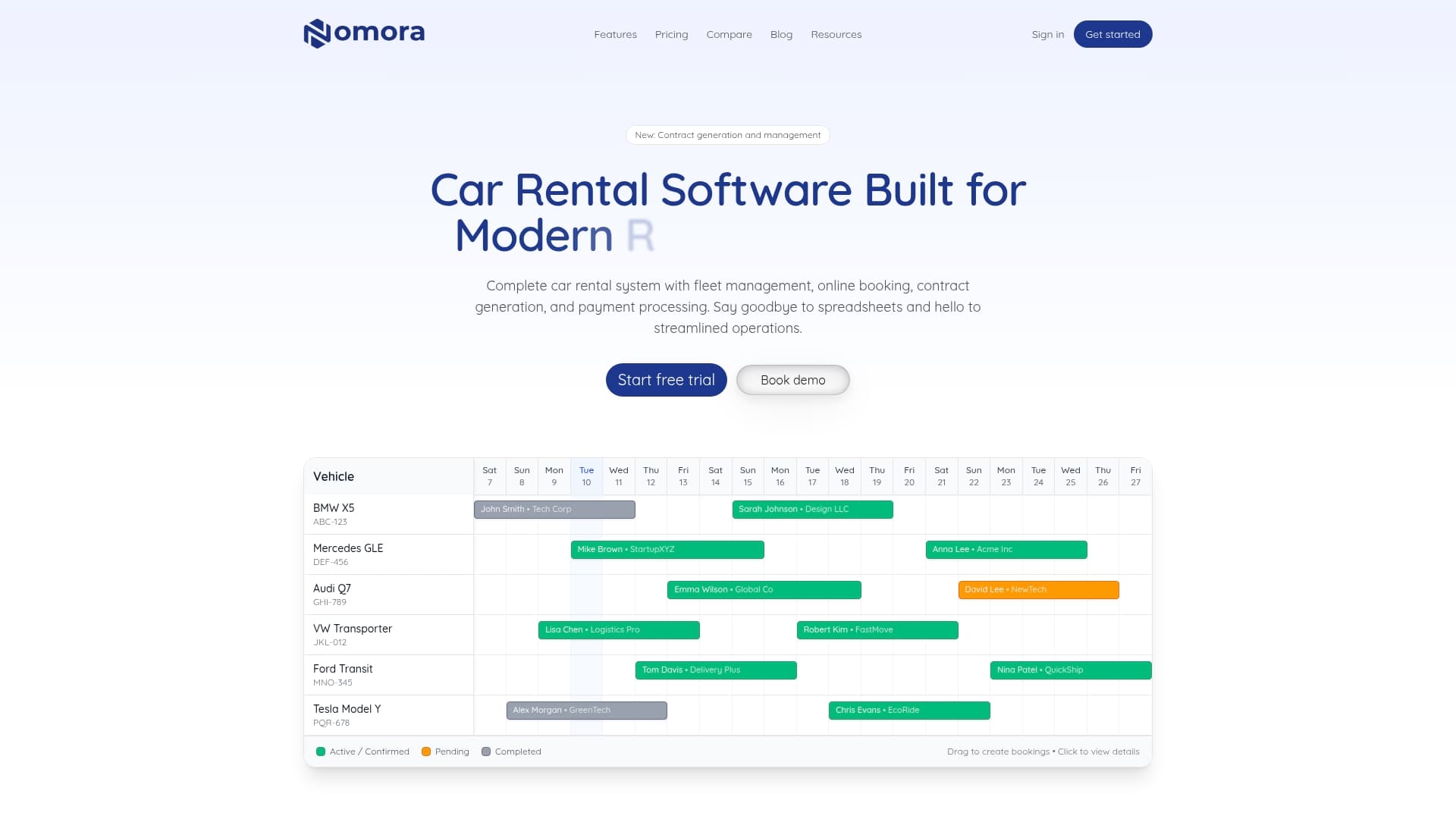
Whether you're managing 15 vehicles or 150, Nomora's fleet management software helps you monitor utilization, apply rate rules, and track the metrics that drive profitability. You can explore car rental software use cases tailored to your specific operation type, and review transparent software pricing to find the plan that fits your business. Setup takes as little as 24 to 48 hours, so you can move from insight to action quickly.
Frequently asked questions
What is the first step in setting a rental pricing strategy?
Start by defining your business goals and collecting accurate fleet, cost, and market demand data. As industry guidance confirms, contribution margin and booking system integration should be prioritized from the start.
How often should I update my rental prices?
Review and adjust your rental pricing at least once per month and immediately during any significant market shift, such as a sudden competitor price drop or a major local event.
What are rate fences in rental pricing?
Rate fences are structured conditions like vehicle type, minimum rental days, or advance booking windows that allow you to offer different rates to different customer segments. Both physical and non-physical rate fences are effective tools for capturing more value across your customer base.
Which benchmarks should car rental managers focus on?
Monitor RevPAR, RevPAV, and RPD as your primary benchmarks. During peak demand periods, operators using active revenue management see revenue surges of 20 to 50% compared to standard periods.
Recommended