Key Takeaways
| Point | Details |
|---|
| Strategic allocation drives profit | Effective fleet allocation, not just utilization, is essential for maximizing revenue and minimizing costs in rental car operations. |
| Blend core and advanced tactics | Combining forecasting, pricing, rebalancing, and data-driven overbooking leads to higher efficiency and flexibility. |
| Follow industry benchmarks | Track daily and seasonal utilization rates and regularly benchmark your fleet against industry standards to gauge success. |
| Continuous review is vital | Frequent analysis and adjustment of allocation strategies outperforms a 'set and forget' approach every time. |
Why fleet allocation matters for rental profitability
Fleet allocation is the deliberate process of assigning specific vehicles to specific locations, time windows, and customer segments to maximize both revenue and operational efficiency. It goes well beyond simply keeping cars rented. Poor allocation creates a cascade of problems that erode margins quietly and consistently.
Idle assets are the most visible symptom. A compact sedan sitting unused at a suburban branch while the airport location turns away economy bookings is a direct profit leak. Less obvious is overbooking bleed, where mismatched supply creates upgrade costs, customer dissatisfaction, and administrative overhead that eat into margin. There are also missed premium opportunities, where high-margin SUVs or specialty vehicles end up parked while lower-margin economy units churn through high-demand periods.
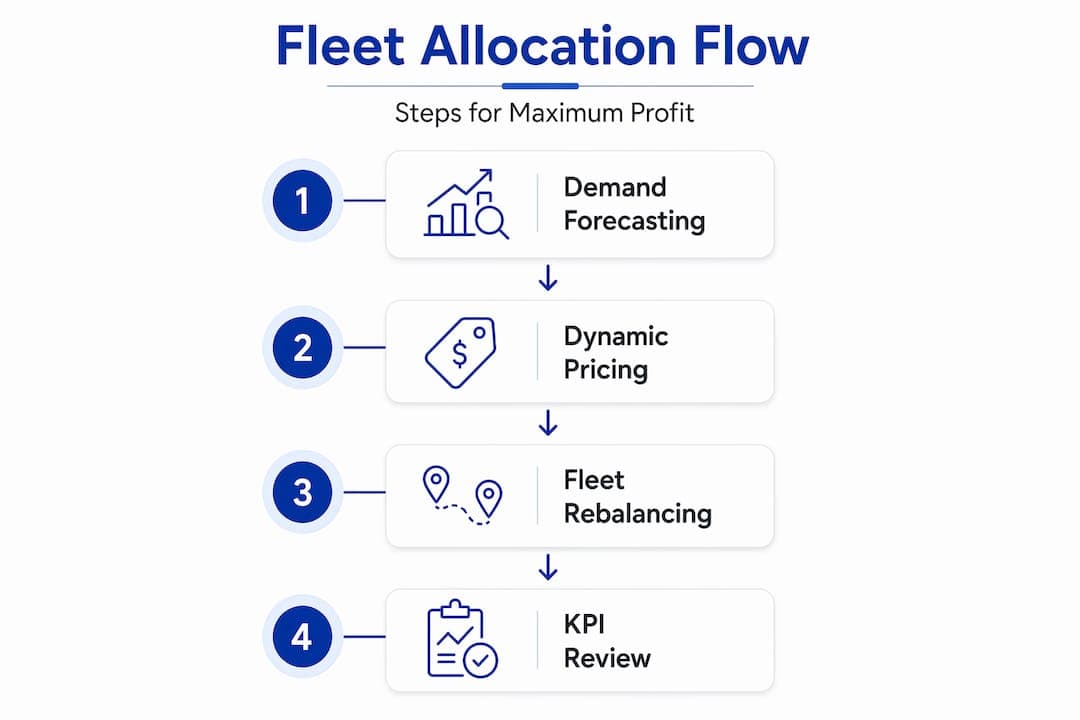
Fleet allocation strategies for rental companies center on four interlocking disciplines: demand forecasting, dynamic pricing, fleet rebalancing, and vehicle class optimization. Each one supports the others. Forecasting informs pricing decisions. Pricing signals feed back into rebalancing priorities. Class optimization shapes the entire vehicle mix.
The tangible benefits of getting this right include:
- Lower idle time across all vehicle classes and locations
- Higher revenue per vehicle through better price positioning
- Reduced upgrade costs from accurate demand matching
- Faster response to seasonal shifts without reactive over-purchasing
- Stronger customer satisfaction when availability matches expectations
Understanding these benefits through fleet utilization reporting and sharp rental inventory insights is where sustainable improvement begins.
Core strategies for optimal fleet allocation
Effective fleet allocation is not a single tactic. It is a system of interconnected strategies that reinforce each other over time. Here is how each one works in practice.
Demand forecasting uses historical booking data, seasonal trends, local events, and market signals to predict how many vehicles of each class will be needed at each location on any given day. Accurate forecasting prevents both under-supply, which turns away revenue, and over-supply, which creates idle costs. Demand forecasting tools built into modern rental management platforms automate much of this analysis in real time.
Dynamic pricing adjusts rental rates based on current demand, availability, and competitive positioning. Rather than holding a flat daily rate, dynamic pricing captures premium revenue during high-demand windows and stimulates bookings during slow periods. Rental pricing strategies that incorporate dynamic adjustments consistently outperform flat-rate models across all fleet sizes.
Fleet rebalancing is the physical or logistical movement of vehicles between locations to correct supply imbalances before they become revenue problems. A branch with too many compact cars and a surplus of weekend demand at another location creates an obvious rebalancing opportunity, provided the transport cost is justified.
Vehicle class optimization ensures that the overall mix of economy, mid-size, premium, and specialty vehicles reflects actual demand patterns rather than historical buying habits. Many fleets carry too many economy units because they were cheap to acquire, not because they are the most profitable to rent.
Core steps for each strategy:
- Forecasting: Analyze 12 to 24 months of booking history, segment by vehicle class and location, then layer in event calendars and seasonal indexes.
- Dynamic pricing: Set floor and ceiling rates per class, define trigger thresholds (e.g., below 40% availability activates surge pricing), and review results weekly.
- Rebalancing: Map surplus and deficit locations daily, calculate net revenue gain after transport cost, and action only positive-gain moves.
- Class optimization: Review revenue per vehicle by class quarterly, retire low-performers, and adjust acquisition or lease plans accordingly.
Pro Tip: For unpredictable demand, a hybrid fleet mix combining owned vehicles for stable baseline demand, leased vehicles for growth periods, and short-term rented units for peak surges can significantly reduce idle asset risk without locking up capital.
| Acquisition model | Best for | Flexibility | Cost profile |
|---|
| Owned | Stable, predictable demand | Low | High upfront, low ongoing |
| Leased | Steady growth, medium-term | Medium | Predictable monthly |
| Rented (short-term) | Peak demand and seasonal spikes | High | Premium per unit |
| Hybrid mix | SMEs with variable demand | High | Balanced across the cycle |
Fleet rotation and revenue management data shows that dynamic pricing and forecasting together can boost utilization by 3-25%, while MIP (Mixed Integer Programming) revenue models increase revenue per car by 2 to 8%. Even without advanced modeling, systematic application of these four strategies produces measurable gains within two to three rental cycles.
Utilization benchmarks and measuring allocation success
Knowing what good looks like is essential before you can manage toward it. Industry data provides a clear baseline for small and medium rental operations.
| Metric | Off-peak target | Average daily target | Peak season target |
|---|
| Fleet utilization rate | 55-65% | 70-79% | 90-95% |
| SME focused management | 60-70% | 82% | 90%+ |
| Revenue per vehicle/day | Variable | Benchmark to market | +15-20% above average |
| Idle days per vehicle/month | Less than 8 days | Less than 6 days | Less than 3 days |
"Small and medium rental fleets of 20 to 60 vehicles can achieve 82% average daily utilization through focused management" — this is not an aspirational figure. It is a documented outcome from operators who treat allocation as an active discipline rather than a passive result.
Measuring allocation success requires tracking the right indicators. Here are the four KPIs that matter most:
- Fleet utilization rate: The percentage of available vehicle-days actually rented. This is your primary efficiency signal, but it must be read alongside profitability data to avoid chasing numbers at the expense of margin.
- Revenue per vehicle per day (RevPVD): Combines utilization and pricing into a single profit-oriented metric. A vehicle rented at 60% utilization at premium rates can outperform one rented at 85% at discounted rates.
- Idle days per vehicle: Measures how many days each vehicle sits unrented in a given period. Breaking this down by vehicle class and location reveals allocation gaps immediately.
- Vehicle turnover speed: How quickly a returned vehicle is inspected, prepared, and made available for the next booking. Slow turnaround artificially suppresses utilization even when demand is strong.
Tracking fleet KPIs with precision, and reviewing them against fleet utilization best practices, separates operators who improve consistently from those who react only when problems are already visible.
A common pitfall is tracking total utilization as the only success measure while ignoring per-class or per-location breakdowns. A 78% aggregate figure can mask a premium segment running at 45% while economy units hit 95%, which means the most profitable vehicles sit idle during the periods when customers are willing to pay the most.

Advanced tactics: Overbooking, rebalancing, and adaptation
Once the core strategies are running well, several advanced tactics can push efficiency further. These carry higher risk if implemented without solid data foundations, but the upside is significant for operators who get them right.
Advanced strategies worth considering:
- Data-driven overbooking: Accepting more reservations than available units, calibrated to historical no-show rates by segment and location, to ensure near-full utilization during high-demand windows.
- Cross-branch vehicle rebalancing: Systematically moving vehicles between locations on a scheduled or triggered basis to correct supply imbalances before they translate into lost bookings.
- Short-term asset shifting: Temporarily reassigning specific vehicle classes from low-demand branches to high-demand locations during predictable demand events such as holidays, local festivals, or corporate travel peaks.
- Segment-based availability holds: Reserving a portion of fleet availability for last-minute premium bookings that historically generate higher RevPVD than advance economy reservations.
Pro Tip: Only implement overbooking where you have at least 12 months of no-show data segmented by vehicle class, booking channel, and location. Without that specificity, the compensation costs and customer dissatisfaction from walking a customer will outweigh the utilization gain. As overbooking analysis makes clear, overbooking requires robust historical no-show data and a well-defined compensation flow.
Rebalancing is perhaps the most misapplied tactic in the industry. Fleet managers sometimes move vehicles between branches on instinct rather than calculation, incurring transport costs, driver time, and fuel expenses that exceed the revenue recovered. The rule is simple: never rebalance unless the projected net revenue gain after all transport costs is positive. For fleet rebalancing examples that clarify how this calculation works in practice, operators can find guidance tailored to different fleet sizes and branch structures.
Seasonal adaptation requires a different mindset. During high season, the priority is maximizing availability speed and minimizing idle time between rentals. During low season, the focus shifts to right-sizing the active fleet, concentrating vehicles at highest-demand locations, and using pricing to stimulate bookings on slower days. Practical vehicle rebalancing resources offer additional context on how fleet-level logistics decisions play out across different operating environments.
What most rental fleet guides miss about allocation
Most guides on fleet allocation treat it like an annual exercise. Set your vehicle mix, define your pricing tiers, and revisit next year. That framing is the root cause of chronic underperformance in small and medium rental operations.
The reality is that fleet allocation is a continuous, iterative process. Market conditions shift. A competitor opens near your airport branch. A corporate client shifts their travel policy toward compact SUVs. A local infrastructure project floods your city center with contractors needing extended rentals. Each of these events creates a new allocation puzzle that your annual plan did not anticipate.
"Great allocation isn't about 99% utilization. It is about maximizing profit per vehicle and minimizing opportunity cost from the wrong car, in the wrong place, at the wrong time."
Chasing high utilization numbers at the expense of flexibility is a trap. Operators who push toward maximum occupancy by discounting aggressively or skipping rebalancing decisions often find that their revenue per vehicle deteriorates even as their utilization climbs. The math looks good in the utilization column and breaks down everywhere else.
The stronger approach is to build regular allocation reviews into your operational cadence. A monthly review of KPIs by class and location, combined with a quarterly reassessment of your vehicle mix and acquisition strategy, gives you both the responsiveness to address emerging imbalances and the strategic perspective to make sound fleet investment decisions.
Full fleet management guidance reinforces that data-driven iteration, not static annual planning, is what separates growing rental operations from stagnant ones. The willingness to experiment, measure the outcome, and adjust quickly is a genuine competitive advantage that any operator can develop regardless of fleet size.
Turn insights into action with fleet management solutions
Implementing the strategies covered in this article manually through spreadsheets and phone calls is possible, but it is slow, error-prone, and difficult to scale. The operational complexity grows quickly when you are managing demand forecasting, dynamic pricing, rebalancing decisions, and KPI tracking simultaneously across even a modest fleet.
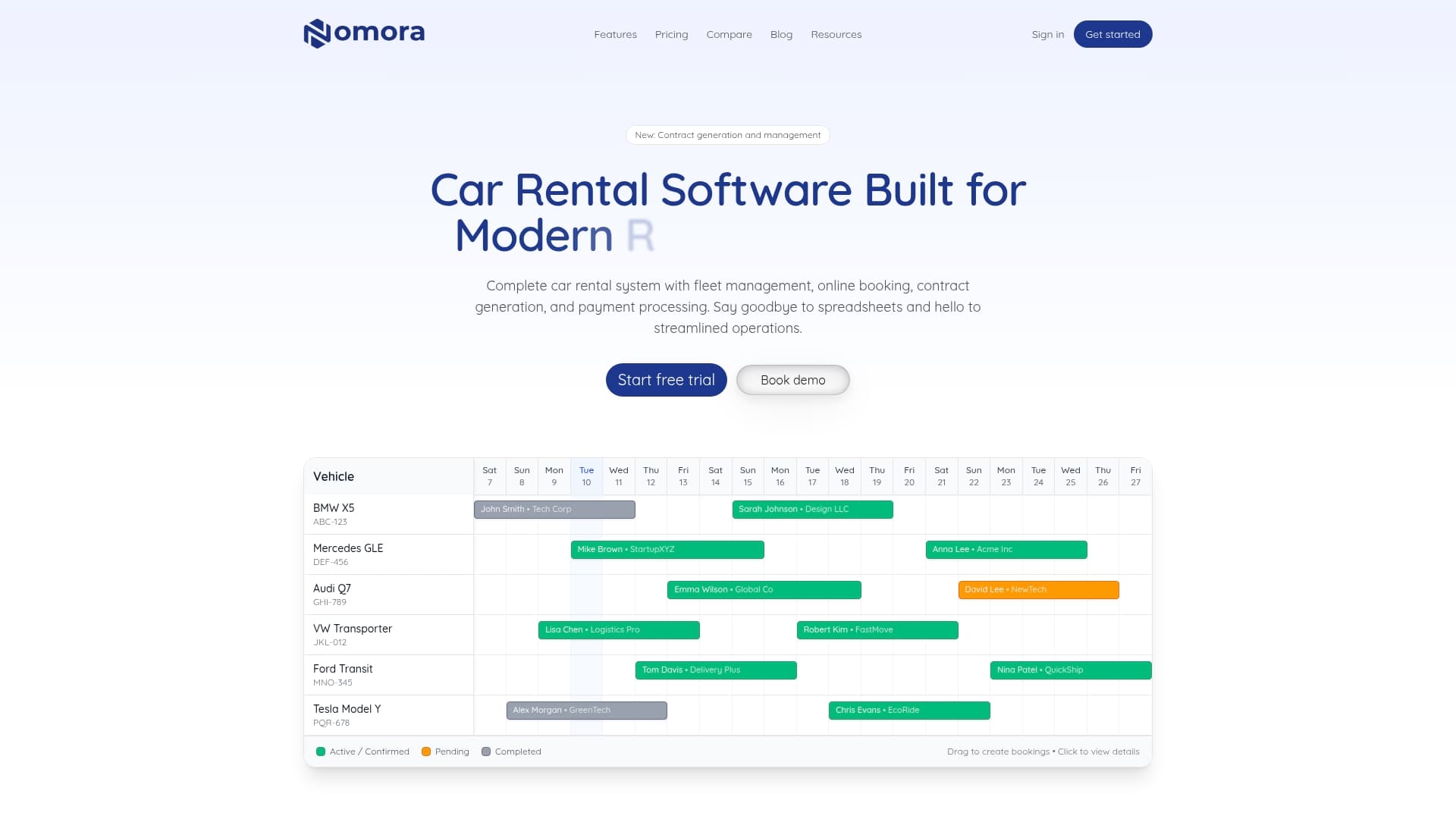
Nomora is built to serve as the central nervous system of your rental operation, connecting reservations, fleet status, pricing, and reporting into a single cloud-based platform. You can act on real-time Nomora platform data rather than yesterday's spreadsheet. For operators who want to explore how these capabilities apply to their specific fleet size and business model, the Nomora car rental use cases page provides concrete examples across independent operators, multi-branch companies, and corporate fleet managers. Features like conflict-free booking logic also directly prevent double bookings, eliminating one of the most common and costly allocation errors in manual systems.
Frequently asked questions
What is the ideal fleet utilization rate for small rental companies?
Small and medium rental fleets typically target 70 to 82% average daily utilization, with peaks of up to 90-95% during high season, achievable through active allocation management across a 20 to 60 vehicle fleet.
How does overbooking help improve fleet allocation?
Overbooking fills gaps created by predictable no-shows, but it only improves allocation outcomes when grounded in accurate no-show data by segment and location, with clear compensation plans ready when it does not go as planned.
What mix of owned, leased, or rented vehicles works best for SMEs?
A hybrid fleet approach is widely recommended, combining owned vehicles for stable demand, leased units for flexibility, and short-term rented vehicles for seasonal peaks, which minimizes idle assets while keeping fixed costs manageable.
The four most actionable KPIs are fleet utilization rate, revenue per vehicle per day, idle days per vehicle, and vehicle turnover speed, because together they reveal both efficiency and profitability gaps.
How do dynamic pricing and demand forecasting impact rental profit?
Used together, they can boost utilization by 3-25% and increase revenue per car by 2 to 8%, making them among the highest-return investments a rental operator can make in their management process.
Recommended