Key Takeaways
| Point | Details |
|---|
| Centralized fleet management | Central oversight across multiple branches provides real time visibility and standardized processes to optimize utilization. |
| Real time visibility | A unified dashboard shows every vehicle in every location to prevent idle inventory and booking errors. |
| Predictive maintenance | A centralized system tracks mileage and service intervals to reduce unexpected breakdowns and extend asset life. |
| Vehicle rebalancing | Automated workflows coordinate transfers and pricing to balance supply when demand shifts between locations. |
| One way rentals challenge | One way rentals create imbalances across sites and require proactive planning and cross site data sharing. |
Understanding multi-location fleet management
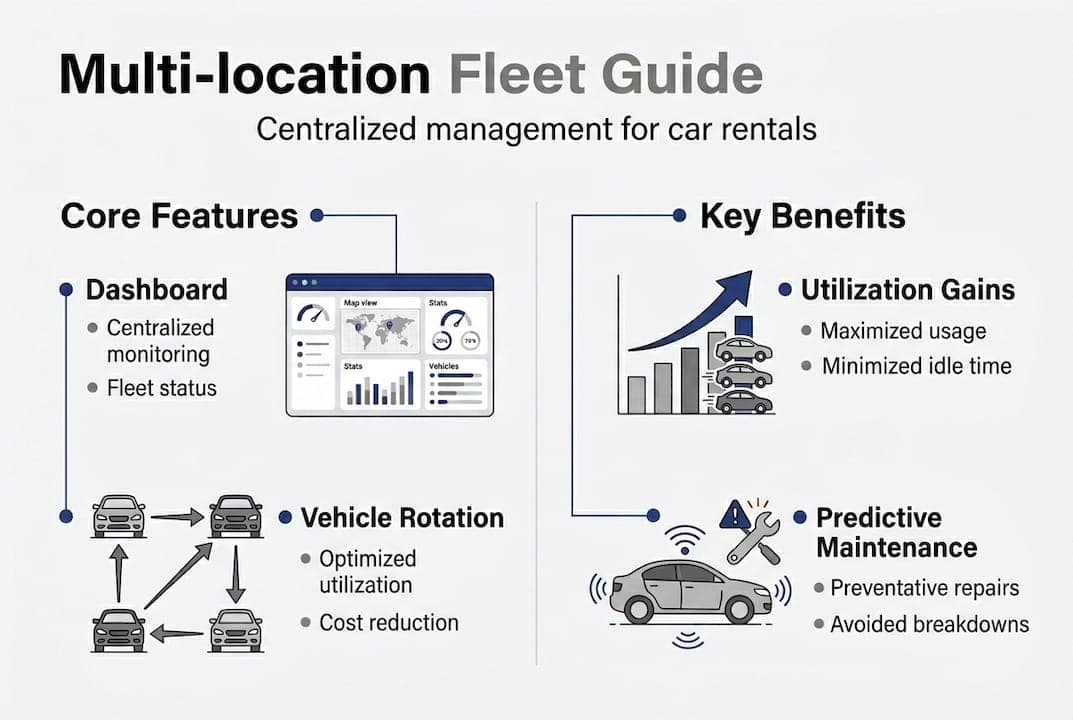
Multi-location fleet management involves centralized oversight of vehicles, reservations, maintenance, and utilization across multiple branches, using integrated software for real-time visibility and standardized processes. Unlike single-location operations where you can visually inspect every vehicle and manually coordinate bookings, multi-site management requires systems that treat your entire fleet as one unified asset pool while respecting geographic and operational differences.
Key mechanics include centralized dashboards, automated workflows, vehicle rotation, predictive maintenance, dynamic pricing, and GPS tracking. Your dashboard shows real-time availability across all branches, preventing the common scenario where one location sits with idle vehicles while another turns away customers. Automated workflows handle pricing adjustments based on local demand, generate contracts consistently across sites, and trigger maintenance alerts before breakdowns occur.
Vehicle rotation becomes critical when demand shifts between locations. A beach town branch might overflow with returns during winter while your airport location runs short. Effective systems identify these imbalances and coordinate transfers, either through staff shuttles or strategic one-way rental pricing. GPS tracking provides real-time location data, essential for verifying vehicle positions and optimizing pickup logistics.
Predictive maintenance scheduling reduces costly roadside failures. Instead of each branch managing its own service calendar, centralized systems track mileage, service intervals, and inspection dates across your fleet. This prevents the scenario where a vehicle due for service gets rented out because the local manager didn't check the maintenance log. Car rental software use cases demonstrate how integrated platforms handle these complexities while maintaining local operational flexibility.
The integration of software solutions is essential to gain visibility and control across sites. Manual spreadsheets and phone calls between branches create information delays and errors. Cloud-based platforms synchronize data instantly, so reservation changes, maintenance updates, and pricing adjustments propagate across all locations immediately. This centralization improves asset utilization and operational efficiency, directly impacting your bottom line. Corporate vehicle rental solutions show how larger operations leverage these systems for consistent service delivery.
Common challenges and edge cases in multi-location fleet management
Edge cases include one-way rentals causing vehicle imbalances, seasonal and geographic mismatches, double bookings, maintenance backlogs, EV charging disparities, and inter-island relocations. One-way rentals create the most persistent headache. A customer picks up at your airport branch and drops off downtown. Without proactive rebalancing, your airport location gradually empties while downtown overflows. Some operators charge premium fees for one-way rentals to discourage imbalances, while others build regular shuttle runs into their operations.
Seasonality and geographic differences challenge uniform service levels. Your mountain location peaks during ski season while your coastal branch thrives in summer. Maintaining the right vehicle mix at each site requires forecasting local demand patterns and rotating vehicles between locations as seasons shift. Fleet policy simulation studies show how operators model these patterns to optimize relocation strategies.

Double bookings and maintenance delays impact customer satisfaction and costs directly. When branches operate on separate systems or outdated software, the same vehicle can be promised to multiple customers. Maintenance scheduling becomes equally problematic. A vehicle flagged for service at one branch might still appear available in another branch's system, leading to rentals of unsafe vehicles or last-minute cancellations.
Electric vehicle charging infrastructure variability adds new complexity. Your urban branch might have abundant charging stations while your rural location has none. This geographic disparity affects which vehicle types you can deploy where and requires careful planning to avoid stranding EVs without charging access. Some operators maintain separate EV and gas fleets by location rather than attempting full integration.
Decentralized data causes siloed operations and higher costs, while centralization and role-based access prevent overload and improve utilization by 10-20%. When each branch manages its own spreadsheets and booking systems, you lose visibility into overall fleet performance. One location might turn away customers while another has idle vehicles. Centralized platforms solve this, but require thoughtful implementation of role-based access. Branch managers need visibility into their local operations without drowning in data from every other site.
Pro Tip: Implement a weekly rebalancing review where you compare utilization rates across branches and identify vehicles to relocate. Even moving 2-3 vehicles per week based on demand forecasts can significantly improve overall utilization and revenue.
The key to managing these challenges lies in preventing double bookings through real-time synchronization and building rebalancing logistics into your standard operations rather than treating it as an emergency response. Multi-location car rental software addresses these issues systematically rather than forcing you to patch problems manually.
Benefits of centralized multi-location management and software solutions
Centralized management unlocks 10-20% utilization gains, with average rental fleet utilization ranging 70-79% and peaking at 90-95%. This improvement comes from eliminating the information silos that cause one branch to sit idle while another turns away business. When you can see real-time availability across all locations, you can direct customers to nearby branches with available inventory or proactively move vehicles to high-demand sites.
Utilization benchmarks show daily fleet usage should ideally range 65-85% to balance profits and maintenance. Push too high above 85%, and you risk inadequate maintenance windows and customer service failures when unexpected demand spikes occur. Fall below 65%, and you're carrying excess inventory that drains cash through depreciation and insurance without generating revenue. Maintenance costs average 5-15% of revenue, and balanced utilization optimizes revenue and fleet health.
| Utilization Range | Maintenance Cost % | Revenue Impact | Fleet Health |
|---|
| Below 60% | 8-12% | Low revenue per vehicle | Excellent condition, underused |
| 65-75% | 6-10% | Optimal revenue balance | Good condition, sustainable |
| 76-85% | 5-8% | High revenue efficiency | Acceptable wear, manageable |
| Above 85% | 10-18% | Revenue peaks but risks rise | Accelerated wear, service delays |
Proper maintenance scheduling reduces costs and downtime significantly. Centralized systems track service intervals across your fleet and automatically schedule maintenance during low-demand periods. This prevents the reactive maintenance cycle where vehicles break down during peak season, forcing expensive emergency repairs and lost rental days. Predictive maintenance flags issues before they become failures, reducing roadside assistance calls and customer dissatisfaction.
Dynamic pricing and AI forecasting help manage demand fluctuation and seasonality effectively. Instead of manually adjusting rates at each branch, centralized systems analyze booking patterns, local events, and competitor pricing to optimize rates automatically. During your beach location's off-season, rates drop to maintain utilization. When a conference hits your downtown branch, rates rise to maximize revenue from constrained inventory.
Software solutions tailored for SMBs offer cloud-based, affordable, and scalable options that don't require enterprise-level IT infrastructure. You access the system from any device with internet, making it practical for owners who split time between locations or manage operations remotely. Car rental software for small fleets and medium fleets demonstrates how these platforms scale with your business without forcing you into complex enterprise systems.
Pro Tip: Track utilization by branch weekly rather than monthly. Weekly reviews let you spot emerging imbalances and rebalance vehicles before they impact revenue. Monthly reviews often reveal problems too late to fix for that period.
The fleet utilization statistics show that operators using centralized systems consistently outperform those managing locations independently. The data visibility alone drives better decisions, but the automation of pricing, maintenance, and rebalancing creates compounding efficiency gains that directly boost profitability.
Practical steps for SMB rental owners to implement multi-location fleet management
Small to medium owners should prioritize cloud-based centralized software with utilization KPIs per branch to identify rebalancing needs and avoid over-expansion without solid single-location profitability. Here's how to implement effective multi-location management:
-
Evaluate current single-location profitability and operational efficiency before expanding. If your first location struggles with utilization below 65% or frequent service issues, adding locations multiplies problems rather than revenue. Achieve consistent 70%+ utilization and streamlined operations at your primary site first.
-
Choose cloud-based, centralized fleet management software suitable for SMB scale. Look for platforms that handle reservations, fleet tracking, maintenance scheduling, and financial reporting in one system. Avoid cobbling together separate tools for each function, as integration gaps create the data silos you're trying to eliminate.
-
Define key utilization KPIs per branch and monitor them weekly. Track daily utilization rate, average rental duration, revenue per vehicle per month, and maintenance downtime percentage. Set targets based on your market and vehicle types, then review performance weekly to catch trends early.
-
Use dynamic pricing and predictive maintenance to optimize operations. Enable automated pricing adjustments based on demand forecasts and competitor rates. Set up maintenance alerts based on mileage and time intervals, scheduling service during predicted low-demand periods.
-
Train staff with role-based system access to avoid information overload. Branch managers need full visibility into their location plus summary views of other sites for rebalancing coordination. Front-desk staff need reservation and contract tools without access to financial reporting or system configuration.
When selecting software, consider these factors:
- Real-time synchronization across all locations to prevent double bookings
- Mobile access for managers who travel between branches
- Automated maintenance scheduling with service provider integration
- Dynamic pricing capabilities based on local demand
- Financial reporting that consolidates across locations while showing branch-level detail
- GPS tracking integration for vehicle location verification
- Customer database that works across all branches for repeat business
- Scalability to add locations without platform changes
Start with two locations to learn multi-site coordination before expanding further. The operational complexity increases non-linearly, so mastering two-location management prepares you for additional growth. Multi-location car rental software provides the foundation, but success requires building processes around the technology.
Document your rebalancing procedures, maintenance protocols, and customer service standards in writing. As you add locations, these documented processes ensure consistency and reduce training time for new staff. Review and update procedures quarterly based on what you learn from actual operations.
Monitor how car rental software boosts profits through improved utilization and reduced administrative overhead. Track the time saved on manual processes like contract generation and payment processing. Calculate the revenue gained from better utilization and dynamic pricing. These metrics justify the software investment and guide future operational improvements.
Budget for software as a percentage of revenue rather than a fixed cost. Most car rental software pricing scales with fleet size, aligning costs with business growth. Factor in the utilization gains and administrative time savings when evaluating options. A system that costs 2-3% of revenue but improves utilization by 15% delivers clear positive ROI.
Get the right software for multi-location fleet success
Managing multiple rental locations effectively requires purpose-built software that centralizes operations while respecting local differences. Nomora's multi-location car rental software provides the centralized dashboards, automated workflows, and real-time synchronization that transform scattered operations into a unified, efficient system.
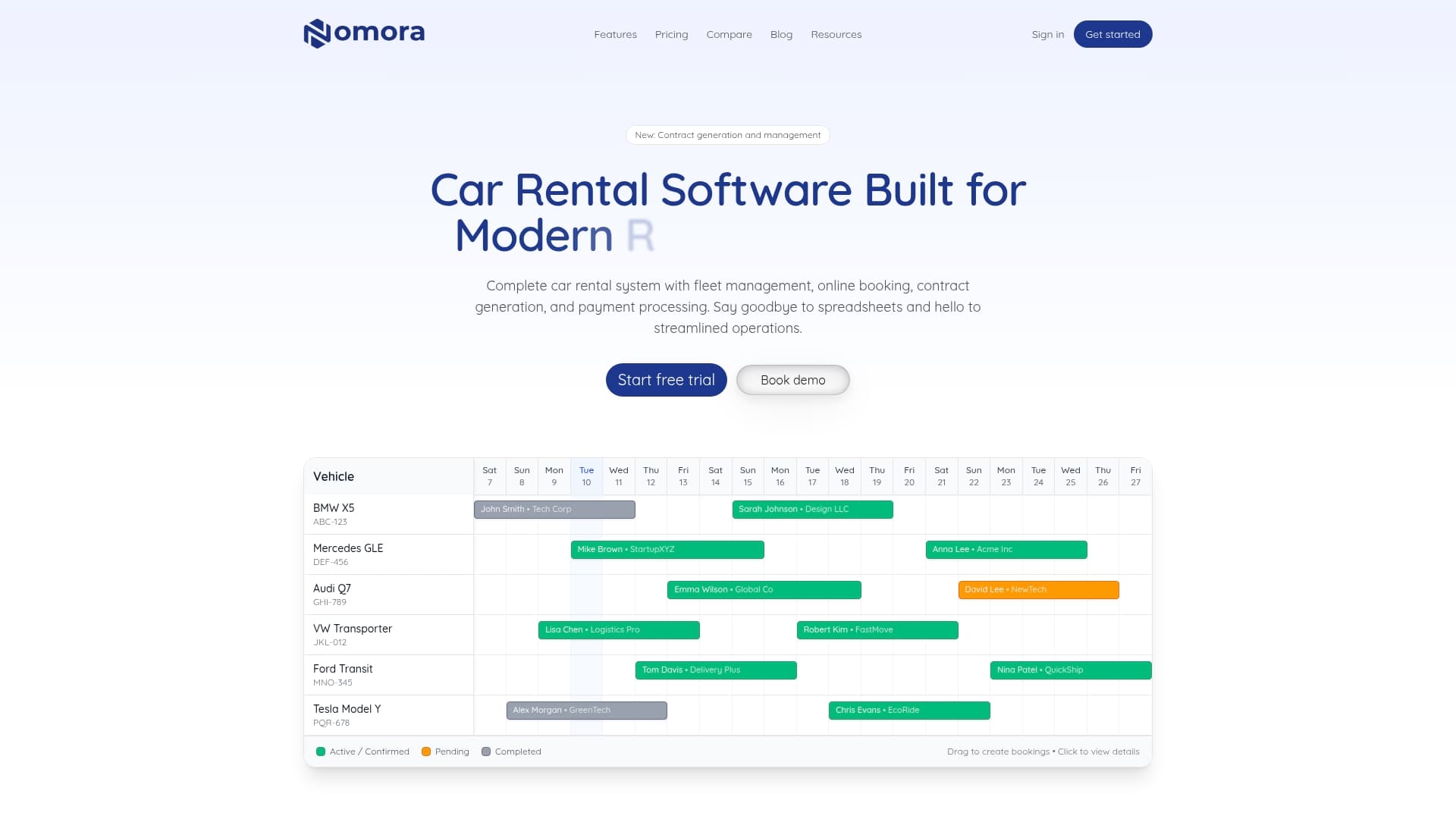
Our platform handles the complexities discussed throughout this guide. Real-time availability prevents double bookings across branches. Predictive maintenance scheduling reduces downtime and emergency repairs. Dynamic pricing optimizes rates based on local demand patterns. GPS integration tracks vehicle locations for efficient rebalancing. The cloud-based system gives you access from anywhere, essential when you're splitting time between locations.
Fleet management software for 50+ vehicles scales with your growth without forcing platform changes. Start with two locations and expand confidently knowing your software supports additional branches seamlessly. Role-based access keeps staff focused on their responsibilities without information overload.
Explore how rental businesses like yours use centralized software to boost utilization by 10-20% and reduce administrative overhead. Review car rental software use cases to see specific scenarios where integrated systems solve the challenges outlined in this guide. The right software doesn't just track your fleet, it actively improves profitability through better utilization and operational efficiency.
Frequently asked questions
What distinguishes multi-location from single-location fleet management?
Multi-location management requires centralized software for real-time visibility across branches, strategic vehicle rebalancing between sites, and standardized processes that work consistently across different geographic markets. Single-location management can rely on manual coordination and visual oversight, while multi-site operations demand automated systems to prevent information silos and utilization imbalances.
How does technology improve multi-location operations?
Centralized platforms provide real-time availability across all branches, preventing double bookings and enabling customer redirection to locations with inventory. Automated maintenance scheduling reduces downtime, dynamic pricing optimizes revenue by location, and GPS tracking facilitates efficient vehicle rebalancing. These technologies typically unlock 10-20% utilization improvements compared to manual multi-location management.
What are common pitfalls to avoid when expanding fleet across locations?
Expanding before achieving solid single-location profitability multiplies operational problems rather than revenue. Using separate systems per location creates data silos that prevent effective rebalancing. Neglecting to document standard processes leads to inconsistent service quality. Failing to implement role-based access overwhelms staff with irrelevant data from other branches.
How can small rental businesses start managing multi-location fleets effectively?
Start by proving profitability and operational efficiency at your first location, achieving 70%+ utilization consistently. Choose cloud-based software designed for SMB scale that centralizes reservations, fleet tracking, and maintenance. Add your second location and master two-site coordination before expanding further. Set branch-level KPIs and review them weekly to catch imbalances early.
Recommended