Key Takeaways
| Point | Details |
|---|
| Instant digital signing | Digital contracts allow customers to sign rental agreements on any device in seconds, eliminating lines and paperwork. |
| Efficiency and savings | Digital contracts can cut operational costs by up to 30% and reduce admin hours from 120-160 to 20-30 each month. |
| Fewer errors, better ROI | Automation reduces booking mistakes from 8-12% to under 1%, with most fleets seeing ROI within one month. |
| Advanced automation potential | Integrating contracts with fleet software and smart contracts unlocks proactive management and scalable compliance. |
What are digital contracts in car rental?
Understanding the technology starts with a clean definition. A digital contract in car rental is an electronic rental agreement that customers sign via smartphone, tablet, or computer, replacing the traditional paper form entirely. These agreements carry the same legal weight as paper contracts in most jurisdictions, provided they meet regional e-signature requirements.
Digital contracts via e-signatures enable instant agreement signing from any device and fully replace paper-based workflows. That shift alone removes a significant bottleneck from the check-in process. But the real value goes deeper than just eliminating paper.
Modern digital contract platforms for car rental typically include the following core features:
- Custom templates: Pre-built agreement structures that auto-populate with customer and vehicle data, reducing manual entry
- Digital signature capture: Touch-based or typed signatures recorded directly on the device
- Audit trails: Timestamped logs that record the signing device, IP address, and user identity for every agreement
- Automated PDF generation: Instant document creation and delivery to the customer's inbox upon signing
Configurable templates, touch and typed signatures, audit trails, and PDF generation form the operational backbone of any credible digital contract system. These mechanics matter because they directly address the two biggest failure points in paper contracts: data accuracy and dispute resolution.
Audit trails deserve particular attention. When a customer disputes a damage charge or a return time, a paper contract leaves your team scrambling through filing cabinets. A digital audit trail gives you an exact timestamp, the device used, and the IP address tied to every signature. That level of documentation is not just operationally useful; it is often decisive in legal or insurance disputes.
If you are new to the topic, reviewing rental contract basics provides helpful context before exploring more advanced implementations. For those already familiar with the fundamentals, streamlining the contract process offers a practical look at workflow redesign. You can also see a working example of how digital car rental works in practice.
Compared to paper, digital contracts reduce manual data entry by a significant margin, lower the risk of illegible or incomplete forms, and make compliance audits far less painful. They are not just a convenience upgrade. They are a structural improvement to how your business handles agreements.
Operational benefits: Efficiency, cost savings, and fleet optimization
With a clear grasp of digital contract features, next, let's examine the bottom-line impact on business operations.
Automation cuts operational costs by up to 30%, reduces admin hours, lowers booking errors, and boosts fleet utilization. That figure reflects the combined effect of faster processing, fewer manual corrections, and better data flowing into your fleet management system.

Booking errors are a particularly costly problem. In paper-based operations, error rates typically run between 8% and 12% per rental cycle. With automated digital contracts, that figure drops below 1%. Each error avoided represents saved staff time, reduced customer friction, and lower risk of a dispute escalating.
| Metric | Paper-based workflow | Digital contract workflow |
|---|
| Check-in time | 8 to 12 minutes | Under 2 minutes |
| Booking error rate | 8 to 12% | Below 1% |
| Monthly admin hours | High | Reduced by up to 30% |
| Fleet utilization | Lower due to delays | Higher with streamlined handover |
| Document retrieval | Manual, time-consuming | Instant, searchable |
Fleet utilization is another area where digital contracts create direct financial value. When check-in and check-out processes are faster, vehicles spend less time idle between rentals. That improved turnaround translates directly into more revenue per vehicle per month.
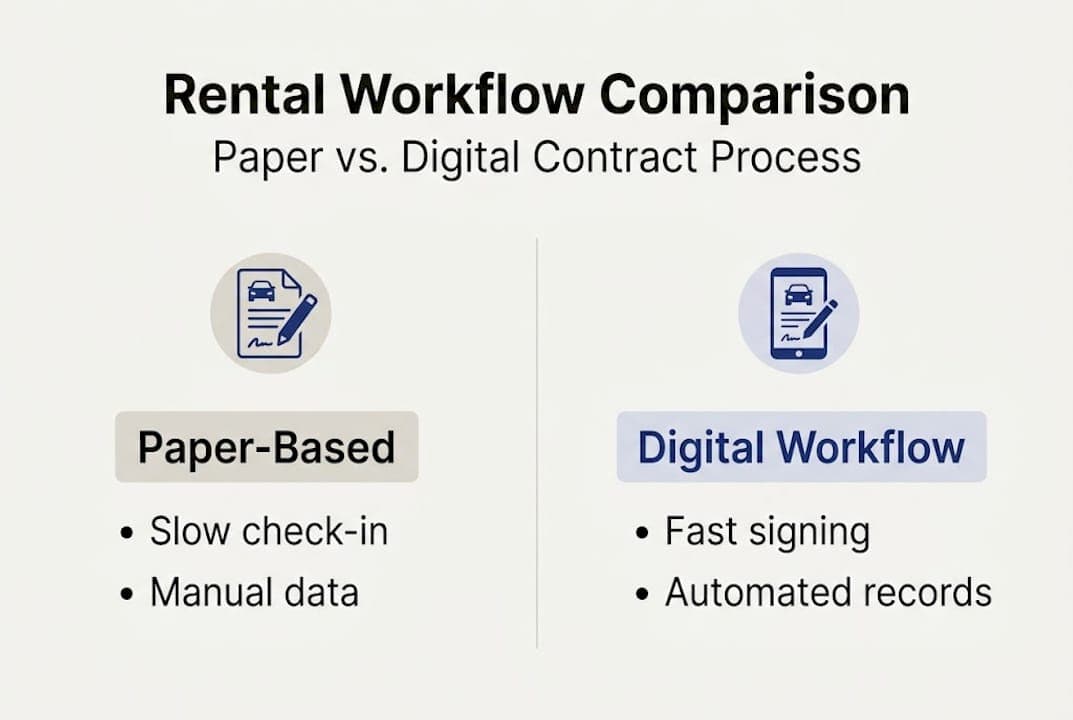
Hertz saved over 3 million ISK per year and improved customer experience significantly after adopting digital contracts. That kind of result is not unusual. The savings come from reduced paper and printing costs, lower staff hours spent on document handling, and fewer errors requiring manual correction.
For a deeper look at the efficiency data behind these gains, Nomora's research breaks down the numbers by business size and fleet type. You can also review contract essentials to understand which agreement components drive the most operational risk when handled manually.
Key insight: The cost savings from digital contracts are not one-time gains. They compound monthly as your team spends fewer hours on paperwork and your fleet turns over faster.
Pro Tip: Track admin hour reductions and fleet utilization rates every month after switching to digital contracts. Quantifying the ROI in real numbers makes it easier to justify further investment in automation and integration.
Customer journey: Instant signing, fewer delays, happier clients
With the operational side covered, it's vital to see the impact on the end user.
The customer experience in car rental has historically been defined by waiting. Waiting to sign forms, waiting for staff to process paperwork, waiting for the vehicle to be confirmed. Digital contracts eliminate most of that wait. Digital contracts enable instant signing and dramatically reduce check-in lines, which directly affects how customers perceive your brand.
Here is how the digitized customer journey typically unfolds:
- Booking: Customer completes a reservation online or through your app
- Pre-signing: Agreement is sent automatically before arrival; customer signs from home or on the way
- Pick-up: Staff verify identity, confirm the pre-signed agreement, and hand over the vehicle in under two minutes
- Return: Condition is logged digitally, and the customer receives a digital receipt instantly
This sequence removes the single biggest source of customer frustration: standing in line at a counter while staff type information into a system. Pre-arrival signing is particularly powerful because it shifts the administrative burden away from the physical location entirely.
"When queues are eliminated at vehicle pickup, customer satisfaction scores rise sharply. The rental counter experience is often the first physical touchpoint a customer has with your brand, and speed signals competence."
Digital records also reduce disputes at the return stage. When damage, return time, or contract terms are questioned, fleet managers benefit from audit trails and centralized management that makes dispute resolution faster and more objective. There is no ambiguity about what was signed or when.
For rental businesses exploring self-service models, the customer self-service advantages are well-documented and worth reviewing. If you are still evaluating platforms, a comparison of best rental software options in 2026 can help you identify which tools support the full digital customer journey.
The cumulative effect is a customer who feels respected, not processed. That perception drives repeat bookings and positive reviews, both of which matter significantly for long-term revenue.
Advanced integrations and legal edge cases
To maximize digital contract impact, fleet managers must master integration and be proactive about compliance.
Integration with fleet software automates contract generation and workflows, removing the manual handoff between booking systems and contract creation. When your reservation platform, telematics system, and contract tool share data automatically, you eliminate an entire category of human error.
Beyond standard e-signatures, some operators are exploring blockchain-based smart contracts. Blockchain smart contracts provide automation and immutable audit trails but come with real adoption and legal cost challenges. The table below compares both models:
| Feature | Standard e-signature | Blockchain smart contract |
|---|
| Legal acceptance | Widely recognized | Varies by jurisdiction |
| Implementation cost | Low to moderate | High |
| Audit trail | Timestamped logs | Immutable blockchain record |
| Automation capability | Moderate | High |
| Scalability | Proven at scale | Still maturing |
Beyond the technology choice, legal edge cases require careful planning. Key considerations include:
- Per-rental resigning: Some jurisdictions require fresh signatures for each rental, even for repeat customers
- Multi-language agreements: International customers may require contracts in their native language to be legally enforceable
- Voided contracts: Clear procedures for voiding and reissuing agreements must be built into your workflow
- Regional data privacy: GDPR in Europe and equivalent laws elsewhere govern how you store and process signed agreements
For a practical guide on managing these complexities, integration best practices covers the technical and compliance dimensions in detail. If you are ready to evaluate specific tools, Nomora's automated contract solutions address both standard and advanced use cases.
Pro Tip: For blockchain adoption, start with a hybrid model combining standard e-signatures with a blockchain-based audit layer. This approach captures the immutability benefits without the full implementation cost and legal uncertainty of pure smart contracts.
Our perspective: What most rental operations miss about going digital
Digital contracts are a catalyst, not a cure-all. That distinction matters more than most operators realize when they first make the switch.
The companies that see the biggest gains from digital contracts are not the ones with the most advanced technology. They are the ones that redesigned their workflows, trained their staff thoroughly, and measured results consistently after adoption. Many businesses make the mistake of a direct lift-and-shift: they replace paper with a digital form but keep every other process exactly the same. The result is modest improvement at best.
Real transformation requires asking harder questions. Which steps in your current process exist only because of paper? Which staff behaviors were shaped by manual document handling? Answering those questions honestly is what separates high performers from average adopters.
Measurement is equally critical. Without tracking admin hour reductions, error rates, and customer satisfaction scores before and after adoption, you cannot know whether the investment is paying off. Many operators skip this step and then underestimate the ROI they are actually generating.
For teams looking to get this right, maximizing digital contracts requires a phased approach: nail the fundamentals first, then layer in advanced capabilities like blockchain audit trails or API-driven automation.
Pro Tip: Run a post-adoption audit at 30, 60, and 90 days. Validate admin time savings, cost reductions, and customer satisfaction metrics against your baseline. The data will guide your next investment decision with confidence.
Ready to streamline your contracts? See Nomora in action
Nomora's platform is built specifically for rental businesses that want to move beyond manual processes and realize the operational gains described throughout this article. From instant digital contract generation to automated workflows and real-world fleet integrations, Nomora handles the complexity so your team can focus on customers.
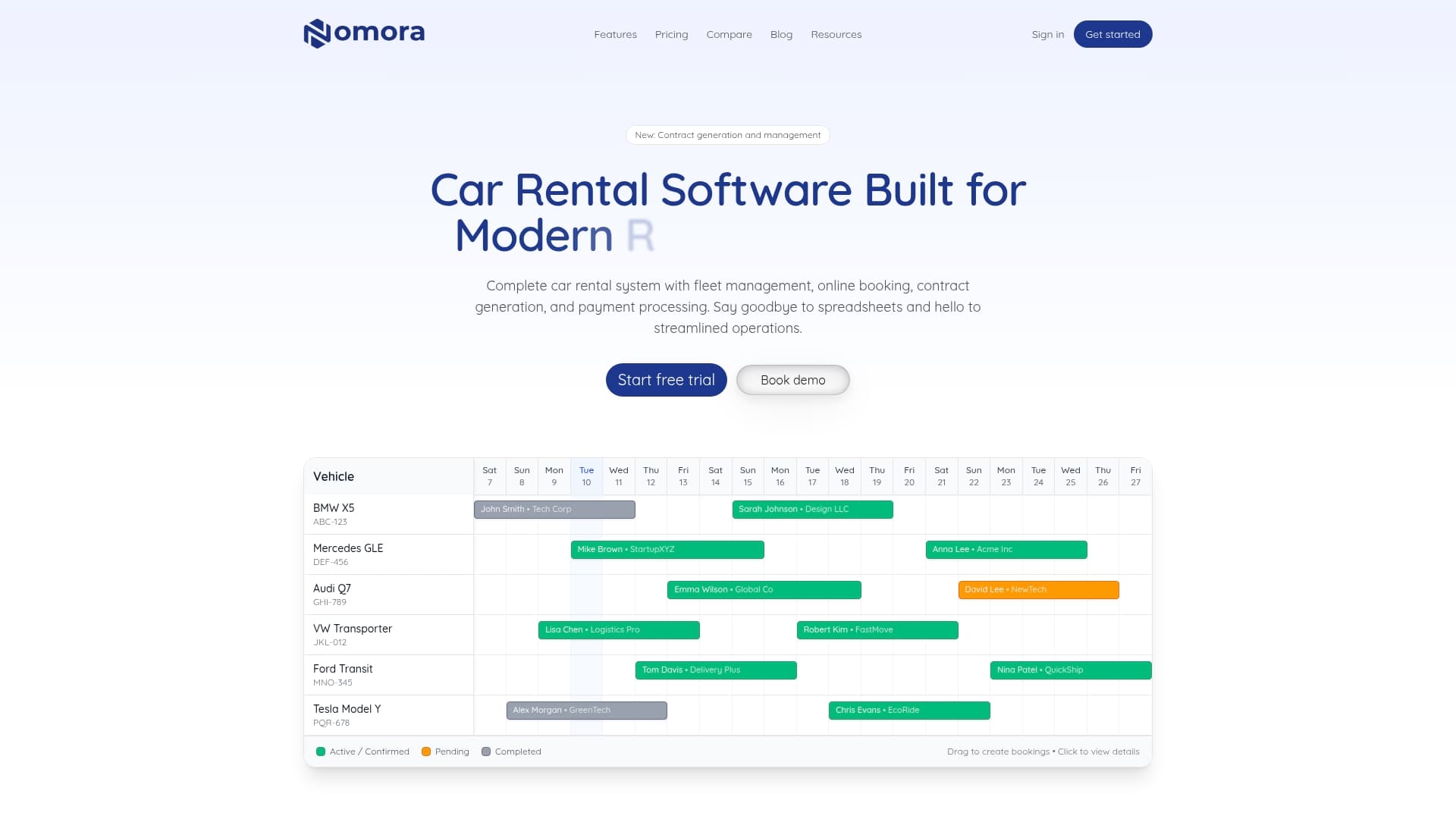
Whether you manage a small independent fleet or a large franchise network, Nomora's use cases show how businesses like yours have applied these solutions in practice. If you are ready to see the platform in action, explore Nomora's contract software solution and book a demo to get a clear picture of what adoption looks like for your specific operation.
Frequently asked questions
How do digital contracts reduce costs for car rental companies?
Automation cuts operational costs by up to 30% by eliminating manual paperwork, reducing materials expenses, and lowering booking error rates while improving fleet utilization across the entire rental cycle.
Are digital contracts legally valid for car rentals in all regions?
Digital contracts are valid in most regions, but legal review is required for jurisdiction-specific clauses, multi-language requirements, and data privacy compliance before full deployment.
What's the difference between traditional e-signatures and blockchain smart contracts?
Blockchain smart contracts offer automation and immutable audit trails but face higher implementation costs and scalability challenges, while traditional e-signatures provide proven compliance and speed at a fraction of the cost.
How quickly can car rental businesses see ROI after switching to digital contracts?
Most managers see ROI in under a month through measurable reductions in admin hours, lower error correction costs, and faster vehicle turnaround between rentals.
Recommended