TL;DR:
- Choosing a reservation system is a vital decision that impacts booking accuracy, customer satisfaction, and operational efficiency. Cloud-based and integrated platforms are recommended for scalability, real-time updates, and seamless tool connections, especially for growing vehicle rental businesses. Proper evaluation of deployment models, integration quality, and scalability ensures optimal performance and reduces costly errors.
Choosing the right reservation system is one of the most consequential operational decisions a vehicle rental business will make. The wrong choice leads to double bookings, manual reconciliation headaches, and customers who walk away frustrated before they even reach your lot. The right choice acts as the central nervous system of your entire operation, connecting availability, payments, contracts, and customer data in one place. This article walks you through the main types of reservation systems available in 2026, the criteria you should use to evaluate them, and a clear comparison to help you decide what fits your business.
Table of Contents
Key takeaways
| Point | Details |
|---|
| System type shapes operations | On-premise, cloud-based, and integrated platforms each serve different operational needs and budget structures. |
| Integration is non-negotiable | Real-time API connections between booking, inventory, and payment layers prevent costly availability errors. |
| Cloud scales faster | Cloud-based systems deploy in days and scale without additional IT infrastructure or staffing costs. |
| Integrated platforms replace multiple tools | Best-in-class platforms now act as commerce hubs, replacing five or more separate legacy systems in a single stack. |
| Cost varies widely | Pricing for reservation software ranges from $5 to $125+ per month, so matching cost to business scale is critical. |
1. Understanding the types of reservation systems for vehicle rental
Before evaluating specific platforms, you need a clear picture of what categories actually exist. The core types of booking systems fall into three primary deployment models: on-premise, cloud-based, and integrated platforms. Each model differs in how data is stored, how the software is maintained, and how well it connects with other tools in your operation.
Knowing which category a system belongs to tells you a lot before you even look at feature lists. It shapes your upfront costs, your IT requirements, and how quickly you can adapt when your business grows or your market changes. For vehicle rental operators managing fleets across multiple locations, that context is foundational.
2. Key criteria to evaluate before choosing
Selecting among reservation system options without a clear evaluation framework is how businesses end up locked into tools that don't scale. Before comparing any platforms, run every candidate through these criteria:
- Deployment model. On-premise requires your own servers and IT staff. Cloud-based runs on vendor infrastructure. Integrated platforms combine multiple functions in a single hosted environment. Your operational complexity and IT capacity should guide this decision. Nomora's deployment comparison guide breaks this down in detail for rental businesses specifically.
- Real-time availability. For vehicle rentals, stale inventory data means double bookings and damaged customer trust. Prioritize systems using real-time bidirectional APIs rather than batch syncing methods that can lag behind actual availability.
- Payment integration. Modern systems function as full buying layers, not just calendars. Look for built-in deposit management, package pricing, and direct payment gateway connections.
- Multi-channel booking support. Systems that handle geographic and seasonal price and inventory variance across multiple channels give you a genuine operational edge.
- Scalability. A system that works for five vehicles should also work for 500. Verify that pricing tiers and feature sets scale with your fleet size.
- Integration with third-party tools. GPS tracking, CRM platforms, accounting software, and marketplace connectors all need to communicate with your reservation system cleanly.
- User experience. A system your staff finds confusing will cost you more in training and errors than you save on licensing fees.
Pro Tip: Before signing any contract, ask the vendor for a live demo using your actual vehicle catalog and pricing structure. Generic demos often hide usability problems that surface immediately when applied to real-world fleet data.
3. On-premise reservation systems
An on-premise reservation system installs directly on servers that you own and manage. All data lives within your own infrastructure, which appeals to businesses with strong IT teams and specific data sovereignty requirements.

The main advantage is control. You decide when updates happen, how data is backed up, and who can access what. For large, established rental operations handling sensitive corporate contracts, that level of control can be worth the investment.
The trade-offs are real, though:
- Higher upfront costs. Server hardware, licensing fees, and installation expenses add up quickly before a single booking is processed.
- IT dependency. Any system failure requires in-house resolution or a costly service contract with the vendor.
- Limited remote access. Staff managing bookings from off-site or across multiple locations face friction without additional configuration.
- Slower feature updates. New functionality requires formal update cycles, often meaning months between improvements.
On-premise systems are best suited to large, single-location operators with dedicated IT staff and compliance requirements that mandate local data storage. They are a poor fit for growing businesses that need to move fast.
Pro Tip: If data control is your primary concern but you want the flexibility of cloud access, look for hybrid deployment options before committing to a fully on-premise build. Many vendors now offer local data storage with cloud-accessible interfaces.
4. Cloud-based reservation systems
Cloud-based reservation systems run on the vendor's infrastructure and are accessed through a web browser or mobile app. You pay a subscription fee, and the vendor handles servers, updates, and security patches. This model has become the standard for most growing vehicle rental businesses.
The operational benefits are significant:
- Anywhere access. Staff can check availability, confirm bookings, and manage fleet status from any device with an internet connection.
- Automatic updates. New features roll out without requiring action from your team or downtime for your operation.
- Lower startup cost. No server hardware to purchase. Most cloud systems are active within 24 to 48 hours of signing up.
- Built-in scalability. Adding new vehicles, locations, or users typically requires only a pricing tier adjustment, not a new IT deployment.
One honest limitation is internet dependency. If your location has unreliable connectivity, cloud systems introduce operational risk during outages. That said, online booking integration expands customer reach by up to 26% compared to manual booking processes, making the tradeoff favorable for most operators.
Pricing for cloud systems typically ranges from entry-level plans around $5 per month to enterprise tiers exceeding $125 per month. Per-booking fees, sometimes around 3.5%, may apply at certain pricing levels. Reviewing Nomora's software pricing structure gives a practical reference point for what vehicle-rental-specific cloud platforms actually cost.
Integrated platforms represent the most sophisticated category of reservation management tools available today. Rather than functioning as a standalone booking calendar, these systems act as full commerce hubs connecting reservations, fleet inventory, payment processing, customer data, and operational workflows in one environment.
The shift is significant. Modern booking systems function as buying and engagement layers, not merely scheduling tools. That means deposits, promotional packages, loyalty data, and contract generation all flow through the same platform rather than requiring separate tools patched together.
Key advantages of integrated platforms for vehicle rental businesses include:
- Consolidated data. Every booking, payment, and customer interaction lives in one record, giving you accurate reporting without manual data merging.
- Workflow automation. Contract generation, payment reminders, and fleet availability updates happen automatically based on booking triggers.
- Channel management. Integrated platforms sync inventory across direct booking pages, third-party marketplaces, and partner channels simultaneously.
- Payment layer integration. Deposits, balance collection, and refunds process directly within the booking workflow rather than requiring a separate system.
The primary challenge with integrated platforms is vendor dependency. Migrating away from a tightly integrated system is more complex than switching a standalone tool. Cost is also higher at the enterprise level, though the savings from eliminating five or more separate legacy systems typically offset the investment.
For vehicle rental businesses, the integrated model is increasingly the default choice. Real-time API-driven architecture connecting booking, inventory, and payment layers is now considered the minimum viable stack for competitive operations.
6. Side-by-side comparison of reservation system types
This table provides a direct booking platforms comparison across the three main system types, covering the factors that matter most for vehicle rental decision-makers.
| Factor | On-premise | Cloud-based | Integrated platform |
|---|
| Upfront cost | High (hardware + install) | Low (subscription only) | Medium to high |
| Monthly cost | Low ongoing after setup | $5 to $125+ per month | Varies by plan and features |
| Scalability | Limited without IT investment | High, tier-based scaling | High, purpose-built for growth |
| Maintenance | In-house IT required | Vendor managed | Vendor managed |
| Remote access | Requires configuration | Full browser and app access | Full browser and app access |
| Integration support | Manual and limited | API-based, broad support | Deep, multi-layer API architecture |
| Data control | Full local control | Vendor hosted, GDPR options | Vendor hosted, GDPR options |
| Best for | Large single-location operators | Growing multi-location fleets | Businesses consolidating tools |
One important caution when evaluating integration capabilities: improper ID mapping between your internal vehicle catalog and external marketplace connectors is one of the most common causes of availability errors and lost bookings. Whichever system type you choose, verify that the onboarding process includes proper connector mapping as a standard step.
My honest take on choosing a reservation system
I've worked alongside vehicle rental operators ranging from two-car independents to regional franchise networks, and the pattern I see most often is this: businesses underinvest in their reservation system early, then spend twice as much fixing the problems that creates.
The operators who choose on-premise systems for cost reasons often forget to budget for the IT staff time that keeps those systems running. The ones who pick the cheapest cloud subscription frequently discover that missing integrations mean their staff is still maintaining a parallel spreadsheet for fleet availability. Neither of those is a winning position.
What actually works, in my experience, is choosing a system at least one level beyond where your business is today. If you're running 15 vehicles across two locations, choose a platform built for 50 vehicles across five locations. You will grow into it faster than you expect, and the migration cost of switching systems mid-growth is far more painful than paying for capacity you haven't used yet.
The other thing I'd push back on is the idea that any single factor, whether price, features, or brand name, should dominate the decision. I've seen operators pick the most feature-rich platform on the market and use 20% of what they paid for. The best reservation software is the one your staff actually uses correctly and that connects cleanly to the other tools in your operation. When evaluating options, spend more time testing how booking automation works in practice than reading feature comparison pages.
— Dizzy
How Nomora fits into your reservation system decision
If you've worked through this article and you're ready to evaluate a specific platform, Nomora is worth a close look. It operates as a cloud-based, fully integrated reservation management platform built specifically for vehicle rental businesses. That means reservations, fleet tracking, contract generation, payment collection, and customer data all run through one system rather than several tools you're trying to keep synchronized.
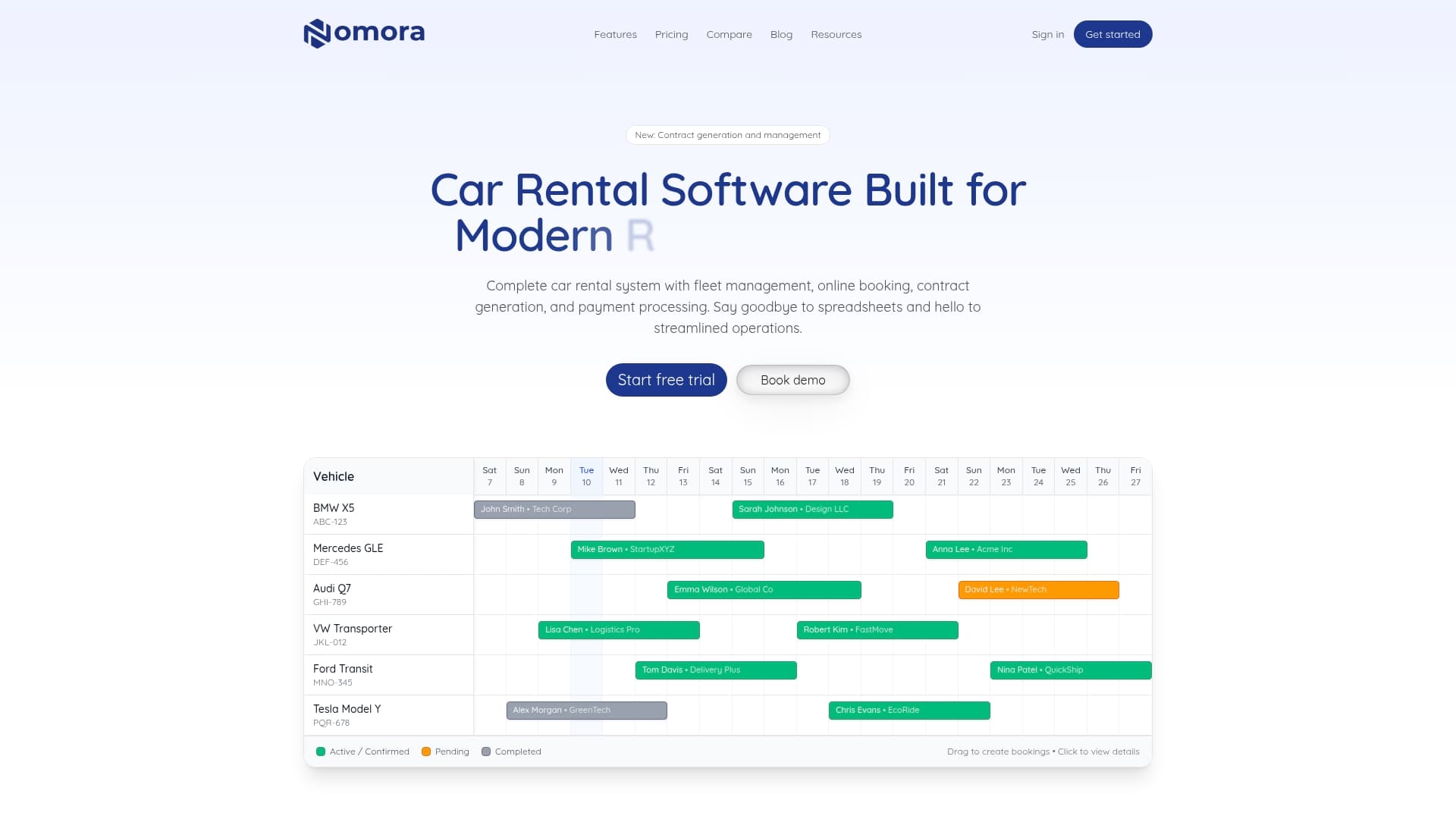
Nomora deploys in 24 to 48 hours with GDPR-compliant data handling and flexible pricing tiers designed to fit both independent operators and franchise networks. The platform connects with GPS tracking tools and payment gateways through native integrations, so the connector mapping issues that plague poorly integrated systems are handled during onboarding rather than discovered after launch.
Explore Nomora's use cases by business type to see how the platform supports different fleet sizes and operational models. If preventing booking conflicts is a top priority, the guide on avoiding double bookings covers exactly how Nomora's real-time availability engine handles that. For businesses ready to remove manual payment steps, automated payment processing is built directly into the booking workflow.
FAQ
What are the main types of reservation systems?
The three main types of reservation systems are on-premise, cloud-based, and integrated platforms. Each differs in deployment model, cost structure, and how well it connects with other operational tools.
Which reservation system type is best for vehicle rental businesses?
Most vehicle rental businesses benefit most from cloud-based or integrated platform systems, which offer real-time availability, remote access, and built-in payment handling without requiring dedicated IT infrastructure.
If you currently rely on multiple separate tools for bookings, payments, and fleet tracking, an integrated platform will reduce redundancy and errors. If you need a single booking system to get started quickly, a cloud-based option is the faster, lower-cost entry point.
What does reservation system pricing typically look like?
Pricing ranges from around $5 per month for basic plans to $125 or more per month for enterprise systems, with some platforms also charging per-booking fees of approximately 3.5% for channel-managed reservations.
Why does integration quality matter so much in reservation systems?
Poor integration between your reservation system and external marketplaces or payment tools can cause availability errors and lost bookings. Proper connector mapping during setup is critical to keeping inventory data accurate across all channels.
Recommended