Key takeaways
| Point | Details |
|---|
| Predictive analytics prevents failures | Early detection of degradation signals allows planned maintenance before costly breakdowns occur. |
| Multi-source data is non-negotiable | Combining telematics, diagnostics, fuel, and maintenance records reveals patterns no single data stream can show alone. |
| Feedback loops drive accuracy | Linking predictions to actual repair outcomes via standards like VMRS continuously improves model precision. |
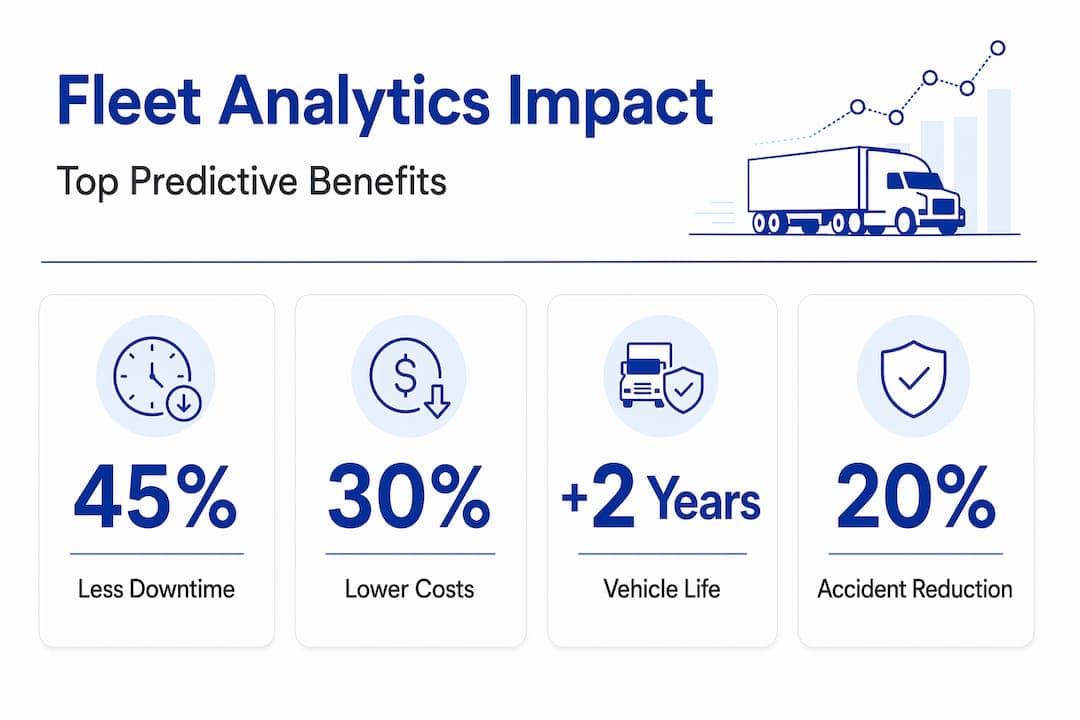
| Benefits are measurable and significant | Predictive maintenance can reduce unscheduled downtime by up to 45% and extend component lifespan by 20 to 25%. |
| Implementation requires organizational alignment | Technology alone is insufficient. Teams, workflows, and data standards must connect for analytics to deliver real value. |
The role of predictive analytics in fleet management
Predictive analytics is often confused with reporting. Reporting tells you what happened. Predictive analytics tells you what is likely to happen next and gives you a window to act. In a fleet context, this means correlating multiple data streams from telematics, engine diagnostics, fuel consumption patterns, and maintenance histories to detect early signs of component degradation before those signs become failures.
The core inputs that feed a predictive analytics system in fleet management include:
- Telematics data: GPS location, speed, idling time, acceleration patterns, and hard braking events
- OBD/CAN diagnostics: Real-time fault codes and sensor readings from the vehicle's onboard computer
- Maintenance records: Service histories, parts replaced, technician notes, and odometer readings at service
- Fuel data: Consumption trends that can indicate engine inefficiency or developing mechanical issues
- Driver behavior data: Patterns like harsh cornering or excessive idling that accelerate wear
Once these streams are integrated, statistical models and machine learning algorithms look for correlations between early signals and eventual failures. For example, a gradual increase in engine oil temperature combined with a slight drop in fuel economy may indicate a cooling system issue weeks before a warning light appears.
Pro Tip: Before selecting a predictive analytics platform, audit which data streams you currently capture. A system that promises predictive maintenance but only connects to one data source will underperform. Your data maturity determines your analytics ceiling.
A critical but underappreciated element is the feedback loop. When a prediction leads to a repair, the outcome of that repair needs to be recorded and fed back into the model. This is where the Vehicle Maintenance Reporting Standards protocol, known as VMRS, becomes the connective tissue of a well-functioning predictive system. VMRS provides a standardized language for documenting what was predicted, what was found, and what was fixed. Over time, this feedback refines the model and improves the accuracy of future predictions.
Key benefits for rental and corporate fleets
The benefits of predictive analytics for fleet managers go well beyond avoiding breakdowns. They reach into cost control, safety, customer satisfaction, and strategic planning. Here is where the operational and financial gains are most pronounced.
Reduced downtime and extended vehicle life
Telematics-enabled predictive maintenance can reduce unscheduled downtime by 35 to 45% and extend component lifespan by 20 to 25%. For a rental fleet where every vehicle off the road is revenue lost, these numbers translate directly to the bottom line. A van sitting in the shop for an unplanned transmission repair for three days is not just a repair cost. It is lost rental revenue, potential customer refunds, and a logistical headache for your operations team.

Predictive analytics turns those unplanned events into scheduled events. Scheduled maintenance costs less, takes less time, and can be coordinated around low-demand periods in your rental calendar. That kind of control is transformative for fleet uptime management.
Improved driver safety and risk management
Driver behavior data feeds directly into risk scoring models. Advanced AI risk scoring systems trained on billions of kilometers of driving data can produce continuous, explainable risk scores for individual drivers. These scores are not just safety metrics. They are predictive indicators of accident probability, which directly affects insurance costs and liability exposure.

For corporate fleets with duty-of-care obligations, this changes the conversation. Instead of reacting to incidents, fleet managers can identify high-risk drivers early, trigger coaching interventions, and track improvement over time. Partner tools like fleet dashcams complement this data by adding visual evidence to behavioral patterns, making the case for coaching clearer and more credible.
Operational and customer service advantages
Predictive analytics in transportation extends beyond maintenance into route optimization, demand forecasting, and capacity planning. Statistical modeling of historical data enables fleet operators to anticipate high-demand periods, pre-position vehicles, and reduce repositioning costs. For rental fleets, this means fewer empty vehicles in the wrong location and fewer customer-facing shortfalls.
Customer satisfaction in rental operations depends heavily on vehicle reliability and availability. When a customer picks up a rental and it breaks down the same day, that is not just a one-time complaint. It is a negative review and a lost account. Predictive analytics directly reduces the frequency of these events by catching issues before the vehicle is assigned.
Challenges in implementing predictive analytics
Understanding the benefits is one thing. Getting a predictive analytics program to actually work at the level your fleet needs is a separate challenge. There are several common pitfalls that cause programs to underdeliver.
The most frequent mistake is treating telematics data as sufficient on its own. Relying solely on telematics signals is insufficient for early degradation detection. A telematics device knows where the vehicle is and how it is being driven. It does not have the full picture of engine health, maintenance history, or fuel efficiency trends. Each data stream contributes a layer of context that the others cannot provide.
Other major implementation challenges include:
- Data silos: Telematics, fuel cards, maintenance management systems, and diagnostics tools often operate independently and do not communicate with each other
- Lack of data standardization: Without a shared language like VMRS, connecting predictions to repair outcomes becomes manual, slow, and error-prone
- Dashboard overload: Multiple disconnected analytics tools create more noise than signal. Fleet managers end up spending time managing data rather than acting on it
- Absence of feedback loops: Predictions that are never validated against actual repair results stop improving. The model stagnates and confidence in its outputs erodes
- Organizational readiness gaps: Even when the technology is right, teams may lack the processes or training to translate alerts into timely actions
Pro Tip: Start your predictive analytics implementation with one high-value use case, such as engine health prediction for your highest-mileage vehicles. Get the feedback loop right for that segment before scaling. A narrow, accurate program beats a broad, unreliable one every time.
The role of analytics in fleet operations is not passive. It requires active management of both the data infrastructure and the human processes that respond to insights.
How to apply predictive analytics in practice
Moving from concept to execution requires a structured approach. Here is a practical sequence for fleet managers building or refining a predictive analytics program.
- Assess your data maturity. Catalog which data streams you currently capture and how they are stored. Identify gaps, especially in maintenance record quality and diagnostic integration. This audit tells you which predictive use cases are realistic now and which require infrastructure work first.
- Select a platform with genuine integration capability. The platform needs API connections to your telematics provider, your maintenance management system, and your fuel card provider. A standalone analytics tool that requires manual data exports will not scale.
- Standardize your data taxonomy. Adopt VMRS codes for maintenance records across all repair shops and internal teams. This single step significantly improves the quality of your feedback loop and the accuracy of predictions over time.
- Launch with a defined pilot use case. Predictive maintenance for vehicles with the highest failure history is the most common and most defensible starting point. Define success metrics upfront: reduction in unplanned repairs, reduction in average repair cost, and improvement in vehicle availability rate.
- Build the feedback mechanism. After every predicted event, record the actual outcome and feed it back into your model. This is where tools like FleetREDI, which provides second-by-second GPS and CAN data summaries, can add benchmarking depth for technology selection decisions.
- Expand to safety and operations. Once maintenance prediction is stable, extend analytics to driver risk scoring, route efficiency, and demand planning.
The table below summarizes how predictive analytics applies across the core fleet management functions.
| Fleet function | Predictive analytics application | Key data inputs |
|---|
| Maintenance scheduling | Failure probability forecasting | Diagnostics, maintenance history, telematics |
| Driver safety | Continuous risk scoring | Driving behavior, incident data, claims |
| Route efficiency | Demand and disruption prediction | GPS, historical routes, traffic patterns |
| Vehicle availability | Demand forecasting and pre-positioning | Reservation data, seasonal trends |
| Cost control | Component lifespan modeling | Repair records, fuel data, mileage |
Connecting predictive insights to your repair shops and operational teams is the final step many programs skip. Fleet management best practices in 2026 treat analytics as a shared tool, not a back-office function. Technicians, dispatchers, and fleet managers all need visibility into relevant alerts to close the loop between data and action.
Future trends in fleet predictive analytics
The technology is advancing rapidly, and several trends will reshape how predictive analytics operates in rental and corporate fleets over the next few years.
- Explainable AI: Regulators and risk managers increasingly require risk models to justify their outputs. The move toward explainable risk scores, already seen in driver risk models validated on hundreds of thousands of claims, will spread into maintenance prediction and compliance monitoring
- Connected IoT ecosystems: Predictive models will increasingly draw from tire pressure sensors, brake wear indicators, and battery health monitors integrated directly into a central analytics layer, not treated as separate systems
- Data sharing and standardization platforms: Industry-wide datasets that allow benchmarking across fleets will improve model accuracy for smaller operators who lack sufficient internal data volume to train reliable models on their own
- Expansion into logistics and demand forecasting: Predictive analytics will extend further into supply chain applications, including anticipating disruption, managing vehicle allocation across locations, and optimizing service scheduling
- Regulatory and privacy compliance built in: As data privacy regulations tighten, platforms will need to demonstrate GDPR and equivalent compliance as a baseline, not an add-on
The fleets that invest now in clean data infrastructure, standardized records, and integrated platforms will be positioned to absorb these advances without a disruptive overhaul.
My honest take on what actually makes predictive analytics work
I have seen fleet managers invest in impressive analytics platforms and come away disappointed. The technology was not the problem. In most cases, the gap was in the feedback loop.
What I have learned is that predictive analytics gets genuinely powerful when you close the circuit between a predicted event and its verified outcome. The moment you start feeding confirmed repair data back into the model using a consistent standard like VMRS, the accuracy of predictions improves at a noticeable rate. Fleets that skip this step are essentially running a model that never learns. The predictions become stale and teams stop trusting them.
I have also seen organizations chase data volume rather than data quality. Hundreds of metrics feeding into a dashboard that nobody acts on is not analytics. It is noise. Big data becomes valuable only when it produces specific, timely, and trustworthy signals that someone with authority can act on.
The most underrated factor is organizational readiness. Predictive analytics changes a fleet manager's role from reactive to genuinely strategic. That shift requires buy-in from technicians, dispatchers, and leadership. The best implementation I have seen was not the one with the most sophisticated model. It was the one where every team member knew what the alerts meant and had a clear process for responding to them. Technology gets you to the door. Culture and process get you through it.
— Dizzy
How Nomora supports smarter fleet operations
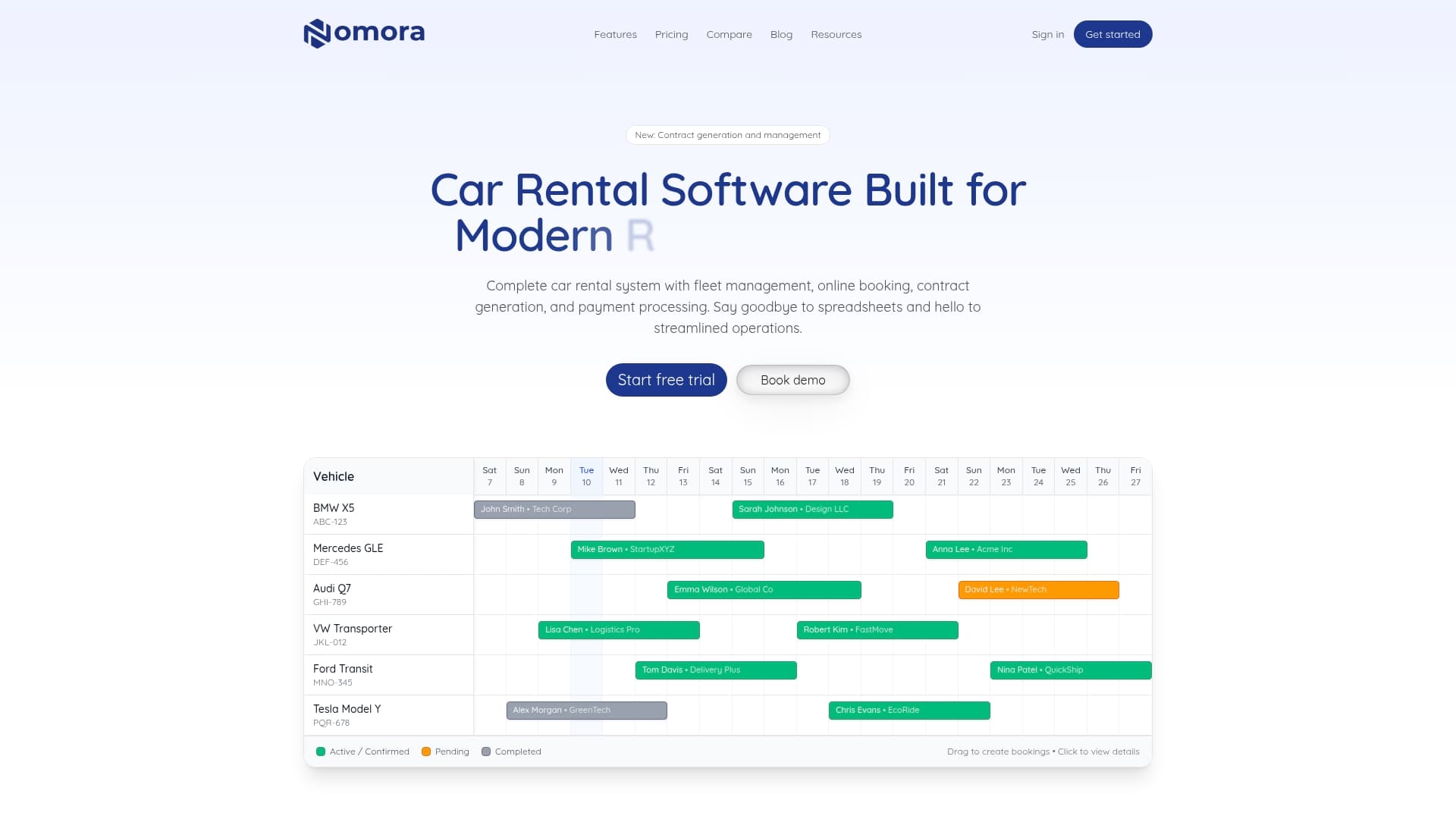
Nomora functions as the central nervous system for rental and corporate fleet operations, connecting reservations, vehicle tracking, maintenance scheduling, and customer data in one cloud-based platform. For fleet managers looking to act on predictive insights, Nomora's integration with GPS tracking providers means your location and telematics data feeds directly into your operational workflows, not into a separate system you have to check separately.
The platform's maintenance scheduling tools allow you to translate predictive alerts into booked service appointments without manual coordination. Rental fleet operators can see vehicle availability in real time and plan around upcoming maintenance windows. Explore the full range of fleet management use cases to see how Nomora supports data-driven decision-making for businesses of every size. You can also visit Nomora's platform overview to see how the core tools connect.
FAQ
What is the role of predictive analytics in fleet management?
Predictive analytics in fleet management uses data from telematics, diagnostics, maintenance records, and fuel systems to forecast failures and operational needs before they occur. Its primary role is to shift fleet management from reactive to proactive decision-making.
How does predictive analytics reduce fleet downtime?
By detecting early degradation signals across multiple data sources, predictive analytics enables planned maintenance interventions during scheduled shop windows. Telematics-enabled predictive maintenance can reduce unscheduled downtime by 35 to 45%.
What data sources are needed for predictive fleet analytics?
Effective predictive analytics requires telematics, OBD diagnostics, maintenance records, fuel data, and driver behavior data. Relying on telematics alone is insufficient. The combination of all these streams reveals degradation patterns no single source can identify.
Why is VMRS important for predictive analytics accuracy?
VMRS provides a standardized maintenance data language that links predicted failures to actual repair outcomes. This feedback loop is what allows predictive models to learn over time and improve their accuracy.
Can predictive analytics be used for more than maintenance?
Yes. Predictive analytics in transportation applies to driver safety scoring, route optimization, demand forecasting, and vehicle pre-positioning. As AI models mature, their applications continue to expand across all core fleet functions.
Recommended