A digital check-in module built into your rental management platform automates document collection, payment pre-authorization, and walkaround inspection capture, so customers arrive ready to drive. Counters stop being the bottleneck. Digital check-in bundles identity verification with photo-based damage documentation, and the workflow can be integrated directly into fleet and contract management.
TL;DR:
- Successful rollout requires a step-by-step approach including mapping customer flow, choosing verification methods, testing at one location, and measuring KPIs for 30 days pre-launch.
- Critical integrations include real-time identity verification, instant payment authorization, telematics data, and reliable API/webhook connections; platform choices like Nomora streamline these processes.
- Staff roles shift from routine checks to exception handling, with training focused on damage review, escalation procedures, and customer reassurance, while maintaining a staffed counter for fallback.
- Common failure points include poor connectivity and document mismatches, so fallback options like SMS verification and physical keys must be built in from the start.
Table of Contents
What Are the Operational Benefits and KPIs of Digital Check-In?
The clipboard walkaround has a real cost, and it shows up in two places: idle counter time and unrecovered damage fees. Tablet-based inspection with timestamped photos can cut check-in duration roughly in half compared with paper-based processes, and that time savings compounds across every rental in a fleet's daily volume.
Utilization improves too. When customers confirm pickup windows and preferences online, staging vehicles ahead of arrival becomes far more predictable, which trims the idle gaps between one rental ending and the next beginning. Photo evidence captured at handoff also gives operators documented proof of pre-existing damage, which means fewer disputed charges and more recovered fees.
Track these metrics before and after rollout:
- Average check-in time per rental, measured from arrival to key handoff.
- Dispute rate on damage charges, tracked as a percentage of total rentals.
- Fleet utilization rate, calculated as rented days divided by available days.
- Recovered damage fee revenue, compared quarter over quarter.
Pro Tip: Run these four numbers for 30 days before launch. Without a baseline, you cannot prove the platform paid for itself.
How Do You Roll Out Digital Check-In Step by Step?
Rolling out digital check-in works best as a sequence, not a single flip of a switch. Skipping steps here is where most pilots stall.
- Map the customer flow first. Decide exactly which fields you need: license number, insurance proof, secondary driver details, and any loyalty or corporate account tags. Fewer fields mean faster completion.
- Choose a verification approach. Some fleets rely on OCR-based document scanning paired with a selfie match; others add a manual review step for flagged cases. Decide the threshold that triggers human review.
- Map your integrations. Reservation data, payment authorization, contract generation, and telematics all need to talk to each other in real time, not in a nightly batch.
- Build the interface and the fallback path simultaneously. Every screen that asks a customer to upload a document needs a companion screen for when that upload fails.
- Pilot at one location for four to six weeks. Collect the KPIs above, train staff on the exceptions that come up, and confirm your offline fallback actually works before expanding.
- Gate expansion on results. Do not roll out to a second location until the first shows measurable improvement in check-in time and dispute rate.
The pilot phase matters more than any other step. It is where you find the edge cases, like a renter whose license photo will not scan, before those edge cases pile up across ten locations at once.
What Technical Integrations Does Digital Check-In Require?
A digital check-in flow is only as strong as the systems feeding it. If identity verification, payment authorization, and telematics do not talk to each other in real time, the customer ends up waiting anyway, just on a screen instead of at a counter.
Four technical pieces need to work together:
- Identity verification. OCR document scanning and liveness checks need to map cleanly to an approve, flag, or reject decision inside the reservation record.
- Payment gateway. Pre-authorization holds must sync instantly with the reservation, and any PCI-compliant processor handling card data needs to keep that data out of your core database entirely.
- Telematics and inspection inputs. Timestamped photos and odometer or fuel readings tied to the vehicle record at pickup create the evidence trail that supports billing decisions later.
- API and webhook reliability. Every integration point needs a retry policy and an offline queue, so a dropped connection at pickup does not lose the transaction.
Nomora's platform handles these connections through its integration framework, pairing contract generation with payment and telematics data in a single record rather than three disconnected systems.
How Does Staffing Change After Going Digital?
Counter staff do not disappear. Their job changes. Digital check-in shifts the workload away from routine document checks and toward exception handling, remote support, and monitoring the flow for stalls.
Training should focus on three areas:
- Inspection review. Staff need to know what a clear damage photo looks like so they can catch a bad upload before it becomes a dispute.
- Verification escalation. When OCR flags a document, someone needs a clear script for resolving it fast.
- Customer support tone. A renter stuck on a failed upload needs reassurance, not a lecture on how the app works.
Pro Tip: Build a hybrid staffing model during the transition: keep one staffed counter lane open at all times while digital-support shifts absorb the rest. This preserves institutional knowledge while your team reskills.
Fleets that hit the manual-process ceiling, typically somewhere around 100 to 150 vehicles, tend to feel this staffing shift most acutely, since spreadsheet-era habits do not scale into a digital workflow without deliberate retraining.
What Happens When Digital Check-In Fails?
Every digital flow needs a manual escape hatch. The most common failure points are poor connectivity at the pickup location, ID verification errors on nonstandard documents, and mismatches between what the app shows as available and what is actually on the lot.
Build these fallbacks in from day one:
- SMS-based verification as a backup when the app cannot load.
- A staffed counter lane for escalations, never fully eliminated.
- A temporary physical key process for lot mismatches.
- Monitoring dashboards with alerts that flag repeat failures at a single location before they become a pattern.
When Should You Actually Adopt Digital Check-In?
Smaller fleets with high dispute rates should move first. Larger operators nearing the manual-process ceiling should follow. Expect measurable gains in check-in time and dispute recovery within 60 to 90 days of a well-run pilot. Automate the routine work, but never remove the human fallback. Customers forgive a slow app far more easily than a locked-out counter.
— Dizzy
How Nomora Supports a Digital Check-In Rollout
A comprehensive platform can unify reservations, contracts, payments, and telematics in one system, so identity checks, damage photos, and payment pre-authorizations feed the same record instead of three disconnected ones.
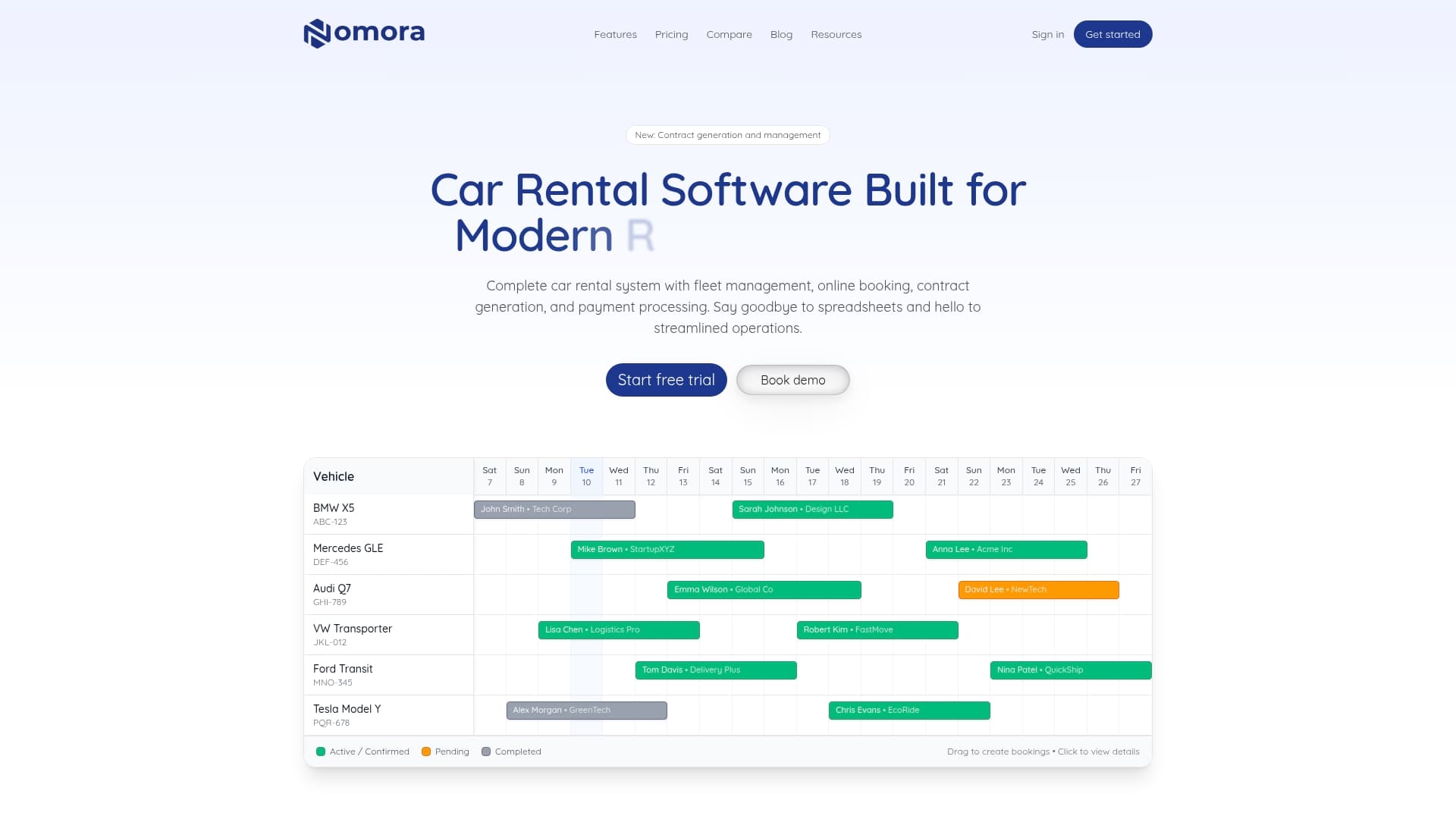
The platform's reservation and fleet management modules connect directly to automated payment processing and contract generation, and onboarding typically runs 24 to 48 hours, which means a pilot location can be live within the same week you commit to testing it. Fleet operators across independent lots, franchise networks, and corporate fleets use these same modules to run the exact rollout sequence described above. If you manage a fleet and want to see how the check-in workflow fits your specific vehicle count and locations, explore how it applies to your business type and request a walkthrough of the platform.
Sources
Recommended
Ready to streamline your car rental business?
Book 30 minutes with the founder. We set up everything in this guide on your own vehicles, and migrate you out of Excel for free.