Yes, you can connect Zapier to your car rental system, and for most small and mid-size fleets it eliminates the majority of manual data entry between booking, billing, and communication tools. Zapier acts as the connective layer between your reservation platform and the apps you already use for accounting, messaging, and reporting, moving data automatically the moment something happens in your rental system.
Think of it as a switchboard operator that never sleeps: a booking comes in, and Zapier routes the details to every app that needs them, instantly and without anyone touching a keyboard.
For rental operators, that translates into concrete, day-to-day wins:
Automated booking notifications sent to your team the second a reservation is created
Accounting syncs that push payments and deposits straight into QuickBooks or Xero
Document routing that files signed contracts into cloud storage without manual uploads
Customer messaging triggered by rental status changes (confirmed, started, returned)
Fleet calendar updates that keep every booking visible across your team in real time
The catch is that not every rental platform exposes the same triggers, and your results depend on plan limits, webhook support, and how much latency you can tolerate before a "New Booking" notification actually shows up in Slack. Those decision factors matter more than most guides admit, and they're worth understanding before you build your first Zap.
Quick take: if you want the specifics now, here they are.
Point
Details
Zapier works with most rental systems
Platforms with a Zapier app page expose triggers and actions you can connect with no code.
Instant triggers beat polling
Webhook-based triggers cut delay for time-sensitive alerts like new bookings or cancellations.
Start with high-friction tasks
Automate the manual step that eats the most staff time first, usually booking-to-accounting entry.
Nomora offers built-in automation
Nomora pairs native booking and payment automation with Zapier connectivity for added flexibility.
Key Takeaways
Zapier automates most routine car rental tasks reliably, but instant triggers, careful field mapping, and task budgeting determine whether that automation actually saves time.
Point
Details
Pick one automation this week
Start with the manual task costing the most staff hours, usually booking-to-accounting entry.
Test webhook latency before launch
Confirm whether your rental platform uses instant triggers or polling before automating time-sensitive alerts.
Estimate monthly task usage early
Multi-step Zaps consume more tasks than single-step ones, so budget your plan tier accordingly.
Keep a manual fallback ready
Document a backup process for the day a Zap breaks so operations don't stall.
Consider built-in automation
Nomora pairs native booking, contract, and payment automation with Zapier connectivity for added flexibility.
What Does Zapier Integration for Car Rental Actually Look Like?
Before building anything, you need to know where to find the technical details for your rental software's Zapier connection. Every app that supports Zapier has a public app page listing its supported triggers, actions, and authentication method. This is where you confirm whether your platform can actually do what you're picturing.
Zapier's app pages for rental platforms list specific triggers such as "New RentalAgreement Created" and "RentalAgreement Is Closed," along with the exact inputs each action requires and how the app authenticates. A rental system built for automation will typically expose these action inputs directly on its Zapier integration page, which shows you not just that a trigger exists but what data comes with it.
Reading one of these pages correctly means checking three things:
Supported triggers and actions. This is the list of events the platform can send to Zapier (new reservation, canceled booking) and the actions it can receive (create a customer record, update a status).
Sample inputs. Action listings show which fields you can populate programmatically, such as vehicle ID, start date, end date, or renter type, as shown on Wheelbase's Zapier page.
Authentication method. Most modern rental apps use API keys or OAuth. OAuth tends to be more secure since it doesn't require you to copy a static key into Zapier's settings.
You'll also want to check whether the integration fires instantly via webhook or relies on polling, where Zapier checks the app every few minutes for changes. That distinction affects how fast your automations respond, which matters a lot if you're sending time-sensitive customer texts.
Pro Tip:Before committing to a multi-step Zap, open the app's Zapier page and count how many triggers it actually supports. Some platforms list an integration but only expose one or two basic triggers, which limits what you can automate without custom webhooks.
Rental-specific platforms like Wheels Car Rental System, MyRent, Fleetwire, and Wheelbase each maintain their own Zapier listings with varying depth of support, so don't assume feature parity across vendors just because they all say "Zapier integration" on their marketing pages.
Which Triggers and Actions Matter Most for Rental Workflows?
Most rental automation boils down to a handful of triggers paired with a handful of actions, repeated across different destination apps. Once you understand this pattern, building new Zaps gets faster because you're mapping familiar fields instead of starting from scratch each time.
The triggers rental operators use most often include:
New reservation or booking created
Rental started (vehicle checked out)
Rental returned or closed
Payment or deposit received
Contract signed
On the action side, you'll typically connect those triggers to:
Create or update a reservation record in a CRM
Send an SMS or email confirmation
Create an invoice in accounting software
Add a new customer record
Post a notification to a team channel
Field mapping is where most first-time Zap builders stumble. Date and time fields need to match formats between systems (a common failure point), vehicle IDs need consistent naming across your fleet database and rental app, and deposit amounts need currency fields that align rather than assuming decimals carry over cleanly.
Trigger
Key fields
Common destination field
New reservation created
Customer name, vehicle ID, start/end date
CRM contact record or Google Sheets row
Rental started
Odometer reading, driver license number
Fleet tracking log
Payment received
Deposit amount, payment method, invoice ID
Accounting software line item
Contract signed
Contract URL, signature timestamp
Cloud storage folder
Rental returned
Return date, vehicle condition notes
Maintenance scheduling app
Pro Tip:Map your date fields as a plain text string first when testing a new Zap. Once you confirm the data flows correctly, switch to a formatted date field. This isolates formatting errors from connection errors during setup.
Which Automation Patterns Should You Build First?
The most useful car rental Zaps aren't complicated.
New booking → row added to Google Sheets. Keeps a running log for reporting without anyone copying data manually.
New booking → branded SMS to the customer. Confirms details instantly and cuts down on "did my reservation go through" calls.
Payment received → invoice created in accounting software. Removes the lag between a deposit hitting your account and it showing up in your books.
New booking → Slack or Teams notification. Keeps your front desk and operations staff aligned without a shared inbox.
Booking canceled → calendar updated and ops team notified. Frees up the vehicle in your scheduling system automatically.
Rental returned → maintenance ticket created. Triggers a vehicle inspection workflow the moment a car comes back.
Contract signed → document filed in cloud storage. Keeps signed paperwork organized without manual uploads.
New customer → added to email marketing list. Builds your remarketing list passively, one booking at a time.
Once these basic Zaps are running, look for places to add filters or paths. A Filter step stops a Zap from running unless a condition is met, useful if you only want SMS confirmations sent for rentals over $200. Paths let you branch logic: a short-term rental (under three days) might get a different message than a week-long corporate booking. Delays are worth adding too. A "return reminder" message sent exactly 24 hours before drop-off works better as a scheduled delay step than as an instant trigger.
How Do You Connect Your Rental System and Build Your First Zap?
Setting up your first automation follows the same basic sequence regardless of which rental platform or destination app you're using.
Create or log into your Zapier account and confirm your plan supports the number of steps you're planning to build.
Connect your rental app by authenticating through API key or OAuth, whichever method your platform requires.
Choose your trigger event, such as "New Reservation Created," and select the specific record type if the app offers options.
Add your action app (accounting software, SMS tool, spreadsheet, CRM) and authenticate that connection too.
Map the fields from the trigger to the action, matching vehicle ID, customer name, dates, and amounts carefully.
Add filters or paths if you need conditional logic based on rental length, vehicle type, or payment amount.
Test the Zap with real data, not placeholder values, so you catch formatting mismatches before going live.
Turn the Zap on once your test runs cleanly through every step.
Before trusting a new Zap with live bookings, run through this testing checklist:
Test with an actual sample booking, not a blank template
Verify vehicle IDs and customer IDs match between systems exactly
Confirm currency and deposit amounts carry the correct decimal formatting
Check that emails or texts land in the right inbox, not spam
Review the accounting entry for accuracy before reconciling books
Pro Tip:If a Zap fails silently, check the authentication first. Expired API keys and revoked OAuth tokens are behind more failed Zaps than any actual data-mapping problem. Common troubleshooting issues include mismatched date formats (fix by standardizing to ISO format where possible), empty fields (usually a mapping error, not a platform bug), and duplicate records (often caused by a Zap re-triggering on an update rather than a true "new" event). For a deeper technical walkthrough of connecting rental systems to outside tools, Nomora's integration guide for car rental software covers field-mapping conventions in more detail.
What Do Zapier's Plans and Task Limits Mean for a Rental Business?
Cost on Zapier scales with how many "tasks" your Zaps run each month, not how many Zaps you build. Every time a step in a Zap executes (an action firing, a trigger checked) it typically counts as a task, so a multi-step Zap consumes more of your monthly allowance than a single-step one.
Three factors drive your actual usage:
Task volume. A booking-heavy fleet running five-step Zaps across every reservation will burn through tasks faster than a boutique operator with fifteen bookings a month.
Polling versus instant triggers. Instant, webhook-based triggers fire the moment an event happens. Polling triggers check for new data on an interval, which introduces some lag and can affect how responsive your customer-facing automations feel.
Premium features. Paths, advanced filters, and certain webhook configurations often require a paid tier, not the entry-level free plan.
Tier type
Typical fit
Tradeoff
Free
Testing a single Zap, very low volume
Limited tasks per month, no multi-step Zaps
Starter/paid entry tier
Small operators running a handful of core automations
More tasks and multi-step support, but premium apps may cost extra
Business/higher tier
Multi-location or high-volume fleets
Supports Paths, advanced filters, and higher task ceilings for complex workflows
A few tactics keep costs predictable as your fleet grows. Batch updates where possible instead of triggering a task for every single field change. Use Filters aggressively so Zaps only run when conditions genuinely warrant it, rather than firing on every event and discarding irrelevant ones downstream. And where your rental platform supports webhooks directly, use them instead of polling triggers. Zapier's developer resources document how Zaps execute behind the scenes, which is worth a look if you want to understand exactly where your task budget goes.
How Do You Keep Rental Data Secure When Automating with Zapier?
Automating customer and payment data means more systems touching sensitive information, so a basic security checklist matters before you connect anything.
Use least-privilege API credentials, scoped only to the data your Zap actually needs
Rotate API keys on a regular schedule rather than leaving one active indefinitely
Choose OAuth authentication over static API keys wherever your rental platform offers it
Limit which fields get exported into third-party apps, especially personally identifiable information
Enable audit logging so you can trace exactly what data moved and when
Many Zapier app pages, including rental-specific ones, reference SOC 2 and GDPR compliance statements as part of their security posture. Check both the Zapier listing and your rental vendor's own documentation for current certifications before automating anything involving customer payment data.
Sensitive items deserve extra care. Store links to driver's license scans and signed contracts rather than passing raw images through multiple Zap steps. Route payment tokens directly between your payment processor and accounting software where possible, minimizing the number of apps that see raw card data at all.
Pro Tip:Run a quarterly audit of every active Zap and ask whether it still needs access to the fields it was originally granted. Rental businesses that skip this step often discover old Zaps still pulling full customer records for a report nobody uses anymore.
The 42-Point Car Rental Operations Checklist
The exact checks profitable rental operators run every week — free, straight to your inbox.
Fleet readiness & handover
Bookings & no-show prevention
Pricing & revenue reviews
Contracts & compliance
Payments & invoicing
Maintenance & fleet health
One email with the checklist. No spam, unsubscribe anytime.
Zapier, Built-In Integrations, or a Direct API: Which One Fits?
Not every automation belongs on Zapier. The right choice depends on volume, timing, and how much in-house development support you have.
Zapier tends to be the right call when you're connecting a handful of destinations at low to moderate volume and don't have a developer on staff to maintain custom code. Direct webhooks or native integrations make more sense once you're running high-volume, time-critical workflows where even a few seconds of polling delay causes real problems, or when your rental platform's schema changes often enough that a Zap needs constant re-mapping.
Use this quick checklist to sort your situation:
Low booking volume, varied destination apps, no developer resources: Zapier is the practical choice.
High volume with time-sensitive customer notifications: prioritize instant webhooks or a native integration over polling-based Zaps.
Frequent changes to your rental platform's data structure: favor a vendor-managed integration that adapts automatically rather than a Zap you have to rebuild each time.
Complex multi-condition logic across many systems: weigh whether a direct API integration is more maintainable long term than a sprawling multi-path Zap.
Many full-featured rental platforms bundle booking, dynamic pricing, fleet tracking, and payments as native features, which reduces how much you need Zapier for internal operations, leaving it free for external connections like accounting or marketing tools.
Rental operators don't need to choose one integration method for life. Nomora delivers built-in automation for reservations, contracts, and payments, while still connecting to Zapier for the tools that live outside the platform, giving fleets a foundation that doesn't force an all-or-nothing decision.
What Do Real Rental Integrations Teach You That the Manuals Don't?
Three things separate a rental business that automates well from one that just adds complexity: testing webhooks against live bookings instead of trusting sample data, checking task usage weekly rather than getting blindsided by a plan overage, and keeping a manual fallback process for the day a Zap silently breaks.
That third point gets overlooked constantly. Automation fails eventually. A payment processor changes its API response format, a rental platform updates a field name, or an OAuth token expires on a Friday night. Fleets that survive these moments without chaos are the ones with a documented manual process staff can fall back on for a day or two while someone fixes the Zap.
The most common integration pitfalls worth watching for are date mismatches between systems using different formats, timezone confusion when a fleet operates across regions, and duplicate customer records created when a Zap re-fires on an update instead of a genuine new booking. Each of these has a straightforward fix: standardize date formats early, set a single timezone standard across all connected apps, and configure triggers to fire only on true "created" events rather than any change to a record.
Automation platforms built around contactless handovers and telematics are pushing the whole industry toward fewer manual touchpoints, but the fleets that benefit most are the ones that automated the boring, repetitive tasks first rather than chasing the flashiest feature.
Ready to Automate Your Rental Business Beyond Spreadsheets?
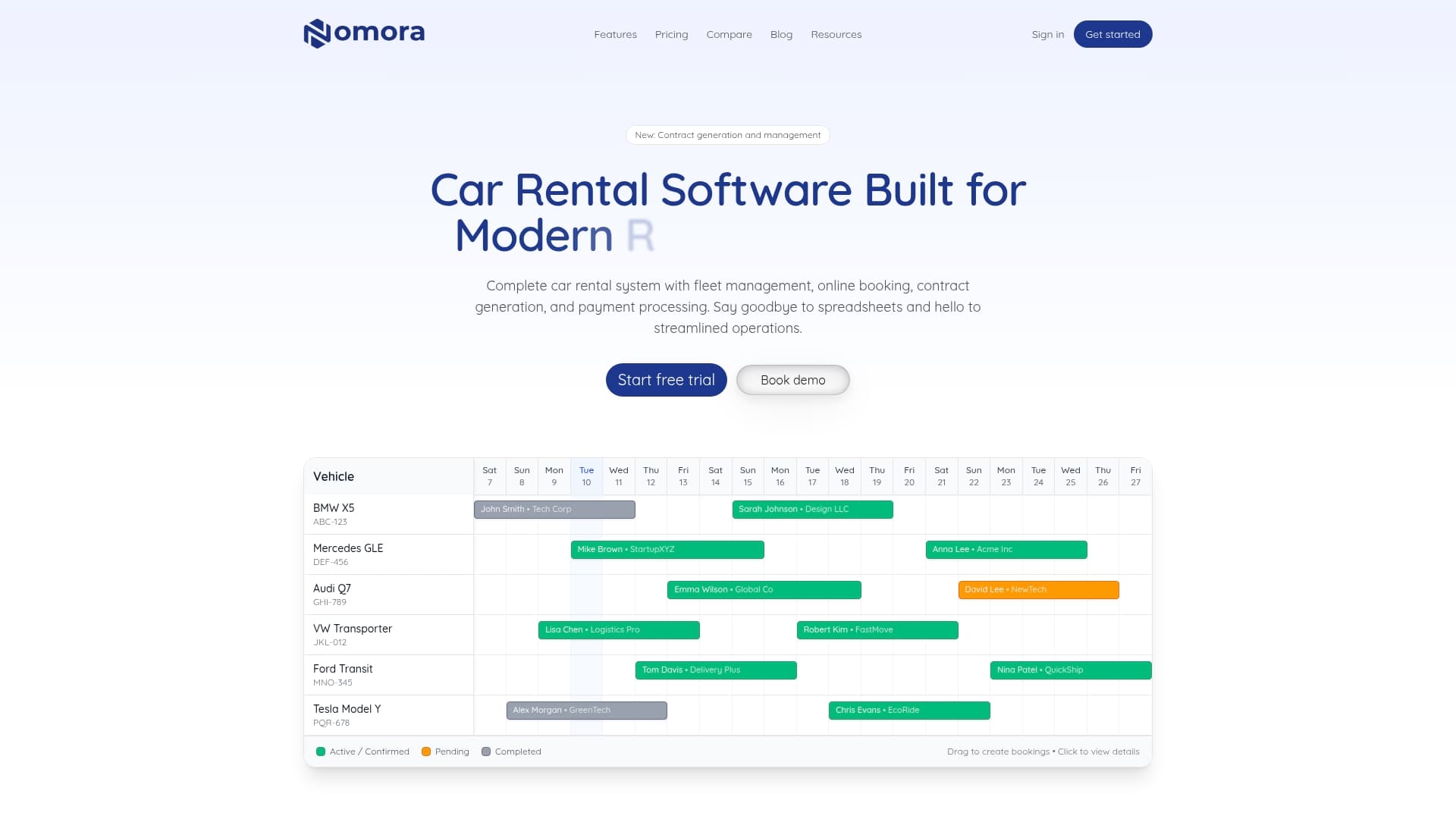
Zapier connects your rental system to hundreds of outside tools, but Nomora gives you automation built directly into the platform, so bookings, contracts, and payments sync without a single Zap to configure. That means fewer moving parts to maintain and no monthly task limit standing between you and a working workflow.
For small and mid-size operators, that difference shows up fastest during onboarding. Nomora typically gets a rental business live within 24 to 48 hours, with real-time booking visibility, automated contract generation, and integrated payment processing already working out of the box. You still get Zapier connectivity for the specialized tools you already use, but you're not rebuilding basic operations from scratch as multi-step Zaps.
Security and compliance come standard rather than requiring a separate audit of every connected app, which matters once customer payment data and signed contracts are moving through your systems daily.
If you're running a fleet that's outgrowing spreadsheets and one-off Zaps, look at how Nomora fits your specific business type on the use cases page, or go straight to the car rental software overview to see what a built-in automation setup actually looks like before your next renewal cycle.
Where to Learn More Before You Build
A few resources are worth bookmarking as you expand your automation setup beyond the first few Zaps.
Only platforms that publish a Zapier app page with defined triggers and actions can connect directly. If your rental system doesn't have one, you'll need a webhook-based workaround or a platform with native automation built in.
Does Zapier for car rental work in real time?
It depends on whether your rental platform supports instant, webhook-based triggers or relies on polling. Polling checks for changes on an interval, which introduces a delay that matters for time-sensitive customer notifications.
How many Zaps does a small rental business typically need?
Most operators start with four to six core Zaps covering booking notifications, payment-to-accounting syncs, and customer messaging, then add more as specific bottlenecks appear.
Is Zapier secure enough for payment and customer data?
Many rental-related Zapier integrations reference SOC 2 and GDPR compliance, but you should still limit exported fields, use OAuth where available, and avoid passing raw payment data through unnecessary steps.
Should I choose Zapier or a platform with built-in automation?
Zapier suits low-to-moderate volume connections to outside tools. High-volume, time-critical workflows or businesses wanting fewer moving parts often do better with a platform like Nomora that builds automation directly into reservations, contracts, and payments.