TL;DR:
- Improving rental operations through process automation reduces costs, tenant churn, and staff workload, enabling sustainable growth.
- Key areas for automation include rent collection, maintenance coordination, and tenant communication, which directly enhance tenant retention and profitability.
- Focusing on workflow clarity before implementing technology, starting with high-impact processes, ensures measurable benefits within months, boosting long-term asset value.
Most rental business owners think improving operations is fundamentally about cutting costs. That assumption costs them far more than any single expense line ever could. The real reason to why streamline rental operations matters is what happens when you don't: tenant churn accelerates, staff gets buried in preventable tasks, and your ability to grow stalls at whatever size your manual processes can handle. This article breaks down the specific operational bottlenecks dragging your business down, explains how targeted process improvements directly impact tenant retention and revenue, and shows you exactly what a more efficient operation looks like in practice.
Table of Contents
Key Takeaways
| Point | Details |
|---|
| Bottlenecks cost real money | Manual rent collection, maintenance delays, and fragmented communication reduce profitability and drive tenant turnover. |
| Maintenance responsiveness drives retention | Faster maintenance resolution correlates with 40% of renters willing to stay longer and extend their leases. |
| Automation scales without adding headcount | Technology handles repetitive tasks so your team focuses on high-value work as your portfolio grows. |
| Turnover is your biggest hidden expense | Each tenant turnover event costs between $2,000 and $5,000, making retention a direct profit lever. |
| Technology adoption is accelerating | Half of property managers plan to adopt or expand technology use specifically to cut costs and improve efficiency. |
Common operational bottlenecks in rental businesses
If your operation relies on spreadsheets, phone calls, and email chains to manage day-to-day tasks, you are already dealing with bottlenecks. You may not always see them clearly because the work still gets done, eventually. But the delays, errors, and duplicated effort add up fast. Inefficient manual processes are the primary operational drag in rental businesses, targeting specific points where workflows slow down or break entirely.
The three most common problem areas are:
- Manual rent collection. Chasing payments by phone or email consumes staff time that should go toward leasing and maintenance. Late payments become routine when tenants lack self-service options to pay and confirm on their own schedule.
- Maintenance coordination delays. A maintenance request that bounces between a tenant, a manager, and a vendor through three different communication channels gets lost. Each handoff is a failure point, and process handoffs in maintenance intake and vendor assignment consistently cause the workflow leaks that lead to tenant dissatisfaction.
- Fragmented communication. When tenant messages come in through text, email, voicemail, and in-person visits simultaneously, nothing gets tracked reliably. Staff spends time reconstructing conversations instead of resolving issues.
The financial consequences of these bottlenecks compound across a portfolio. A single delayed maintenance resolution can turn a renewal into a vacancy. A missed payment reminder stretches your receivables and creates cash flow uncertainty. At ten or twenty units, these problems feel manageable. At fifty or one hundred, they become the ceiling on your growth.
How efficiency improvements directly affect tenant retention
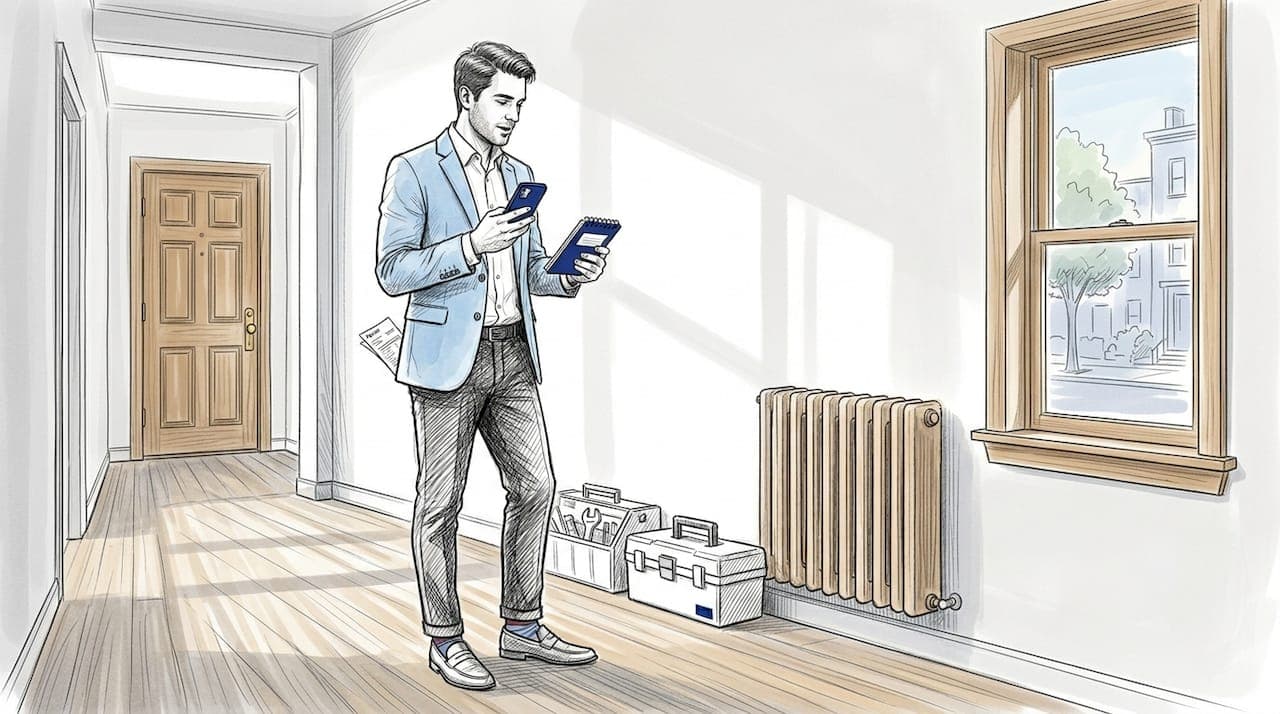
Tenant retention is where operational efficiency converts most directly into profit. Renters do not leave because rent goes up. They leave because something broke and nobody responded for two weeks. Or because they could never get a straight answer about their lease renewal. Speed and transparency are the core variables by which tenants and owners judge property management performance, and both are directly controlled by how well your internal processes function.
The data here is specific and worth understanding in detail. Faster maintenance and communication correlates with 40% of renters being willing to stay longer and 31% renewing their leases. These are not soft engagement metrics. These numbers represent lease contracts and revenue.
"Maintenance responsiveness strongly influences owner retention and tenant satisfaction." — Buildium's 2026 industry report
What this means practically is that your maintenance workflow is not a back-office operational detail. It is a retention strategy. Maintenance as a competitive advantage is a posture that high-performing operators actively use to differentiate themselves in any market.
Here is what a more efficient tenant communication and maintenance process looks like in practice:
- Tenants submit requests through a single digital channel, not a mix of texts and calls
- Requests are automatically logged, categorized, and routed to the right vendor or staff member
- Status updates go out automatically at each stage so tenants know progress without calling
- Resolution timelines are tracked and reportable so you can identify recurring problem vendors or unit types
Pro Tip: Prioritize your maintenance intake and update workflow before anything else. It is the single highest-leverage change you can make for tenant retention, and it delivers measurable results within weeks, not quarters.
The same principle applies to owner communication. 43% of rental owners expect a same-day response from their property manager, and 57% cite poor communication as the primary reason they switch managers. Your communication process is not just a customer service issue. It is a business retention issue.
The most consistent concern rental business owners raise about growth is staffing. How do you manage more units without proportionally increasing your team? The answer is that automation enables portfolio growth without requiring proportional increases in staffing, as long as you deploy it where it actually removes manual load rather than just adding another software login.
Here are the four categories of technology that produce the clearest operational gains:
- Centralized digital platforms. A single system that holds all leases, maintenance history, tenant records, and communications eliminates the fragmentation that causes errors. Think of this platform as the central nervous system of your operation. Every other tool feeds into it or draws from it.
- Automated payment systems. Reliable automated rent collection reduces late payments and staff workload by giving tenants self-service options with automatic confirmation. This frees your team from payment chasing entirely.
- Maintenance ticketing and vendor dispatch. Online ticketing systems that automatically assign work orders, notify vendors, and track completion replace the phone tag that kills maintenance response times.
- Tenant and owner self-service portals. When tenants can check their payment history, submit a request, or review their lease without calling your office, your inbound contact volume drops substantially.
The table below shows where technology investment produces the clearest return:
| Operational area | Manual process cost | Automated process gain |
|---|
| Rent collection | Staff time + late payment delays | Automated reminders, self-service payment, instant confirmation |
| Maintenance coordination | Phone tag, lost requests, slow resolution | Single intake, auto-routing, status updates |
| Tenant communication | Fragmented channels, slow response | Centralized messaging, automated updates |
| Lease and document management | Paper storage, retrieval delays | Cloud access, searchable records, digital signatures |
Pro Tip: Do not automate everything at once. Start with rent collection and maintenance intake. These two areas carry the heaviest manual load and produce the fastest measurable improvement in both staff capacity and tenant satisfaction.
Half of property managers plan to adopt or better use technology to cut costs and improve efficiency, with maintenance platforms ranking highest in perceived value. The operators who move on this now will carry a real operational advantage over those who wait.
One critical balance point: automation should handle the routine, not replace the personal. Onboarding a new tenant, resolving a billing dispute, or managing a difficult maintenance situation all require human judgment and relationship-building. Automation frees your team to concentrate on exactly those high-touch interactions rather than spending their day confirming payment receipts.
The financial case for rental operations optimization
Operational efficiency is not an abstract management philosophy. Every improvement converts directly into a number on your income statement. The clearest way to see this is to calculate what operational failure actually costs you.
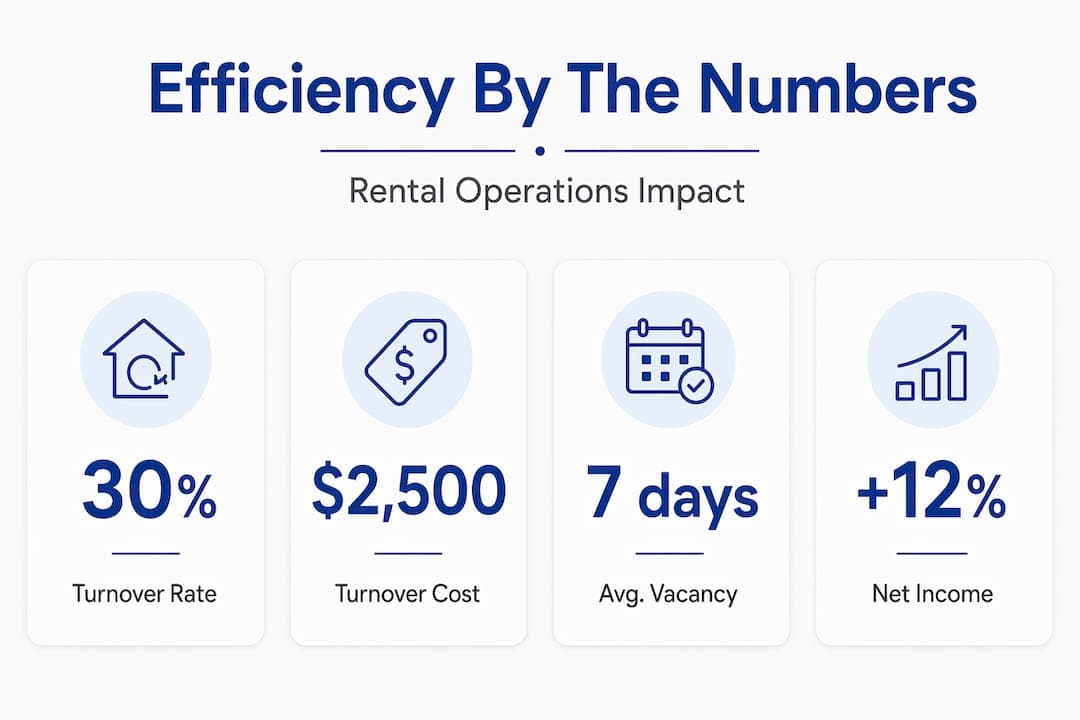
Tenant turnover is the most expensive single event in rental management. Each turnover event costs between $2,000 and $5,000 when you account for lost rent, cleaning, repairs, leasing fees, and administrative time. At a fifty-unit portfolio with a 30% annual turnover rate, that is fifteen turnover events per year, which translates to $30,000 to $75,000 in annual costs driven almost entirely by operational factors you can control.
Vacancy days are the second largest cost driver. Every additional vacancy day after move-out represents lost income that compounds across a portfolio. If your current process takes 21 days from move-out to move-in and you cut that to 14 days through faster cleaning approval workflows and automated marketing, you recover one week of rent per vacancy across your entire portfolio.
Consider the following comparison:
| Cost category | Unoptimized operation | Optimized operation |
|---|
| Tenant turnover rate | 30% annually | 18% annually |
| Turnover cost per event | $3,500 average | $3,500 average |
| Annual turnover cost (50 units) | $52,500 | $31,500 |
| Average vacancy days per turnover | 21 days | 12 days |
| Rent lost to vacancy (50 units, $1,500/mo avg) | $52,500 | $30,000 |
The difference between these two scenarios is not theoretical. It is the result of specific, measurable process changes in how your team handles maintenance, communication, and re-leasing workflows.
The benefits of streamlining rentals also show up in net operating income and, by extension, property valuation. Higher NOI means higher appraised value when you refinance or sell. Improving rental efficiency is not just an operational decision. It is a long-term asset management decision.
My take on why rental owners underestimate this
I've seen a consistent pattern across rental businesses of every size: owners know their operations are messy, but they underestimate how much that mess costs them. The reasoning is usually something like, "We've always done it this way and the business is still running." That framing treats operational drag as a fixed condition rather than a choice.
What I've found is that the biggest trap is not the absence of technology. It's the assumption that better software alone fixes the problem. I've watched businesses adopt five different platforms and remain just as chaotic because the underlying processes were never actually defined. The technology you choose matters far less than the clarity of the workflow you're automating. Define the process first, then automate it.
The other mistake I see regularly is trying to improve everything at once. Rental operations optimization works best when you pick the two or three bottlenecks causing the most measurable pain and solve those completely before moving on. Maintenance intake and payment collection are almost always the right starting points because they touch every tenant and every owner in your portfolio every single month.
The transition is not painless. Your team will push back on new systems. Some tenants prefer calling over using a portal. Expect a three-to-six month adjustment period where things feel harder before they feel easier. The operators who commit through that period are the ones who scale.
— Dizzy
How Nomora helps you put this into practice
Nomora is purpose-built to address the exact operational gaps this article covers. Its cloud-based platform handles reservations, fleet management, automated payments, contract generation, and customer data in a single integrated system, replacing the spreadsheets and manual workflows that slow rental businesses down.
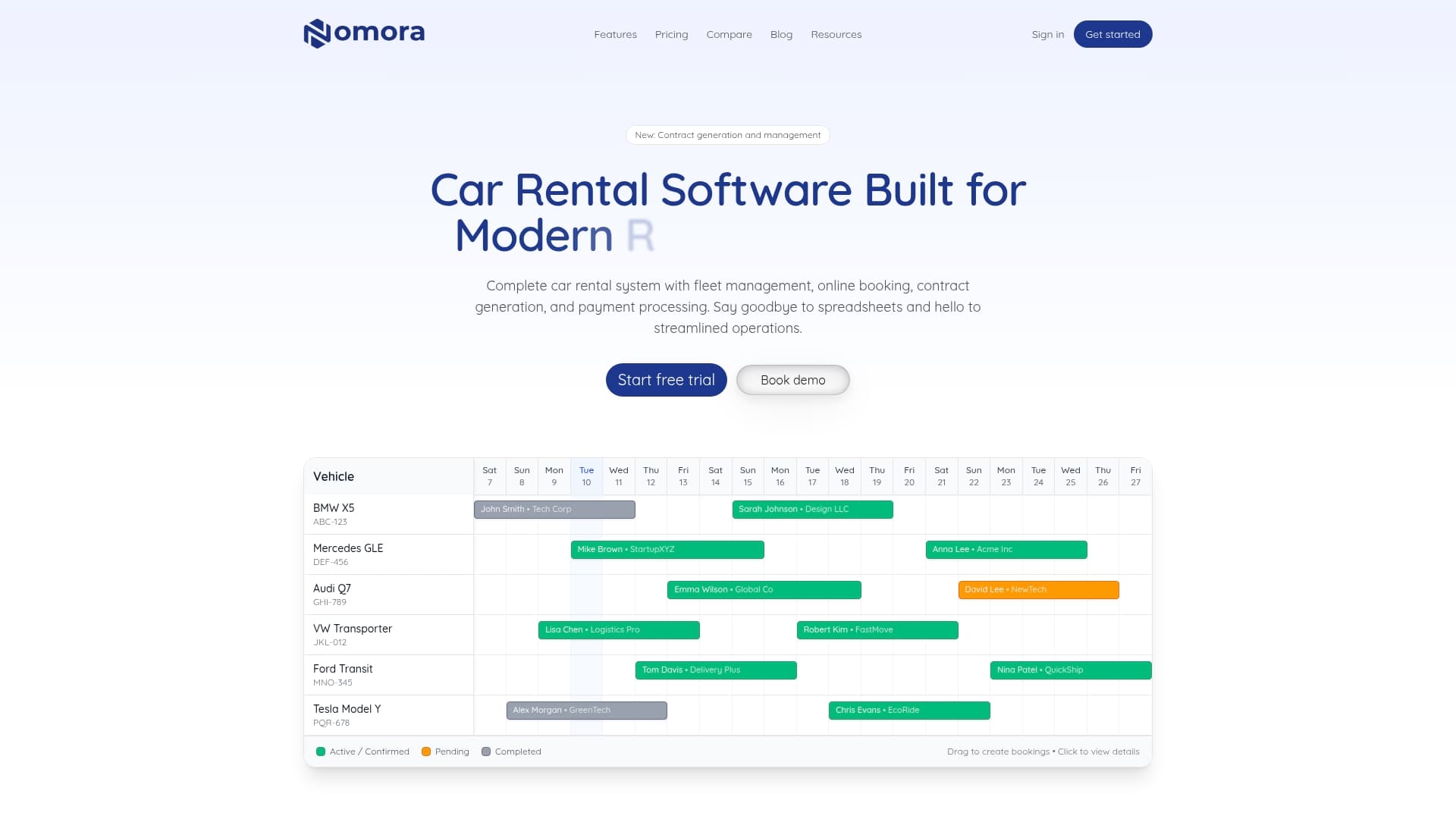
Whether you run a small independent operation or a multi-location fleet, Nomora adapts to your scale without requiring a large IT investment or a long onboarding period. The platform is live within 24 to 48 hours, and its automated payment tools eliminate the manual collection process that consumes staff time daily. Explore Nomora's use cases by business type to see how rental operators like you are improving efficiency and reducing overhead with the right platform in place.
FAQ
Why streamline rental operations instead of just hiring more staff?
Hiring adds fixed cost that scales linearly with your portfolio. Process improvements and automation reduce the per-unit labor cost, so your margins hold or improve as you grow rather than compressing.
What is the biggest financial benefit of improving rental efficiency?
Reducing tenant turnover delivers the clearest return. Each avoided turnover event saves between $2,000 and $5,000 in direct costs, making retention improvements more profitable than most other operational investments.
How does maintenance responsiveness affect tenant retention?
Research from Buildium shows that faster maintenance and communication correlates with 40% of renters willing to stay longer and 31% more likely to renew their leases, making it one of the strongest retention levers available.
Which rental processes should be automated first?
Start with rent collection and maintenance intake. These two areas carry the heaviest manual workload and affect every tenant in your portfolio every month, so improvements produce the fastest measurable results.
How long does it take to see results from rental operations optimization?
Most operations see measurable improvements in staff capacity and tenant satisfaction within two to three months of implementing automated payment and maintenance systems, with retention and financial impacts visible within six months.
Recommended
Ready to streamline your car rental business?
Book 30 minutes with the founder. We set up everything in this guide on your own vehicles, and migrate you out of Excel for free.