TL;DR:
- Flexible pricing allows businesses to adjust prices based on demand and customer usage, helping capture revenue and improve retention. It often uses hybrid models combining fixed fees with variable charges, enabling real-time adjustments and market responsiveness. Implementing automated billing and clear communication minimizes operational challenges and fosters customer trust.
Flexible pricing is defined as a strategy that lets businesses adjust prices based on demand, customer usage, or market conditions rather than locking every buyer into a single fixed rate. Car rental operators, SaaS companies, and subscription businesses all use this approach to capture more revenue, retain more customers, and stay competitive when market conditions shift. The question of why flexible pricing plans matter is not academic. Businesses that align price to actual customer value consistently outperform those that do not, and the mechanics behind that advantage are worth understanding in detail.
Fixed pricing treats every customer identically. That works when your product is a commodity, but it fails the moment customers have different needs, usage levels, or willingness to pay.

Flexible pricing lets businesses move beyond rigid tiers, offering plans that charge customers only for the features or usage they actually value. The result is higher retention because customers never feel they are paying for things they do not use. A small car rental operator renting five vehicles has fundamentally different needs than a franchise network managing 500. A single fixed plan cannot serve both well.
The benefits of flexible pricing extend beyond retention. Revenue grows because businesses can capture spending from customers who want more and keep customers who need less. Hybrid models combining base fees with variable usage charges balance predictable income with the ability to grow alongside each customer. That balance is the core financial argument for moving away from flat-rate pricing.
Key advantages include:
- Customer retention: Plans matched to actual usage reduce the incentive to cancel or downgrade.
- Revenue maximization: Usage-based components capture spending from high-volume customers that flat rates miss.
- Market segmentation: Different tiers attract different customer profiles, widening the addressable market.
- Competitive positioning: Dynamic adjustments let businesses respond to competitor pricing without restructuring their entire model.
- Upselling pathways: Tailored pricing is a starting point for growing revenue as customers expand and demand additional features.
Pro Tip: Map your customer segments by usage volume before designing tiers. A tier built around actual usage data converts better than one built around assumptions.
How do flexible pricing strategies adapt to market conditions?
Pricing flexibility is not just about offering multiple plans. The strongest implementations respond to external signals in real time.
Dynamic pricing enables real-time adjustments to maximize revenue during peak demand and apply competitive discounts during slow periods. For a car rental business, that means higher rates during holiday weekends and promotional rates during low-occupancy weeks. The mechanism maintains cash flow and prevents inventory waste, whether that inventory is vehicle days or software seats.
Four mechanisms drive adaptive pricing strategies:
- Demand-based adjustments. Prices rise when demand exceeds supply and fall when inventory sits idle. This is the core logic behind demand forecasting software used by rental operators to set rates days or weeks in advance.
- Customer segmentation. Different customer groups receive different price points based on volume, contract length, or feature requirements. A corporate fleet manager negotiates differently than a leisure traveler booking online.
- Inventory-linked pricing. As available units decrease, prices increase automatically. This prevents underpricing during high-demand periods and reduces the manual work of rate management.
- Competitor-responsive pricing. Monitoring market rates and adjusting accordingly keeps a business competitive without requiring a full pricing overhaul. This works best when automation handles the monitoring and adjustment cycle.
Pricing models should align with how customers derive value, using relevant metrics like user seats, rental days, or API calls. That alignment is what makes pricing feel fair to customers and profitable for the business simultaneously.
What are the main flexible pricing models and how do they work?
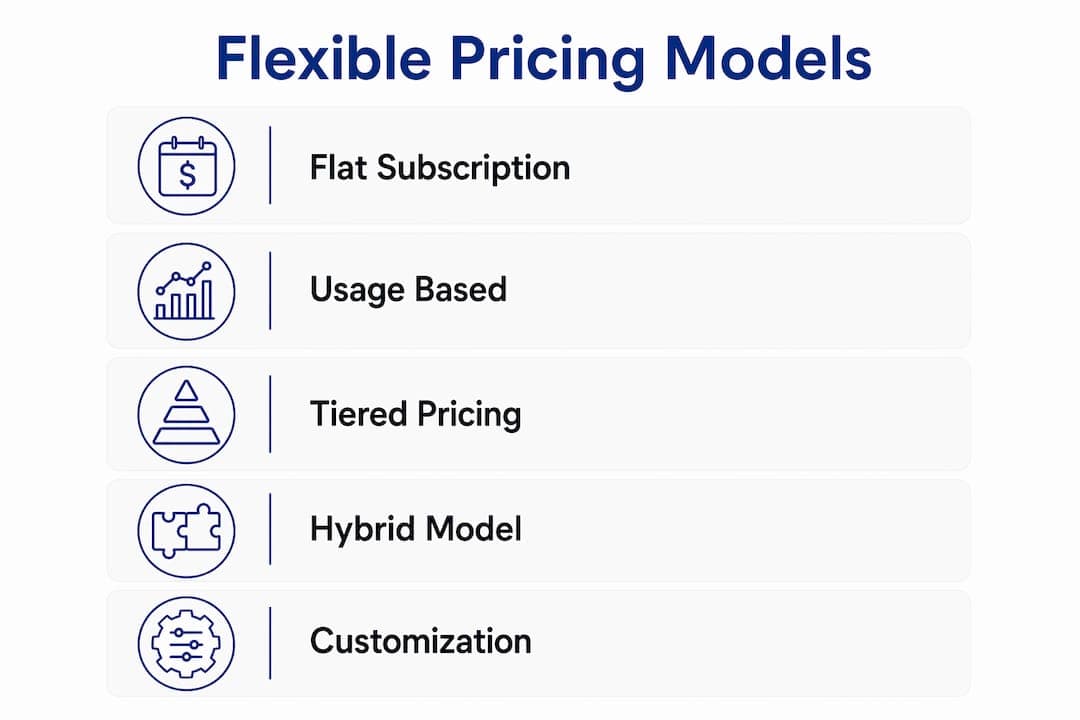
Three core models cover most business scenarios. Each suits a different product type and customer relationship.
| Model | How it works | Best for | Trade-off |
|---|
| Flat subscription | Fixed monthly or annual fee regardless of usage | Predictable, low-variance products | Undercharges heavy users; overcharges light users |
| Usage-based | Customers pay per unit consumed (rental days, API calls, seats) | Variable-demand products | Revenue is harder to forecast |
| Hybrid | Base fee plus variable usage charges | Most subscription and rental businesses | Requires clear billing communication |
| Tiered | Segmented plans with defined feature sets at each level | Businesses with distinct customer segments | Customers may feel constrained by tier boundaries |
Pure usage-based pricing can create unpredictable revenue, which is why hybrid models have become the preferred structure for businesses that need both stability and growth potential. The base fee covers fixed costs and provides a revenue floor. The variable component captures upside when customers use more.
Tiered pricing works well when customer segments are clearly defined. A car rental platform might offer an entry-level plan for independent operators, a mid-tier plan for regional fleets, and an enterprise plan for franchise networks. Each tier bundles features that match the actual needs of that segment, so customers self-select rather than requiring a sales conversation for every deal.
Flexibility does not mean lack of structure. Businesses maintain standardized plans for simplicity while customizing behind the scenes to capture enterprise opportunities that standard tiers would miss. That dual-layer approach is how mature pricing architectures work in practice.
Pro Tip: For fleet-based businesses, explore vehicle rental pricing strategies that combine seasonal base rates with daily usage variables. That structure captures both predictable revenue and peak-season upside.
What challenges come with implementing flexible pricing?
Flexible pricing creates real operational complexity. Acknowledging that upfront leads to better implementation decisions.
Billing complexity is the most common friction point. When prices vary by usage, billing cycles become harder to manage manually. Administrative complexity is the top challenge in flexible pricing, and automation is the primary solution. Businesses that try to manage usage tracking through spreadsheets create errors, disputes, and customer frustration. Automated billing systems that log usage in real time and generate accurate invoices remove that friction entirely.
Customer confusion is the second major risk. When customers cannot predict their bill, they lose trust. Setting clear spending caps prevents sticker shock, which is one of the leading causes of churn in usage-based models. Spending caps give customers a ceiling they can plan around, which makes flexible pricing feel safe rather than risky.
Revenue predictability requires deliberate design. A business that relies entirely on variable usage charges will see revenue swing with customer behavior. Hybrid models address this directly by guaranteeing a base revenue floor while preserving upside. For car rental operators, that means a monthly platform fee that covers core software costs, with usage charges tied to fleet size or booking volume.
Technology automation is essential to reduce the administrative burden and maintain transparency for customers. Businesses that invest in the right platform before launching flexible pricing avoid the most common implementation failures.
Pro Tip: Communicate upgrade paths clearly at every tier. Customers who understand what they get by moving up are far more likely to expand their plan than customers who have to ask.
Key Takeaways
Flexible pricing plans outperform fixed-rate models because they align price to actual customer value, which drives retention, revenue growth, and competitive positioning simultaneously.
| Point | Details |
|---|
| Align price to value | Charge customers based on what they actually use or need, not a one-size-fits-all rate. |
| Use hybrid models | Combine a base fee with variable charges to balance revenue predictability with growth potential. |
| Automate billing | Use technology to track usage and generate accurate invoices, removing manual errors and disputes. |
| Set spending caps | Clear billing ceilings prevent sticker shock and build the customer trust that drives long-term retention. |
| Design for expansion | Treat initial pricing as a starting point; build upgrade paths that grow revenue as customers scale. |
Pricing flexibility is a growth strategy, not just a feature
I have watched businesses treat flexible pricing as a product feature rather than a revenue strategy, and that framing consistently limits the results they get.
The businesses that extract the most value from pricing flexibility are the ones that design it around a specific question: at what point does this customer's usage justify a higher price? That question forces clarity on value metrics, tier boundaries, and upgrade triggers. Without it, flexible pricing becomes a collection of plans that nobody fully understands, including the team selling them.
The other mistake I see regularly is building complexity into customer-facing plans while keeping the backend rigid. The better approach is the reverse. Keep the customer experience simple, with two or three clear options, and build the complexity into the backend where automation handles it. Flexible plans enable ongoing upselling opportunities as customer needs evolve, but only if the upgrade path is obvious and frictionless.
For car rental operators specifically, the opportunity is significant. Dynamic pricing strategies for fleet profitability are still underused in the independent operator segment, where most businesses still set rates manually. The operators who automate that process gain a real competitive edge, not because their prices are lower, but because their prices are always right for the moment.
Trust is the foundation. Customers accept variable pricing when they understand it and can predict their costs. The businesses that communicate clearly, set honest caps, and deliver on the value their pricing implies are the ones that retain customers through market cycles.
— Dizzy
How Nomora supports flexible pricing for car rental businesses
Nomora is built for car rental businesses that need pricing to work as hard as their fleet does.
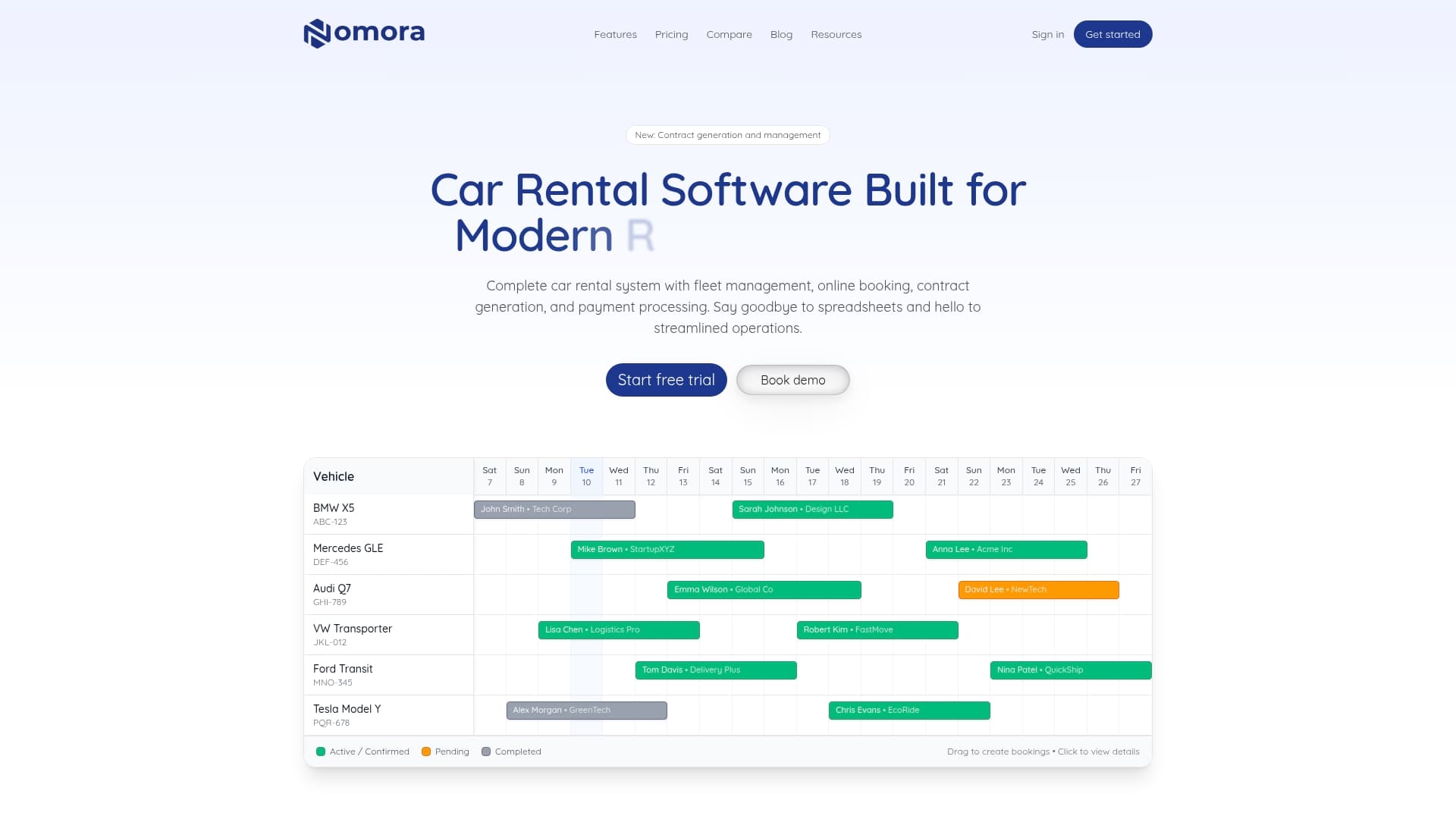
The platform handles reservations, fleet management, contract generation, and payments in one integrated system, which means usage data flows directly into billing without manual intervention. That automation is what makes flexible and dynamic pricing practical at any fleet size. Nomora's automated payment tools track rental activity in real time and generate accurate invoices, removing the billing complexity that stops most operators from adopting usage-based models. Whether you run five vehicles or five hundred, Nomora's use cases by business type show exactly how the platform adapts to your operation. Setup takes 24–48 hours, so you can move from fixed rates to a flexible pricing structure without a long implementation cycle.
FAQ
What is flexible pricing and how does it work?
Flexible pricing is a model where businesses adjust prices based on customer usage, demand levels, or market conditions rather than charging a single fixed rate. It works by tying price to a value metric, such as rental days, seats, or usage volume, so customers pay in proportion to what they consume.
What are the main benefits of flexible pricing for businesses?
The core benefits are higher customer retention, increased revenue from high-usage customers, and the ability to serve multiple market segments with a single product. Businesses also gain a competitive advantage by adjusting rates in response to demand without restructuring their entire pricing model.
Which flexible pricing model is best for car rental businesses?
Hybrid pricing, which combines a base fee with variable charges tied to fleet usage or booking volume, works best for most car rental operators. It provides a predictable revenue floor while capturing additional income during peak demand periods.
How do businesses prevent customer confusion with flexible pricing?
Setting clear spending caps and communicating upgrade paths at every tier prevents the billing surprises that cause churn. Transparent usage dashboards and automated invoicing also help customers understand exactly what they are paying for and why.
What technology do businesses need to implement flexible pricing?
Businesses need a platform that tracks usage in real time, automates billing, and integrates with payment systems. Manual tracking through spreadsheets creates errors and disputes that undermine customer trust and make flexible pricing operationally unsustainable.
Recommended
Ready to streamline your car rental business?
Book 30 minutes with the founder. We set up everything in this guide on your own vehicles, and migrate you out of Excel for free.