Start with phishing-resistant multi-factor authentication, role-based access control, and a tested incident response plan. Those three controls alone close the most common initial access paths attackers use against fleet operations today. Here is the prioritized checklist to put in motion this week:
- Enforce MFA and RBAC immediately (Owner: IT/Operations) — Remove shared logins and require phishing-resistant MFA for every admin account, telematics portal, and fleet-management platform.
- Inventory all telematics devices and API keys (Owner: Operations) — Document every connected unit, integration, and key in use. You cannot protect what you have not counted.
- Rotate API keys regularly on a frequent cycle (Owner: IT) — Revoke dormant keys monthly. Scope every key to the minimum permissions the integration actually needs.
- Require SOC 2 Type II or ISO/IEC 27001 from every vendor (Owner: Procurement) — Ask for the audit letter before signing any contract.
- Enable encryption in transit and at rest (Owner: IT) — TLS 1.2+ for all data moving between vehicles and back-ends; AES-256 or equivalent for stored data.
- Maintain offline backups and paper DVIRs (Owner: Operations) — Test recovery from those backups quarterly so you know they work before you need them.
- Run a tabletop incident response drill this quarter (Owner: Operations + IT + Legal) — An untested plan is close to no plan at all.
- Assign a named senior owner for fleet cybersecurity (Owner: Leadership) — Accountability without a name attached rarely survives the first incident.
Pro Tip: MFA and RBAC cost almost nothing to enable on most platforms and eliminate the credential-stuffing and shared-account attacks that account for a large share of fleet-system breaches. Do those two things first, before anything else on this list.
Key Takeaways
Effective fleet data security requires a tested incident response plan, phishing-resistant MFA, vendor SOC 2 evidence, and continuous monitoring — applied as a repeatable program, not a one-time project.
| Point | Details |
|---|
| Start with MFA and RBAC | Enable phishing-resistant MFA and least-privilege access controls before any other technical control. |
| Rotate API keys every 90 days | Scope keys to minimum permissions and revoke dormant keys monthly to close the most common exfiltration path. |
| Require vendor SOC 2 or ISO 27001 | Demand audit letters at procurement and include breach-notification SLAs of 72 hours or less in every contract. |
| Test incident response quarterly | An untested plan is nearly equivalent to no plan; tabletop drills and offline simulations reveal gaps before attackers do. |
| Nomora as your platform foundation | Nomora centralizes audit logs, enforces RBAC and MFA, and provides scoped API key management to support your security program. |
Table of Contents
Where your fleet data is actually exposed
Fleet operations carry a wider attack surface than most managers realize. Telematics units, ELDs, mobile apps, cloud platforms, and integrations are the primary entry points attackers target, and each one carries a different risk profile.
The table below maps the key surfaces, what attackers typically want from each, and the first mitigation to apply.
| Attack surface | Sensitivity | Attacker goal | First mitigation |
|---|
| Telematics / TCUs | High | Location data, cargo tracking, remote access | Scoped API keys, MFA on vendor portals |
| ECUs / CAN bus | High | Remote vehicle control, safety manipulation | Encrypted vehicle-to-backend comms, ban unauthorized OBD-II dongles |
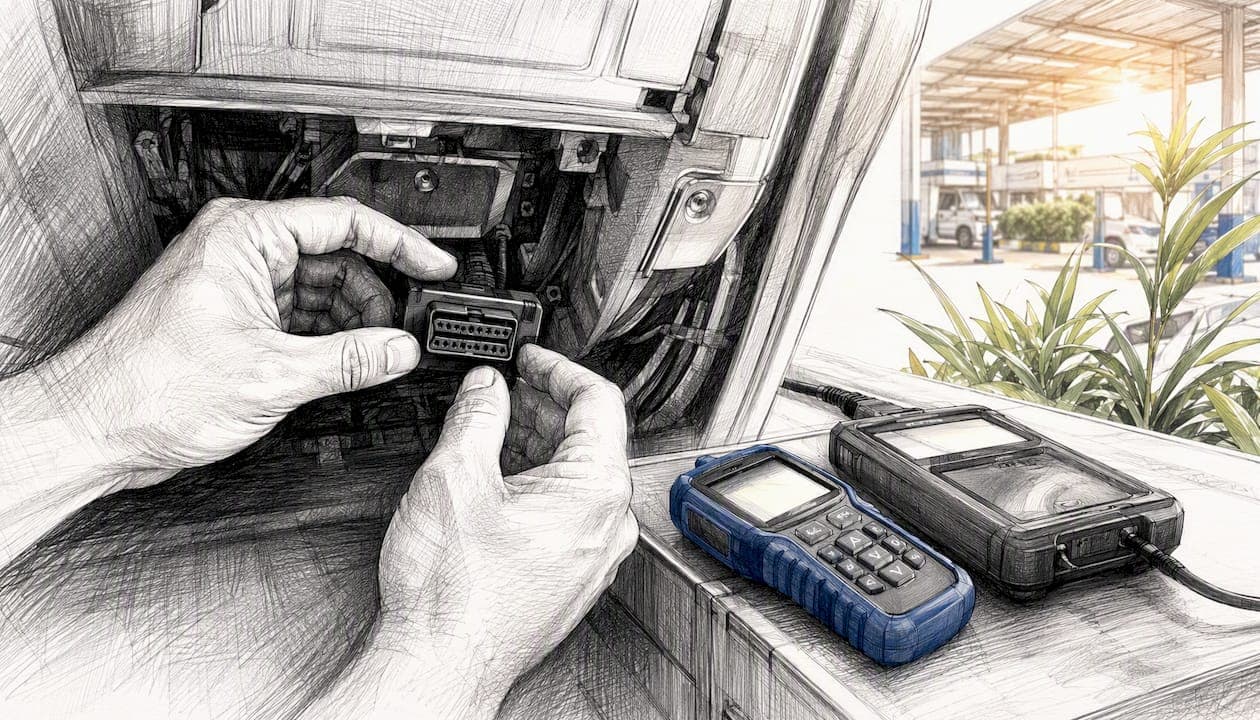
| OBD-II ports / aftermarket dongles | High | CAN bus bridge, credential theft | Policy ban on unapproved hardware, vendor vetting |
| ELDs | Medium | HOS data theft, ransomware pivot | Firmware updates, access controls, FMCSA-compliant retention |
| Driver mobile apps | Medium | Credential theft, phishing | MDM enrollment, app allowlisting, MFA |
| Cloud platforms / APIs | High | Bulk data exfiltration, tenant-wide exposure | Key rotation, least-privilege scopes, audit logging |
| Fuel card / TMS integrations | Medium | Financial fraud, route data | Scoped API access, anomaly monitoring |
| EV charging / EVSE | Medium | Session hijacking, grid disruption | Encrypted charging sessions, EVSE vendor SLAs |
| Maintenance tools / garages | Medium | Firmware tampering, physical access | Access logs, supervised OBD access, vendor vetting |
Access to the CAN bus, physically or through a compromised telematics unit, can allow an attacker to manipulate vehicle functions directly. GPS spoofing through a compromised TCU can redirect a high-value cargo vehicle. An exposed API key with broad permissions can give an attacker read access to your entire fleet's location history in minutes.
Human vectors are just as dangerous as technical ones. Phishing emails targeting dispatchers, shared credentials passed between drivers, and unsecured USB drives in maintenance bays are all documented initial access paths. Vendor and third-party risk compounds this: every integration partner with access to your fleet data is an extension of your own attack surface. Understanding your vehicle tracking systems and their data flows is the prerequisite for protecting them.
Core technical controls every fleet manager should implement
The direct answer: implement TLS 1.2+ with mutual TLS for all vehicle-to-backend transport, AES-256 or equivalent for data at rest, and a managed key lifecycle using a key management service (KMS) or envelope encryption for sensitive ECU payloads. AWS Connected Mobility guidance specifically recommends client-side and envelope encryption for ECU data and a managed KMS for key rotation and lifecycle control.
Here is the full technical checklist:
- Transport encryption — Require TLS 1.2+ for all telematics-to-cloud links. Mutual TLS (mTLS) adds device-level authentication and should be required for high-sensitivity integrations.
- Encryption at rest — Apply AES-256 or equivalent to all stored fleet data: location history, driver records, ELD logs, and contract data.
- Key management — Use a managed KMS rather than hardcoded keys. Rotate keys on a defined schedule and document who has access to each key.
- Phishing-resistant MFA — Hardware tokens (FIDO2/WebAuthn) or authenticator apps for every admin account. SMS-based MFA is better than nothing but is not phishing-resistant.
- RBAC with least privilege — Assign permissions by role, not by individual. A dispatcher does not need access to API key management; a driver does not need access to billing records.
- API key hygiene — Maintain a live inventory of every key. Rotate keys regularly and revoke dormant keys on a monthly basis. Scope each key to the minimum permissions the integration requires.
- Firmware tracking — Maintain a version register for every telematics unit and ECU. Flag any device more than two firmware releases behind the current vendor release.
- Staged OTA updates — Roll firmware updates to a test group of vehicles first. Validate behavior before fleet-wide deployment. Document the rollback procedure before you start.
- Network segmentation — Isolate vehicle telematics networks from corporate IT. Telematics back-ends should not share a flat network with HR systems or finance. Enforce service-level firewalls between segments.
A bad firmware update that bricks telematics units across your entire fleet is an operational incident, not just a security one.*
Aligning these controls with the CIS Controls framework gives you a prioritized, measurable baseline rather than an ad hoc checklist.
Policies and governance that make technical controls stick
Technical controls fail without clear ownership and enforceable policy. The core principle, supported by Automotive Fleet's cybersecurity guidance, is straightforward: assign a named senior leader as the accountable owner for fleet cybersecurity and integrate that responsibility into existing operations roles, not a separate IT silo.
A policy that cannot be monitored is decoration. Every rule in your fleet cybersecurity policy should have a corresponding monitoring mechanism or inspection step.
Policy checklist:
- Driver device rules — Plain-language prohibition on unauthorized OBD-II dongles, personal hotspots connected to vehicle systems, and USB devices in telematics hardware.
- No shared accounts — Each driver, dispatcher, and manager gets individual credentials. Shared accounts make audit trails useless.
- Telematics tamper rules — Define what constitutes tampering (covering cameras, unplugging units, modifying mounts) and the consequence for each.
- ELD handling — Drivers must not reset, modify, or allow third parties to access ELD hardware. Maintenance access requires a logged, supervised procedure.
- Device handling in maintenance shops — Require that any shop connecting diagnostic tools to a vehicle uses only vendor-approved, vetted hardware. Log every OBD-II connection.
- Incident reporting — Drivers and dispatchers must report suspected tampering, unusual vehicle behavior, or phishing attempts within a defined window (four hours is a reasonable standard).
Pro Tip: Write each policy statement as a testable condition: "No driver may connect a personal device to the OBD-II port. Compliance is verified by monthly vehicle inspection and telematics tamper-alert review." If you cannot describe how you will verify it, the rule will not hold.
Review the full policy annually at minimum. Link compliance to performance reviews for drivers and operations staff. Periodic vehicle inspections, not just digital monitoring, catch physical tampering that software cannot see. For a practical fleet risk management framework that integrates these governance steps, the operational overlap is significant.
Building a fleet-specific incident response plan
Write the plan before you need it, assign every role before the incident happens, and test it quarterly. Those three sentences summarize what separates fleets that contain breaches quickly from those that spend weeks recovering.
A fleet incident response plan has components that generic IT playbooks miss: vehicle isolation procedures, offline route continuity, and a vendor contact matrix that works when your cloud platform is down.
Core plan components:
- Detection and triage — Define what triggers the plan (tamper alert, API anomaly, ransomware indicator, driver report). Assign a triage lead with authority to escalate.
- Isolation procedures — Document how to isolate a compromised telematics unit, revoke an API key, or take a cloud integration offline without stopping vehicle operations.
- Communication protocols — Pre-draft notifications for legal counsel, insurers, affected customers, and regulators. Know your breach-notification obligations before an incident, not during one.
- Offline continuity — Maintain paper DVIRs, printed route sheets, and offline driver contact lists. Test whether dispatchers can operate for four hours with no telematics access.
- Forensics and chain of custody — Document how logs will be preserved, who has authority to collect evidence, and how that evidence will be stored to support legal or insurance proceedings.
- Vendor contact matrix — Every telematics, ELD, and cloud vendor should have an emergency security contact on file. Verify those contacts are current every quarter.
- Post-incident review — Within 72 hours of resolution, document what happened, what worked, what failed, and what changes the plan needs.
Insight: Fleet managers often underestimate the "breakout window" during an attack. An untested incident response plan is nearly equivalent to having no plan at all, because the first real incident exposes every gap simultaneously. Testing quarterly, even with a 90-minute tabletop drill, closes those gaps before they matter.
Run a full offline drill at least once per year: simulate four hours of telematics unavailability and measure whether dispatch can maintain operations using only offline resources. Document the gaps. Fix them before the next drill.
Specific controls for telematics, ECUs, ELDs, and EV charging
The direct requirement: every onboard system you procure must support encrypted communications, provide security disclosure documentation, and have a defined firmware update cadence. Anything that cannot meet those three criteria is a liability before it is installed.
Telematics unit controls:
- Require per-device identities rather than shared credentials across a fleet of units.
- Enforce MFA on all vendor portals where telematics data is accessible.
- Enable audit logging for every API call, configuration change, and firmware update.
- Configure tamper-detection alerts to notify operations within minutes of a physical event.
- Scope API keys to the minimum data fields the integration requires — a fuel-card integration does not need access to driver behavior scores.
ECU and OBD-II guidance:
- Ban all unauthorized aftermarket OBD-II dongles by policy and enforce it through vehicle inspection. An inexpensive dongle can bridge an attacker directly into the CAN bus, and FEMP guidance confirms that CAN bus access can enable remote vehicle control.
- Vet any aftermarket hardware vendor for ISO 27001 or SOC 2 certification before approval.
- Require that any diagnostic tool used in maintenance shops is logged and vendor-approved.
EV charging / EVSE:
- Require encrypted communication sessions between the EV and the charging station (EVSE). Understand the security implications of J1772, CCS, and CHAdeMO protocols for your specific vehicle mix.
- Demand EVSE vendor SLAs that explicitly cover security incident notification and firmware update timelines.
Procurement questions to ask telematics and EVSE vendors:
- Do you hold a current SOC 2 Type II or ISO/IEC 27001 certification? Can you provide the audit letter?
- What is your firmware update cadence, and how are updates delivered and authenticated?
- How are API keys scoped and rotated in your platform?
- What is your breach notification timeline, and to whom is notification sent?
- Do you maintain immutable audit logs, and for how long?
- Who are your sub-processors, and what security obligations do they carry?
For a deeper look at how telematics data flows through connected systems, the vehicle telematics guide for fleet managers covers deployment and security considerations in practical detail.
How to evaluate and contract fleet-tech vendors for security
Require SOC 2 Type II or ISO/IEC 27001 certification and a breach-notification SLA of 72 hours or less before signing any vendor contract. Those two requirements alone filter out the vendors most likely to become a liability.
Contract clauses to demand:
- Sub-processor disclosure — A complete, current list of every third party that touches your data, with the right to be notified of changes.
- Breach notification ≤72 hours — The vendor must notify you within 72 hours of discovering a breach affecting your data, regardless of whether they have confirmed the full scope.
- Audit rights — You or your designated auditor must have the right to review security controls annually.
- Data deletion and portability — On contract termination, the vendor must delete your data within a defined window and provide it in a portable format on request.
- Encryption standards — Specify TLS 1.2+ in transit and AES-256 at rest as contractual minimums, not just vendor promises.
- Retention rules — Map retention to your legal obligations. FMCSA guidance requires ELD supporting documents to be retained for at least six months; GPS and dashcam retention depends on jurisdiction and business need.
Operational audit checklist:
- Annual security questionnaire completed and reviewed by your team.
- Penetration test evidence from the past 12 months (third-party, not self-assessed).
- Incident history disclosure: ask directly whether the vendor has experienced a breach in the past three years and what the outcome was.
- Verification that the vendor enforces least-privilege API practices for your integration.
Red flags that should stop a procurement:
- No audit letter or certification, only a self-assessment questionnaire.
- No documented key rotation policy.
- Opaque or incomplete sub-processor list.
- Breach notification window longer than 72 hours, or no contractual commitment at all.
- Resistance to audit rights clauses.
Vendor security directly affects your insurance posture. Insurers increasingly ask for evidence of vendor due diligence during underwriting. A documented procurement scorecard with security criteria is both a risk-reduction tool and an insurance asset.
What to monitor and how to detect attacks early
Centralize logs, enable tamper alerts, and integrate telematics activity into a SIEM or a structured log-review cadence. Detection speed is the variable that most determines containment cost. The signals below are the ones most likely to indicate an active threat.
Key telemetry to monitor:
- Firmware-change events on any telematics unit or ECU outside a scheduled maintenance window.
- API key usage spikes, particularly bulk export calls or calls from unfamiliar IP ranges.
- Bulk data export attempts from the fleet-management platform.
- Unusual location patterns: vehicles appearing in unexpected geographies, GPS coordinates that do not match route data, or sudden location data gaps.
- Tamper alerts from telematics hardware.
- Vendor portal logins outside business hours or from unrecognized devices.
The table below maps signals to likely indicators and the immediate response action.
| Signal | Likely indicator | Immediate action |
|---|
| API key usage spike | Possible data exfiltration | Rotate key, isolate integration, review logs |
| Firmware change outside schedule | Unauthorized update or tampering | Quarantine device, verify vendor, audit chain |
| GPS anomaly / location gap | Spoofing or device tampering | Cross-check with driver, inspect hardware |
| Bulk export attempt | Insider threat or compromised credential | Suspend account, preserve logs, escalate |
| Tamper alert | Physical hardware interference | Dispatch inspection, log event, notify IR lead |
| Off-hours portal login | Credential compromise | Force password reset, review session logs |

Forensic readiness:
Immutable logs are the foundation of any post-incident investigation. Ensure your fleet-management platform and telematics vendor both maintain timestamped, tamper-evident audit trails. Map your log retention periods to legal requirements: FMCSA ELD retention rules set a six-month floor for supporting documents, but litigation holds and state privacy laws may require longer retention for other data types. Document your chain-of-custody procedure for collected evidence before an incident, not after. Understanding your vehicle tracking technology and its data flows makes log interpretation significantly faster during an active investigation.
A phased implementation plan with quick wins and long-term goals
The 90-day quick-win plan is where most of the risk reduction happens. The longer roadmap builds the program infrastructure that sustains it.
This week (hours of effort, low cost):
- Enable MFA on all admin accounts and telematics portals (IT, 2–4 hours).
- Remove all shared logins and assign individual credentials (IT/Operations, 4–8 hours).
- Inventory every telematics device and active API key (Operations, 4–8 hours).
- Request SOC 2 Type II or ISO 27001 audit letters from your top three vendors (Procurement, 1–2 hours).
This month (days of effort, low to medium cost):
- Enable TLS 1.2+ on all telematics-to-cloud connections; confirm encryption at rest with each vendor (IT, 1–3 days).
- Draft and distribute the plain-language driver and device policy (Operations, 1–2 days).
- Establish a firmware version register for all telematics units (Operations/IT, 1–2 days).
- Schedule the first tabletop incident response drill (Operations + IT + Legal, 2 hours to plan).
This quarter (weeks of effort, medium cost):
- Implement RBAC across the fleet-management platform and telematics portals.
- Automate API key rotation on a 90-day cycle.
- Run the tabletop drill and document gaps.
- Add security clauses (breach notification, audit rights, deletion SLAs) to the next vendor contract renewal.
- Test offline continuity: four-hour dispatch simulation with no telematics access.
6–12 month roadmap (medium to high investment):
- Integrate telematics logs into a SIEM or structured log-review process.
- Conduct annual security questionnaires with all telematics and ELD vendors.
- Implement envelope encryption and KMS for sensitive ECU payloads.
- Commission a third-party penetration test of your telematics integrations.
- Build security KPIs into fleet operations dashboards: patch lag, time to rotate keys, drill completion rate.
The fleet management best practices guide covers how security KPIs can be integrated alongside utilization and uptime metrics without creating separate reporting overhead.
Why testing your incident response plan is the single most important control
Fleets with tested incident response plans recover faster and contain breaches at lower cost than those relying on untested documentation. Testing is not a compliance checkbox; it is the mechanism that reveals whether your plan actually works under pressure.
Industry insight: An untested incident response plan is nearly equivalent to having no plan at all. The first real incident exposes every gap simultaneously, and the gaps that surface during a live breach are far more expensive to close than those found in a 90-minute drill.
The evidence from fleet and automotive industry reporting is consistent: the "breakout window" — the time between initial access and lateral movement or data exfiltration — is often measured in hours, not days. A team that has rehearsed isolation procedures, offline continuity, and vendor escalation paths can act in minutes. A team reading the plan for the first time during an incident cannot.
Action steps for an IR test cycle:
- Run a tabletop drill quarterly: 60–90 minutes, scenario-based, with operations, dispatch, IT, legal, and at least one vendor representative present.
- Run a full offline drill annually: simulate four hours of telematics unavailability and measure dispatch performance against offline resources.
- After each drill, document three specific gaps and assign owners and deadlines to close them.
- Verify that offline backups are recoverable — not just that they exist — every quarter.
Pro Tip: Invite your telematics vendor's security contact to at least one tabletop drill per year. Vendors who decline or cannot name a security contact are telling you something important about their incident-readiness.
Fleet cybersecurity works best as a continuous program
Cybersecurity for fleet operations succeeds when it runs as a repeatable program, not a one-time project. The program rhythm is: inventory, apply controls, monitor, test, audit vendors, repeat. Each cycle builds on the last and closes gaps the previous cycle revealed.
The program rhythms that matter most:
- Monthly: Review access logs, revoke dormant API keys, check firmware version register for devices falling behind.
- Quarterly: Run incident response drills, test offline backup recovery, review tamper alerts and anomaly logs.
- Annually: Conduct vendor security questionnaires, review and update the cybersecurity policy, commission or review penetration test evidence, update the retention matrix against current FMCSA and state privacy rules.
- Continuously: Monitor telematics telemetry for the signals listed in the detection section above.
The most practical shift fleet managers can make is integrating security KPIs into the same dashboards they already use for fleet performance. Patch lag (days since a firmware update was available versus applied), time to rotate API keys, and drill completion rate are all measurable. When those numbers sit alongside vehicle uptime and utilization, cybersecurity stops being an IT abstraction and becomes an operational metric with an owner. That is when fleet security actually improves.
Nomora supports the security controls your fleet program needs
A secure fleet-management platform is not just a convenience — it is the infrastructure that makes the controls in this article sustainable at scale. Nomora is built as a cloud-native, security-minded platform that centralizes audit logs, enforces per-user RBAC, supports MFA, and segregates critical fleet data across its architecture.
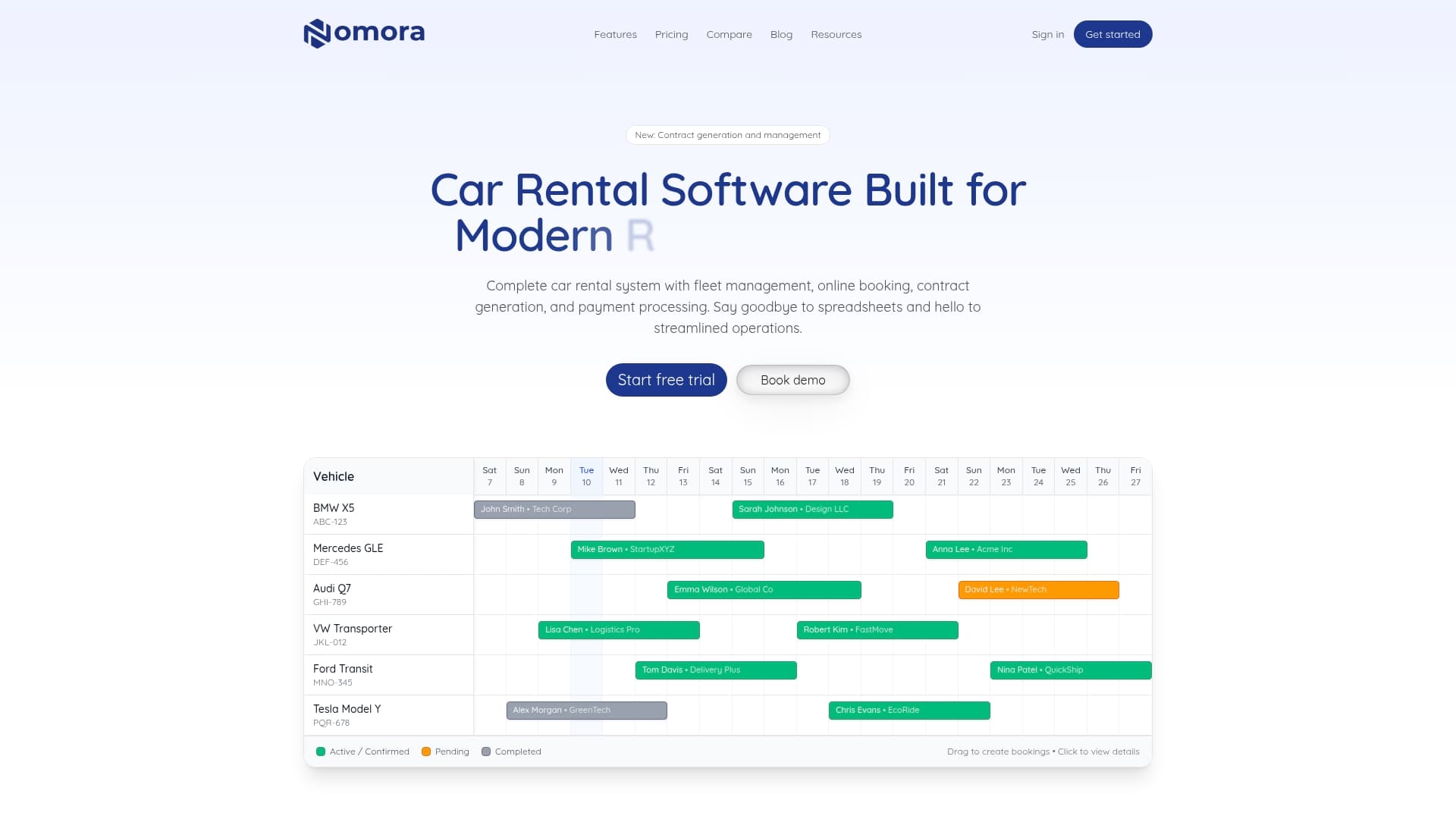
For fleet managers working through the checklist above, Nomora provides the platform capabilities that map directly to those controls: encryption in transit and at rest, scoped API key management, per-user access controls with audit trails, GPS tracking integrations with defined data flows, and GDPR-aligned data handling. The platform replaces the spreadsheets and manual processes that create the most common security gaps in fleet operations — shared credentials, untracked integrations, and no audit trail.
If you are evaluating a fleet-management platform against the procurement criteria in this article, explore Nomora's full feature set or request a security walkthrough to see how the platform's controls map to your specific operation.
Useful resources for deeper reading
The sources below are the foundational references used throughout this article. Each is worth bookmarking for vendor audits, policy drafting, and procurement decisions.
- Federal fleet cybersecurity — U.S. Department of Energy (FEMP/NLR) — Technical guidance on CAN bus risk, EVSE mitigation patterns, and encrypted vehicle-to-backend communications. Use this for procurement requirements and EVSE vendor evaluation.
- AWS Well-Architected: Connected mobility lens — data protection — Encryption architecture patterns for connected vehicles: TLS, client-side encryption, envelope encryption, and KMS key lifecycle. Use this when specifying technical requirements for telematics vendors.
- Cybersecurity in vehicles and fleets — Nationwide — Practical overview of fleet attack surfaces, ransomware and data breach consequences, and the case for ISO 27001, SOC 2, and NIST/CIS alignment. Useful for building the business case internally.
- Building smarter cybersecurity policies for fleet operations — Automotive Fleet — Guidance on policy ownership, enforcement mechanisms, and the annual review cadence. Use this as a template reference when drafting driver and device policies.
- Implementing telematics at scale: data governance, retention and privacy for fleets — Insurance Curator — Retention matrix, FMCSA ELD retention requirements, automated purging guidance, and vendor SLA requirements for data deletion and portability. Use this for compliance mapping and contract drafting.
Sources
Recommended