TL;DR:
- On-demand fleet access allows businesses to use vehicles only when needed through reservations, subscriptions, or API networks, eliminating idle asset costs. This flexible model offers faster response times, lower capital expenditure, and scalable operations suited for demand fluctuations. Implementing it successfully involves assessing network coverage, integrating systems, and running pilots to ensure reliable and cost-effective vehicle access.
On-demand fleet access is defined as the practice of using vehicle capacity only when needed, through short-term reservations or subscriptions, rather than maintaining a permanently owned fleet. This model lets fleet managers and business owners match vehicle availability directly to actual demand, eliminating the cost of idle assets. Platforms like REPOWR and OneRail have made this approach practical at scale, giving operators access to trailers, vans, and commercial vehicles without long-term capital commitments. For businesses facing seasonal demand swings or unpredictable delivery volumes, understanding what on-demand fleet access means is the first step toward a more cost-efficient operation.

What is on-demand fleet access and how does it work?
On-demand fleet access operates through three core mechanisms: reservation platforms, API-managed carrier networks, and Fleet-as-a-Service subscriptions. Each mechanism serves a different operational need, but all share the same principle. You pay for vehicle capacity when you use it, not when it sits idle.
Reservation-based systems, like REPOWR's trailer marketplace, allow businesses to reserve trailers for specific loads and defined time windows. Once a load is complete, the asset turns over quickly for the next operator. This model works well for businesses with predictable but irregular freight needs. The key advantage is that you control the reservation window without owning the depreciating asset.
API-managed networks take this further by connecting businesses to large pools of pre-vetted carriers and drivers in real time. OneRail, for example, provides same-day capacity dispatch across more than 1,000 carriers and 12 million drivers throughout North America. That scale means a business experiencing a sudden demand spike on a Tuesday afternoon can activate additional delivery capacity within hours, not weeks.
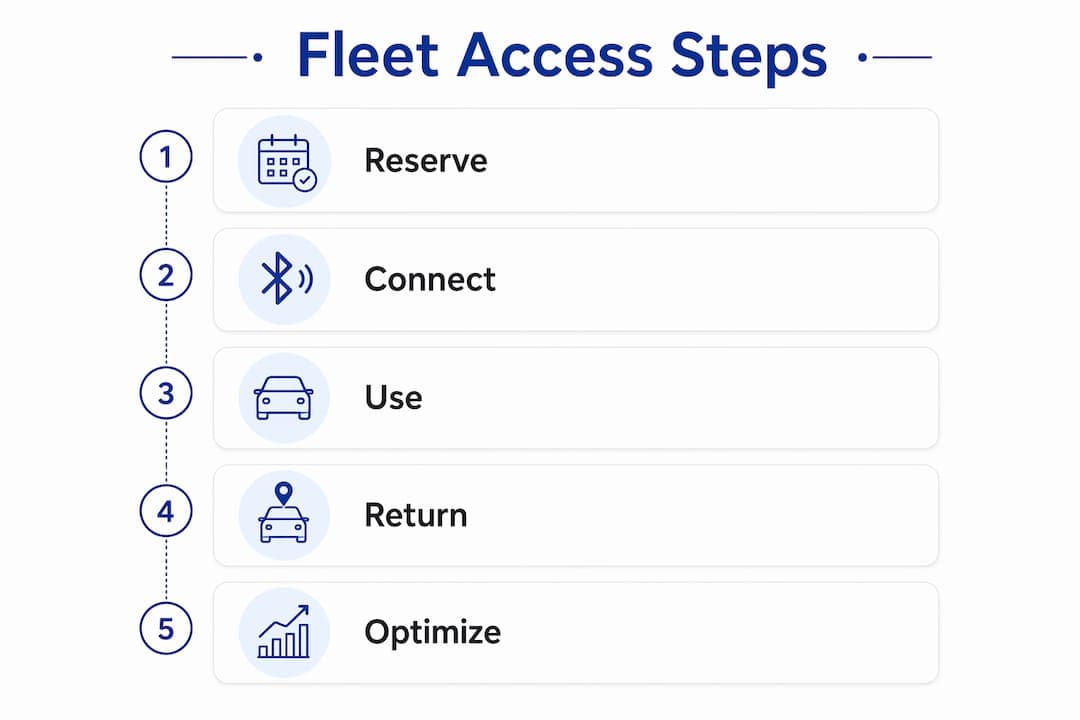
Here is how a typical on-demand fleet activation sequence works:
- A business submits a capacity request through a reservation app or API call
- The platform matches the request to available vehicles or carriers in the target geography
- Dispatch confirmation and driver or asset details are returned automatically
- The vehicle is deployed, tracked, and released back to the network after the job
Pro Tip: Before committing to any on-demand fleet provider, test their activation speed in your specific operating geography. A provider with 12 million drivers nationally may still have thin coverage in your region, which directly affects how quickly capacity scales when you need it.
Fleet-as-a-Service (FaaS) subscriptions sit between full ownership and pure on-demand access. You pay a recurring fee for access to a third-party owned and maintained fleet, often with defined usage caps. This model transfers maintenance responsibility to the provider while giving you predictable monthly costs. The access-over-ownership model, popularized by platforms like Zipcar and Airbnb, applies the same logic to commercial fleets: the customer gains utility without the balance-sheet burden of ownership.
What are the main types of on-demand fleet access?
The terminology around on-demand fleets varies enough to cause real confusion. Misidentifying which model a provider offers leads to miscalculated costs, unexpected maintenance obligations, and service-level surprises. The three primary models differ significantly in cost structure, control, and operational responsibility.
| Model | How it works | Cost structure | Maintenance responsibility | Control level |
|---|
| Reserved owned assets | Business reserves its own vehicles for specific windows | Fixed ownership + variable reservation management | Business owns all maintenance | High |
| Fleet-as-a-Service (FaaS) | Subscription to third-party owned fleet | Recurring subscription fee | Provider handles maintenance | Medium |
| API instant capacity | On-demand access via carrier network APIs | Per-use or per-mile pricing | Carrier handles maintenance | Lower |
Each model suits a different operational profile. Reserved owned assets work best for businesses with high utilization rates and specific vehicle requirements. FaaS subscriptions suit mid-sized operators who want predictable costs without capital expenditure. API instant capacity is the right fit for businesses with highly variable demand, where owning or subscribing to a fixed fleet would result in chronic underutilization.
The practical implications go beyond cost. With reserved owned assets, you control vehicle condition, branding, and driver assignment. With API instant capacity, you trade that control for speed and scale. Neither is universally superior. The right choice depends on your demand patterns, geographic footprint, and tolerance for operational variability.
For businesses exploring short-term vehicle leasing as a middle path, this option sits closest to the FaaS model. You access vehicles without ownership while retaining more control than a pure API network provides.
What are the operational and financial benefits of fleet access?
The financial case for on-demand fleet access is grounded in capital efficiency. Owning a fleet large enough to cover peak demand means those vehicles sit idle during off-peak periods. That idle time represents depreciation, insurance, and storage costs with zero revenue offset.
The benefits of fleet access extend across four measurable dimensions:
- Lower capital expenditure: Businesses avoid the upfront cost of purchasing vehicles, freeing capital for revenue-generating activities
- Reduced idle asset costs: You pay only for active use, eliminating the carrying cost of underutilized vehicles
- Faster demand response: API-based networks activate capacity within hours, not the weeks required to procure and register new owned vehicles
- Predictable variable costs: Per-use pricing converts an unpredictable capital expense into a controllable operational line item
The technology integration behind these benefits is measurable. A Meta data center implementing automated fleet management with scan-and-go vehicle access saved 11 minutes per trip and $350,000 annually. That figure illustrates how much time and money accumulates from friction in vehicle access processes. Multiply that across a fleet of dozens or hundreds of vehicles, and the operational savings become a significant competitive advantage.
Fleet managers who shift from ownership to access models report faster response to regional demand spikes and a measurable reduction in the administrative overhead tied to asset management.
Scalability is the benefit that matters most during growth phases. When demand increases in a new region, an on-demand model lets you test that market without committing to a permanent fleet. If the region underperforms, you scale back without stranded assets. If it grows, you increase capacity through the provider network while you evaluate whether permanent investment is warranted. This approach to fleet utilization optimization is increasingly standard practice among operators who manage multi-region delivery networks.
Mobile teams also benefit from centralized fueling access and reduced downtime when fleet management integrates with on-demand vehicle services. Good maintenance and scalable policies help businesses meet customer demand without overstaffing or overinvesting in assets.
How to implement on-demand fleet access successfully
Adopting on-demand fleet services requires more than signing a provider contract. The implementation decisions you make in the first 90 days determine whether the model delivers its promised efficiency gains or creates new operational headaches.
Follow this sequence to build a reliable on-demand fleet operation:
-
Audit your current demand patterns. Identify your peak and off-peak periods, geographic concentration, and vehicle type requirements. This data determines which on-demand model fits your operation and which providers have sufficient network density to serve you.
-
Evaluate provider network coverage. Instant capacity reliability depends on carrier density in your specific operating geographies. A provider with strong national coverage may still have gaps in rural corridors or secondary markets. Request coverage maps and test activation times before committing.
-
Integrate reservation and dispatch systems. Connect your existing fleet management software to the provider's API or reservation platform. This integration eliminates manual booking steps and gives you real-time visibility into asset availability. Platforms that support fleet management integrations via API reduce the setup time significantly.
-
Define service-level agreements clearly. Specify minimum activation times, vehicle condition standards, and escalation procedures for failed dispatches. Vague SLAs are the most common source of dissatisfaction with on-demand fleet providers.
-
Run a parallel pilot before full transition. Operate your on-demand access model alongside your existing fleet for 30 to 60 days. This reveals coverage gaps, cost model surprises, and integration issues before they affect your core operations.
Pro Tip: Verify that your provider's network density covers your lowest-volume routes, not just your busiest corridors. Elastic capacity only works if the network is thick enough in the places where you need surge coverage most.
The cost model deserves particular attention. Per-use pricing sounds straightforward, but fuel surcharges, repositioning fees, and minimum booking windows can push actual costs well above the headline rate. Build a full cost model before comparing on-demand pricing to your current owned-fleet cost per mile.
For businesses considering electric or hybrid vehicles as part of their on-demand fleet strategy, electric van leasing options now offer flexible terms that align with the access-over-ownership approach while meeting sustainability targets.
Key takeaways
On-demand fleet access works because it converts fixed ownership costs into variable usage costs, giving businesses the capacity they need without the assets they don't.
| Point | Details |
|---|
| Core definition | On-demand fleet access means using vehicles only when needed, via reservations, subscriptions, or API networks. |
| Three distinct models | Reserved owned assets, FaaS subscriptions, and API instant capacity each carry different cost and control trade-offs. |
| Financial impact | Eliminating idle assets and automating access can save hundreds of thousands of dollars annually at scale. |
| Implementation priority | Provider network density in your specific geography is the single most important factor in service reliability. |
| Adoption approach | Run a 30 to 60 day parallel pilot before fully transitioning to confirm cost models and coverage before committing. |
The ownership assumption is the real problem
The businesses that struggle most with fleet costs are not the ones that made bad purchasing decisions. They are the ones that never questioned whether purchasing was the right decision at all. Fleet ownership became the default because it was once the only reliable option. That assumption has not aged well.
What I find most telling is how quickly the math changes once you account for idle time honestly. Most fleet managers I have spoken with estimate their utilization rates at 70 to 80 percent. When they actually measure it, the number is closer to 50 percent. That gap represents real money sitting in a parking lot.
The access-over-ownership shift is not about chasing a trend. It is about recognizing that vehicle capacity is a utility, not an asset class. The businesses that treat it that way gain a structural cost advantage over competitors still carrying the full weight of ownership on their balance sheets. The technology to make this work at scale, from REPOWR's trailer marketplace to OneRail's carrier network, now exists and is mature enough for serious operational reliance.
My honest advice: start with one route or one vehicle category. Prove the model in a contained environment before scaling. The data you collect in that pilot will be more persuasive to your leadership team than any vendor case study.
— Dizzy
How Nomora supports on-demand fleet operations
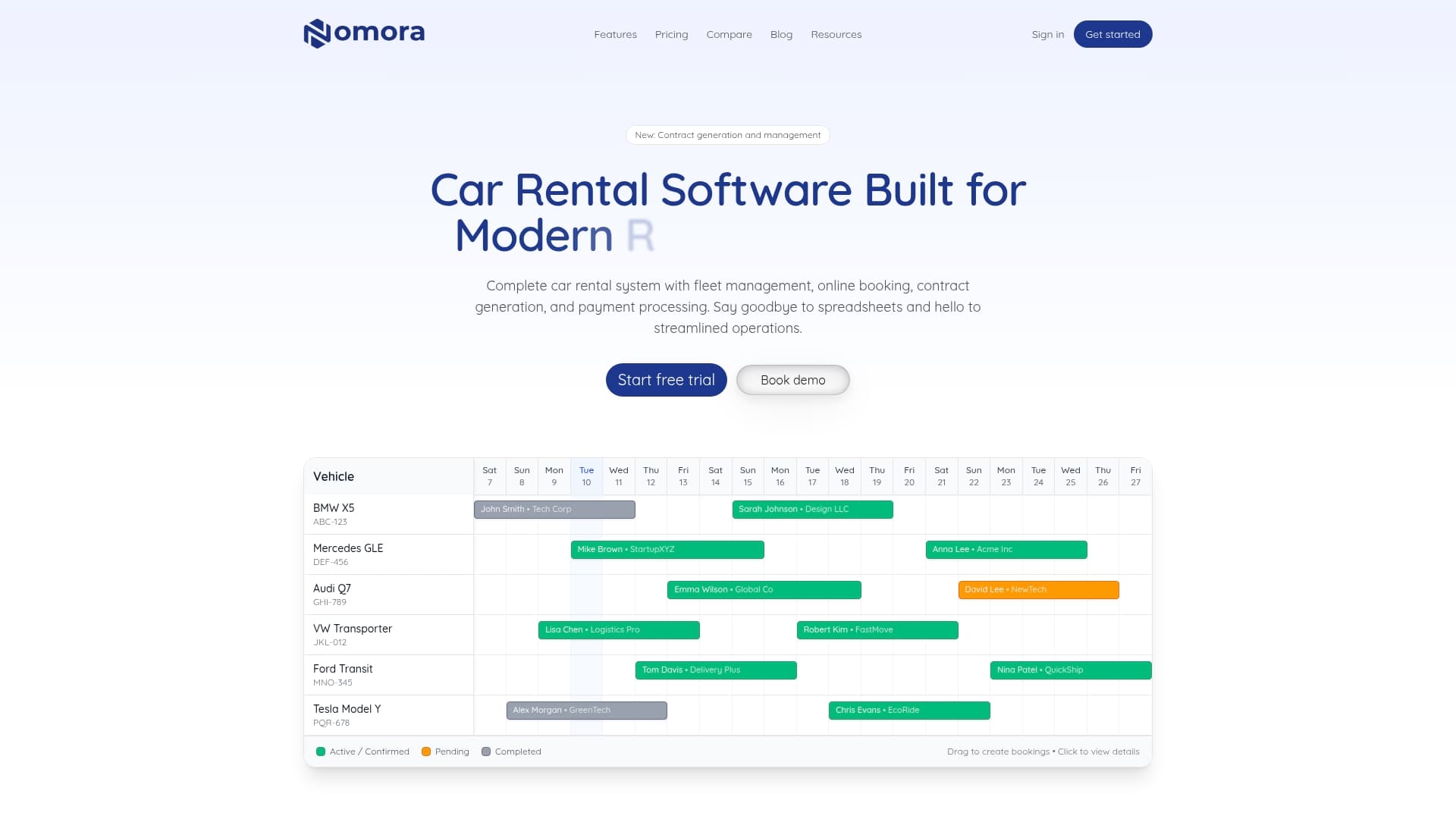
Nomora's cloud-based platform is built for exactly the kind of flexible, reservation-driven fleet management that on-demand access models require. The platform handles reservations, contract generation, and payment processing in one integrated system, replacing the manual coordination that makes on-demand fleet operations difficult to scale. Nomora connects with GPS tracking and payment gateways via API, giving fleet managers real-time visibility into vehicle availability and booking status without spreadsheets or manual check-ins. For businesses managing short-term vehicle access across multiple locations, Nomora's fleet management use cases cover everything from independent operators to corporate fleet networks. Setup takes 24 to 48 hours, so you can start managing on-demand bookings without a lengthy implementation project.
FAQ
What is on-demand fleet access in simple terms?
On-demand fleet access means using vehicles only when your business needs them, through short-term reservations or subscriptions, rather than owning a permanent fleet. It converts fixed vehicle ownership costs into variable usage costs tied directly to operational demand.
How does on-demand fleet access differ from traditional leasing?
Traditional leasing commits you to a fixed vehicle for a set term regardless of usage, while on-demand fleet access scales up or down based on actual need. On-demand models include per-use API networks and FaaS subscriptions that carry no long-term asset obligation.
What technology enables on-demand fleet access?
API-managed carrier networks, reservation platforms, and cloud-based fleet management software are the core technologies. Providers like OneRail use APIs to dispatch across networks of more than 1,000 carriers, activating capacity within hours of a request.
What are the biggest risks of on-demand fleet access?
The primary risks are thin provider network coverage in specific geographies and hidden costs in per-use pricing models, including fuel surcharges and repositioning fees. Running a parallel pilot for 30 to 60 days before full transition is the most reliable way to surface these issues before they affect operations.
Is on-demand fleet access suitable for small businesses?
Yes. FaaS subscriptions and reservation-based platforms scale down to small operators who need occasional vehicle access without the capital required for ownership. The cost model is often more favorable for small businesses than leasing, particularly when demand is seasonal or irregular.
Recommended
Ready to streamline your car rental business?
Book 30 minutes with the founder. We set up everything in this guide on your own vehicles, and migrate you out of Excel for free.