TL;DR:
- A rental software switching checklist guides owners through data export, testing, and training to ensure a smooth transition. Proper planning, data cleanup, parallel running, and clear communication minimize risks and operational disruptions during migration. Role-based training and tools like Nomora support quick setup and seamless data portability.
A rental software switching checklist is a structured plan that guides rental business owners through every phase of migrating from one platform to another without losing data, disrupting bookings, or confusing staff. Your rental software acts as the central nervous system of your operation, handling reservations, contracts, payments, and fleet data simultaneously. A failed migration can mean double-booked vehicles, lost customer records, and broken payment flows. This guide gives you a practical, data-backed checklist covering data export, migration timelines, testing, communication, and training so your switch goes smoothly from day one.
1. What critical data should you prepare and export before switching rental software?

Data preparation is the single most important step in any rental software migration. Data rarely maps 1:1 between platforms, which means mismatched categories, custom field names, and inconsistent statuses cause import failures if you do not clean your records first.
Start by identifying every data category your operation depends on:
- Customer records: Names, contact details, driver's license numbers, and rental history
- Upcoming bookings: Reservation dates, vehicle assignments, deposit amounts, and confirmation numbers
- Fleet inventory: Vehicle details, pricing rules, availability calendars, and maintenance records
- Contracts and waivers: Legally required documents tied to specific rentals
- Financial records: Outstanding balances, payment histories, and invoicing data
Export these datasets in CSV format, which is the industry standard for cross-platform data transfer. CSV files work with virtually every rental management platform and give you a clean, readable backup.
Before exporting, deduplicate customer records, standardize field names, and remove outdated entries. A messy export produces a messy import. Many businesses also archive older historical data externally rather than migrating it, keeping only operationally relevant records in the new system. This keeps the new platform fast and uncluttered.
Pro Tip: Export your data twice on different days and compare the two files. Any differences reveal records that changed unexpectedly, which signals either active data entry or a system error worth investigating before migration.
2. How do you plan a structured rental software migration timeline?
A phased migration timeline prevents the chaos of a hard cutover. The standardized 4-week migration framework breaks the process into four distinct stages:
- Week 1: Setup and configuration. Build your account structure, configure pricing rules, set up user roles, and connect integrations like GPS tracking and payment gateways.
- Week 2: Core data migration. Import your cleaned CSV files, map custom fields to the new system's structure, and verify record counts match your exports.
- Week 3: Validation and parallel run. Run both systems simultaneously. New bookings enter the new platform while existing reservations complete in the old one.
- Week 4: Cutover and go-live. Deactivate the old system, redirect all booking channels to the new platform, and monitor closely for the first 48–72 hours.
Running both systems in parallel for 1–2 weeks is the gold standard for risk mitigation. It gives your team time to catch errors before they affect real customers.
Schedule your migration window during your lowest-activity period. For most car rental businesses, that means mid-week in an off-peak month rather than a Friday before a holiday weekend. Assign clear staff roles for each phase: who owns data import, who handles testing, and who communicates with customers. When roles are undefined, tasks fall through the cracks.
3. What testing and validation steps confirm your system is ready?
Testing is not optional. Skipping it before go-live is the fastest way to lose customer trust and revenue.
Perform at least 10 sample bookings that mirror your real transaction types. Test a standard daily rental, a multi-day booking with a deposit, a booking with a discount code, and a cancellation with a refund. Each scenario should produce the correct dates, pricing, and confirmation details.
Check these specific areas during validation:
- Reservation accuracy: Confirm that imported booking dates, vehicle assignments, and deposit amounts match your original records exactly
- Payment processing: Run test transactions through your payment gateway to verify charges, receipts, and refund flows work correctly
- Automated communications: Trigger confirmation emails, reminder messages, and return notifications to confirm they send with accurate details
- Reporting and financials: Compare revenue reports and outstanding balance totals between the old and new systems to catch any discrepancies
- Integration functionality: Verify that GPS tracking, calendar syncs, and any third-party API integrations respond correctly
Involving front-line staff in testing uncovers real usability problems that managers miss. A counter agent testing the checkout flow will spot a confusing screen or a missing field that a back-office review never catches.
Pro Tip: Create a dedicated test environment using sample data before touching your live records. This lets your team practice without any risk to real customer information or active bookings.
4. How should you manage stakeholder communication during the switch?
Stakeholder communication is the most overlooked step in most rental software migrations. Skipping it creates revenue gaps, confused customers, and frustrated staff.
Notify each audience group with a tailored message and enough lead time to prepare:
- Internal staff: Share the migration timeline at least three weeks before cutover. Include training dates, system access instructions, and a point of contact for questions.
- Customers: Send a clear message explaining any changes to the booking portal, payment process, or confirmation format. Customers who receive no warning often assume something is wrong and call to cancel.
- Owners and investors: Confirm that reporting formats and financial summaries will remain consistent. If report layouts change, provide a comparison document.
- Vendors and partners: Update any vendors who access your platform for invoicing or fleet servicing with new portal credentials and login instructions.
For automotive rental businesses managing workforce transitions alongside a software switch, clear internal communication becomes even more critical. Staff changes and system changes happening at the same time multiply confusion.
Timing matters. Send your first internal notice three weeks out, a customer-facing message one week before cutover, and a confirmation message on go-live day. Use email for formal notices and your team messaging app for daily updates during the parallel run period.
5. What training practices help staff adapt to new rental software?
Training is not a post-migration task. It belongs in the middle of your migration timeline, during the testing phase, when staff can practice on real data in a low-stakes environment.
Role-based training produces faster adoption than generic group sessions. Counter agents need to master the booking and checkout flow. Fleet managers need to understand vehicle assignment and availability views. Administrators need to configure pricing, user permissions, and reporting. Mixing all roles into one training session wastes everyone's time and leaves gaps.
Designate two or three internal champions before go-live. These are staff members who receive deeper training and become the first point of contact for questions after launch. Champions reduce the volume of support tickets and build team confidence faster than any external helpdesk can.
Training bottlenecks undermine migration success when end-users are not involved until after go-live. Surprises at launch create resistance that takes weeks to overcome. Build a short reference document for each role covering the five most common daily tasks. Keep it to one page. Staff will actually use a one-page reference. They will not read a 40-page manual.
Platforms like Nomora reduce onboarding time significantly, with setup completing in as little as 24–48 hours. That speed only translates to real adoption when your team is trained and ready before the system goes live.
Software lock-in is the risk that your new platform traps your data or makes future migrations prohibitively difficult. Auditing all third-party integrations and confirming the new platform offers flexible APIs before you commit protects you from this outcome.
Ask every vendor candidate three direct questions before signing a contract. First, can you export all your data at any time in a standard format like CSV or JSON? Second, does the platform offer open API access for connecting to GPS providers, payment gateways, and accounting tools? Third, what does the offboarding process look like if you decide to leave?
Review your current rental software features against your new platform's capabilities before migration. Any feature gap you discover after go-live is far more expensive to address than one you identified during evaluation. A thorough rental software evaluation checklist includes not just current needs but projected needs 18–24 months out.
Nomora's open integration architecture supports GPS tracking systems, payment gateways, and external reporting tools, which means your data stays portable and your workflows stay connected regardless of what changes in your business.
Key Takeaways
A successful rental software migration requires clean data, a phased timeline, thorough testing, proactive communication, and role-based training before go-live.
| Point | Details |
|---|
| Clean data before export | Deduplicate records and standardize field names to prevent import failures. |
| Use a 4-week phased timeline | Structure migration across setup, import, validation, and cutover stages. |
| Run parallel systems for 1–2 weeks | Keep the old system active while new bookings enter the new platform. |
| Communicate early with all stakeholders | Notify staff, customers, and vendors at least three weeks before cutover. |
| Train staff during the testing phase | Role-based training during validation reduces resistance and speeds adoption. |
What I've learned from watching migrations go wrong
The most common mistake rental businesses make is treating a software switch like flipping a light switch. They set a go-live date, import their data the night before, and expect everything to work by morning. It almost never does.
The businesses that switch successfully treat migration as a four to six week operational project, not an IT task. They assign an internal project lead, run parallel systems without exception, and communicate with customers before anyone has a chance to get confused. The ones that skip parallel operation to save time almost always regret it within 48 hours of go-live.
Data cleanup is the step that gets underestimated every single time. Managers assume their existing records are clean because the old system "worked fine." But old systems hide a lot of inconsistency. When you try to move that data into a new structure, every inconsistency becomes an error. Budget at least a full week for data cleanup alone.
The other thing I would tell any rental manager: use the migration as a reason to improve your processes, not just replicate them. If your old system had a workaround for a broken workflow, do not rebuild that workaround in the new system. Fix the workflow. A well-planned migration roadmap bundles operational improvements with the technical switch, and the businesses that do this come out significantly stronger than they went in.
— Dizzy
How Nomora supports your rental software transition
Switching platforms is a significant operational decision, and having the right support structure makes the difference between a smooth go-live and a costly restart.
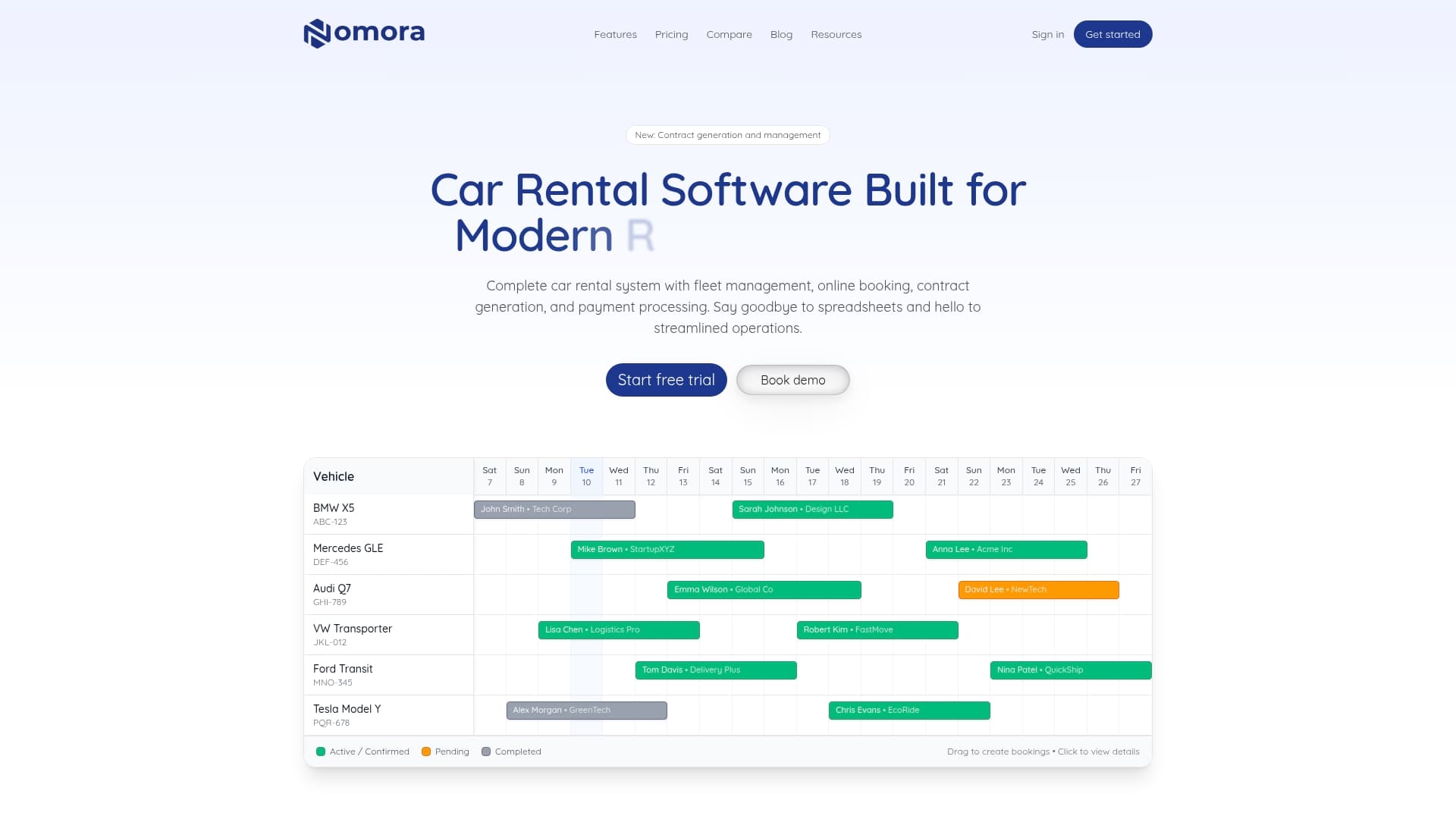
Nomora is built for rental businesses of all sizes, from independent operators to corporate fleet managers. Its cloud-based platform handles reservations, fleet management, contract generation, and payments in one place, with setup completing in 24–48 hours. The car rental software use cases page shows how Nomora adapts to different business types, whether you manage 10 vehicles or 500. For larger operations, the fleet management tools provide real-time visibility across your entire fleet during and after migration. Nomora's team supports data import, integration setup, and onboarding so you are not navigating the transition alone.
FAQ
What is a rental software switching checklist?
A rental software switching checklist is a structured list of steps covering data export, migration planning, testing, communication, and training that guides rental businesses through a platform change without losing data or disrupting operations.
How long does a rental software migration typically take?
A standard migration follows a 4-week timeline covering setup, data import, parallel validation, and go-live. Running both systems in parallel for 1–2 weeks during week three reduces risk significantly.
What data should I export before switching rental software?
Export customer records, upcoming bookings, fleet inventory, pricing rules, contracts, and financial data in CSV format. Archive older historical records externally and migrate only operationally active data.
How do I avoid data loss when moving to new rental software?
Clean and deduplicate your records before export, export twice to verify consistency, and run both systems in parallel during the validation phase. Confirm record counts match between your export files and the new system after import.
When should I notify customers about a software switch?
Send customer-facing communication at least one week before cutover, explaining any changes to the booking portal or payment process. Customers who receive no warning often assume an error and contact support or cancel bookings.
Recommended