TL;DR:
- Fleet scalability involves expanding fleet size, geographic reach, and service scope without overhauling systems or increasing costs proportionally. Success depends on automating processes, robust software architecture, and standardized operations that support growth seamlessly. Building scalable rental fleets grants capacity for growth, efficiency, and improved profit margins without operational chaos.
Understanding what is fleet scalability separates rental businesses that survive growth from those that collapse under it. Most fleet managers assume scaling means buying more vehicles. In reality, adding cars without the right systems, processes, and technology creates operational chaos faster than it creates profit. Fleet scalability is about your entire operation's ability to grow without breaking down. This guide breaks down the definition, the key components, the strategies, and the technology decisions that determine whether your rental business can handle what comes next.
Table of Contents
Key Takeaways
| Point | Details |
|---|
| Scalability is more than vehicle count | True fleet scalability covers systems, staffing, policies, and technology, not just the size of your fleet. |
| Automation is non-negotiable | Adding vehicles without automating policy enforcement and workflows leads to operational breakdown at scale. |
| Optimize before expanding | Auditing utilization rates before purchasing new vehicles prevents waste and reveals real capacity gaps. |
| Software must grow with you | Fleet management software that handles 5 vehicles often fails at 20+; choose platforms built for horizontal growth. |
| Profitability should scale too | Effective scaling decouples revenue growth from overhead growth so margins improve, not just costs. |
What fleet scalability means for rental operations
The fleet scalability definition most commonly cited in operations circles is this: the ability to expand fleet size, geographic coverage, or service scope without requiring a complete overhaul of your existing systems or a proportional increase in operational costs. According to GoFleet, scalability enables businesses to adapt to market demand without extensive reconfigurations. That is the ideal. What you actually build toward depends on how you structure your technology, processes, and team from the start.
For rental vehicle businesses specifically, the fleet scalability definition extends beyond logistics. It includes your booking system's ability to handle more reservations, your payment infrastructure's capacity to process more transactions, and your team's ability to manage more contracts without proportionally more staff. All of these must grow together or growth stalls.
The importance of fleet scalability becomes clear when you look at market context. The global fleet management market is projected to reach USD 96.56 billion by 2032 at a CAGR of 13.92%. Businesses that build scalable operations now are positioning themselves to capture that growth. Those that don't are building a ceiling into their own operations.
Here is what a scalable rental fleet actually covers:
- Fleet size: the number of vehicles under management, across one or multiple categories
- Geographic reach: single location vs. multi-branch or multi-region operations
- Service diversity: adding new vehicle types, corporate accounts, or subscription models
- Operational infrastructure: reservations, contracts, payments, maintenance scheduling, and customer data
- Technology architecture: whether your software can handle more data, users, and integrations without slowing down
The distinction between fleet size and fleet scalability matters. A business with 50 vehicles and poor systems is less scalable than a business with 20 vehicles and solid automation. Size is a snapshot. Scalability is a structural capacity.
Key components and challenges in scaling a fleet
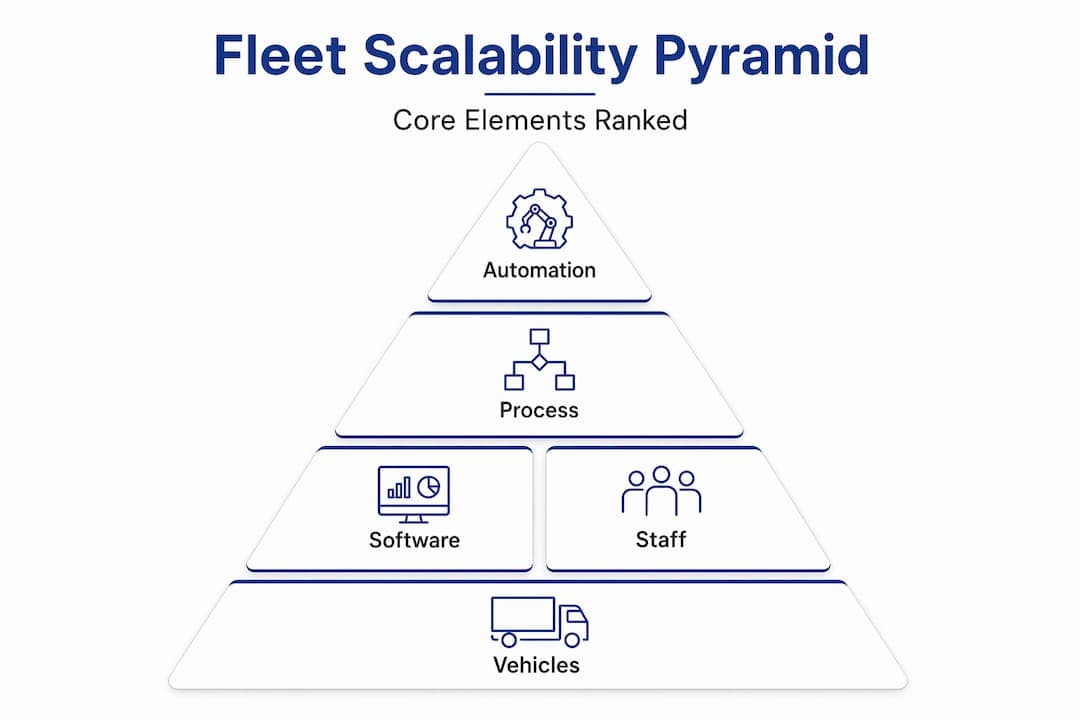
Achieving fleet scalability requires getting several components right at the same time. Most rental operations that struggle during growth fail in one of three areas: technology, process automation, or operational standardization.
On the technology side, your fleet management software is the central nervous system of the operation. It needs to handle increased data loads, support more user roles, and integrate with external tools like GPS trackers and payment gateways without performance degradation. Software that supports 5 trucks often fails at 20 or more due to performance bottlenecks. This is not a hypothetical risk. It is a known architectural failure point, and it catches businesses off-guard precisely because the software worked fine at smaller scale.

On the process side, policy enforcement is where many fleet managers fall behind. Many organizations fail at scaling because they accumulate manual processes instead of automating them. Every new vehicle added to a fleet that relies on spreadsheets and phone calls adds a proportional burden to your team. The goal of true scalability is managing 50 vehicles as efficiently as you manage 10.
Common challenges that affect fleet scalability include:
- Manual process bottlenecks: reservation tracking, contract generation, and damage reporting done by hand do not scale
- Inconsistent service quality: without standardized workflows, customer experience degrades as volume grows
- Data overload without visibility: more vehicles generate more data, but without centralized dashboards the data becomes noise
- Staffing pressure: growth that requires hiring in a 1:1 ratio with vehicle additions is not truly scalable
- Integration gaps: when your booking tool, payment processor, and vehicle tracker do not communicate, errors multiply at scale
Pro Tip: Before adding a single vehicle to your fleet, map every manual step in your current operations from reservation to vehicle return. Every step you cannot automate is a future bottleneck.
The role of automation here is not about replacing your team. It is about removing the low-value, repetitive tasks so your team can focus on customer experience and business decisions. Centralized visibility, standardized workflows, and automated policy enforcement are the foundation of any scalable rental fleet.
How technology supports scalable fleet management
Technology is what separates a fleet that grows cleanly from one that grows painfully. A transport management system (TMS) enables structured fleet growth by automating processes like shipment allocation and providing centralized operational visibility. For rental businesses, the equivalent is a cloud-based fleet management platform that handles reservations, contracts, payments, and customer data in one place.
The features that matter most for scalability are not always the ones vendors lead with. Here is what to evaluate when choosing a platform for scaling a fleet management operation:
- Horizontal scaling capability: Can the software handle more users, vehicles, and transactions without slowing down? Look for platforms built on cloud infrastructure with horizontal API scaling.
- Role-based access control (RBAC): As your team grows, you need granular permission levels. Managers, agents, and technicians should see different things. RBAC and horizontal API scaling are key design features for managing complexity at scale.
- Integration depth: Does the platform connect to your GPS provider, payment gateway, and accounting tools via native integrations or open APIs?
- Automation breadth: Can you automate booking confirmations, contract generation, payment collection, and overdue notifications?
- Real-time data visibility: Centralized dashboards showing fleet availability, utilization rates, and revenue performance in real time are not optional at scale.
Pro Tip: Ask any software vendor what happens to their platform's performance at 3x your current fleet size. If they cannot answer with specifics, treat that as a red flag.
The comparison below illustrates the operational difference between a manually managed fleet and a system-driven one:
| Area | Manual management | System-driven management |
|---|
| Reservation handling | Staff take calls and update spreadsheets | Automated booking with conflict detection |
| Contract generation | Manually drafted for each rental | Generated automatically from templates |
| Payment collection | Invoiced by hand, followed up manually | Automated collection with payment gateway |
| Fleet visibility | Periodic updates from staff | Real-time dashboard across all locations |
| Scaling effort | Requires proportional staff increase | Handles growth without linear cost increase |
For fleet managers looking to go deeper on the operational side, Nomora's fleet management best practices resource covers utilization and efficiency tactics worth reviewing before making platform decisions.
Practical strategies for scaling your rental fleet
Knowing the definition of fleet scalability is only useful if you know how to achieve fleet scalability in practice. These strategies address both the preparation phase and the active growth phase.
- Audit utilization before expanding: Fleet managers often overemphasize adding vehicles without first optimizing existing utilization rates. A utilization audit often reveals that your current fleet has untapped capacity. If your vehicles sit idle 40% of the time, buying more vehicles is not the answer.
- Consider leasing before buying: Leasing provides critical capacity flexibility to respond to seasonal demand without over-investing in depreciating assets. For rental businesses with fluctuating demand cycles, leasing is a strategic scaling tool, not just a financing alternative.
- Standardize every customer-facing process: Reservation flows, contract terms, damage assessment procedures, and return protocols should be identical across your entire operation. Standardization is what makes multi-location growth manageable.
- Automate policy enforcement: Setting rules for late returns, security deposits, and fuel policies inside your platform removes the need for staff to manually handle exceptions. The more you automate enforcement, the more consistently your policies apply as volume grows.
- Decouple revenue from overhead: The defining characteristic of truly scalable growth is that revenue grows faster than costs. This happens through automation, better utilization, and platform efficiency, not by hiring in proportion to vehicle count. For a detailed breakdown of how this works in practice, Nomora's guide on scaling for profit is a practical starting point.
- Plan for multi-location from day one: Even if you operate one location today, your software, workflows, and data structure should support a second location without rebuilding. Retrofitting systems for multi-branch operations is significantly more expensive than building for it upfront.
These fleet scalability strategies are most effective when applied together. Optimizing utilization gives you a baseline. Automating enforcement removes friction. Leasing adds flexibility. Standardizing operations creates consistency. Together, they give you a foundation you can actually build on.
Scaling approaches compared: what works and what doesn't
Not all approaches to scaling a fleet management operation produce the same results. Understanding where common pitfalls occur helps you avoid the most expensive mistakes.
| Approach | How it scales | Main risk |
|---|
| Manual-first growth | Add staff as fleet grows | Costs rise linearly; errors multiply with volume |
| Vehicle-first growth | Buy vehicles before optimizing systems | Fleet outgrows operational capacity quickly |
| System-first growth | Build automation and platform before expanding | Higher upfront cost but clean, controllable growth |
| Hybrid leasing model | Lease for peaks, own for baseline demand | Requires accurate demand forecasting |
The data supports a clear conclusion. Mega fleets of 500-plus vehicles are increasing their share of fleet spending from 30% to 45% by 2035, yet 70% report dissatisfaction with their current scalable solutions. The problem is not ambition. It is the quality of the platforms and approaches those fleets have chosen.
Fleet service providers that focus too narrowly on single metrics like fuel costs, while ignoring booking, payment, and customer data integration, consistently produce systems that do not scale well. Choosing a platform built around integrated operations and customer-centric design is a fleet scalability best practice that pays compounding returns as you grow.
My take on what most scaling advice gets wrong
I've read a lot of fleet scalability guidance, and most of it stops at the obvious. Buy better software. Automate your bookings. Track your utilization. All of that is correct, but it misses what actually causes scaling efforts to fail in the middle of execution.
In my experience, the single most underestimated problem is software performance degradation. Managers choose a platform at 15 vehicles, it works fine, and they assume it will work fine at 50 or 100. Then at some point around 25 to 30 vehicles, things slow down. Reports take longer to load. Booking conflicts start slipping through. Staff start creating workarounds. By the time the problem is visible, the business is mid-growth and switching platforms feels impossible.
What I've learned from observing this pattern is that the questions most managers do not ask during vendor selection are the ones that matter most. How does the platform perform under concurrent user loads? What is the database architecture at scale? Does it use caching to handle high transaction volumes? These are not exciting questions, but they are the ones that determine whether your technology actually supports scalable fleet management or just pretends to.
The other thing I'd flag is the EV transition. Fleet scalability in 2026 is increasingly inseparable from how you plan to integrate electric vehicles into your mix. Charging infrastructure, different maintenance cycles, and range considerations add a new layer of operational complexity that standard fleet management software often handles poorly. Build your scalability strategy with that shift in mind now, before it becomes urgent.
— Dizzy
How Nomora helps rental fleets scale with confidence
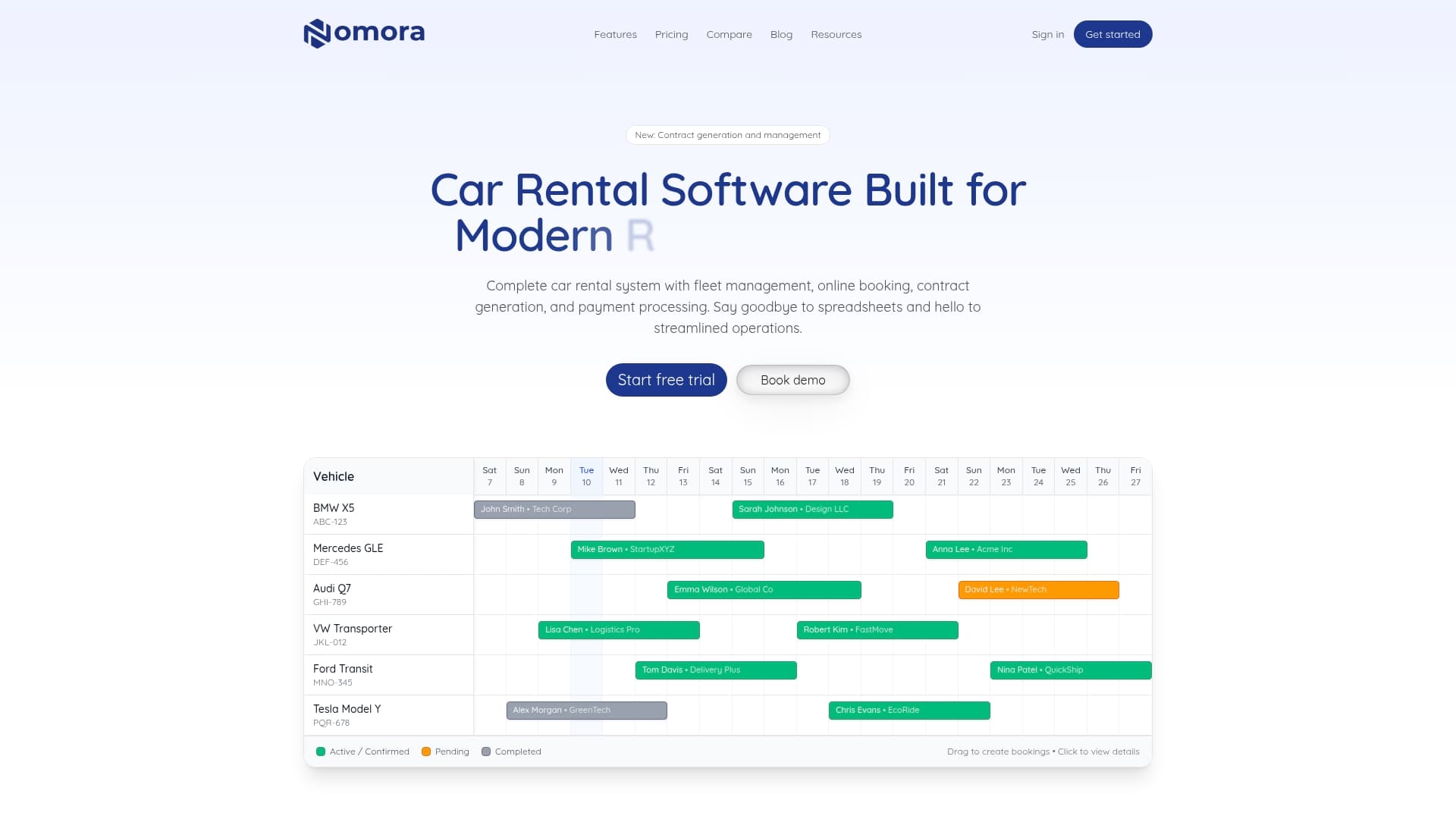
Nomora is built specifically for rental vehicle businesses that are serious about operational growth. The platform replaces manual processes and disconnected tools with a single cloud-based system that handles reservations, contracts, payments, customer data, and fleet visibility in one place. Whether you operate 10 vehicles or 200, Nomora's architecture is designed to grow with you, with no need to switch platforms as your fleet expands.
Key capabilities that directly support fleet scalability include automated booking conflict detection, contract generation, GPS integration, and payment gateway connectivity. These are not add-ons. They are core features designed to reduce overhead as volume grows. You can explore how Nomora serves different rental business types, from independent operators to corporate fleet managers, through Nomora's rental software use cases. For operations where payment efficiency is a priority at scale, Nomora's automated payment system removes manual collection from the equation entirely. Setup takes 24 to 48 hours, which means the time between decision and operational improvement is very short.
FAQ
What is the fleet scalability definition?
Fleet scalability is the ability of a fleet operation to grow in size, geographic reach, or service complexity without requiring a complete system overhaul or a proportional increase in costs. It covers technology, processes, staffing, and infrastructure, not just vehicle count.
What affects fleet scalability the most?
The biggest factors are software architecture, process automation, and operational standardization. Software that cannot handle growing data loads and manual workflows that accumulate with volume are the two most common points of failure.
How do you achieve fleet scalability in a rental business?
Start by auditing current utilization, then automate booking, contract, and payment workflows before expanding your fleet. Use leasing to add flexible capacity, standardize all customer-facing processes, and choose a platform designed for multi-location, high-volume operations.
What are the main benefits of fleet scalability?
The primary benefits are the ability to grow revenue faster than costs, maintain consistent service quality across higher volumes, and respond to market demand without operational disruption. Scalable fleets also reduce per-unit administrative overhead as they grow.
What is the difference between fleet size and fleet scalability?
Fleet size is simply the number of vehicles you operate. Fleet scalability is the structural capacity of your operation to manage more vehicles, locations, and customers without breaking down. A larger fleet is not automatically a more scalable one.
Recommended
Ready to streamline your car rental business?
Book 30 minutes with the founder. We set up everything in this guide on your own vehicles, and migrate you out of Excel for free.