Multi-branch management consolidates operations across multiple vehicle rental locations using a unified system. It improves real-time visibility, operational efficiency, and data accuracy to support better decision-making. Implementing early and standardizing processes ensures long-term success and competitive advantage.
Multi-branch management is defined as the centralized coordination of financial transactions, inventory, and staff operations across multiple business locations through a unified system. For vehicle rental businesses, this means replacing disconnected spreadsheets and branch-level reporting with a single platform that gives you real-time visibility into every location at once. The industry is shifting rapidly toward cloud-based unified platforms, and rental operators with three or more locations are feeling the pressure most acutely. Understanding this approach is the first step toward running a tighter, more profitable operation across all your branches.
What is multi-branch management and why does it matter?
Multi-branch management is the practice of consolidating control over all business locations into one centralized system. In the vehicle rental context, that system acts as the central nervous system of your entire operation, connecting reservations, fleet status, contracts, payments, and customer records across every branch in real time.
The core value is visibility. Centralized data eliminates the reliance on spreadsheets and supports real-time performance metrics like revenue, margin, and fleet turnover. Without that visibility, a branch manager can over-report sales or under-report vehicle damage, and headquarters never knows until the monthly close.
The standard industry term for this approach is centralized multi-location operations management, though "multi-branch management" is the phrase most operators use day to day. Both refer to the same model: one platform, all locations, one source of truth. For vehicle rental businesses specifically, this covers fleet allocation across branches, unified pricing, centralized booking, and consolidated financial reporting.
What are the main benefits of multi-branch management?
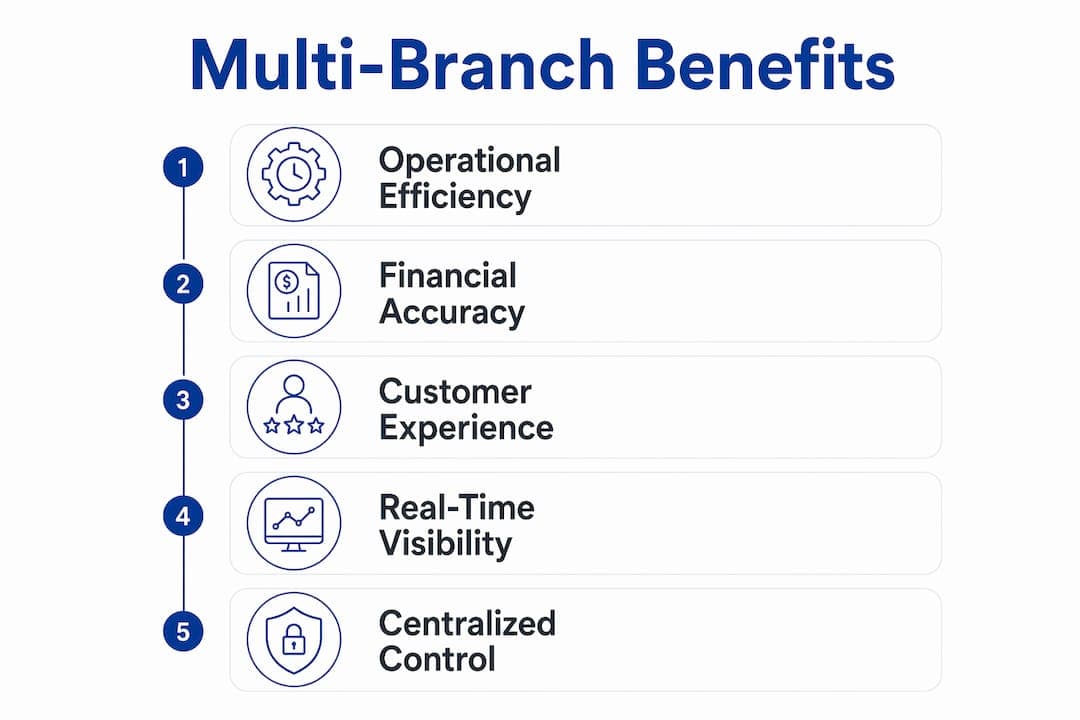
The benefits of multi-branch management fall into three categories: operational efficiency, financial accuracy, and customer experience.
Operational efficiency is the most immediate gain. Real-time visibility allows immediate corrective action, such as spotting a 30% revenue drop mid-shift that would otherwise surface only after a week. Automated cross-branch inventory transfers prevent unnecessary new vehicle orders by redistributing surplus fleet from one location to another. For a rental business, that means fewer idle cars at one branch while another turns away customers.
Financial accuracy improves because all branch data feeds into one accounting output. Centralized management can compress a monthly financial close from a full day per branch down to 20 minutes total. That is not a minor convenience. It frees your finance team to analyze performance rather than chase down numbers.
Customer experience becomes consistent across all locations. Standardized workflows protect brand reputation by preventing disparate service quality between branches. A customer who rents from your airport location and then your downtown branch expects the same contract process, the same pricing logic, and the same vehicle condition standards.
Key benefits at a glance:
Real-time revenue and fleet utilization dashboards across all branches
Automated inter-branch vehicle transfers to balance fleet demand
Unified pricing controls that prevent rate inconsistencies
Consolidated financial reporting for faster compliance and auditing
Role-based access so branch managers see only what they need
Pro Tip:Set a weekly cross-branch performance review using your centralized dashboard. Comparing branch metrics side by side takes 15 minutes and surfaces problems that would otherwise take weeks to appear in manual reports.
How does multi-branch management technology work in practice?
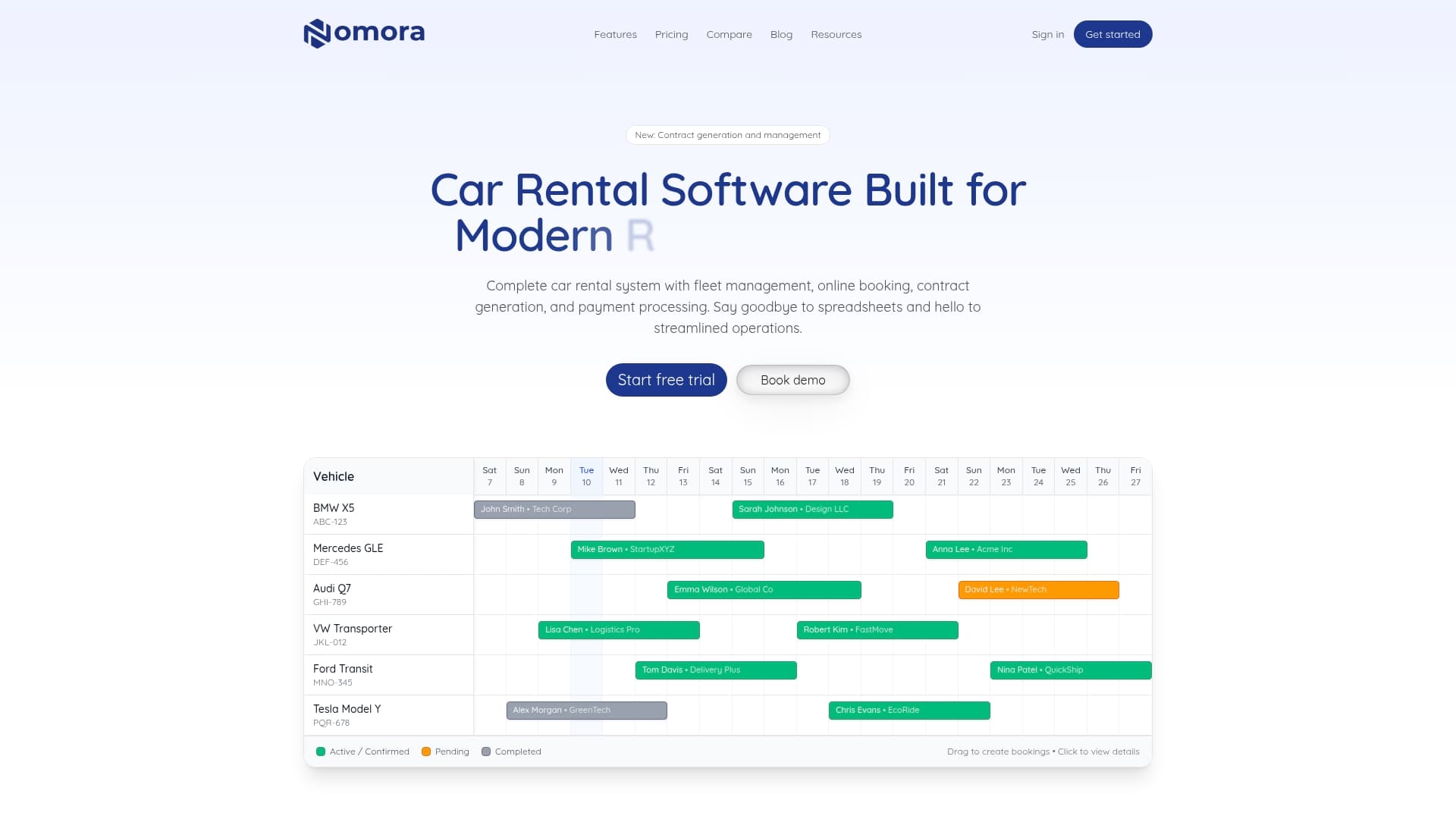
The technology behind multi-branch management centers on cloud-based software that syncs all branch data in real time. Effective multi-branch systems require centralized CRM with location-based lead routing, real-time dashboards for branch comparisons, and unified accounting outputs for compliance. For vehicle rental operators, this means one login gives you a live view of every vehicle, every booking, and every contract across your entire network.
Here is how the core components work together:
Cloud-based fleet management: Vehicle status, mileage, and availability sync across branches instantly. A car returned at Branch A can appear as available for Branch B within seconds.
Centralized CRM: Customer records, loyalty data, and rental history follow the customer, not the branch. Location-based lead routing sends inquiries to the nearest or most available branch automatically.
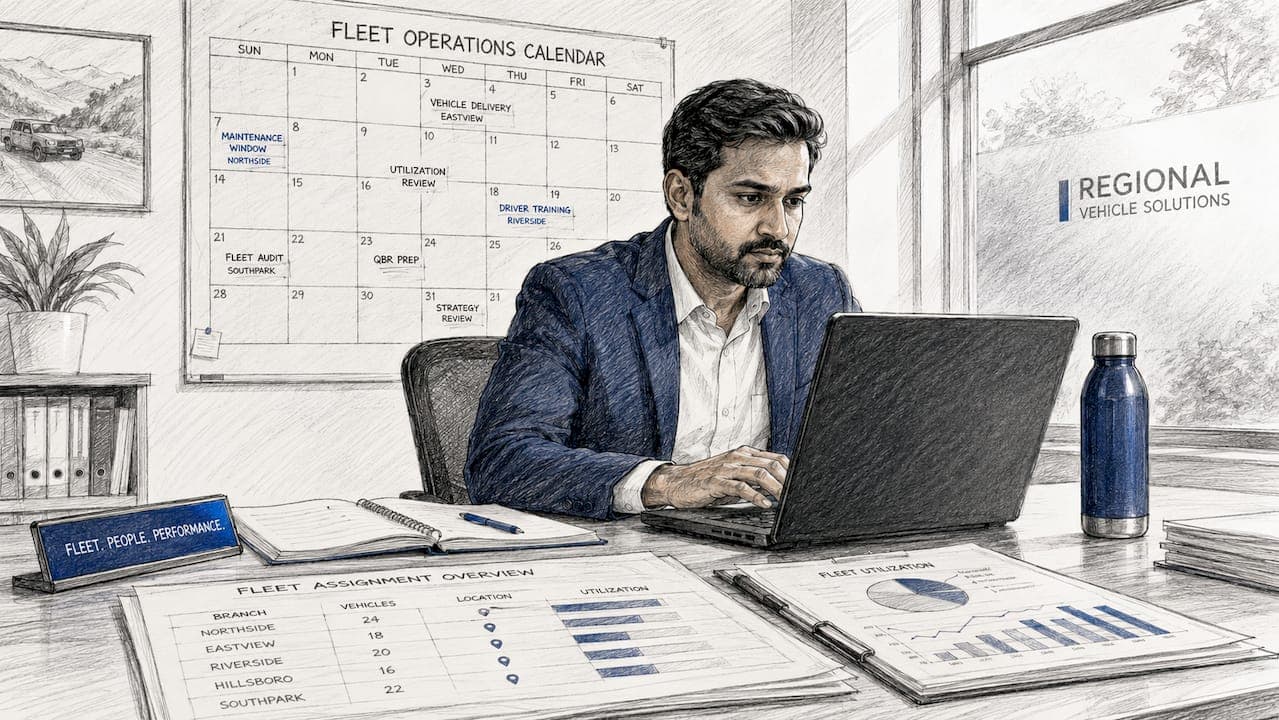
Real-time dashboards: Branch managers see their own metrics. Regional managers see comparisons across all branches. Ownership sees consolidated totals. Each level gets the data relevant to their role.
Automated inter-branch transfer tracking: When a vehicle moves between locations, the system logs the transfer, updates availability, and generates the necessary documentation automatically.
Role-based access control: Systems allow role-based configurations to maintain security and operational focus for different management levels. A branch manager cannot alter pricing set at the corporate level.
Integrating GPS tracking data into your multi-branch platform adds another layer of real-time fleet intelligence. You can see exactly where every vehicle is, confirm returns, and flag unauthorized use, all from the same dashboard you use to manage bookings.
Pro Tip:When evaluating multi-branch software, test the dashboard with data from at least three simulated branches before committing. A system that looks clean with one location often becomes cluttered and slow with five.
Feature
Single-branch system
Multi-branch platform
Fleet visibility
One location only
All branches, real time
Pricing control
Set per branch
Centralized with branch overrides
Financial reporting
Manual consolidation
Automated, unified output
Customer records
Branch-level only
Network-wide CRM
Access control
Basic user roles
Role-based, branch-specific
What are common challenges in multi-branch vehicle rental management?
Multi-branch operations introduce complexity that single-location businesses never face. The challenges are predictable, and knowing them in advance lets you build systems that prevent them rather than react to them.
Fragmented reporting. Manual branch reporting is highly unreliable. Branch managers may over-report sales or under-report vehicle damage, which distorts headquarters data. These data integrity problems compound with scale. By the time you have five branches reporting manually, your financial picture is fiction.
Inconsistent pricing and availability. Failing to standardize quoting and fleet availability across branches erodes brand equity through inconsistent customer experiences and review ratings. A customer who gets a different rate at two of your branches will not return to either.
Staff management across locations. Turnover is higher in distributed teams because branch-level managers often feel disconnected from company direction. Without centralized HR visibility, you may not know a branch is understaffed until it starts affecting customer wait times.
Inter-branch resource allocation. Moving vehicles between branches without a tracking system creates gaps in availability records. A car logged as "in transit" for two days is effectively invisible to your booking system.
Late adoption of centralized systems. Retrofitting multi-branch infrastructure after multiple locations are established is far more difficult than implementing it during early expansion. Data migration, staff retraining, and process redesign all cost more when done under operational pressure.
The most expensive mistake a multi-location rental operator can make is waiting until the pain is unbearable before adopting a unified system. By that point, bad data habits are baked into the culture, and fixing them takes longer than the software implementation itself.
Pro Tip:Audit your current branch reporting process before selecting software. If managers are copying data into email or spreadsheets, that behavior will continue unless the new system makes the correct process easier than the old one.
For a deeper look at how to address these operational gaps, the multi-location rental management guide from Nomora covers branch-specific strategies in detail.
How to implement multi-branch management in a vehicle rental business
Implementation follows a clear sequence. Skipping steps creates the exact fragmentation you are trying to eliminate.
Assess your readiness. Operational complexity increases sharply after 4–5 locations. Before that point, manual processes may suffice. At or beyond that threshold, centralized cloud-based management becomes necessary, not optional. If you are opening your third branch, start now.
Select software built for vehicle rental. Generic business management tools lack fleet-specific features like vehicle condition tracking, mileage-based pricing, and contract generation. Choose a platform designed for rental operations with native multi-branch support. Review the car rental software integrations guide to understand what API connections your chosen platform should support.
Standardize before you migrate. Define your pricing rules, fleet allocation policies, contract templates, and customer service workflows before loading them into the new system. Migrating inconsistent processes into a centralized platform just centralizes the inconsistency.
Train branch managers first. Branch managers are the adoption bottleneck. If they do not trust the system, they will maintain parallel spreadsheets as a backup. Train them on the dashboard, show them how it reduces their daily workload, and give them a direct line to support during the first 30 days.
Set up performance monitoring routines. Configure your dashboards to surface the metrics that matter most: fleet utilization rate, revenue per branch, average rental duration, and vehicle downtime. Review these weekly at the branch level and monthly at the network level.
Iterate based on data. After 60–90 days, your centralized data will reveal patterns that were invisible before. Use those patterns to adjust fleet allocation, staffing levels, and pricing by branch. This is where the investment pays off.
Pro Tip:Implement the system at your highest-volume branch first. Success there builds internal credibility and gives you a working model to replicate at other locations.
The 42-Point Car Rental Operations Checklist
The exact checks profitable rental operators run every week — free, straight to your inbox.
Fleet readiness & handover
Bookings & no-show prevention
Pricing & revenue reviews
Contracts & compliance
Payments & invoicing
Maintenance & fleet health
One email with the checklist. No spam, unsubscribe anytime.
Key Takeaways
Effective multi-branch management requires centralized software, standardized processes, and real-time data visibility across every location to protect fleet utilization, brand consistency, and financial accuracy.
Point
Details
Centralize early
Adopt unified systems by your third branch to avoid costly retrofitting later.
Real-time visibility matters
Live dashboards let you catch revenue drops and fleet gaps before they compound.
Standardize before migrating
Define pricing, contracts, and workflows first, then load them into the platform.
Role-based access protects data
Configure access levels so each management tier sees only what is relevant to their role.
Consistency drives brand trust
Uniform pricing and service quality across branches directly protects customer retention.
The case for treating multi-branch management as a long-term investment
Most operators I have worked with treat multi-branch software as a one-time fix. They implement it, feel the immediate relief, and then stop paying attention to how the system evolves with their business. That is where the real risk sits.
The businesses that get the most out of centralized management are the ones that treat it as a continuous process. They review their dashboards weekly, adjust fleet allocation monthly, and revisit their pricing rules every quarter. The platform gives you the data. What you do with it determines whether you grow or plateau.
The next frontier is integrating telematics and GPS data directly into the multi-branch platform. When you can see real-time vehicle location, fuel level, and mileage alongside your booking and revenue data, fleet decisions become genuinely predictive rather than reactive. AI-driven analytics for demand forecasting by branch is already available in enterprise-grade platforms, and it will become standard across mid-market rental software within the next few years.
My strongest advice: do not wait for the pain to force your hand. The operators who implement centralized management at branch two or three scale with far less friction than those who retrofit it at branch eight. The data habits, the staff training, and the process discipline are all easier to build early. And the competitive advantage of having clean, real-time data across your entire network compounds over time in ways that are very difficult for late adopters to close.
— Dizzy
Nomora's approach to multi-branch rental operations
Nomora is built specifically for vehicle rental businesses that need to manage bookings, fleet, contracts, and payments across multiple locations from one platform.
Adding a new branch in Nomora takes hours, not weeks. The platform syncs fleet availability, customer records, and financial data across all locations in real time. Role-based access means your branch managers see what they need, and your finance team sees everything. Automated contract generation and payment processing reduce the manual work that typically multiplies with each new location. Explore the full range of rental business use cases to see how Nomora supports operations at every scale, from independent operators to franchise networks. For a complete overview of platform capabilities, visit the car rental software page.
FAQ
What is the multi-branch management definition?
Multi-branch management is the centralized coordination of financial, inventory, and staff operations across multiple business locations through a single unified system. It replaces fragmented local processes with real-time, network-wide visibility.
When should a vehicle rental business adopt multi-branch management?
Operational complexity increases sharply after 4–5 locations, making centralized cloud-based management necessary at that point. Adopting the system at branch two or three avoids the harder and more expensive process of retrofitting later.
How does multi-branch management improve fleet utilization?
Centralized systems enable automated inter-branch vehicle transfers, redistributing surplus fleet from low-demand branches to high-demand ones. This prevents idle vehicles at one location while another turns away customers.
What are the biggest challenges in multi-branch management?
The most common challenges are fragmented manual reporting, inconsistent pricing across branches, and late adoption of centralized systems. Each of these compounds with scale, making early standardization the most effective prevention.
How does role-based access work in multi-branch software?
Role-based access control lets administrators configure what each management level can view and edit. Branch managers see their own location's data, regional managers see branch comparisons, and ownership sees consolidated network totals.