Digital contract generation automates the creation of legally binding contracts using templates and dynamic data, reducing drafting time and errors. It integrates with business systems like CRM and ERP, enabling real-time data transfer and operational workflows. Successful adoption requires standardizing templates, refining data intake processes, and maintaining human legal review.
Digital contract generation is the automated creation of legally binding contracts using predefined templates, dynamic data fields, and clause libraries to replace manual drafting. For business owners managing high volumes of agreements, this process cuts drafting time from hours to minutes, reduces human error, and embeds compliance requirements directly into every document produced. The industry term for the broader discipline is Contract Lifecycle Management (CLM), and digital contract generation sits at its core. Understanding what this process involves, how it integrates with your existing systems, and where it typically breaks down gives you a clear framework for making the right adoption decisions.
What is digital contract generation and how does it work?
Digital contract generation automates contract creation using templates, clause libraries, and dynamic data fields, reducing drafting time from hours to minutes. The system pulls structured data from intake forms or connected business platforms, inserts it into the correct contract fields, and applies pre-approved legal language based on the contract type. The result is a fully structured, policy-compliant document produced with minimal human input.
The technology behind this process typically combines document automation software, a clause library, and a rules engine. The rules engine determines which clauses apply based on variables like contract value, jurisdiction, or counterparty type. AI-driven systems using Natural Language Processing can interpret user requirements and suggest appropriate language, though human review remains the final check on legal accuracy.
This is not simply a digital version of a Word document. True digital contract generation creates a living document connected to business data, audit trails, and workflow triggers. When a contract is signed, it can automatically trigger payment schedules, renewal reminders, or compliance alerts, making it a functional part of your operations rather than a static file.
What are the key stages in the digital contract creation process?
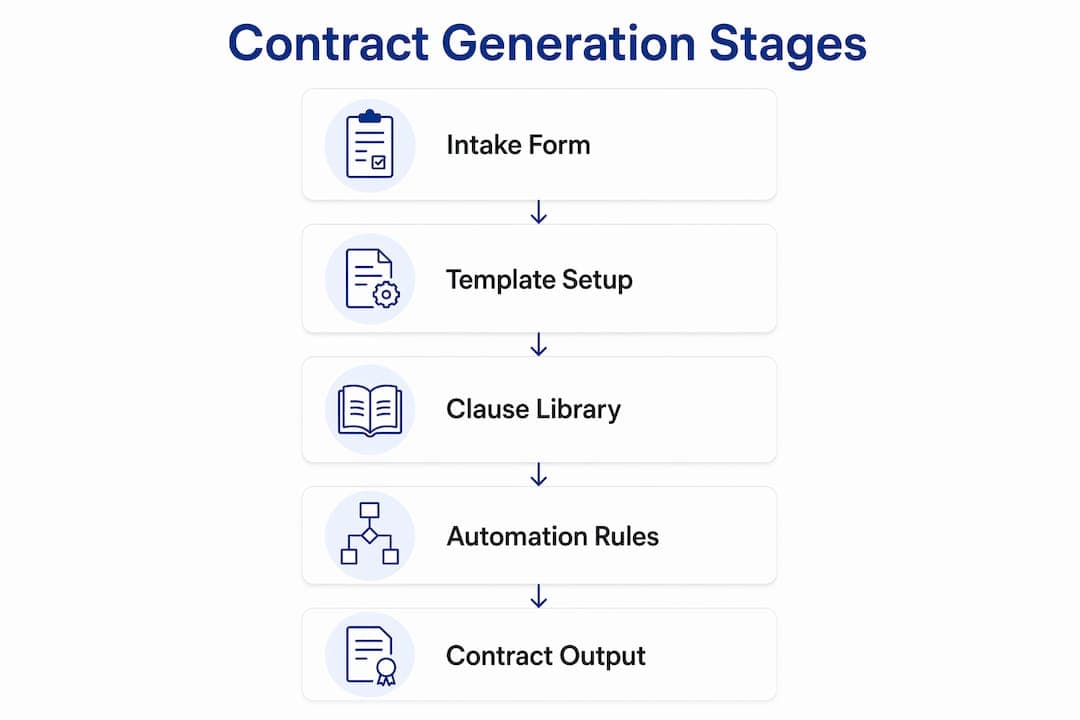
The digital contract workflow follows six core stages, each designed to reduce manual effort and embed organizational policy into the output. Skipping any stage increases the risk of errors, rogue versions, or compliance gaps.
Define requirements. The requesting party specifies the contract type, parties involved, key terms, and any special conditions. Centralized intake forms capture this data in a structured format.
Select template. The system matches the requirements to the appropriate pre-approved template from the clause library. Templates are modular, allowing approved clauses to be swapped in or out based on the rules engine.
Automate drafting. Data from the intake form or connected CRM/ERP system populates the template fields automatically. AI tools can flag missing data or suggest clause alternatives at this stage.
Legal review. A qualified reviewer checks the generated draft for accuracy, edge cases, and any terms that fall outside standard parameters. This step is not optional, even with mature automation.
Electronic execution. The contract is sent for e-signature through an integrated digital signature platform. Electronic signatures carry legal weight under frameworks like the U.S. ESIGN Act and the EU eIDAS regulation.
Storage and tracking. The executed contract is stored in a centralized cloud repository with metadata tags for renewal dates, obligations, and counterparty details, enabling real-time visibility into your entire contract portfolio.
Pro Tip:Build your intake form before you build your templates. The quality of your data input determines the quality of your generated contract. A poorly structured intake form produces contracts that require heavy manual correction, defeating the purpose of automation.
How does digital contract generation integrate with business systems?
Integration is where digital contract generation moves from a document tool to an operational asset. CRM and ERP platforms like Salesforce, SAP, and Oracle can auto-populate contract fields with customer data, pricing, and terms, eliminating manual data entry entirely for those fields. That single capability removes a major source of errors and prevents revenue leakage caused by incorrect pricing or missed obligations.
A well-integrated contract generation setup typically connects the following components:
CLM platform: Manages the full contract lifecycle from request to renewal, providing a single source of truth for all agreements.
CRM system: Feeds customer and deal data directly into contract templates at the point of generation.
ERP system: Supplies pricing, product, and vendor data to populate commercial terms accurately.
E-signature platform: Handles electronic execution with a legally valid audit trail.
Document repository: Stores executed contracts with searchable metadata for renewals, obligations, and compliance tracking.
Centralized cloud repositories provide real-time contract visibility into metadata, milestones, and renewal dates. That visibility prevents the common problem of contracts expiring unnoticed or auto-renewing on unfavorable terms. For businesses managing dozens or hundreds of active agreements, this alone justifies the investment in a connected system.
Pro Tip:Map your data flows before selecting software. Know exactly which system holds the authoritative version of customer names, pricing, and payment terms. If two systems hold conflicting data, your generated contracts will reflect that conflict.
Nomora's integration capabilities for car rental operations demonstrate how connecting contract generation with payment gateways and fleet management systems creates a fully automated operational loop, from booking to signed agreement to payment collection.
What are the benefits and challenges of adopting digital contract generation?
The benefits of digital contracts are concrete and measurable. AI-driven systems can produce a fully structured contract in under 10 minutes given basic inputs like party names and payment terms. That speed advantage compounds across hundreds of contracts per month, freeing legal and operations teams for higher-value work.
Key benefits include:
Faster turnaround. Contracts that previously took days of back-and-forth drafting are generated in minutes, accelerating deal cycles.
Fewer errors. Standardized templates with pre-approved language eliminate the copy-paste mistakes and outdated clauses common in manual drafting.
Built-in compliance. Organizational policies and regulatory requirements are embedded in templates, so every generated contract meets baseline standards automatically.
Full audit trail. Every version, edit, and approval is logged, giving you defensible documentation if a dispute arises.
Operational visibility. A centralized repository with metadata tracking means you always know which contracts are active, expiring, or in negotiation.
The challenges are equally real. The primary obstacle is not the technology itself but the state of your existing contract library. Businesses that automate disorderly, inconsistent templates accelerate the production of flawed agreements. Auditing and standardizing your clause library before automation is not optional preparation. It is the work that determines whether automation succeeds or fails.
Resistance to change and the absence of standardized data intake processes are the main hurdles to successful adoption, not software complexity. Teams accustomed to drafting contracts in email threads or shared drives often push back on structured intake forms and approval workflows. Change management and clear internal communication matter as much as the software configuration.
What best practices maximize digital contract generation success?
Successful implementation follows a clear pattern. Businesses that get it right treat the process as a workflow redesign project, not a software installation.
Audit your contract library first. Catalog every contract type your business uses. Identify which templates are current, which are outdated, and which can be consolidated. Standardizing templates before automation is more critical than any technology choice.
Build centralized intake forms. Standardized intake processes prevent rogue contract versions and protect data integrity from the start of every generation request.
Start with low-risk, high-volume contracts. NDAs, service agreements, and standard vendor contracts are ideal first candidates. Phased rollouts starting with simpler agreements build internal confidence and allow you to refine automation logic before tackling complex deals.
Keep human review in the workflow. AI tools reduce repetitive drafting tasks but do not replace legal judgment. Build a review step into every contract type, even if it becomes a quick spot-check for standard agreements over time.
Schedule regular template maintenance. Laws change, business terms evolve, and approved clause language needs updating. Assign ownership of the template library to a specific person or team and set a review cadence, at minimum annually.
Pro Tip:Pilot your automation with one contract type for 30 days before expanding. Measure error rates, turnaround time, and user feedback. The data from that pilot will tell you exactly what to fix before you scale.
For car rental businesses, Nomora's approach to automating rental contracts illustrates how these best practices apply in a high-volume, time-sensitive environment where every booking generates a contract that must be accurate and signed before keys change hands.
The 42-Point Car Rental Operations Checklist
The exact checks profitable rental operators run every week — free, straight to your inbox.
Fleet readiness & handover
Bookings & no-show prevention
Pricing & revenue reviews
Contracts & compliance
Payments & invoicing
Maintenance & fleet health
One email with the checklist. No spam, unsubscribe anytime.
Key Takeaways
Digital contract generation succeeds when businesses standardize their templates and data intake processes before deploying automation technology.
Point
Details
Core definition
Digital contract generation automates legally binding agreements using templates, clause libraries, and dynamic data fields.
Six-stage workflow
The process runs from requirement definition through template selection, drafting, review, e-signature, and centralized storage.
Integration drives value
Connecting to CRM, ERP, and e-signature platforms eliminates manual data entry and prevents revenue leakage.
Start with NDAs and standard service agreements to build confidence and refine logic before scaling.
The part most businesses get wrong about contract automation
Most businesses I have seen approach digital contract generation as a technology purchase. They evaluate software features, compare pricing tiers, and sign a contract with a CLM vendor. Then they spend the next six months wondering why the system is not delivering the promised efficiency gains.
The uncomfortable truth is that the technology is rarely the problem. The problem is almost always the contract library and the data. Teams have been drafting contracts in slightly different ways for years, accumulating dozens of near-identical templates with small but legally significant differences. When you automate that chaos, you produce flawed agreements faster than before.
The businesses that get real value from contract automation spend the first phase of their project doing something unglamorous: reading every contract template they own, merging duplicates, updating outdated language, and building a clean clause library. That work takes weeks, not days. But it is the only foundation that holds.
The second thing most businesses underestimate is user adoption. Full digital contract lifecycle management requires real-time collaboration and structured workflows. That means your sales team cannot email a contract draft to a client from their personal template anymore. That change in behavior requires clear leadership, not just a software mandate.
AI contract generation tools are genuinely useful. They reduce the time your legal team spends on repetitive drafting and free them to focus on the agreements that actually need careful thought. But AI acts as a drafting assistant, not a legal substitute. The businesses that treat it as a replacement for legal review are the ones that end up with signed agreements containing errors nobody caught.
— Dizzy
How Nomora handles contract generation for rental businesses
Nomora is built around the reality that car rental businesses generate contracts at high volume, under time pressure, and with zero tolerance for errors in pricing or terms.
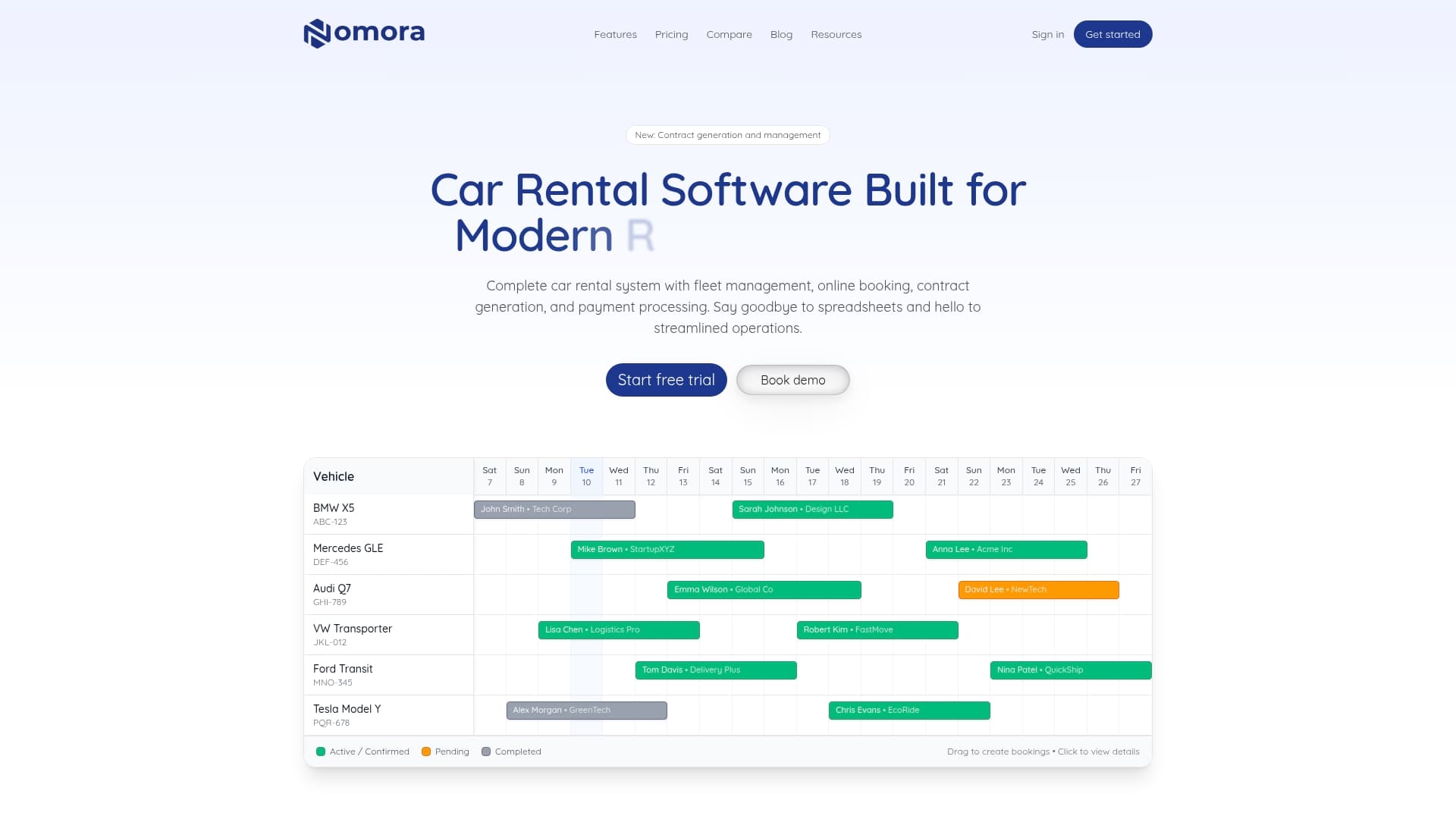
The platform acts as the central nervous system of a rental operation, connecting reservations, fleet data, customer records, and payment processing into a single workflow that generates accurate rental agreements automatically. Every contract reflects current pricing, vehicle details, and customer information pulled directly from the system, with no manual entry required. Nomora supports businesses from independent operators to franchise networks, with setup completed in 24–48 hours. Explore Nomora's use cases to see how different rental business types use contract automation in practice, or review the automated payment features that connect directly to the contract workflow.
FAQ
What is digital contract generation in simple terms?
Digital contract generation is the automated process of creating legally binding contracts using pre-built templates and data inputs, replacing manual drafting. It reduces contract creation time from hours to minutes.
How do I generate digital contracts for my business?
Start by auditing your existing contract templates, building standardized intake forms, and selecting a CLM or document automation platform that integrates with your CRM or ERP system. Begin with simple, high-volume contract types like NDAs before expanding to complex agreements.
What software is used for digital contract generation?
Digital contract software typically includes a CLM platform, a document automation engine, an e-signature tool, and a centralized cloud repository. These components connect with CRM systems like Salesforce and ERP platforms like SAP or Oracle to auto-populate contract data.
What are the main benefits of digital contracts over paper contracts?
Digital contracts are faster to produce, contain fewer errors, carry a full audit trail, and store automatically in searchable repositories. They also support electronic signatures that are legally valid under frameworks like the U.S. ESIGN Act.
Is AI reliable enough to generate contracts without human review?
AI tools are reliable for generating standard contract drafts from approved templates, but human legal review remains necessary for accuracy. AI reduces repetitive drafting work; it does not replace legal judgment on complex or non-standard terms.