A centralized reservation system manages vehicle bookings, pricing, and inventory across all sales channels in real time. It prevents double bookings, protects revenue, and supports multi-location operations through instant synchronization and integrated fleet management. Proper implementation and discipline ensure the system becomes the core of efficient, error-free vehicle rental business operations.
A centralized reservation system (CRS) is defined as a unified software platform that manages vehicle inventory, pricing, and bookings across all sales channels from a single control point. In the vehicle rental industry, this is the operational backbone that connects your direct booking website, third-party agencies, call center staff, and walk-in counters into one synchronized workspace. Platforms like Nomora are built specifically around this model, replacing spreadsheets and disconnected tools with real-time data visibility. Understanding what is centralized reservation means understanding how modern rental businesses prevent overbooking, protect revenue, and meet the expectations of customers who now demand instant, self-service booking options.
What is centralized reservation and how does it work?
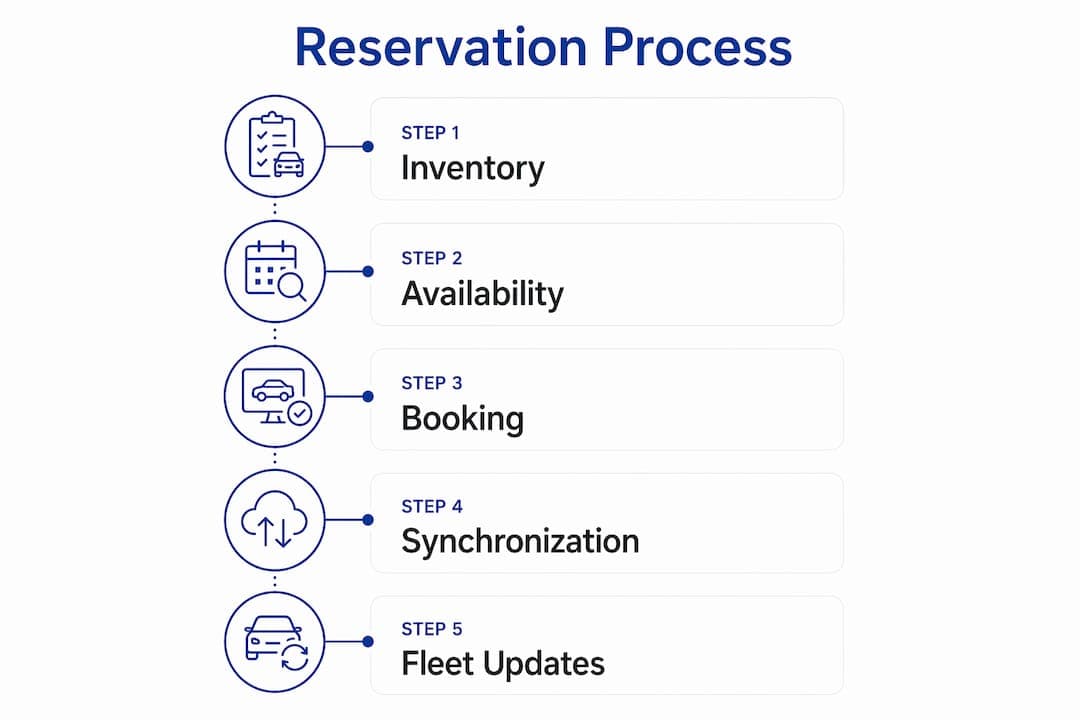
A CRS acts as the single source of truth for inventory, pricing, and reservation data, synchronizing availability in real time across all connected platforms within milliseconds. That speed matters because a vehicle confirmed on one channel must immediately disappear from every other channel. Without that instant update, two customers book the same car, and your staff spends the next hour managing the fallout.
The mechanics work like this: when a customer books a sedan through your website, the CRS pushes that update simultaneously to your OTA listings, your call center dashboard, and any partner agency portals. The system does not wait for a nightly batch sync. It processes the change immediately and propagates it everywhere at once.
Cloud-based infrastructure makes this possible at scale. Modern CRS platforms support 150 or more distribution channels simultaneously and include automated reconciliation to keep financial records aligned with booking activity. That reconciliation alone eliminates hours of manual cross-checking each week.
The connection to fleet operations is equally important. A well-integrated CRS does more than confirm a booking. It triggers real-time updates in maintenance and check-in modules so your team knows which vehicles need to be cleaned, inspected, and staged before a customer arrives. Without that link, you can have a confirmed booking and an unavailable vehicle at the same time.
Pro Tip:Before selecting a centralized booking system, verify that it integrates directly with your fleet maintenance software. A CRS that cannot communicate with your operational systems creates the same gaps you were trying to close.
What are the key benefits of centralized reservations for rental businesses?
The benefits of centralized reservations go well beyond avoiding double bookings. Here are the most significant operational and financial gains vehicle rental businesses report after adopting a CRS:
Eliminated pricing drift. Manual rate updates across multiple portals lead to inconsistent pricing and lost revenue. A CRS automates rate propagation across every booking channel simultaneously, so your weekend rate on your website matches your OTA listing and your call center quote every time.
Reduced administrative overhead. Fragmented systems force staff to log into multiple platforms, reconcile conflicting data, and manually update availability. A centralized booking system collapses that work into a single interface, freeing your team for customer-facing tasks.
Better customer self-service.Over 70% of travelers preferred online self-service booking channels as of late 2025, and 94% said they would switch providers for a better online booking experience. Those numbers reflect a clear shift in customer expectations that a CRS directly addresses by powering real-time availability on your booking page.
Stronger reporting and fleet decisions. Centralized booking data enables accurate reporting of economic impact and supports justification for fleet expansion. When all your reservation data flows into one system, you can see which vehicle categories are underperforming, which locations are at capacity, and where to invest next. That analysis is nearly impossible with siloed spreadsheets.
The financial case is straightforward. Pricing consistency protects margin. Reduced manual labor cuts cost. Better data drives smarter investment. These are not incremental improvements. They compound over time.
How does a CRS compare to a PMS or channel manager?
Many rental operators confuse a CRS with related systems. The distinctions matter when you are deciding what to buy and how to connect your tools.
System
Primary function
Scope
CRS (Central Reservation System)
Manages distribution, pricing, and bookings across all channels
A CRS manages distribution and bookings across channels, while a PMS handles granular on-site operational details like vehicle maintenance and check-out workflows. Think of the CRS as the command layer that controls what the outside world sees, and the PMS as the engine room that keeps vehicles ready to deliver. A channel manager sits between the CRS and OTAs, but it does not enforce business rules or manage the full booking lifecycle the way a CRS does.
The most effective rental operations integrate all three. The CRS controls pricing and availability. The PMS tracks vehicle readiness. The channel manager distributes to booking platforms. Gaps between these systems create the operational failures that damage customer trust.
Pro Tip:If your current setup uses a channel manager without a true CRS behind it, you are distributing availability without enforcing rate parity or business rules. That is a revenue leak worth fixing before you scale.
Best practices for implementing a centralized reservation platform
Deploying a centralized reservation platform requires more than flipping a switch. These are the practices that separate successful rollouts from costly restarts:
Plan for a 24–48 hour sync window. Initial inventory, pricing, and customer data synchronization typically takes 24–48 hours to complete. Schedule your go-live during a low-demand period to minimize disruption.
Standardize your data before migration. Inconsistent vehicle category names, rate codes, and customer records create sync errors. Clean your data first. A CRS can only organize what you give it.
Build in offline capability. Offline mode or cached availability data is critical insurance for rental staff during cloud or internet outages. Confirm your platform supports this before signing a contract. An operational freeze during a connectivity issue is an avoidable problem.
Train staff on the new workflow, not just the software. The technology is only as effective as the people using it. Staff who revert to spreadsheets or manual overrides undermine the system's integrity. Invest in structured onboarding and define clear escalation paths for edge cases.
Automate commission reconciliation. Partner bookings through agencies and OTAs generate commission obligations. Manual reconciliation of those payments is error-prone and time-consuming. A CRS with built-in automated commission calculations removes that burden and reduces disputes with partners.
Support multi-location operations from day one. If you operate more than one branch or plan to expand, confirm your CRS handles location-level inventory separately while still giving you a consolidated view. That architecture is what makes franchise networks function without chaos.
The cloud infrastructure benefits for multi-location operations are significant. Cloud-based systems allow managers at any location to see real-time fleet status, accept bookings, and access customer records without being physically present at a specific branch.
Key takeaways
A centralized reservation system is the single most impactful operational investment a vehicle rental business can make to protect revenue, reduce errors, and scale efficiently.
Point
Details
CRS is the single source of truth
It synchronizes inventory, pricing, and bookings across all channels in real time.
Integration with operations is non-negotiable
A CRS must connect to fleet and maintenance systems or confirmed bookings may go unfulfilled.
Rate parity protects revenue
Automated rate updates across all channels prevent pricing drift and margin loss.
Customer self-service drives retention
Over 70% of travelers prefer online booking; a CRS powers that experience directly.
Implementation requires preparation
Plan for a 24–48 hour sync window, clean data migration, and offline failover capability.
The 42-Point Car Rental Operations Checklist
The exact checks profitable rental operators run every week — free, straight to your inbox.
Fleet readiness & handover
Bookings & no-show prevention
Pricing & revenue reviews
Contracts & compliance
Payments & invoicing
Maintenance & fleet health
One email with the checklist. No spam, unsubscribe anytime.
Why incomplete centralization is the real risk
I have worked with rental operators who invested in a CRS and still struggled. The pattern is almost always the same. They deployed the booking layer but left the operational side disconnected. Reservations flowed in cleanly. Vehicles were not ready. Customers arrived to find their booking confirmed and their car in the shop.
The technology is not the hard part. The hard part is convincing your team that the system is the authority. When a manager overrides availability manually because they "know" a car will be back by noon, they break the integrity of the entire platform. One manual override creates a ripple that the CRS cannot account for.
The operators who get the most value from centralization are the ones who treat the system as the central nervous system of the business. Every booking, every rate change, every vehicle status update flows through it. Nothing happens outside it. That discipline is what turns a software purchase into a genuine competitive advantage.
The data analytics potential is also consistently underused. Rental managers who review their aggregated booking data monthly make better fleet decisions than those who rely on gut feel. Which vehicle class fills fastest on weekends? Which location has the highest cancellation rate? A CRS answers those questions automatically. Most operators never ask them.
My honest advice: before you evaluate any platform, map out every place a booking currently touches your business. Website, phone, walk-in, agency, corporate account. If any of those channels operates outside your central system after implementation, you have not centralized. You have added another silo.
— Dizzy
How Nomora handles centralized vehicle rental reservations
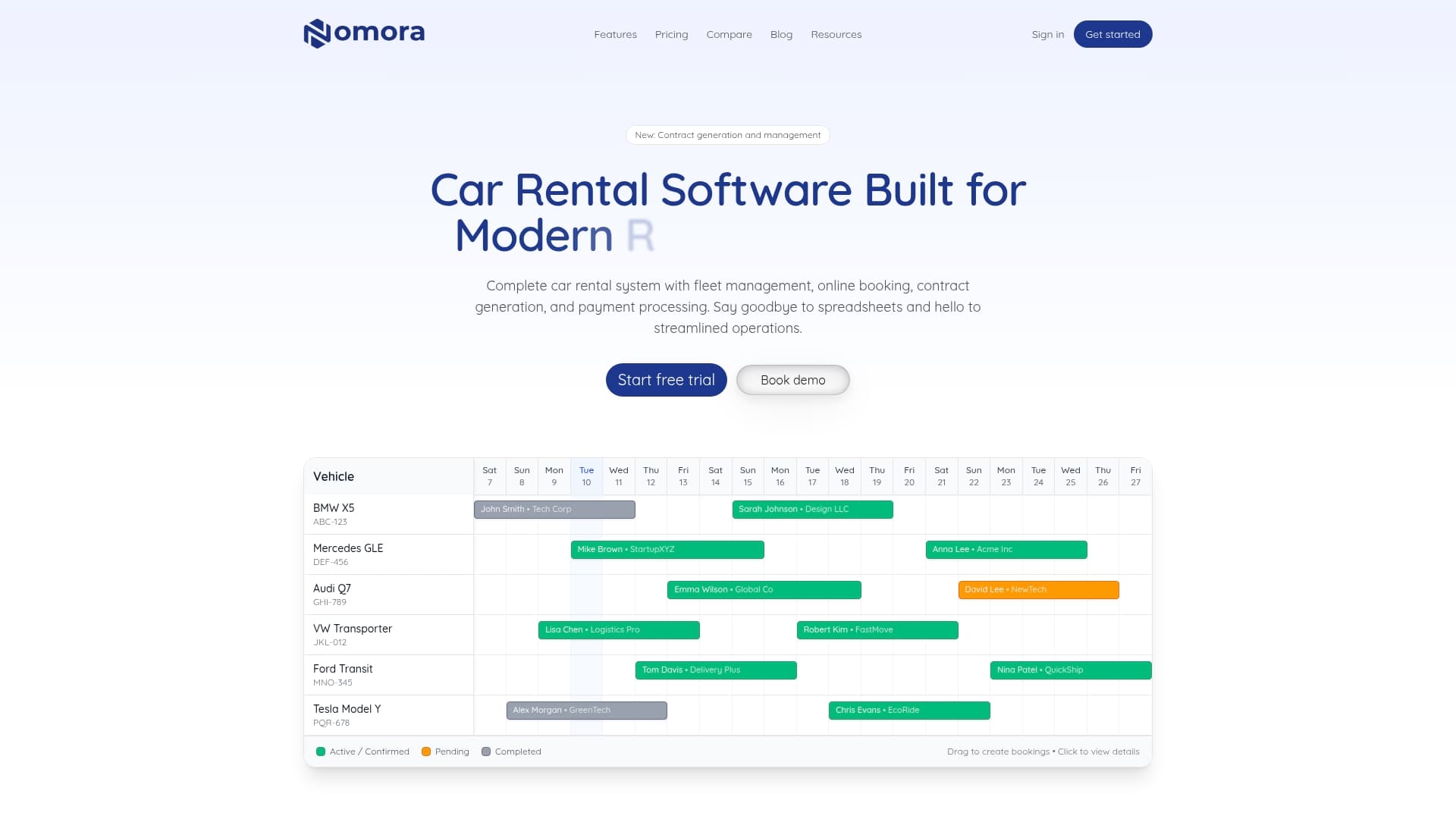
Nomora is a cloud-based car rental management platform built around the CRS model. It handles reservations, fleet management, contract generation, payments, and customer data in one integrated system. Setup takes 24–48 hours, and the platform supports multi-location operations, real-time inventory synchronization, and automated commission reconciliation for partner bookings. Nomora connects with GPS tracking systems and payment gateways, so your operational and financial data stay aligned without manual intervention. If you manage a single location or a franchise network, the platform scales to fit. Explore rental software use cases to see how Nomora applies to your specific business type and booking volume.
FAQ
What is a centralized reservation system in simple terms?
A centralized reservation system is software that manages all vehicle bookings, pricing, and availability from one platform. It updates every connected sales channel instantly when a booking is made or a rate changes.
How do centralized reservations prevent double bookings?
A CRS updates inventory across all channels within milliseconds of a confirmed booking. That real-time synchronization removes the vehicle from availability everywhere else before a second customer can select it.
What is the difference between a CRS and a channel manager?
A channel manager distributes availability to OTAs but does not enforce business rules or manage the full booking lifecycle. A CRS controls pricing logic, rate parity, and the complete reservation process across all channels.
How long does it take to set up a centralized booking system?
Initial inventory, pricing, and customer data synchronization typically takes 24–48 hours. Full staff training and workflow alignment may require additional time depending on the size of your operation.
Can a centralized reservation platform support multiple rental locations?
Yes. Cloud-based CRS platforms manage location-level inventory separately while providing a consolidated view for managers. That architecture is what allows franchise networks and multi-branch operators to function from a single system.