What should you look for in car sharing software?
The right platform is the central nervous system of your operation. Choose the wrong one and every manual workaround compounds as your fleet grows. Use this checklist before you sit down with any vendor.
Must-have capabilities:
- Conflict-free booking engine with real-time availability
- Fleet management dashboard with GPS tracking and vehicle health
- Keyless access (BLE, OBD-II, or OEM API integration)
- Integrated billing with automated invoicing and payment processing
- ID verification and driver license validation
- Scalable architecture that handles peak load without degraded performance
- Role-based backoffice access and audit trails for compliance
Questions to ask vendors during discovery:
- Which telematics partners do you support natively, and what is the integration effort for hardware we already own?
- Do you offer white-label iOS and Android apps, or only co-branded options?
- What are your SLA uptime commitments, and how are incidents communicated?
- What is the total cost of ownership across setup fees, per-vehicle fees, and transaction fees?
- Can we access a sandbox environment and sample API payloads before signing?
Red flags to watch for: hidden per-transaction fees that scale painfully at volume, telematics support limited to one or two hardware brands, no white-label mobile app option, and booking conflict resolution that requires manual operator intervention.
Pricing primer: most vendors structure fees as a monthly per-vehicle SaaS subscription, a revenue-share percentage, or a hybrid with a setup fee. Per-vehicle pricing is the most predictable for budget planning. Review Nomora's pricing structure to benchmark against vendor quotes you receive.

Think of the platform as a set of interlocking modules. Each one handles a distinct operational job, and gaps in any module create manual workarounds that slow your team down.
Core modules every operator needs:
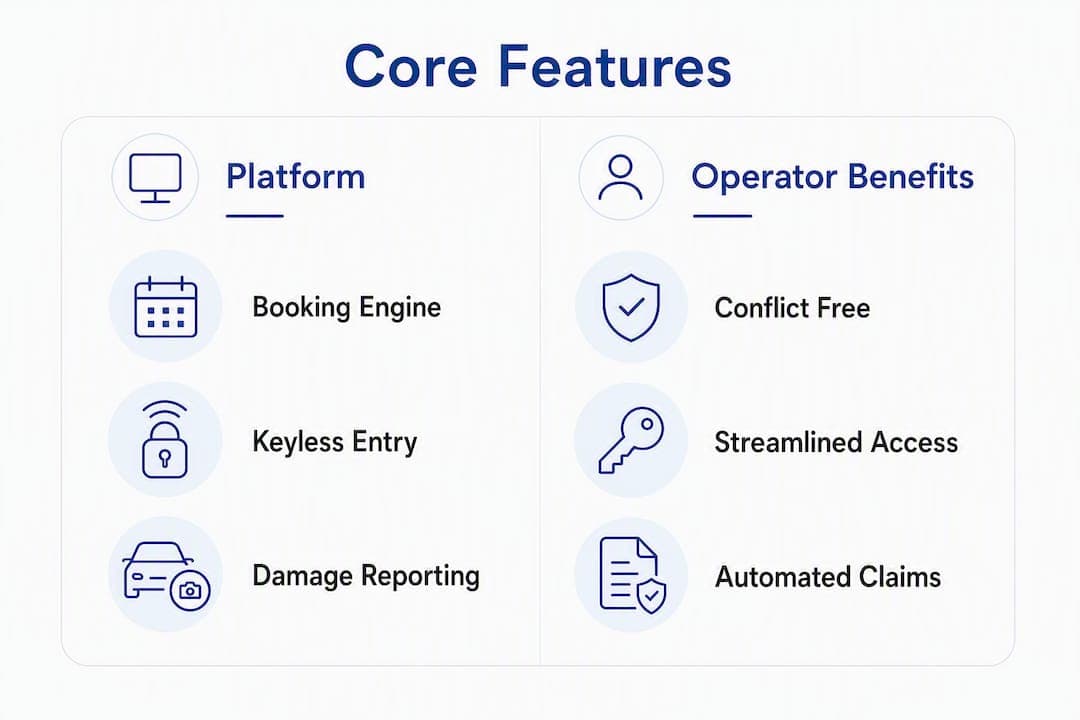
| Core feature | Operator benefit |
|---|
| Conflict-free booking engine | Fewer manual overrides and double-bookings |
| GPS and telematics integration | Real-time fleet visibility and faster incident response |
| Automated billing and invoicing | Reduced accounts-receivable workload |
| ID verification workflows | Lower fraud risk and faster driver onboarding |
| Damage reporting with photo capture | Cleaner dispute resolution and insurance claims |
| Analytics dashboard | Data-driven decisions on pricing and fleet sizing |
Nomora's all-in-one platform covers every module in this table, replacing the spreadsheets and disconnected tools that slow most early-stage operators down.
Pro Tip: At pilot stage, prioritize booking, payments, and keyless access. Add damage reporting workflows and advanced analytics once you have real trip data to act on. Trying to configure every module before launch delays your go-live date without improving your first 30 days of learning.
What should rider and operator apps actually do?
Consumer-facing services like Zipcar have set a high bar for rider expectations: instant booking, phone-based unlock, and a clean post-trip invoice delivered automatically. Your platform needs to match that baseline or riders will churn before your first month closes.
The rider flow your app must support:
- Account signup with ID and license verification
- Browse available vehicles by location or time window
- Confirm booking and receive confirmation
- Unlock the vehicle via the mobile app (BLE or OEM API)
- Complete the trip and lock the vehicle through the app
- Receive an automated invoice with trip summary
Operator app and backoffice capabilities to require:
- Live dashboard showing all active trips and vehicle locations
- Manual unlock and remote immobilization for emergencies
- Trip audit log with timestamps, GPS trace, and odometer readings
- Maintenance workflow to flag vehicles out of service and schedule returns
- Push notification tools for rider communications
On the white-label question: a fully white-labeled iOS and Android app gives you brand control from day one and avoids the awkward co-branded experience that confuses riders about who they are actually renting from. Speed to market matters, but brand consistency matters more at scale. Platforms that offer white-label apps paired with trusted telematics partners are the recurring pattern among vendors that successfully support fleets growing across multiple markets.
Pro Tip: Track mobile onboarding completion rates from your first week of pilot. A drop-off above 30% at the ID verification step usually signals a friction point in the verification flow, not a problem with your marketing. Fix the UX before you scale acquisition spend.

How do hardware, telematics, and keyless access work together?
Hardware choice shapes your installation timeline, your per-vehicle cost, and which vehicles you can actually put into service. There is no universally correct answer, but the trade-offs are clear.
| Connectivity type | How it works | Key trade-off |
|---|
| OBD-II dongle | Plugs into the vehicle's OBD port; provides GPS, lock/unlock, and basic diagnostics | Fastest install; limited to vehicles with accessible OBD port |
| Dedicated telematics box | Hardwired unit with GPS, immobilizer, and BLE; deeper diagnostics | 30–60 minutes per vehicle to install; most reliable offline operation |
| BLE module | Enables keyless unlock via rider's phone in low-network environments | Requires pairing with another connectivity layer for full telemetry |
| OEM API (software-only) | Uses the vehicle manufacturer's connected-car API for lock/unlock and telemetry | No installation cost; restricted to compatible models with active connectivity subscriptions |
Hardware installs for dedicated telematics boxes typically take 30–60 minutes per vehicle, and BLE-enabled devices can unlock vehicles even without cell coverage, which matters in underground parking structures. Software-only connectivity via OEM APIs avoids that installation entirely, but it locks you to vehicle models with manufacturer-supported connectivity. Run a vehicle-compatibility audit before committing to a software-only path.
Practical planning steps:
- Pilot with a mixed hardware set (OBD-II plus one dedicated box) to compare reliability before standardizing
- Verify OEM API coverage for every vehicle model in your fleet before selecting a software-only approach
- Confirm that your platform vendor supports OTA firmware updates for hardware devices
- Test offline unlock behavior in your actual parking locations before launch
Which deployment model fits your operation?
The model you choose determines how your platform must be configured, what your operational burden looks like day-to-day, and how vendors will structure your fees.
Station-based: vehicles live at fixed locations and riders return them to the same spot. Inventory management is predictable, but utilization depends on station placement. Platform requirements include zone-based availability rules and station capacity limits. Fee structures tend to be straightforward per-vehicle subscriptions.
Free-floating: vehicles can be picked up and dropped off anywhere within a defined geofence. Redistribution becomes a real operational cost as vehicles cluster in high-demand areas. The platform must handle dynamic geofencing, parking zone validation, and automated pricing zones. Vendors often charge a higher per-vehicle fee or add a per-transaction component to cover the complexity.
Peer-to-peer (P2P): private vehicle owners list their cars for other drivers to rent. P2P platforms like Turo demonstrate that trust mechanisms, including ID verification, damage reporting, and clear insurance workflows, are non-negotiable when non-commercial owners participate. Platform requirements include owner-side dashboards, payout workflows, and dispute resolution tools. This model carries the highest insurance and verification complexity.
Corporate programs: a closed fleet available only to employees or approved drivers. Booking rules, cost-center billing, and approval workflows matter more than public-facing UX. Nomora's corporate fleet capabilities cover these requirements, including role-based access and reporting by department.
Which APIs and payment integrations should you require?
Integration gaps are the most common cause of delayed launches. Nail down these requirements before you sign a contract.
Critical integrations to confirm:
- Telematics and vehicle APIs: native support for your hardware brand or OEM API, with documented endpoints for vehicle state, lock/unlock, and GPS
- Payment gateways: Stripe and Adyen are the most common in the U.S. market; confirm which processors your vendor supports natively versus via a custom integration
- ID verification: built-in or API-connected identity and license verification (Persona, Stripe Identity, or equivalent)
- CRM and accounting: webhook or native sync with tools like Salesforce, HubSpot, or QuickBooks for customer and revenue data
- EV and charging integrations: if your fleet includes EVs, confirm the platform can track state of charge and flag vehicles below a usable threshold
Mini API checklist for vendor demos:
POST /bookings — create a reservationPOST /trips/start and POST /trips/end — trip lifecycle managementGET /vehicles/{id}/state — real-time vehicle statusPOST /vehicles/{id}/lock and /unlock — remote access commands- Webhook support for booking events, trip completion, and payment status
Validate integration readiness by requesting sandbox access and sample payloads during the demo. A vendor who cannot provide a working sandbox before contract signature is telling you something about their implementation support. Nomora's GPS tracking and payment gateway integrations are documented and available for review during the evaluation process.
How long does onboarding actually take?
A realistic rollout has three phases. Compressing them saves calendar time but increases integration risk.
- Pilot readiness (days 1–2): platform configuration, user account setup, and basic booking flow tested with a small vehicle set. Nomora's onboarding process targets 24–48 hour setup for this phase.
- Hardware and integration validation (week 1–2): telematics devices installed and tested, payment gateway connected, ID verification workflow confirmed end-to-end.
- Soft launch and scale (weeks 3–8): first real riders onboarded, trip data reviewed, pricing rules adjusted based on utilization patterns, and additional vehicles added to the fleet.
Support options to confirm with any vendor:
- Dedicated onboarding manager for the first 60 days
- Installation partner network for hardware deployment
- Developer support with documented API and webhook references
- SLA tiers with defined response times for critical incidents
Pro Tip: Scope your pilot at 10–25 vehicles with a mix of hardware types and at least one EV if your target fleet includes them. A representative pilot surfaces integration issues before they affect a full fleet, and it gives you real utilization data to justify the next phase of investment to leadership.
What proof points should you request from vendors?
Before you commit, ask for evidence, not just feature lists.
KPIs to request from any vendor:
- Fleet utilization rate (target: above 60% for urban deployments)
- Average booking lead time (shorter lead times signal rider confidence in availability)
- Vehicle downtime per month (maintenance and connectivity issues)
- Maintenance turnaround time from flag to return-to-service
- Revenue per vehicle per month across comparable fleet types
Case study snapshots to ask for:
- Pilot scope (vehicle count, deployment model, market) and the KPI delta achieved within 90 days
- Timeline from contract signature to first live trip
- How the vendor handled a specific integration challenge during rollout
Request a demo and ask Nomora for a pilot checklist that covers your vehicle count, integration list, and target KPIs. A vendor who cannot produce that checklist during the sales process is unlikely to produce it during implementation either.
What are the concrete next steps to move forward?
Nomora is the recommended choice for operators who want fast onboarding, integrated payments, and a platform that scales from a 10-vehicle pilot to a multi-location fleet without a platform migration.
Three actions to take this week:
- Schedule a demo with Nomora and bring your vehicle count, hardware situation, and target deployment model to the call
- Scope a 24–48 hour pilot with 10–25 representative vehicles, including at least one hardware type and one payment gateway test transaction
- Prepare an integrations checklist covering your telematics hardware, payment processor, ID verification provider, and any accounting or CRM tools you need to connect
Request pricing and a personalized quote during the demo call so you can compare total cost of ownership against your current operational spend.
Key Takeaways
Nomora is the recommended all-in-one car sharing software for operators who need fast onboarding, integrated fleet management, and payments in a single cloud platform.
| Point | Details |
|---|
| Pilot readiness within 24–48 hours | Nomora's onboarding targets pilot-ready configuration within 24–48 hours for most operators. |
| Hardware compatibility audit first | Run a vehicle-compatibility check before choosing software-only OEM API connectivity. |
| White-label apps matter at scale | Fully white-labeled iOS and Android apps protect brand consistency as your fleet grows. |
| Pilot with 10–25 vehicles | A representative pilot surfaces integration issues before they affect a full fleet rollout. |
| Nomora covers every core module | Reservations, fleet management, payments, and GPS tracking are centralized in one platform. |
Most operators spend the first half of their vendor evaluation comparing feature lists. That is the wrong starting point. Feature parity among serious platforms is closer than most buyers realize. The real differentiator is integration depth and onboarding support, because those two factors determine whether you launch in 48 hours or 48 days.
The second mistake is treating the pilot as a checkbox. A pilot with five vehicles parked in one lot tells you almost nothing about how the platform behaves under real operational conditions: mixed hardware, concurrent bookings, a payment failure at 11 PM, a rider who cannot unlock the car because their phone is in low-power mode. A well-scoped pilot with 10–25 vehicles, mixed connectivity, and at least one stress scenario gives you actual evidence to bring to leadership.
The third mistake is underweighting the mobile onboarding experience. Operators focus on the backoffice because that is where they spend their time. Riders experience the signup and verification flow, and a clunky ID verification step will kill your early adoption numbers before your marketing has a chance to work.
Pro Tip: During your pilot, configure at least two pricing zones and one promotional rate. Not because you need them immediately, but because testing the billing engine under realistic conditions before launch is far cheaper than discovering a pricing rule conflict after your first hundred trips.
Nomora gets operators from evaluation to live fleets faster
Fleet operators who have spent weeks comparing spreadsheets and vendor decks know the real cost is not the software subscription. It is the time between decision and first live trip. Nomora cuts that gap with 24–48 hour pilot readiness, a platform that handles reservations, GPS-integrated fleet management, automated contracts, and payment processing without requiring a separate tool for each job.
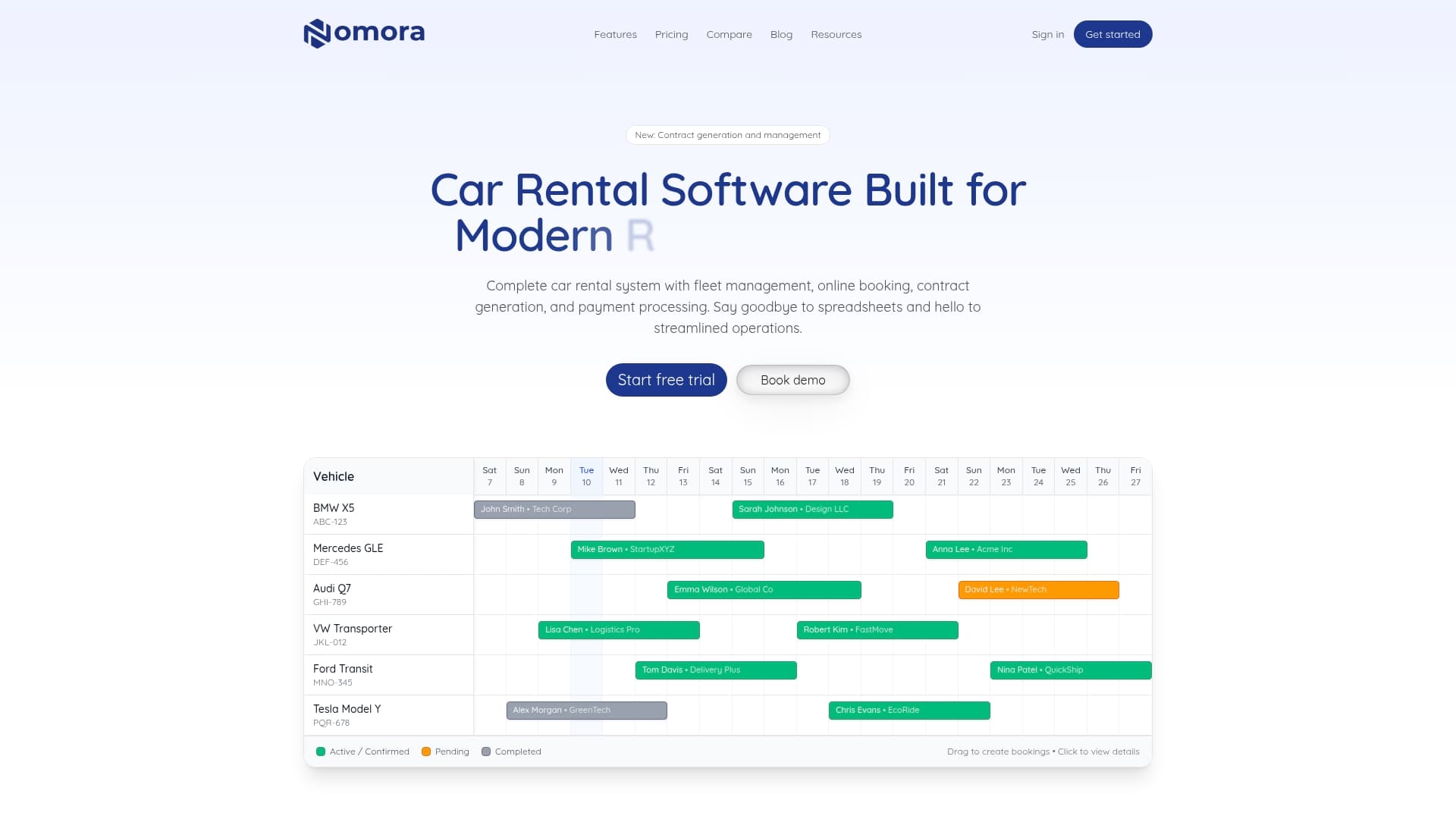
The platform supports every deployment model covered in this guide: station-based, free-floating, corporate programs, and peer-to-peer. White-label iOS and Android apps are included, so your riders see your brand from the first booking. Security and GDPR compliance are built in, and SLA commitments are defined before you sign. For operators ready to move from evaluation to a live pilot, the next step is straightforward: request a demo and bring your vehicle count, hardware situation, and target KPIs to the call. Nomora's team will scope a pilot that fits your operation and your timeline.
Recommended