Start with a clean baseline. Without it, every improvement is a guess.
Core KPIs to define first:
| KPI | Formula | Source |
|---|
| RevPACD | Total Revenue ÷ (Fleet Size × Available Days) | Reservation + finance system |
| Utilization Rate | Rented Days ÷ Operational Fleet Days | Fleet register (subtract immobilizations) |
| ADR (Average Daily Rate) | Total Revenue ÷ Total Rented Days | Reservation management system (RMS) |
| ARPU | Total Revenue ÷ Number of Units | Finance ledger |
| Time-to-Ready | Minutes from return to re-rent-ready | Maintenance/ops log |
| DOS (Days Out of Service) | Days a unit is unavailable due to repair | Shop work orders |
Worked RevPACD example: A 50-car fleet earns $48,000 in a 30-day month. RevPACD = $48,000 ÷ (50 × 30) = $32.00. Now you have a number to beat.
Measuring utilization against your operational fleet (total fleet minus immobilized units) is critical. It exposes how much revenue your shop is actually costing you, a figure that gross utilization hides entirely.
Pro Tip: Pull ARPU and RevPACD weekly, not monthly. Weekly tracking lets you catch a rate or utilization problem before it compounds across a full billing cycle.
Your data audit should cover six areas: reservation system exports, fleet register (VIN, class, odometer), maintenance logs, channel rate sheets, payment processor reports, and GPS/telemetry availability. If any of these lives in a spreadsheet, that is your first integration target.
What should you prioritize first: quick wins or long projects?
Score every opportunity on two axes: revenue impact and implementation effort. High-impact, low-effort items go first. Always.
Quick wins (0–14 days):
- Pricing laddering on your top two vehicle classes
- Pre-check-in automation to reduce front-desk time
- Accessory stock control (car seats, GPS units) to capture ancillary revenue
- Booking conflict checks if not already active
Medium initiatives (weeks 3–8):
- Full RMS deployment with rate rules and pacing reports
- Automated maintenance triggers linked to odometer readings
Long projects (months 2–3):
- Fleet mix rebalancing based on class-level RevPACD data
- Multi-site transfer logic and one-way pricing rules
| Initiative | Effort | Revenue Impact | Start Window |
|---|
| Pricing laddering | Low | High | Day 1 |
| Conflict-free booking | Low | Medium | Day 1 |
| Maintenance triggers | Medium | High | Week 3 |
| Fleet mix rebalancing | High | High | Month 2 |
Run your first pilot on a single site and a single vehicle class. Define success before you start: a target RevPACD lift, a DOS reduction, or a utilization threshold. That discipline prevents scope creep and gives you clean data to justify the next phase.
Which pricing levers lift RevPACD without hurting utilization?
Dynamic pricing aligned to forecasted demand is the highest-leverage tool most operators underuse. As a location trends toward sell-out, ladder rates up and pair those moves with suggested transfers from surplus locations.
Sample pricing rules:
| Rule | Trigger | Expected Impact |
|---|
| Rate ladder up | Utilization >80% with 7+ days lead time | ADR +8–15% |
| Length-of-stay discount | Rental >5 days | Volume increase, lower per-unit cost |
| One-way surcharge | Outbound-only lane imbalance | Covers repositioning cost |
| Ancillary bundle | At booking confirmation | ARPU increase |
Structure A/B tests over 7–14 day windows. Change one variable per test, measure RevPACD before and after, and hold utilization constant as a control. When utilization is high but RevPACD is flat, the problem is rate. When RevPACD is rising but utilization is falling, you may be pricing out volume. Pacing data tells you which signal to trust. For a deeper look at dynamic pricing tactics, the mechanics of rate laddering and rules engine setup are worth reviewing before your first test.
How do fleet mix and rotation affect revenue per unit?
Right-sizing is about class mix, not just total car count. A fleet with too many midsize sedans and too few SUVs in a market that skews family travel leaves RevPACD on the table regardless of how well you price.
Fleet mix checklist:
- Measure RevPACD and contribution margin separately for each class (economy, midsize, premium, SUV).
- Identify chronic exporter locations (always sending units out) and chronic importers (always receiving them). Pre-position inventory before demand peaks rather than reacting after.
- Set upgrade and downgrade rules. Protect premium stock from being used as a buffer for economy demand.
- Define disposal triggers: when a unit's per-day margin falls below a class threshold or mileage crosses a set point, disposition beats holding.
For premium and specialty classes, protecting margin through disciplined class management requires separate utilization targets and rate floors, not the same rules applied fleet-wide.
How do you reduce vehicle downtime and speed up turnarounds?
Every minute shaved from return to re-rent-ready adds sellable hours across the fleet. Map your turnaround funnel with timestamps: check-in → inspection → fueling → cleaning → tech check → QA sign-off. Time each step for one week. The bottleneck is almost always cleaning or inspection, not fueling.

Pro Tip: Schedule major preventive maintenance during your historically slowest 72-hour windows. Stagger service across classes so no single segment drops below minimum available units.
Parts and consumables control matters as much as labor. Enforce min/max levels by site, run daily counts on top-moving consumables, and use rolling cycle counts for mid-movers. A repair that stalls because a part is out of stock is a DOS day that was entirely preventable.
Automation triggers to build: when odometer hits a service interval OR a fault code is logged → auto-create a shop work order. When a vehicle is returned AND cleaning capacity is free → assign the next booking slot. These two triggers alone can cut DOS by removing the manual handoff that causes delays.
What should your automation and integration checklist include?
Think of your rental management platform as the central nervous system of the operation. Every system that touches a vehicle or a booking should connect to it.
Integration checklist:
- RMS / reservation source (OTA feeds, direct booking engine)
- Fleet registry (VIN, class, odometer, GPS unit ID)
- Maintenance shop system (work orders, parts inventory)
- GPS/telemetry (location, odometer, fault codes)
- Payment gateway (preauthorizations, charges, refunds)
- Accounting system (revenue recognition, cost allocation)
- CRM (customer history, loyalty tiers, contact data)
The architecture that works: events (return logged, booking confirmed, odometer updated) feed a rules engine, which fires actions (create work order, charge preauth, send confirmation). Keep message queuing in place for offline sites so no event is lost during connectivity gaps. Require an audit trail for every manual override.
On procurement: verify PCI DSS compliance for payment handling and confirm your vendor's data retention and access controls. U.S. operators handling EU customer data should also confirm GDPR-aligned data processing agreements are in place.
What should your reporting dashboard track daily, weekly, and monthly?
| Cadence | Metrics |
|---|
| Daily | Utilization by class and site, pacing vs. prior week, open booking conflicts |
| Weekly | RevPACD trend, DOS by cause, ADR vs. target |
| Monthly | ARPU, Net Revenue Per Vehicle (NRPV), fleet mix shift, channel contribution |
Smaller operators can use the same measurement standards as major firms by pulling utilization, RevPACD, ADR, and lead time from their reservation and maintenance systems into a simple dashboard. The data is already there; the gap is usually the reporting layer.
Experiment tracking: for each pricing or operational test, log the hypothesis, primary metric, sample size, test window, and outcome threshold before you start. Review results at the end of the window, not mid-test. Governance: assign one owner per metric, set escalation rules for when RevPACD drops more than 5% week-over-week, and hold a 30-minute weekly review to tune pricing and transfer decisions.
What does a realistic 0–90 day implementation timeline look like?
A practical rollout follows three phases: baseline and design, pilot, then scale.
- Days 0–14: Pull baseline KPIs (RevPACD, utilization, DOS). Run the 7-day turnaround audit. Select pilot site and vehicle class. Define success criteria.
- Days 15–45: Launch pricing ladder on pilot class. Activate conflict-free booking. Connect maintenance triggers. Measure RevPACD daily.
- Days 46–90: Scale pilots to additional sites and classes. Integrate GPS and payment gateway. Publish SOPs. Establish weekly governance cadence.
Cost bands: Quick wins (pricing rules, booking conflict checks) carry near-zero direct cost. RMS deployment and integrations typically fall in the medium range, requiring IT time and subscription fees. Fleet repurchase or large-scale transfers are high-cost, high-impact decisions that belong in month 2 or later, after pilot data justifies them.
Internal approvals needed: IT sign-off on integrations, ops lead for SOP changes, and finance review for any CAPEX commitment above your standard threshold.
Ask every vendor these questions before signing:
Demo checklist: test booking conflicts, simulate a return → inspection → work order → re-rent sequence, verify reporting exports include RevPACD and DOS by class, and confirm offline mobile scanning capability.
Migration checklist: confirm data import fields cover VIN, class, odometer, and rate rules. Map your existing rate structure to the new system before go-live. Have a rollback plan: know which legacy system you can reactivate within 24 hours if needed.
Procurement red flags: opaque API model with no published integration list, no audit trail for manual overrides, and inability to provide live reference customers at a similar fleet size.
How Nomora operationalizes each step of the process
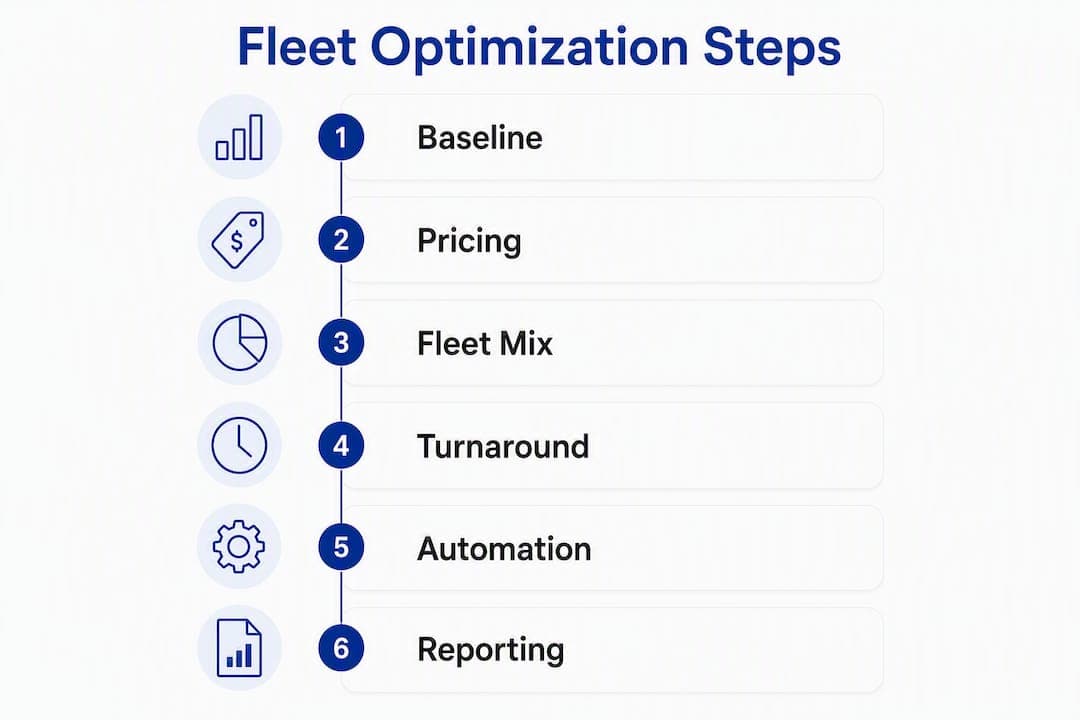
Nomora maps directly to the six-step sequence described above. Its cloud-based platform handles reservations, fleet tracking, automated contract generation, payment processing, and customer data in one system, replacing the spreadsheets and disconnected tools that create DOS and booking conflicts.
Capability alignment:
- Assess: Baseline reports pull RevPACD, utilization, and ADR from live reservation and fleet data.
- Prioritize: Real-time dashboards surface underperforming classes and sites immediately.
- Price: Rate rules and dynamic pricing triggers are configurable without developer support.
- Right-size: Fleet registry tracks class, odometer, and GPS unit per vehicle for rotation decisions.
- Turnaround: Automated maintenance work orders trigger on return events or odometer thresholds.
- Automate: Payment preauthorizations, booking confirmations, and conflict checks run without manual input.
Onboarding typically completes in 24–48 hours for initial setup, with a 2–8 week pilot phase and full scale-out in 1–3 months. Nomora supports GPS integrations, major payment gateways, and operates with GDPR-aligned data security, which matters for U.S. operators handling international customer data. Business types served range from independent operators to franchise networks and corporate fleet managers. For before/after KPI snapshots from operators who have run this process, the results consistently show RevPACD uplift and reduced DOS within the first pilot window.
What are the most common pitfalls and how do you avoid them?
Common red flags:
- Poor data quality in the fleet register (missing odometers, wrong class codes) corrupts every KPI downstream.
- Unguarded overbooking when integrating a new OTA channel without conflict-check rules active.
- Mis-scoped integrations: connecting GPS but not mapping fault codes to maintenance triggers wastes the integration.
- Ignoring DOS budgeting by class, which lets one high-demand segment mask a maintenance problem in another.
Mitigations: Pilot on one site and one class. Require test scripts in every vendor demo. Run a 7–14 day reconciliation period after any new integration goes live. Set overbooking caps by class before activating any new booking channel.
Rollback plan: If RevPACD drops more than 5% and utilization has not risen in two weeks, freeze rate rule changes, revert to prior pricing, pause inter-site transfers, and escalate manual override authority to a single manager until the cause is identified.
How does optimization improve the customer experience?
Operational efficiency and customer experience are not separate tracks. Faster turnarounds mean cleaner, better-prepared vehicles at pickup. Conflict-free booking eliminates the scenario where a customer arrives and their reserved vehicle is unavailable. Automated payment flows reduce friction at pickup and return.
Beyond the basics, operators who have completed the first four steps of this process are positioned to layer in experience enhancements: mobile-first booking and digital contract signing reduce counter time significantly. Loyalty programs tied to ARPU data let you identify and reward high-value customers with targeted upgrades or rate benefits, which increases repeat bookings without discounting broadly. GPS-enabled vehicles support real-time location sharing and faster roadside assistance dispatch, both of which directly affect customer satisfaction scores. The key is sequencing: get the operational foundation right first, then build experience features on top of it. A loyalty program built on a fleet with high DOS and booking conflicts will frustrate customers, not retain them.
Key Takeaways
Consistent RevPACD growth requires a sequenced approach: baseline first; then pricing, fleet mix, turnaround speed, and automation, each measured before scaling to the next.
| Point | Details |
|---|
| RevPACD is your control metric | Calculate it daily: Total Revenue ÷ (Fleet Size × Available Days) and track the weekly trend. |
| Start with a 7-day turnaround audit | Timestamping each return-to-ready phase exposes the bottleneck that costs you the most sellable days. |
| Pilot before scaling | Run one pricing or operational change on a single site and class; two consistent weeks of data justify rollout. |
| DOS budgeting by class | Track Days Out of Service separately per vehicle segment to catch maintenance problems before they mask in aggregate utilization. |
| Nomora as the operational layer | Nomora's 24–48 hour setup, conflict-free booking, and RevPACD-ready dashboards map directly to each of the six steps above. |
The case for starting narrow and measuring everything
The operators who see the fastest RevPACD gains are not the ones who launch the biggest rollouts. They are the ones who instrument one turnaround funnel, run one pricing test, and read the data before touching anything else. That discipline is harder than it sounds when you are managing a live fleet and fielding customer calls, but it is what separates a one-time improvement from a repeatable system.
The six-step sequence in this article is not a theory. It is the order of operations that produces clean, attributable results. Start with your RevPACD baseline this week. Run the turnaround audit in parallel. Then pick one pricing lever and test it for 14 days. The data from that single test will tell you more about your fleet's revenue potential than any forecast.
Nomora gives you the infrastructure to run this plan from day one
Most car rental operators lose RevPACD not because they lack strategy, but because their tools cannot execute it. Nomora closes that gap. Conflict-free bookings prevent the revenue losses that come from double-booking. RevPACD-ready dashboards surface the right numbers daily, not after a manual export. Payment preauthorizations and GPS integrations run automatically, removing the manual handoffs that slow turnarounds and create errors.
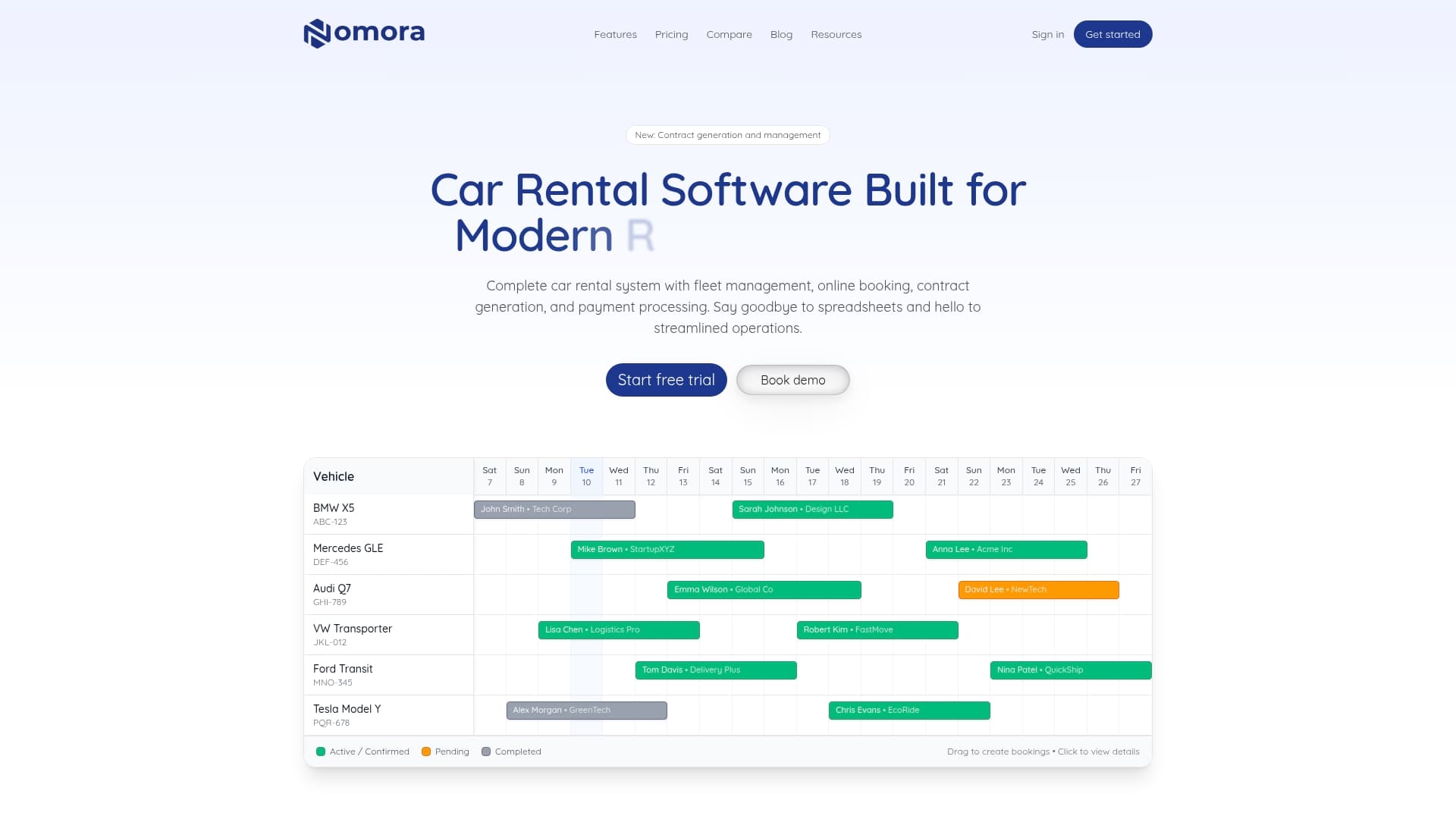
Setup takes 24–48 hours. The pilot phase runs 2–8 weeks, long enough to generate real RevPACD data from your own fleet. Nomora works across independent operators, franchise networks, and corporate fleet managers, so the platform scales with the operation rather than requiring a replacement when you grow.
To see how Nomora maps to your specific fleet size and business type, review the use cases by business type or explore Nomora's payment automation to understand how preauth and PCI handling work in practice. Book a demo with your current RevPACD number in hand and you will leave with a configured pilot ready to run.
Useful sources and further reading
Recommended