Reservation conflicts occur when multiple users or systems try to access the same resource simultaneously, causing double bookings or resource blockages. Repairing these conflicts involves improving system architecture, such as implementing database constraints and transaction isolation, to prevent concurrent booking errors. Using API-based synchronization and automatic hold expiration helps rental businesses avoid ghost and soft conflicts effectively.
A reservation conflict is defined as the condition where two or more users or systems attempt to reserve or access the same resource at the same time, creating an overlap that blocks access, corrupts availability data, or results in a double booking. For rental business operators, this means two customers confirmed for the same vehicle on the same dates. For IT storage administrators, it means two hosts holding exclusive locks on the same logical unit number (LUN), freezing virtual machines and triggering I/O errors. Understanding reservation conflicts is the first step toward eliminating them. The causes range from poor booking system architecture to legacy calendar sync limitations, and the consequences hit your revenue, your reputation, and your customers directly.
What is a reservation conflict in rental and IT systems?
A reservation conflict occurs when a booking system fails to enforce exclusive access to a resource before confirming multiple requests. In rental businesses, the resource is a vehicle, a property, or a piece of equipment. In IT storage environments, the resource is a LUN accessed by multiple ESXi hosts over a SAN. The conflict mechanism is the same in both domains: two requests arrive nearly simultaneously, both see the resource as available, and both receive confirmation before the system registers the first booking.
Most reservation conflicts stem from concurrency issues and poor synchronization between platforms. That means the problem is architectural, not accidental. A rental operator running bookings through a spreadsheet or a basic web form is especially exposed, because neither tool enforces atomic availability checks.
In IT storage, SCSI reservation conflicts occur when a host tries to access a LUN already reserved by another initiator with an exclusive lock. Symptoms include frozen virtual machines and I/O errors. The IT parallel is useful for rental managers because it illustrates exactly what happens when a system lacks a proper locking mechanism: the resource becomes inaccessible to everyone until the conflict is cleared.
What causes reservation conflicts in rental booking systems?
Booking conflicts in rental systems trace back to a small set of root causes. Recognizing them helps you target the right fix.
Race conditions in "check-then-insert" logic. Concurrent user requests can both read availability as "open" and both confirm a booking before the database registers the first insert. This is the most common cause of double bookings in web-based rental platforms.
Weak database isolation. When booking creation is not wrapped in a transaction with strong isolation, two writes can succeed simultaneously. The database records both, and neither customer gets the vehicle they paid for.
iCal synchronization gaps.Ghost conflicts from iCal syncing between platforms like Airbnb and VRBO occur because iCal feeds lack metadata and update asynchronously. Blocked dates get re-imported as foreign reservations, creating phantom double-booking warnings even when no real overlap exists.
Legacy platform sync delays. Calendar feeds from third-party channels can lag by minutes or hours. A booking confirmed on one channel may not propagate to another before a second booking is accepted.
Hardware and network faults in IT storage.SAN switch reboots and network interruptions cause hosts to hold LUN locks longer than intended. This is the IT equivalent of a booking hold that never expires.
Pro Tip:If you manage bookings across multiple channels, replace iCal feeds with API-based channel management wherever possible. API integrations push and pull availability in real time, eliminating the sync lag that creates ghost conflicts.
What types of reservation conflicts occur, and how do they differ?
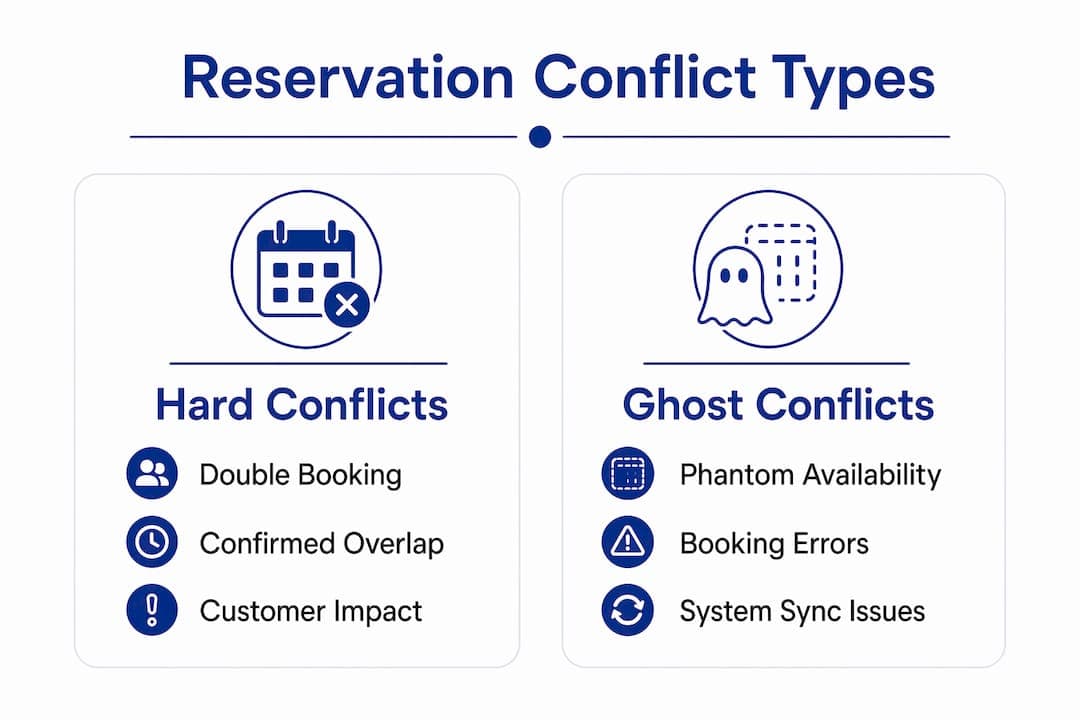
Rental managers encounter several distinct conflict types. Each has a different cause, a different symptom, and a different fix.
Ghost conflicts deserve special attention because they are the most misdiagnosed. Phantom conflicts distort availability and frustrate customers despite no real double booking having occurred. Rental operators who rely on iCal feeds between platforms like Airbnb and VRBO regularly see dates blocked incorrectly, which means lost revenue from dates that were never actually taken.
Hard conflicts are the most damaging. Two customers arrive for the same vehicle on the same day. One leaves without a car. That interaction generates a refund, a complaint, and often a negative review. The cost of a single hard conflict far exceeds the cost of fixing the system that allowed it.
How does booking system design affect reservation conflicts?
The architecture of your booking system determines how often conflicts occur. Most operators do not control the underlying code, but understanding the design principles helps you evaluate and choose the right platform.
"Check-then-insert" is the weakest pattern. A system that checks availability and then inserts a booking in two separate steps creates a window where a second request can slip through. This is a race condition by design.
Database-level constraints close that window.PostgreSQL exclusion constraints with timestamp range columns reject overlapping booking inserts at the database level, even when two transactions run simultaneously. The database enforces the rule, not the application.
Transaction isolation levels matter.Strong isolation levels wrap the availability check and the booking creation in a single atomic operation. If a conflict is detected mid-transaction, the booking is aborted and a clean error is returned. No double booking is recorded.
Optimistic locking adds a second layer of protection. The system assigns a version number to each availability record. If two requests try to update the same record, the second one fails because the version number no longer matches.
Hold expiration prevents soft conflicts. Temporary holds placed during checkout must expire automatically if payment is not completed. A hold that never expires blocks availability indefinitely, creating a soft conflict that looks like a real booking.
Pro Tip:When evaluating a rental management platform, ask the vendor directly whether availability checks and booking inserts are wrapped in a single database transaction. If they cannot answer that question, the system likely relies on application-level logic alone, which is insufficient.
The central nervous system of a conflict-free rental operation is the booking engine. Every other feature, from payment processing to fleet tracking, depends on the booking engine getting this right.
How can rental businesses detect, resolve, and prevent reservation conflicts?
Detection comes before resolution. You cannot fix a conflict you have not identified.
Check system logs and error messages after every booking anomaly. Duplicate booking IDs, failed payment confirmations, and availability mismatches in your dashboard are all signals of an underlying conflict.
Audit your channel connections. If you list vehicles on multiple platforms, map every calendar connection and identify which ones use iCal feeds versus API integrations. iCal connections are your highest-risk points.
Monitor hold expiration. Incomplete checkouts that leave holds in place will shrink your available inventory without generating revenue. A conflict-free booking workflow requires automatic hold expiration built into the system.
Once a conflict is detected, resolution depends on the type:
Conflict type
Resolution method
Time to resolve
Hard overlap conflict
Manual rebooking, refund, or upgrade
Hours to days
Ghost conflict
Clear iCal cache, switch to API sync
Minutes to hours
Soft conflict (expired hold)
Trigger hold expiration, refresh availability
Minutes
SCSI reservation (IT)
Host reset or CLI reservation clear
Minutes to hours
Prevention is where the real work happens. Optimistic locking combined with unique constraints and asynchronous hold expiration creates a booking workflow that balances speed, usability, and data integrity. For rental operators, this translates to a platform that handles concurrent bookings without ever confirming two customers for the same vehicle.
Practical steps for rental managers:
Replace iCal channel connections with API-based integrations wherever your channel manager supports it.
Confirm your booking platform uses database-level constraints, not just application logic, to block overlapping reservations.
Set automatic hold expiration for incomplete checkouts, typically 10–15 minutes.
Test concurrent booking scenarios periodically by simulating two simultaneous requests for the same vehicle.
The 42-Point Car Rental Operations Checklist
The exact checks profitable rental operators run every week — free, straight to your inbox.
Fleet readiness & handover
Bookings & no-show prevention
Pricing & revenue reviews
Contracts & compliance
Payments & invoicing
Maintenance & fleet health
One email with the checklist. No spam, unsubscribe anytime.
Key takeaways
A reservation conflict is a solvable problem, and the solution always starts at the database level, not the application layer.
Point
Details
Definition is precise
A reservation conflict occurs when two requests confirm the same resource simultaneously, causing overlap.
Ghost conflicts are common
iCal sync between platforms like Airbnb and VRBO creates phantom conflicts with no real double booking.
Architecture is the root cause
"Check-then-insert" logic without database constraints is the primary design flaw enabling conflicts.
Database constraints are the fix
PostgreSQL exclusion constraints and strong transaction isolation prevent overlapping bookings at the source.
Prevention beats resolution
Switching to API-based channel management and automatic hold expiration eliminates most conflict types before they occur.
The conflict problem most rental operators underestimate
After working with rental businesses of varying sizes, the pattern I see most often is this: operators treat reservation conflicts as rare edge cases rather than predictable system failures. They handle each double booking manually, apologize to the customer, and move on. They never ask why it happened.
The uncomfortable truth is that most conflicts are not random. They are the direct result of a booking system that was never designed to handle concurrent requests safely. A platform that checks availability and then inserts a booking in two separate steps will produce double bookings under load. That is not a bug. It is the expected output of a flawed design.
What I find most useful is the IT storage parallel. SCSI reservation conflicts in SAN environments are well-documented and well-understood by storage engineers. The rental booking world has the same problem, but far fewer operators recognize it as a systems issue. The moment you start thinking about your booking engine the way a storage engineer thinks about LUN locking, the solutions become obvious.
The operators who eliminate conflicts entirely are the ones who demand database-level guarantees from their platforms. They ask hard questions about transaction isolation and constraint enforcement. They do not accept "we have never had that problem" as an answer. They test it.
— Dizzy
How Nomora helps rental businesses stay conflict-free
Reservation conflicts cost rental businesses real money, not just in refunds but in customer trust. Nomora is built specifically to prevent them.
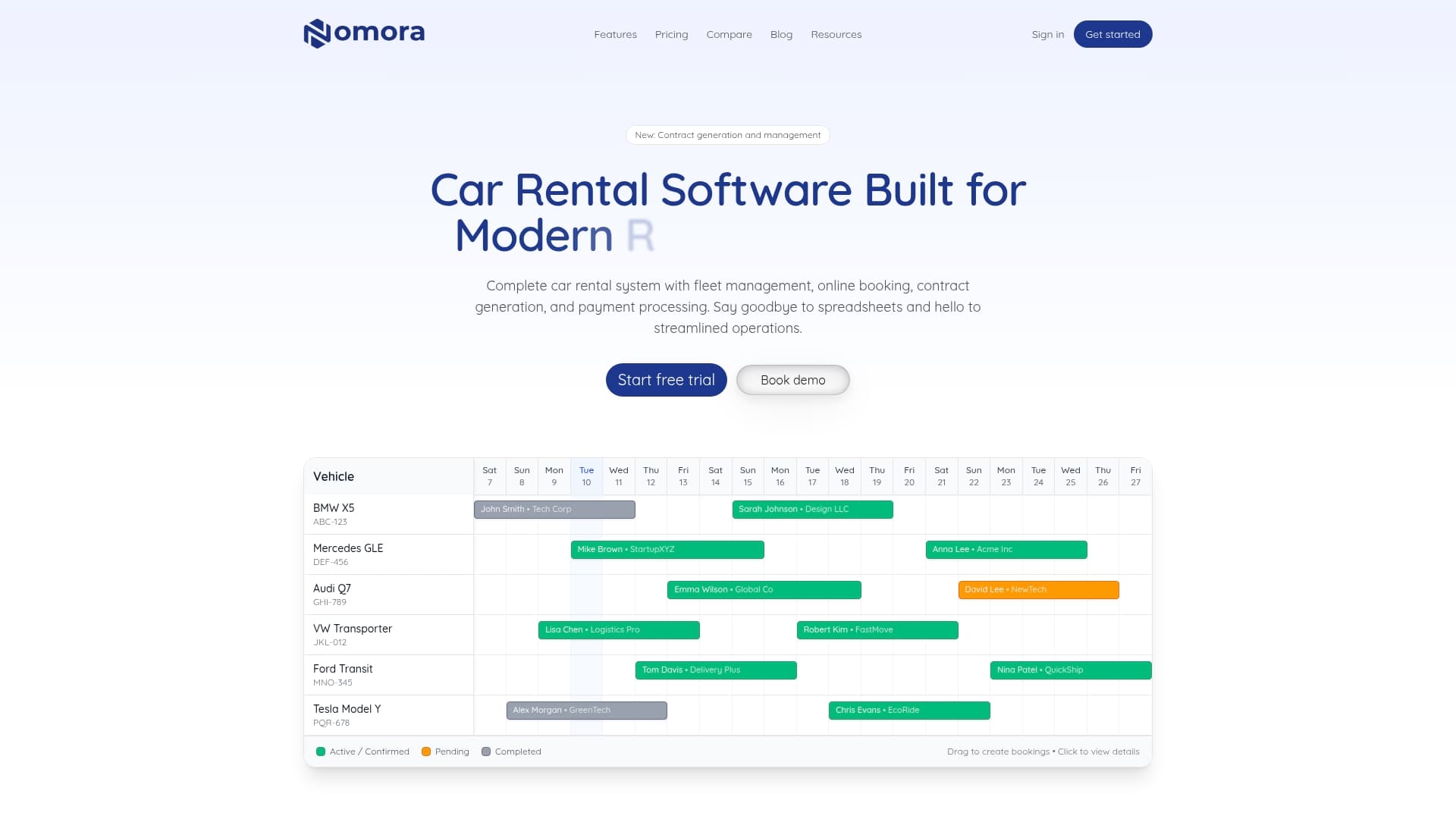
Nomora's booking engine handles concurrent requests with the kind of database-level controls that eliminate double bookings before they reach your customers. The platform covers rental businesses of every type, from independent operators to franchise networks, with real-time availability enforcement across all booking channels. Nomora also includes automated payment processing that closes the checkout window quickly, reducing the hold periods that create soft conflicts. Setup takes 24–48 hours, and the system is cloud-based, so your availability data stays accurate whether your team is in the office or in the field.
FAQ
What is the definition of a reservation conflict?
A reservation conflict is when two or more users or systems attempt to reserve the same resource at the same time, resulting in an overlap, a double booking, or a blocked resource. The term applies to rental booking systems and IT storage environments alike.
What are the most common reservation conflict examples in car rental?
The most common examples are two customers confirmed for the same vehicle on the same dates, and ghost conflicts where iCal sync between listing platforms blocks dates that are not actually booked.
How do you resolve a reservation conflict in a booking system?
Resolution depends on the conflict type. Hard double bookings require manual rebooking or refunds. Ghost conflicts are resolved by clearing the iCal cache or switching to API-based channel sync. Soft conflicts from expired holds resolve automatically once hold expiration is triggered.
What is the difference between a hard conflict and a ghost conflict?
A hard conflict is a confirmed double booking where two customers hold valid reservations for the same resource. A ghost conflict is a phantom warning generated by sync lag or missing metadata, with no actual overlap in real bookings.
How does booking system design prevent reservation conflicts?
Systems that use database-level exclusion constraints and strong transaction isolation prevent conflicts by making availability checks and booking inserts atomic. If two requests arrive simultaneously, only one succeeds and the other receives a clean error, with no double booking recorded.