Why start a car hire business, and which model fits you?
The global car rental market continues to grow, driven by rising travel demand, corporate mobility needs, and the shift away from personal vehicle ownership in urban areas. For a solo founder, that growth translates into real opportunity, but only if the business model matches your capital, risk tolerance, and target customer.
Most independent operators fall into one of five models. The right one determines your fleet size, insurance complexity, and which permits you need on day one.
| Model | Capital requirement | Margin potential | Regulatory complexity |
|---|
| Independent local operator | Low to moderate | Moderate | Moderate |
| Airport concession branch | High | High | High |
| Peer-to-peer host (e.g., Turo) | Low | Low to moderate | Low |
| Specialty/niche rental | Moderate | High | Moderate |
| Subscription or corporate fleet | Moderate to high | High (stable) | Moderate to high |
Independent local operators suit founders who want full control and can secure a physical premises. Margins are workable once utilization exceeds 70%, and the regulatory path is manageable. Airport concessions require significant capital for concession fees and staffing, but foot traffic is built in. Peer-to-peer hosting on platforms like Turo is the lowest-barrier entry point, though the platform takes a cut and limits your brand equity. Specialty rentals (luxury vehicles, cargo vans, contractor trucks) command premium daily rates and attract repeat corporate clients. Subscription models, where customers pay a flat monthly fee for flexible access, offer predictable revenue but require a larger fleet to work.
Pro Tip: Before committing to a model, answer three questions: Who is my primary customer? What utilization rate can I realistically sustain in my market? And how much capital can I deploy without taking on debt that outpaces early revenue?
For most solo founders, starting as an independent local operator with one to three vehicles and adding a Turo listing to fill idle days is the lowest-risk path to consistent cash flow.

What does it actually cost to start a car rental business?
Startup budgets vary widely based on fleet size and model, but the numbers below reflect what small U.S. operators realistically face. Xero's guide puts the total startup range at $10,000–$50,000 for a small operation.
Startup and recurring cost breakdown
| Cost item | Estimated range | Notes |
|---|
| Used vehicle acquisition (per vehicle) | $15,000–$30,000 | Varies by class and condition (per Xero's guide) |
| Commercial fleet insurance (per vehicle/year) | $1,500–$3,000 | Required before first rental (per Xero's guide) |
| State motor vehicle rental license | $100–$500 | Varies by state |
| Surety bond | — | Premium is typically 1–3% of bond |
| LLC formation and registered agent | $50–$500 | State filing fees vary |
| Booking and fleet management software | $50–$300/month | Scales with fleet size |
| Parking and storage | $200/month | Market-dependent |
| Marketing and website setup | — | One-time launch cost |
| Working capital reserve | — | Covers repairs, gaps in utilization |
Funding your fleet: a practical playbook
- SBA loans. The SBA's loan programs (7(a) and 504) can fund vehicle acquisition and working capital for qualified small businesses. Processing takes longer, but rates are competitive and terms are favorable for capital-intensive startups.
Worked breakeven example: 3-vehicle operation
Assume three used sedans at $20,000 each, financed over 48 months at 7% interest. Monthly loan payment per vehicle: approximately $478. Add insurance ($208/month per vehicle), parking ($300/month total), software ($100/month), and miscellaneous ($200/month). Total fixed monthly cost: roughly $2,600.
At an average daily rate (ADR) of $55 and 70% utilization across three vehicles, monthly gross revenue is approximately $3,465. That leaves a margin of roughly $865 before variable costs (fuel reimbursement, cleaning, minor repairs). Raise utilization to 80% and revenue climbs to $3,960, turning a tighter but more comfortable profit. The math confirms what operators learn quickly: utilization and ADR are the two levers that matter most.
How to handle business structure, licenses, and permits
The recommended starting structure for most car hire entrepreneurs is an LLC. It separates personal assets from business liability, passes income through to your personal return by default, and is straightforward to form in every U.S. state. Once revenue grows, an S-corporation election can reduce self-employment tax on distributions, but that conversation belongs with a CPA, not a filing checklist.
Step-by-step legal setup order:
- Obtain an EIN — from the IRS at no cost; you need this before opening a business bank account or hiring staff
StartPermit's regulatory checklist notes that missing any single element, particularly the surety bond or insurance proof, can delay your license by weeks. Build in at least four to six weeks for state-level processing.
If you plan to operate at an airport, concession agreements add another layer: the airport authority sets its own application process, fees, and facility requirements, separate from state licensing.
Pro Tip: Once your brand name is chosen and your LLC is filed, run a trademark search through the USPTO to confirm no one else holds rights to your business name in the rental category. Filing a trademark is optional but protects your brand as you grow.
What insurance and rental agreement terms do you need?
Personal auto insurance will not cover a vehicle used for commercial rental. Full stop. You need commercial fleet insurance, and you need it bound before a single key changes hands.
Core coverages to secure:
- Commercial auto liability (minimum $300,000 combined single limit is common, though some states and airport concessions require $1,000,000 or more)
- Physical damage coverage (collision and comprehensive) for each vehicle in the fleet
- Uninsured/underinsured motorist coverage
- General liability for your business premises
- Loss-damage waiver (LDW) product, if you plan to offer renters the option to waive their deductible responsibility
StartPermit notes that LDW disclosure rules vary by state. In some states, you must disclose in writing that the renter's personal auto policy or credit card may already cover rental damage. Ignoring these disclosure requirements creates legal exposure.
The Graves Amendment (49 U.S.C. § 30106) limits vicarious liability for vehicle owners in many rental scenarios, but it does not protect operators from claims tied to negligent maintenance or negligent entrustment. Your rental agreement and maintenance records are your primary defense.
Essential rental agreement elements:
- Renter identity verification (government-issued photo ID, driver's license number, expiration date)
- List of authorized drivers and prohibition on unauthorized use
- Vehicle condition at pickup (documented with photos or video)
- Mileage limits and overage fees, if applicable
- Fuel policy (full-to-full or prepaid)
- Damage reporting obligations and deductible terms
- LDW offer and written disclosure per state requirements
- Dispute resolution clause and governing law
- Age restrictions (most operators set a minimum of 21 or 25, with a young-driver surcharge)
After an accident: collect photos and police report at the scene, notify your insurer within 24 hours, document the vehicle's condition before any repairs, and follow your insurer's approved repair workflow. Keep every record in the vehicle file.
How should you acquire vehicles and manage daily fleet operations?
For most small operators, the best starting approach is a mix: buy two or three used vehicles outright (or with financing) to build equity, and supplement with a lease or peer-to-peer sourcing when demand spikes. Buying used keeps monthly obligations lower and gives you full control over maintenance scheduling.

| Acquisition method | Upfront cost | Monthly obligation | Maintenance responsibility | Depreciation exposure | Scalability |
|---|
| Buy (used) | Moderate | Loan payment | Owner | Full | Moderate |
| Buy (new) | High | Loan payment | Owner | High (first 3 years) | Moderate |
| Lease | Low | Fixed lease payment | Shared/lessor | Low | High |
| Peer-to-peer sourcing | None | Revenue share | Vehicle owner | None | High but variable |
When selecting your initial fleet, match vehicle class to your target customer. Business travelers and corporate accounts want clean, fuel-efficient sedans. Tourists and leisure renters often prefer SUVs or minivans. Contractors and tradespeople need cargo vans or pickup trucks. Starting with one class keeps maintenance simpler and parts sourcing more efficient. A small business vehicle selection guide can help you evaluate which classes offer the best balance of acquisition cost, demand, and resale value.
Fleet maintenance and telematics checklist:
- Schedule oil changes, tire rotations, and brake inspections on a mileage-based calendar (not just by date)
- Conduct a documented pre-rental and post-rental inspection for every booking, with timestamped photos
- Install GPS telematics on each vehicle to monitor location, mileage, and driving behavior in real time; real-time tracking also simplifies theft recovery and dispute resolution
- Set up odometer reporting to trigger maintenance alerts automatically
- Keep a spare vehicle or a rental-replacement arrangement to cover downtime during repairs
Pro Tip: When sourcing used vehicles, dealer auctions and wholesale channels often offer better per-unit pricing than retail lots. A wholesale automotive sourcing guide walks through the auction process and what to inspect before bidding.
How do you price rentals and hit your profit targets?
The industry net margin for car rental operations typically falls between 5–10%, and reaching that range requires hitting a utilization rate of 70–80% consistently. ADR and utilization are the two variables that move the needle fastest.
Sample pricing matrix
| Rate type | Example rate | Notes |
|---|
| Daily (economy sedan) | $55 | Base rate; adjust for market and season |
| Weekly | $208 | Roughly 15–20% discount vs. daily |
| Monthly/long-term | $300 | Corporate or contractor accounts |
| GPS/navigation add-on | — | High-margin upsell |
| Additional driver fee | $10–$15/day | Standard industry practice |
| Young driver surcharge | $20–$30/day | Drivers under 25 |
State and local rental taxes typically add 10–20% to the customer's total, depending on jurisdiction. Factor that into your rate display so customers are not surprised at checkout.
Practical pricing tactics that protect margin:
- Offer guaranteed-spec tiers (economy, standard, premium) rather than specific models, so you can substitute vehicles without refunding the difference
- Build corporate retainer agreements with a minimum monthly commitment; predictable revenue lets you plan maintenance and staffing without guessing
- Set a cancellation fee (typically one day's rental) for bookings canceled within 24–48 hours
- Use dynamic pricing during peak periods (holidays, local events) to capture demand without permanently inflating your base rate
Which operational systems do you need from day one?
Think of your reservation and fleet management platform as the central nervous system of the operation. Every other tool, payments, accounting, telematics, and customer records, connects to it. Getting this stack right early prevents the manual errors and double-bookings that erode customer trust and eat admin hours.
Minimum viable technology stack:
- Accounting integration — (Xero is a widely recommended option for small operators, per Xero's own guidance) to reconcile payments, track expenses, and prepare for tax time
Implementation order: Start with bookings and payments in week one. Add accounting integration in week two. Connect telematics once your first vehicle is on the road. A car rental system integration guide covers the API patterns and sequencing in detail.
Pro Tip: Accounting and automated payments, when connected through an integrated platform, reduce reconciliation time significantly and keep deposit handling consistent. Inconsistent deposit handling is one of the most common sources of customer disputes in small rental operations.
Platforms that handle reservations, contracts, payments, and fleet tracking in one place reduce the risk of data falling between disconnected tools. Nomora's use cases by business type show how different operator profiles configure the stack for their specific model.
How do you get your first customers?
The fastest path to early bookings combines three channels: local search visibility, peer-to-peer platform listings, and direct outreach to corporate accounts. Each works differently, and the right mix depends on your model.
- Local SEO and Google Business Profile. Claim and fully complete your Google Business Profile on day one. Renters searching "car rental near me" or "[city] car hire" will find you before they find a national brand, especially for same-day or short-notice bookings.
- Turo listing. Even if you operate independently, listing one or two vehicles on Turo fills idle days and generates reviews that build credibility for your direct bookings.
- Corporate account outreach. Email or call local businesses, law firms, construction companies, and healthcare practices that regularly need vehicles for staff. A monthly retainer at a slight discount beats chasing daily bookings.
- Travel agency and hotel partnerships. Offer a referral fee or preferred-rate agreement to local hotels, bed-and-breakfasts, and travel agents. A single hotel concierge who recommends you daily can fill a small fleet.
- Auto repair shop referrals. Body shops and dealerships need loaner vehicles for customers whose cars are in for service. A standing agreement with two or three shops provides a reliable, recurring revenue stream.
Tracking and early promotions:
- Use UTM parameters on every digital channel to track which source drives bookings
- Offer a 10–15% discount for first-time renters who book directly (bypassing the OTA fee)
- Ask every satisfied renter for a Google review; review volume directly affects local search ranking
What does your launch checklist and 90-day timeline look like?
A clear sequence prevents the most common launch mistake: going live before the legal and insurance foundations are in place.
Prelaunch checklist (complete before accepting bookings):
- LLC formed and EIN obtained
- Business bank account open
- State motor vehicle rental license applied for (allow four to six weeks)
- Commercial fleet insurance bound and certificate of insurance on file
- Surety bond in place
- Rental agreement template reviewed by an attorney
- At least one vehicle acquired, inspected, and photographed
- Booking platform live with payment processing and deposit pre-authorization active
- Google Business Profile claimed and verified
- Sales tax and rental tax registration complete
90-day milestone plan:
- Weeks 1–4 (Setup and pilot). Complete all prelaunch checklist items. Accept first bookings from friends, family, and direct outreach. Document every rental meticulously. Identify friction points in your check-in and check-out process.
- Month 2 (Scale bookings and secure partnerships). Activate Turo listing. Reach out to five local businesses for corporate account conversations. Approach two repair shops about loaner arrangements. Target 60–65% utilization.
- Month 3 (Optimize pricing and processes). Review ADR against your breakeven model. Adjust rates for peak and off-peak periods. Automate any remaining manual steps (contract generation, payment reconciliation). Target 70%+ utilization and a positive monthly cash flow.
KPIs to track weekly:
- Daily utilization rate (target: 70–80% by month three)
- ADR (compare to your breakeven model monthly)
- Fleet downtime days (target: under 5% of available days)
- Repair turnaround time (target: under 48 hours for minor damage)
- Customer satisfaction (Google review rating; target 4.5 stars or above)
How Nomora helps you run a rental business without the admin burden
A dedicated rental management platform replaces the spreadsheets, manual contracts, and disconnected payment tools that slow down small operators and cause costly errors. Nomora acts as the central nervous system of your operation, connecting reservations, contracts, payments, fleet tracking, and customer data in one cloud-based system.
Features that matter most to small operators:
- Conflict-free booking engine that prevents double-bookings automatically, even across multiple listing channels
- Automated contract generation that produces a signed rental agreement for every booking without manual drafting
- Payment pre-authorization to hold deposits at booking and charge damage fees without chasing renters after the fact
- GPS telematics integration for real-time location, mileage tracking, and maintenance alerts
- Accounting sync (including Xero integration) to keep financial records clean and tax-ready
- Customer data management with secure storage of renter profiles, license copies, and rental history
Nomora's onboarding takes 24–48 hours, which means you can be fully operational before your first vehicle hits the road. The platform is cloud-based, GDPR-compliant, and accessible from any device, so you are not tied to a desk to manage bookings or check fleet status.
Vendor evaluation checklist (use this when comparing platforms):
- Does it offer conflict-free, real-time booking to prevent scheduling errors?
- Does it generate and store signed contracts automatically?
- Does it support payment pre-authorization and damage charge workflows?
- Does it integrate with your accounting software and telematics provider?
- What is the onboarding time, and is live support included?
- Is the platform cloud-based with role-based access controls and data security certifications?
Pro Tip: Nomora's software feature guide walks through which features deliver the fastest operational gains for operators running fewer than 25 vehicles. Start there before committing to any platform.
How do you stay compliant with safety inspections and emissions standards?
Regulatory compliance for a rental fleet goes beyond the initial license. Vehicles must remain roadworthy and meet state emissions standards throughout their operational life.
Most states require annual safety inspections for registered vehicles. As a fleet operator, you need a system to track inspection due dates across every vehicle and pull a car from service before its inspection lapses. A telematics-integrated fleet management platform can automate these alerts.
Emissions compliance varies significantly by state. California's CARB standards are the strictest in the country; if you operate there, every vehicle in your fleet must meet CARB-compliant emission ratings. Other states follow federal EPA standards, which are less restrictive but still require vehicles to pass state emissions tests at registration renewal. When acquiring used vehicles, check the emissions test history before purchase, particularly for older models that may be approaching the end of their compliant service life.
For operators running vehicles in multiple states, check each state's registration and inspection requirements separately. A vehicle registered in one state but operated primarily in another may trigger residency-based registration obligations.
Keep a compliance calendar with inspection dates, registration renewals, and emissions test deadlines for every vehicle. Missing a deadline can void your insurance coverage and expose you to fines.
How should you handle customer complaints and disputes?
Customer service quality directly affects your Google review rating, and your review rating directly affects local search ranking. For a small operator, a single unresolved complaint can cost more in lost bookings than the original dispute was worth.
A practical dispute-handling framework:
- Respond to every complaint within two hours during business hours. Speed signals professionalism and often de-escalates the situation before it reaches a review.
- Lead with acknowledgment, not defense. Even if the renter is wrong, starting with "I understand this was frustrating" costs nothing and reduces hostility.
- Keep all communication in writing (email or your platform's messaging system). Written records protect you if the dispute escalates to a chargeback or small claims filing.
- For damage disputes, rely on your pre-rental and post-rental photos. If the damage is documented at pickup, the renter is not liable. If it appears in the post-rental photos only, your documentation supports the charge.
- For billing disputes, process refunds promptly when you are clearly in the wrong. Fighting a $30 dispute that results in a one-star review is a losing trade.
Set a clear escalation path: front-line resolution first, then a manager review, then a written final decision with a refund or credit offer if warranted. Most disputes resolve at the first step when handled quickly and professionally.
Key Takeaways
Starting a car hire business in the United States requires an LLC, commercial fleet insurance, and a state motor vehicle rental license secured before the first booking, with startup capital of $10,000–$50,000 for a small operation.
| Point | Details |
|---|
| Legal foundation first | Form an LLC, obtain an EIN, and secure your state rental license before accepting any bookings. |
| Budget realistically | Plan $15,000–$30,000 per used vehicle plus $1,500–$3,000 annually per vehicle for commercial insurance. |
| Utilization drives profit | Industry net margins of 5–10% depend on hitting 70–80% fleet utilization consistently. |
| Automate from day one | A reservation platform with integrated payments and contracts prevents double-bookings and deposit disputes. |
| Nomora as your platform | Nomora's cloud-based system connects bookings, contracts, payments, and GPS tracking in one place, with 24–48 hour onboarding. |
The lesson most new rental operators learn too late
The operators who struggle in year one almost always share the same pattern: they focused on acquiring vehicles before they had their operational systems in place. A fleet of five cars sitting in a parking lot while the owner manually texts booking confirmations and chases deposit refunds is not a business. It is an expensive hobby.
The single most important insight from watching small rental operations launch and stall is this: the administrative layer is where money disappears. Not in vehicle acquisition. Not in insurance. In the hours spent reconciling payments, rewriting contracts, and handling disputes that proper documentation would have prevented.
Founders who automate bookings and payments in week one consistently report fewer double-bookings, faster deposit resolution, and more time for the work that actually grows the business: corporate account outreach, fleet expansion, and pricing optimization. The technology is not the exciting part of starting a car hire business, but it is the part that determines whether the exciting parts are sustainable.
There is also a cashflow trap that catches operators who scale too fast. Adding a fourth or fifth vehicle before the first three are consistently profitable feels like growth. It is actually dilution. Each new vehicle adds fixed costs immediately but adds revenue only when utilization catches up. The operators who reach ten vehicles profitably are almost always the ones who held at three until the numbers were undeniable.
Nomora makes the operational side manageable from the start
Running a rental business manually, through spreadsheets, email confirmations, and paper contracts, costs more than most founders realize until they are already losing bookings to double-scheduling errors and spending weekends reconciling payments.
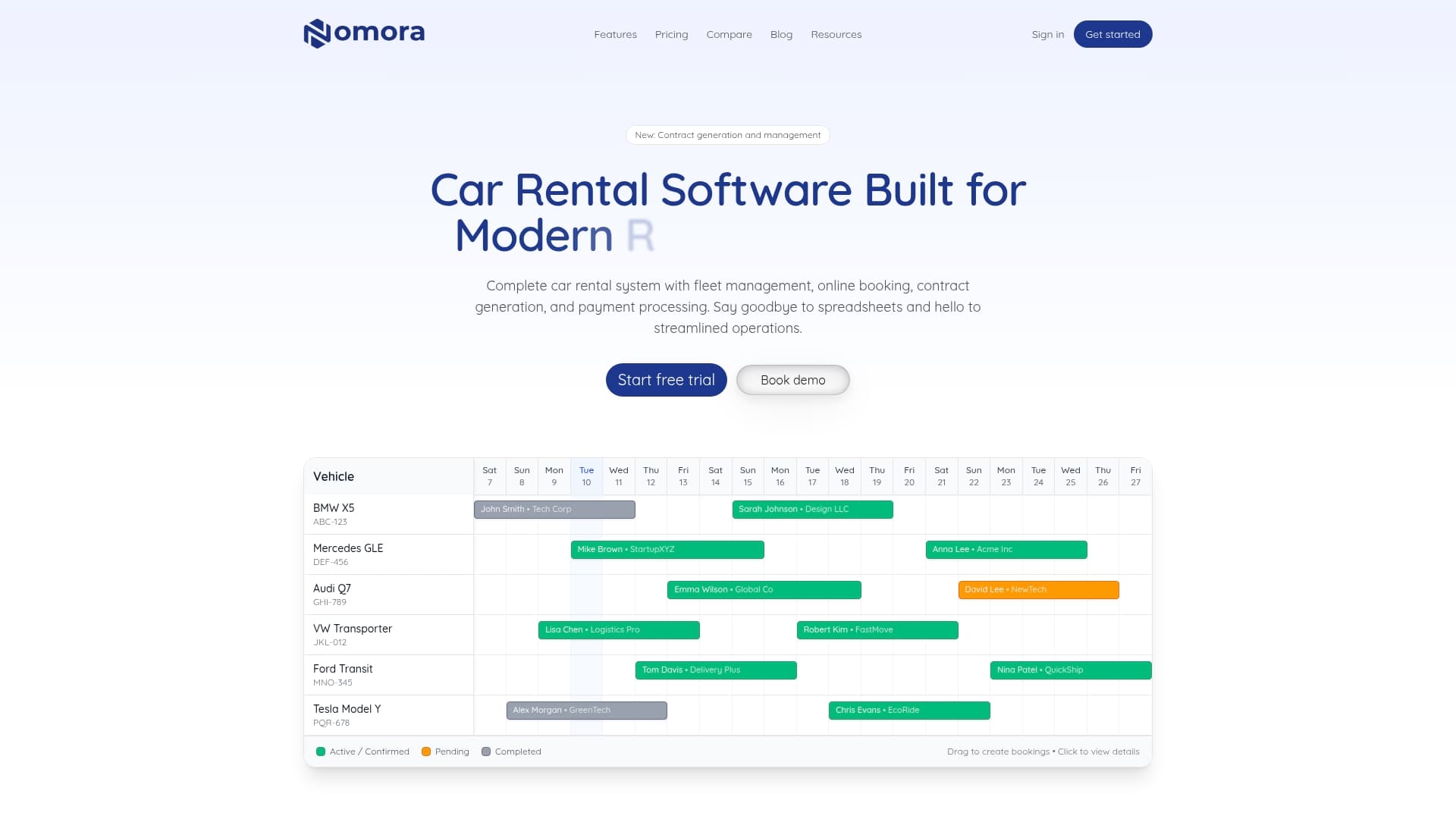
Nomora is built specifically for rental operators who want to replace that manual overhead with a system that handles reservations, automated contracts, payment pre-authorization, GPS fleet tracking, and accounting sync in one place. Setup takes 24–48 hours, and the platform scales from a one-vehicle pilot to a multi-location fleet without requiring a new tool at each stage. For operators evaluating their options, Nomora's use cases by business type show exactly how different rental models configure the platform. You can also explore automated payment workflows to see how pre-authorization and deposit handling work in practice. Schedule a demo and see the full system before your first vehicle goes live.
Authoritative U.S. resources and next-step links
Recommended